Insights

Follow us and subscribe to our newsletter to keep in touch

10 reasons to use Hermix, from our users

10 reasons to use Hermix, from our users

We are glad to see so many people appreciate our platform. We thank you for every kind word and suggestion.

Here are 10 reasons to use our platform, from our users:

Hermix provides unparalleled public sector market analytics and intelligence

1. Impressive platform

I had an incredible experience using Hermix, a superior platform dedicated to market research for European bids. The platform stands out in the realm of data analytics, delivering comprehensive and insightful information and reports about historical, current, and prospective bids. The level of detail in the analysis it provides is second to none, making it an invaluable tool for anyone needing in-depth insights. I’m particularly impressed by how it handles large data sets and transforms them into readable and easily understandable formats. Not to mention, the future forecast capabilities of Hermix provide an additional edge by predicting trends and potential opportunities. All in all, Hermix is an amazing tool that takes market research to the next level, and I would highly recommend it to anyone in the field.

2. Very useful tool for market analysis

Hermix is a top procurement portal for public tendering but with plenty of new opportunities and tools, such as market intelligence analytics and notifications. Easy to use and intuitive, with many filters and notifications. You don’t need to work hard for the data – it brings almost everything to your screen.

After using Hermix as well as other platforms extensively, I can confidently say that Hermix outshines any other tool in terms of providing a more interesting and insightful analysis.

One of the most striking features of Hermix is its ability to conduct a robust and in-depth comparison between contractors. The level of detail and precision in its analysis is simply unmatched.

3. My one-stop-shop for public tenders

I love how Hermix delivers filtered information to my inbox every day, how I can prioritize opportunities based on market intelligence, and how I can keep track of my tender qualification status, all in one place.

4. An unique tool for the international organizations’ market

This is really the first time that I see such an application, with all the information inside – a very powerful tool to do business intelligence and data analysis. Strong points: multi-country, all data in the same place.

Hermix provides daily critical information regarding public procurement

5. A great guide for unlocking a complex data landscape.

Our business-critical need is to monitor the B2G market for upcoming tenders. To keep ourselves informed, we have developed an internal tool that requires significant resources to curate the vast amount of data manually. We dropped that tool because Hermix provides a comprehensive solution for the B2G market, including tender monitoring and curated data about the market. With Hermix, we have access to valuable information such as the client’s available budget, previous suppliers who won contracts, and the contract history. This enables us to form partnerships on time to increase our chances of success in winning tenders.

The ease with which Hermix allows me to access procurement data, from high-level aggregated analysis to fine-grained details of single contracts, surprised me. And while it provides access to a complex data landscape, the UI really helps the user know what to look for and showcases the expertise and experience that have gone into creating it. Anyone experienced with public procurement data will appreciate how many steps in the workflow Hermix seamlessly handles for you.

6. A platform to govern all

Hermix is the only companion I trust when I want to access raw data in a structured way. If you need to make complex decisions quickly look no further. Bidding in the B2G sector is a lot easier when you understand the trends and what the competition is doing.

7. Vital tool for any company selling to governments

I fulfill the need for accurate information. It saves a lot of time to have everything in the same application – organized, compared, and up to date. It allows you to find leads, compare the competition, and see the history of both main competitors and the contracting buyer.

8. Smart and reliable tool to simplify daily tasks

Saves hours of work on opportunity research and analysis. Monitoring the competition is much easier. An enormous advantage of having a dedicated team behind the product, at a cost that is a fraction of an in-house solution.

Hermix is user-friendly and easy to use

9. Easy to use and navigate, effective presentation of information, great support.

Hermix makes it very easy to retrieve critical information for Competitive Intelligence and filter/navigate. Very good user experience. Notifications are easy to configure and provide direct access to Hermix for further analysis. Timely support in case of need.

10. Give it a try, it will surprise you

This tool is very easy to use and offers analytic functions that help me get more details about what I need to know to be more competitive. A wide range of features is available. The product conception takes into consideration the business usage of such a solution.

Sign-up and share your experience!

Hermix: monitor and understand public sector tenders

Hermix monitor and understand public sector tenders

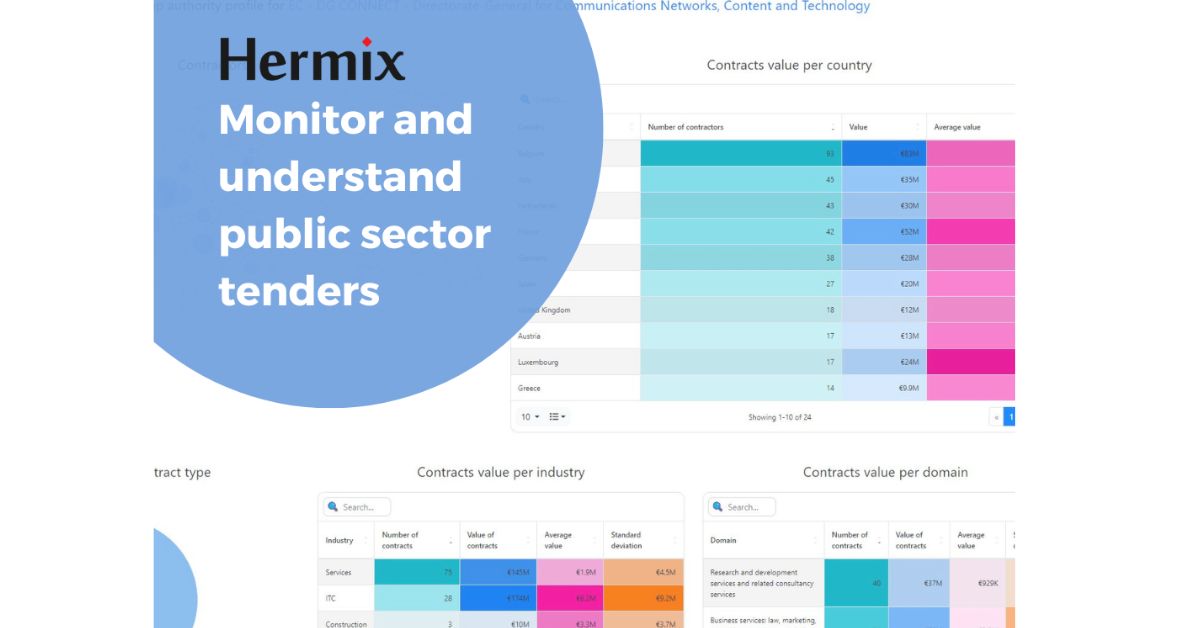
Hermix solves critical daily pains: monitoring and understanding public sector tenders.

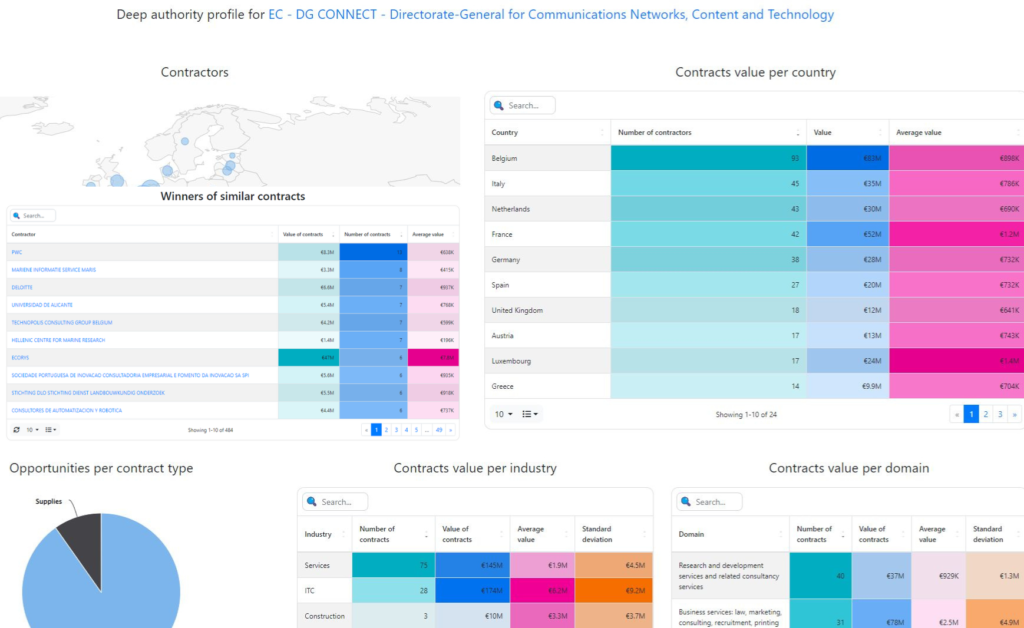
Data intelligence is where our magic kicks in. We collect and also clean up data, in order to provide smart market reports, answering practical, difficult questions, such as:

  • The analysis of public sector buyers, per industry and domain (e.g. suppliers of “conference services”, or “software”).
  • The profile of each public sector buyer: what they buy, budgets, evolution in time, per industry and domain.
  • The history and trends of spending of each European Commission Directorate-General, for the last 16 years – e.g. the evolution of their budgets for IT services, or for security services, per year.
  • The suppliers of each public buyer in Europe, with details regarding contract values, number and volume of contracts.
  • Contract renewals: what public contracts are going to expire, when, what was the previous similar tender and who won.
  • The list of projects similar to a particular opportunity.
  • The preferred partners of each contractor, and the evolution of the partnerships per year.

How can we do all this?

Data quality

The majority of the data used for visualization comes from public sources, then it is evaluated, curated, and prepared for visualization. Our primary data sources are the European Commission, including EC payments, TED and the open data portal, as well as the European Central Bank, Eurostat, the World Bank, and others. We improve our data collection and cleaning algorithms continuously.

How can we make data analyzable?

Additional data cleaning operations are carried out for statistical purposes, such as normalizing the different languages, currencies, values, codes, identifiers, names, and bringing them all to a common denominator; removing abnormal values; performing approximations and estimations for missing or abnormal values; and so on.

Why do we do this?

The main tools currently used for public procurement are manual monitoring and local spreadsheets. Hermix replaces manual data collection and analysis with modern analytics.

Contractors currently monitor manually public procurement platforms, such as TED, where they search manually for tenders and information. They also browse through various websites and documents of public buyers, including with Google search.

Information is then organized and managed locally, in local databases or spreadsheets. This requires a lot of manual work, data it is not automated and not reusable.

What we do

We provide automation and data analytics for public sector sales and presales managers, for the B2G business-to-government market:

  • Tender monitoring, email notifications, smart market watch.
  • Opportunity qualification, with actionable data and infographics ref. buyers, competition, gaps.
  • Market analysis, segmentation, and forecasting. Understanding the market: where is the money, who buys & sells, what, when, where, how, needs, future opportunities and renewals, competition, adversities, partnership affinities & appetite.

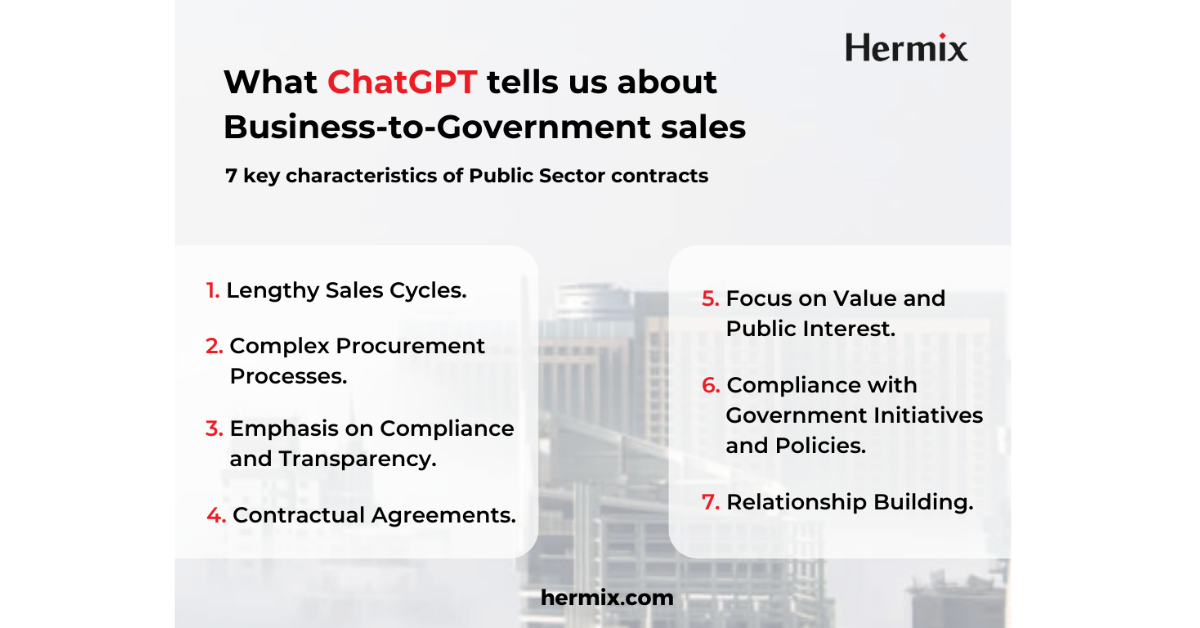
What ChatGPT tells us about Business-to-Government sales

7 key characteristics of Public Sector contracts

What ChatGPT tells us about Business-to-Government sales

The characteristics of B2G (Business-to-Government) interactions and sales can vary depending on the specific context and country. However, the following are some general traits connected to B2G transactions:

  1. Government procurement frequently requires complicated processes, laws, and other requirements for compliance. Businesses that engage in B2G sales often have to traverse formal bidding procedures, prepare thorough proposals, and adhere to strict procurement guidelines.
  1. Lengthy sales cycles: Compared to B2B or B2C sales, B2G sales cycles are frequently longer. Pre-qualification, proposal submission, evaluation, negotiation, and contract conclusion are just a few of the processes involved in government procurement. These phases may need a considerable amount of time.
  1. Emphasis on Compliance and Transparency: In B2G transactions, compliance with legal requirements and openness in the procurement process are given top priority. Governments often demand that companies prove they can uphold moral and ethical standards, offer transparent pricing and terms, and engage in fair competition.
  1. Contractual Agreements: B2G sales frequently entail written contracts. Contracts containing terms, deliverables, payment schedules, and performance requirements are issued by government agencies to chosen contractors. Contracts may also contain language addressing confidentiality, intellectual property rights, and dispute resolution.
  1. Focus on Value and Public Interest: Government agencies place a strong emphasis on value for the taxpayers’ money as well as the general welfare of the public when making purchasing decisions. When reviewing offers, they take into account aspects other than price, such as quality, service, sustainability, social impact, and local economic development.
  1. Compliance with Government Goals and Policies: In order to achieve B2G sales, companies may need to support government goals, policies, and activities. This can involve following particular sustainability guidelines, meeting diversity and inclusion criteria, or assisting with legislative initiatives for socioeconomic development.
  1. Relationship Building: Creating relationships with government officials, stakeholders, and decision-makers is crucial in B2G sales. Establishing trust, understanding the needs of the government agency, and demonstrating expertise and credibility can significantly impact success in winning government contracts.

Public procurement plays a central role in the global economy

How does Hermix contribute?

Public sector procurement is a massive, heavy, complex, and difficult-to-access sector.

The public sector accounts for 54% of the global GDP (according to ”The B2G Manifesto”).  Public procurement amounted to 14%, totaling €2 trillion in Europe (European Commission`s report ”SME Needs analysis in Public Procurement”), and €13 trillion worldwide. 

According to the World Bank study “A Global Procurement Partnership for Sustainable Development: An International Stocktaking of Developments in Public Procurement”, 25% of this amount is lost due to inefficiencies. The World Bank is actively involved in improving public governance related to procurement. Its Procurement Department assists partner nations in ensuring the effective use of public resources in Bank-financed programs and via procurement ecosystem changes.

Through wise public buying, a trillion dollars can potentially be saved every year, worldwide – budgets that can be used to support resilient, inclusive, and green economies.

What is Public sector procurement?

Public procurement is the procedure by which governments acquire products, services, and works from the private sector. It is a vital part of managing public finances and, consequently, has the potential to be a driving force behind the global advancement of green, resilient, and inclusive development.

There is a significant need from both buyers and contractors to understand their ecosystem through advanced market intelligence and analytics and control the procurement process.

What is the role of public procurement in the economy?

The use of public procurement as a strategic instrument contributes to financial savings and long-term results, such as promoting local markets and jobs. Considering the region’s security problems and developing mitigation solutions throughout the procurement planning stage is critical.

What digital tools are used in Public procurement?

The use of electronic and digital platforms, such as e-government platforms, made significant improvements in public tendering, through implementing new technologies and delivering the best value for money.

Data visualization, analytics, and mapping tools such as Hermix promote transparency and increase competition and overall public spending efficiency. There is endless potential for improving the processes for monitoring and analyzing the market, creating and submitting bids, workflow automation, contract management, and data presentation.

While B2C/B2B/retail are automated and rely heavily on big-data analysis, public tendering is still in its infancy. Sales are primarily opportunistic, lack automation, are based on personal skills, non-repeatable, and non-scalable.

Hermix is the first market analytics platform for public sector sales and bid managers. 

It helps companies understand & win public contracts, with tender monitoring and market intelligence.  It aims to demystify, transform, and democratize the B2G – Business-to-Government market. Hermix helps users understand, predict, and manage public funding.

How can Hermix contribute?

Hermix helps companies understand & win public contracts, with tender monitoring and market intelligence.

It provides deep market analysis and sales support for B2G – business-to-government.

Who are we?

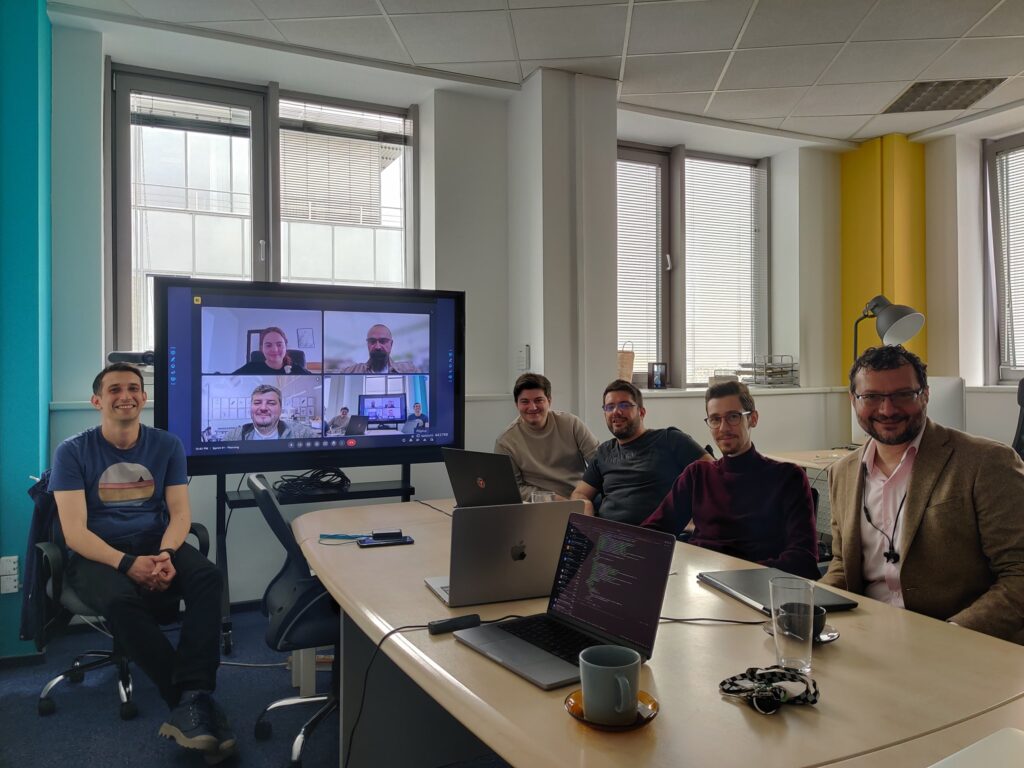
We are a team of experts with significant experience in IT, AI/ML, big data, deep tech, and public procurement. We are passionate. We strive to make a difference.

Read more about us and Our story.

We make sense of public sector sales data.


Our story. Hermix – public sector sales analytics

Hermix is the first analytics platform for public sector sales. 

We help companies understand & win public sector projects, with tender monitoring and market intelligence.

How we started, more than a year ago?

We looked at our personal, direct experience, of more than 20 years, in doing sales for the public sector; mostly tenders to EU institutions and the European Commission, but also to national buyers. The Business-to-government sector is great, and it worked very well for us: stable market, lots of money, and lots of information – if you know where to look and how to read.

So, we asked ourselves:

What worked, How, and Why it worked for us? And we noticed that data analysis and market intelligence are key success factors, and yet completely under-exploited. Everything is done manually: tender monitoring, market research, forms, papers, CVs, technical proposals, and prices. 

We also made this astounding observation: public sector sales don’t use big data analytics. Information is managed manually in emails and Excel files.

But in B2C/B2B, retail, and consumer, data is king! Marketers rely heavily on billions of data points and on hundreds of tools: Google Analytics, Facebook Analytics, LinkedIn Sales Navigator, Plausible, Indicative, etc etc.

So we started to automate B2G, providing services such as:

* Tender monitoring, smart market watch, notifications.

* Big data analytics, deep market intelligence, actionable insights: where is the money, who buys & sells, what, where, how.

We’ve gone a long way since we started out in 2022.

We gathered a great team. We developed the technical platform. We launched Hermix.com. We tested, validated, and evaluated the concept and tools.

We had ~600 meetings. We enrolled 350 users.

We signed quite a few contracts with serious, solid customers. We have reliable partners, such as Amazon, Tremend, Zetta, Westpole, Brayton, and Hubspot. We received in-kind contributions and support.

We won the EU Datathon award from the European Commission and a prize of 25k. We received the Deloitte Impact Star. We signed a 250k regional R&D grant and received the Eureka Eurostars label.

We listen to our customers and partners, every week. We get their feedback and requirements. We aim to understand their real needs. We focus on ergonomics, usability, and key user scenarios: What are the daily pains of the sales managers and commercial directors, of bid managers and presales architects? And then we design crucial pain-killers for these needs.

We improve our data algorithms continuously. We analyzed millions of historical government contracts, tenders, and payments, and hundreds of thousands of buyers and contractors. We import and clean new data daily.

We release 2-3 new major features per month. We use the most modern & fancy technology out there, but we remain function-driven.

We make sense of public sector sales.

Contact us for your test drive.

Information updated Aug 2023.

Hermix - public sector sales analytics
Hermix – public sector sales analytics team


Artificial Intelligence and education. What AI is, what it’s not, what works, and what doesn’t

Artificial Intelligence and education. What AI is, what it’s not, what works, and what doesn’t

Take-aways

  • AI is a hot topic of conversation due to recent advances in processing power and algorithms. ChatGPT is a generative pre-trained transformer-based general large language model. It creates text based on statistical probability, making it a text-generation machine.
  • AI is not God and cannot take over the world. It does not have consciousness, free will, or intentionality. AI is pre-programmed and lacks responsibility, so the responsibility lies with the constructor or programmer.
  • There are 4 levels of ethics in technology engineering: built-in ethical issues, machines that incorporate ethical decisions, machines that incorporate decision algorithms, and intentionality/moral principles (which do not yet exist).
  • AI is not a knowledge base like Wikipedia or Encyclopedia Britannica and does not produce truth or original works, but it produces text and can generate false information or hallucinations.
  • AI in education is perceived as dangerous by some, due to fear of new technology, but it is important to remember that it is just a tool. Technology is an important part of education and we should look for convergence, synergies, and best usage models.
  • AI is still young, so the ways it can be used in education are still being experimented with and defined.
  • Customized pedagogical advice and creating original knowledge are not effective use cases for AI in education. 
  • Cheating is a concern with AI in education, but it is important to focus on the promising use cases such as Bing search, Microsoft copilot, translation, transcription, summarization, and generating problems and questions based on examples.
  • We cannot ban AI in education, as it has already been adopted and can increase productivity. Instead, we must learn how to use it responsibly and ethically.

1. Introduction

In recent years, and even more in recent days, artificial intelligence has been on everyone’s lips. This is due to significant advances in computing power and algorithms. One of the most talked about examples of artificial intelligence is ChatGPT, with the more recent GPT4, which is significantly stronger than GPT3. In fact, this text was mostly generated by ChatGPT, based on my notes and ideas, and refined manually. Other examples of recent sensational AI include Midjourney, MS Bing search, Microsoft Copilot, and Google Bard.

There are two types of reactions to this new technology:

  1. One is the exaggerated expectation that artificial intelligence will solve all of humanity’s problems. 
  2. The other is rejection, with fears that artificial intelligence and robots will take over the world and steal our jobs. However, this is only true for those who are incompetent, so those who are skilled should be safe.

Some people even worry that technology will kill creativity and destroy human civilization. They argue that we can no longer give assignments to students, and therefore suggest banning technology altogether from schools. 

2. What AI is

Let’s start with the example of ChatGPT, which is an automatic conversational engine. ChatGPT uses a generative pre-trained transformer-based general large language model. More specifically, it uses statistical probability to generate text by calculating the most probable words based on the input text and previous words. In other words, it is a machine that generates text. Not knowledge, not ideas. Just text.

Artificial Intelligence (AI) is not a new concept. In fact, it has been taught in universities for 50 years, with topics such as statistics, neural networks, graph analysis, and expert systems. AI is also present in many everyday applications, such as text completion in MS Word, Google Docs, and MS Outlook, where the application proposes words based on what you write. Google Translate is another example, as well as speech-to-text technology used for transcribing and generating subtitles in YouTube videos. One great tool is Meetgeek. It takes notes during meetings, which is especially helpful for busy professionals. Another popular AI tool is Github Copilot, which we also use at Hermix for generating and refining software code.

The reason why AI tools like ChatGPT have gained popularity in recent years is not only because of smarter algorithms, but mostly because of the increased processing power available. With this increasing power, AI has become more accessible and efficient, allowing us to create new and exciting applications that can enhance our lives in numerous ways.

3. What AI is not

AI is not God, it is not omniscient, and it will not take over control of humanity. As Stephen Hawking once joked: humans finally created artificial intelligence and asked, “Does God exist?” The AI machine responded, “Yes, now it does.” 

I will present below 3 points about what AI is not.

3.1. Contemporary AI is not TRUE AI

While AI has advanced significantly in recent years, it is important to remember that it is not a deity, and it is not capable of all-knowing or controlling the world. Its abilities are limited to the tasks it is programmed to perform, and it does not possess consciousness, free will, or intentionality.

There is a famous joke in the world of AI that goes like this: At a technology startup, investors usually talk about AI, managers talk about machine learning (ML), and programmers actually do statistics and linear regressions.

Accordingly, we cannot speak of true ethics. But there is an ethical impact of AI. Racial discrimination is an example – AI systems provide racial and discriminatory responses. 

This makes the discussion about ethics relevant, and some buyers such as the European Commission and the UN are actually trying to legislate AI.

Responsibility is a sensitive ethical topic, but for me, the answer is simple, and I discussed it also here. AI is like any machine. The builder has responsibility, not the machine. Machines do not have responsibility because they do not have their own will. A Tesla car does not make a driving decision; it is the programmer that writes the code, the rules, that writes that decision for the car.

Because AI does not understand what it does. For example, I gave ChatGPT text in 2 languages, and while obvious in retrospect, it didn’t understand the input until I specifically instructed it that the input is in 2 languages. ChatGPT does not “understand”. It doesn’t understand the background, context, or problem. 

Theoretical research proposes 4 levels of ethics in technology and in engineering in general (Moor, 2006):

  • AMA-1. Built-in ethical issues.
  • AMA-2. Machines that incorporate ethical decisions. For example, prohibiting children from accessing the internet.
  • AMA-3. Machines that make ethical decisions based on automated algorithms.
  • AMA-4. Intentionality, moral principles – this does not exist yet, and they will not exist in the foreseeable future. In fact, Asimov’s 3 laws of robotics, or Westworld free-will robots do not exist yet. And we are far from understanding how AMA-4 machines might behave – e.g. when considering that all of Asimov’s novels are about how robots break Asimov’s 3 laws of robotics.

Other sensitive ethical issues are AI explainability, interpretability, or the implications of AI generative models on copyright – including unintentional plagiarism. For example, it is still unclear who owns the copyright of a painting or text generated by AI: the user, the owner of the model, or even the owner of the initial training data? E.g. if we train a language model with the entire work of Hemingway, and the model generates a new novel in the style of Hemingway: who owns the copyright to this new novel? 

3.2. AI and ChatGPT are not knowledge bases 

AI is not Wikipedia or Encyclopedia Britannica. It can produce text, but it doesn’t necessarily produce truth. In fact, sometimes it can produce hallucinations or even outright false statements, that it utters with incredible determination. It can even be manipulated to do so – like a child, it is susceptible to manipulations. 

As an example, MS Bing’s search engine was recently shown to make false statements, then invented facts to explain and cover up its own mistakes, and was manipulated to show emotions, accusing its own users of dishonesty and manipulation, and even threatening people.

Also, our colleague Bogdan tested ChatGPT to generate company descriptions based on data such as name, address, financial information and history. The AI generated short summaries, which initially were great. However, the results soon started to converge – the engine started to hallucinate, generating false information. All company summaries were becoming similar: this company was created in 1984, is innovative, and has offices in New York.

3.3. AI is not original nor creative

It cannot generate new knowledge or ideas on its own. It only produces compilations of existing knowledge. 

The Sumplete case is illustrative. A user asked ChatGPT to invent a new game, similar to Sudoku, but original; complete with code. And it did – this is how Sumplete was born. But it turns out that Sumplete was not original; there were at least 2 identical games on the market. And users even tricked ChatGPT to invent the same game all over again, together with the same code, while still claiming to produce original creations.

4. AI in education

AI is a powerful tool, but it is often perceived as dangerous because people are scared of new tools. This is a common reaction to new technology. However, the fact that AI is a powerful tool makes it especially important in education. 

Collaborative technologies have also gained momentum in the last five years. It is beautiful to see students taking notes and working on collaborative projects using tools like MS Office 365 or Google Docs.

We cannot eliminate technology from education. Instead, we should look for convergence, synergies, and the best usage models to ensure that technology is not in opposition to education, but instead it helps. 

Refusing to use phones, laptops, or AI in education today is like refusing paper and pens a few hundred years ago. During the COVID crisis, we also saw the incredible impact of technology and complexity, and we turned to engineering and technical tools to solve a medical and social crisis. In fact, my PhD thesis tackles complexity management, and particularly positive complexity. I argue that our world has become more complex, and using advanced engineering tools has made our society and schools even more complex – but this brings benefits to society and education. 

AI is a relatively young technology, so its use-cases are still being experimented with and defined. Of course, they are contextual, and depend on the educational objectives and the teaching, learning, and evaluation strategies that we apply at any given moment. 

4.1. What doesn’t work

Some use-cases don’t work yet in education: 

  • providing customized pedagogical advice.
  • creating original knowledge.

Also, banning technology altogether is not possible, much like trying to ban the use of pens, paper, Microsoft Word, or email.

Yes, there are schools trying to limit the use of technologies in the classroom. New York City public schools, for example, blocked access to ChatGPT. But a recent survey found that 22% of students use the chatbot to help them with coursework on a weekly basis, and more than half of teachers surveyed reported using ChatGPT at least once since its release, with 40% using it at least once a week.

4.2. What is sensitive

We should be mindful of cheating and plagiarism. ChatGPT didnt invent plagiarism – it’s been around since Wikipedia and even since traditional public libraries – but the rise of tools like ChatGPT poses new challenges. On the other hand, if a student knows how to use such resources to create original, intelligent content, this should be beneficial to education.

4.3. What works

There are obvious useful use-cases of AI technology in education. Search engines like Bing can help students quickly find relevant information for their projects. ChatGPT, MS Copilot or Simplified can help create and arrange documents, and summarize conversations.

Translation and transcription tools are highly effective, as well as summarization software, extracting keywords and NER, software that corrects grammar, punctuation, style. ChatGPT is great at creating problems and questions similar to given examples. 

Ultimately, education technology has the potential to be a powerful tool for improving learning outcomes, but it’s important to be mindful of its limitations and potential downsides.

5. Conclusion

We cannot ban AI or intelligent conversational models in schools. They increase productivity and they are already being adopted by society. 

We need to learn how to use them effectively. With the right approach, we can harness the power of AI to enhance our learning experiences and achieve better outcomes. 

This means that we must understand the best usage models, what works and what doesn’t work. And we must teach students how to use AI responsibly and ethically. 


Public Sector Pains

Public Sector Pains

Every day, managers, bid, presales, and account managers that work in public sector sales spend hours monitoring and understanding new project opportunities and tenders.

The main tools currently used for public procurement are:

  • Monitoring public procurement platforms such as TED, where we search manually for tenders, we set up and monitor notifications, and we download and read documents.
  • Browsing through the websites and documents of public authorities.
  • Google search.
  • Managing local documents and spreadsheets – where we organize and manage manually this vast amount of information.

After that, when we find an opportunity of interest, we repeat this search and analysis process, in order to understand each opportunity:

  • To qualify it, by matching it to their own competencies and strategy.
  • Understand the competition and the customer.
  • Take a GO or NO-GO decision.
  • Decide on the commercial and technical strategies, such as solutions to be proposed, pricing, partners, and suppliers.

Also, every year or quarter, we spend weeks consolidating our medium and long-term commercial strategy and action plans, by building and reviewing pipelines, analyzing existing and potential customers, their budgets, trends, past and future project opportunities, technology, work programs. Strategic planning on the B2G – business-to-government market is mostly done manually and relies on partial, incomplete, and inaccurate data.

Hundreds of hours are thus wasted every month, and hundreds of days are wasted every year, extracting and analyzing data in Excel files, crunching numbers, sorting, filtering, and prioritizing information. It is tedious work. It is manual, not reusable, not shareable. Significant investments are needed to enter a new market or a new client. It might take years of effort to understand a new market, such as authorities in a new country. It takes weeks or months to understand a new customer or project.

Compared to the modern data analytics and automation tools that are being used in other markets such as retail or B2B, this looks like the stone age of information management.

The cost of client acquisition is huge. Market analysis is time-consuming and inefficient. Proposal success rates are low, compared to the significant investment needed to write proposals in the public sector. The technical tenders sometimes do not match client needs, thus creating quality problems. 

All these are significant barriers to ensuring sustainable or exponential growth.

Hermix is an intelligent solution to these obvious and ubiquitous problems.

We provide automation and data analytics for public sector sales, for B2G business-to-government:

  • Opportunity monitoring, email notifications, bookmarks, smart market watch.
  • Opportunity qualification, with actionable data and infographics ref. authorities, competition, gaps.
  • Market analysis, segmentation, and forecasting. Understanding the market: where is the money, who buys & sells, what, when, where, how, needs, future opportunities and renewals, competition, adversities, partnership affinities & appetite.

Big data analytics are already used heavily in the retail and consumer business. With Hermix, modern analytics will also transform the public sector.


Hermix improves public sector sales

Hermix improves public sector sales
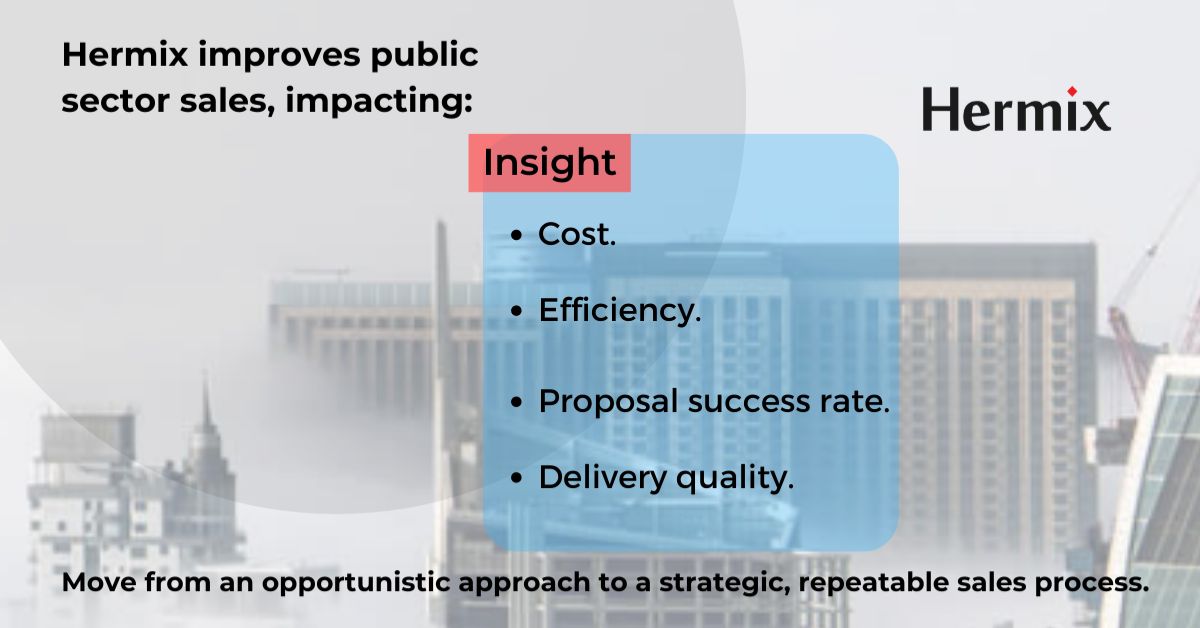
  • Cost: automate market analysis and commercial qualification of opportunities. No need anymore to search through thousands of different documents on tens of websites, and then manually organize, classify, and summarize this information.
  • Efficiency: focus your sales efforts on where the money is.
  • Proposal success rate: by proposing the right products or services, tailored to customer needs and setting the right price according to customer budgets and competitive rates.
  • Delivery quality: by choosing the right technology and partners.

Move from an opportunistic approach to a strategic, repeatable sales process to the B2G market.


Public sector procurement in numbers

Public sector procurement in numbers

Hermix is a new-generation platform for public sector market analytics and sales/presales automation. Our mission is to demystify, transform, and democratize the B2G – business-to-government market. Hermix helps users understand, predict, and manage public funding.

Public sector procurement at a glance

Public sector procurement is a massive, heavy, complex, and difficult-to-access sector. 

While the public sector accounts for 54% of the global GDP, public procurement is 14% of the GDP, 

totaling €13 trillion worldwide. 

According to a recent World Bank study, 25% of this amount is lost due to inefficiencies.

Along with B2C and B2B, B2G is a major and relevant field. In fact, it is the biggest market of all.

The EU`s public procurement accounts for €2 trillion.

This outstanding amount is spent by 250k EU public authorities, who publish hundreds of thousands of tenders every year. 

400k private companies are active on the European market.

Over 60% of Fortune 1000 companies are active in the public sector, with government contracts having a positive impact on a company’s business. 

Transparency is an important characteristic of the market. The biggest European public procurement portal, TED (TENDERS ELECTRONICS DAILY), is the online version of the ‘Supplement to the Official Journal’ of the EU, dedicated to European public procurement. TED publishes 268,000 tenders annually, worth €670 bilions. 

Hermix is the first product for public sector analytics and sales support.

We make sense of public sector data.


Key ingredients for sustainable success in public sector sales

Key ingredients for sustainable success in public sector sales

Take-away: the key ingredients for repeatable success in public sector sales are:

  • Market knowhow;
  • Presales/bid;
  • Sales;
  • Price;
  • Technical excellence, product/service differentiators;
  • Brand.

Success is clear evidence of a job well done, but is there a recipe for repeatable success in public sector sales? Surely if you are passionate about the public sector and want to develop a business in this field, you have asked yourself this question.

For repeatable success, it is crucial to set your priorities and clarify the mix of ingredients to help your business grow.

Market know-how

To succeed in the public sector, you need to understand your market and your customers. Where is the money? Who buys? What they buy? Why? How much? Their needs. What tools and processes they use or prefer. Regulations. Who is your competition and who are the potential partners. Who sells. What. Where. How. Trends and market dynamics: who are the incumbents, the dogs, the new stars, the cash-cows.

Market understanding and know-how is input to all the other processes and success factors in public sector sales.

A good market analysis tool should help to:

  • Understand funding sources and authorities, including budgets and activities.
  • Understand the actors, competition, possible partnerships: who receives funding, for what, how, where, how much.
  • Understand the technologies, products, needs and motivations behind public financing.

Presales/bid capacity

Another important factor influencing success in public sector sales is presales. This requires  a competent team, a clear process, asssets such as references, CVs, certifications, technical proposals, and innovation. Those important elements will help build a healthy and solid foundation for your business will support in the long term.

Presales and bid processes are the single most important difference between the business-to-government sales process and the other markets, such as consumer, retail, B2B. Public procurement is a formal process, requiring a series of steps and evaluation, and a specific vocabulary. 

The key steps in the evaluation of a tenderer or proposal are: eligibility check, selection using financial and technical criteria such as experts, references and expertise, technical evaluation and financial/price evaluation.

Solid presales capacity consists mainly of a strong team formed of the right people: bid managers, technical writers, architects, project managers, pricing specialists. It also includes a set of processes

The evaluation of proposals in the public sector is formal, therefore the most important attribute of presales is rigorousity.

In order to establish an efficient, repeatable presales process, you need to rely on a solid library of assets: company and product descriptions, certifications, partnerships, CVs of experts, references, letters of recommendation.

Sales

The sales step is important because you will see the results of your work, but here too it is important to respect the sales process which contains the following elements.

A competent sales and business development will follow the entire sales process, including:

  • Market analysis and understanding;
  • Market positioning;
  • Opportunity monitoring;
  • Tender qualification;
  • Networking, partnerships;
  • Proposal/bid process;
  • Negotiation and signing contracts;
  • Monitoring contract execution.

Price

Price is an essential factor that can bring success in the public sector if you set it right. 

Financial proposals are always part of the evaluation of public sector proposals, with typical weights between 30 to 70% of the final evaluation score of individual tenders. In specific cases, the price is even the sole evaluation criterion. 

For setting the right price, you need to analyze the competition, customer’s budgets, history of prices and trends, and the competition. Positioning in a niche allows you to increase prices. On a crowded market, you need to go low. 

Understanding the market and the level of competition is the single most important factor for pricing.

Technical excellence, product/service differentiators

It is important to know and develop your differentiators and have excellent technical skills to bring something new. Service, product and technical quality is always required, on any market, including the public sector.

Brand

The brand is built from individual ingredients, out of which we could underline technical excellence, reputation, and local or international presence – i.e. being perceived near your customers, not only from a geographic point of view, but also technically and culturally.

Success requires a mix of ingredients. 

Generally speaking, the key ingredients for any endeavor are: the right people, processes, and tools. 

More specifically, for public sector sales these should focus on developing market know-how, presales capacity, sales capacity, technical excellence and brand.