Insights

Follow us and subscribe to our newsletter to keep in touch

What is a Tender in the Public Sector? – Hermix

What is a Tender in the Public Sector - Hermix - Knowledge base

Whether you’re a supplier trying to win your next public contract or just trying to decode procurement jargon, you’ve probably stumbled across the term “tender” or “public tender” more times than you can count. But what is it, really? What does it mean to submit a bid? And how does this all fit into the broader procurement puzzle?

Our article breaks it down for you: from the tender definition to how the entire tender process works, including documents, evaluations, deadlines, and what it takes to win. If you’ve ever been confused by the difference between a tender and a bid, wondered how public sector procurement works, or struggled to get, read, analyze, understand, and process the documents required for construction tenders, this one is for you.

As a side quest, we’ll also show you how platforms like Hermix use AI to make the whole process not just bearable, but simpler, more strategic, and surprisingly smart.

Let’s start, shall we?

1. What is a tender? The real meaning of tender in procurement

The term “tender” in business is referred to as a formal offer to supply goods or services at a specified price. In the process, when an organization needs a product, service, or project completed, it will issue a request for tender (RFT). Companies or individuals then submit a bid, also called a tender offer, in response to that request.

In simpler terms, a tender is usually a formal invitation to do business. It’s the entire structured process that helps organizations, especially in the public sector, find the most suitable supplier based on price, quality, experience, and other evaluation criteria.Knowing the tender definition helps clarify a lot of the bureaucratic noise. A tender is a formal process, designed to be fair and transparent. Whether it’s an open tender or a call for bids, the aim is to ensure that every bidder competes on equal ground.

2. What’s the difference between a tender and a bid?

Here’s a classic confusion: is a tender the same as a bid?

Short answer: not exactly.

  • A tender is the entire process: from the initial invitation to tender, to the submission, evaluation, and awarding of the contract.
  • A bid is the response: the actual proposal or offer submitted by a company or individual.

So, the bid must follow the requirements of the tender. While the buyer’s organisation publishes a tender, it’s the bidder (or supplier) who submits a bid. The key is that every tender document defines the rules, scope, and expectations, and your bid follows that structure.

Understanding the difference between tender and bid helps you approach the bidding process with the right mindset and strategy.

3. How does the tender process actually work?

The tender process typically involves multiple steps:

  1. Tender notice or advertisement: The organisation issues a tender notice, often on dedicated portals.
  2. Request for information (RFI) or expressions of interest may be published to assess market readiness.
  3. Request for tender (RFT): Full details and documents are made available.
  4. Tender submission: Interested suppliers submit their bids within a specified deadline.
  5. Evaluation of tender submissions: Bids are scored based on evaluation criteria.
  6. Awarded the contract: The winner is chosen and notified.

The process is governed by rules meant to ensure the process is fair, especially when it comes to public tenders. The public procurement process can also involve a pre-qualification questionnaire (PQQ) for more complex contracts.

Modern tender processes have grown increasingly sophisticated, making use of procurement portals and sometimes even automated evaluation systems. The process involves multiple stakeholders, including procurement professionals, technical experts, and decision-makers who collectively assess each submission against predetermined criteria. This collaborative approach ensures that the winning tender represents the optimal combination of technical capability, commercial competitiveness, and overall value proposition.

Timing is crucial. Miss a deadline, and your tender response may be disqualified, even if it’s perfect. 

Create your free account and start winning public contracts, easier.

4. What is included in a tender document?

A tender document is a bundle of everything a supplier needs to know and respond to. It typically includes:

  • Scope of works or services
  • Contract conditions
  • Evaluation criteria
  • Documents required (like certifications or past project examples)
  • Bid price expectations
  • Deadline and submission format

Think of it as the blueprint. Your response is the architectural design that must fit the blueprint exactly. A mistake in understanding the terms of the documents required can cost you the contract.

Hermix simplifies this step using AI-based tender summarization, pulling out key points from 500-page technical annexes into one smart overview.

5. What makes a tender offer competitive?

A competitive tender offer distinguishes itself through a combination of technical excellence, commercial competitiveness, and strategic positioning. The most successful tender offers demonstrate a clear understanding of the client’s needs while presenting innovative solutions that deliver exceptional value for money. Developing a winning tender offer requires careful analysis of evaluation criteria and strategic alignment of your organisation’s capabilities with the client’s requirements.

The offer must address all aspects of the evaluation criteria while highlighting your organisation’s unique strengths and competitive advantages. This includes showing relevant experience, technical capability, financial stability, and commitment to quality assurance. The formal offer should present a compelling narrative that positions your organisation as the ideal partner for delivering the required outcomes.

Creating a standout tender offer also involves understanding the broader context of the specific needs, including the client’s strategic objectives, operational challenges, and long-term goals. The most successful tender offers go beyond simply meeting the minimum requirements to propose value-added solutions that enhance the client’s operations and deliver measurable benefits. This approach demonstrates strategic thinking and positions your organisation as a trusted partner rather than just another supplier.

Simpler said, to stand out in a sea of tender offers, your bid needs:

  • A clear value for money proposition
  • Strong unique selling points
  • Strict compliance with every requirement in the tender documentation
  • Proper quality assurance processes
  • Clear articulation of your bid strategy

A competitive offer also means understanding the buyer’s priorities, aligning your tender response with the evaluation criteria, and showing how your solution meets the contract value in both price and quality.

Platforms like Hermix can help identify historical price ranges, past winners, and contract sizes, helping you sharpen your bid strategy.

6. How to prepare a tender response that wins

Crafting a winning response takes time, clarity, and structure:

  1. Read the tender documents carefully. Use tools like Hermix to generate AI summaries if you’re short on time.
  2. Structure your response according to the format requested.
  3. Use a professional bid writer or expert in full tender writing, especially for complex or high-value tenders.
  4. Highlight your success rate, past projects, and how you meet the requirements of the tender.
  5. Attach all documents required, formatted and labelled properly.

Many companies invest heavily in bid management and bid writing to improve outcomes. The better your understanding of the tender is evaluated, the stronger your chances of creating a winning tender.

7. What is competitive tendering and why is it important?

Competitive tendering is the practice of inviting multiple suppliers to submit their offers for the same project or contract. It ensures that the process becomes transparent and cost-effective.

Why is it important?

  • It ensures best value for money
  • Encourages innovation and quality
  • Opens access to contract opportunities for SMEs
  • Builds trust in the procurement process

The process may include an open tender, restricted tender, or negotiated procedures depending on the context. Competitive tendering allows both large and small firms to bid for contracts, assuming they meet the criteria.

8. How does public sector procurement differ from the private sector?

Here, the rules are stricter, transparency is a must, and the procurement in construction or other services follows formal laws (like the EU Procurement Directive).

Key differences:

  • Public sector requires publishing every tender advertisement
  • Tenders must be evaluated using pre-published criteria
  • There’s emphasis on social value, sustainability, and non-discrimination
  • Every submission is subject to audit and public record

In the private sector, there’s more flexibility and often direct negotiation. But the lack of formal processes can lead to inconsistency.

For B2G sales, understanding these nuances is crucial. Hermix specializes in public sector analysis and helps companies optimize their process within this more rigid framework.

Create your free account and start winning public contracts, easier.

9. Why are construction tenders so detailed?

The construction sector is one of the most document-heavy industries when it comes to procurement. Why?

  • Complex design and build requirements
  • Risk mitigation through detailed specifications
  • Legal obligations for safety, compliance, and sustainability
  • Large contract values requiring robust planning

A construction contract might involve dozens of annexes, technical drawings, and safety compliance clauses. Tendering allows contractors to submit their bids based on these documents, with accuracy being vital.

Using Hermix, construction firms can streamline this overload: AI can extract and summarize technical requirements, and past construction tenders can be used to benchmark pricing and team requirements.

10. How can Hermix simplify the tender process for you?

Let’s face it: the traditional tender process is tedious. Companies spend hours reading, evaluating, and writing tender offers that might never get awarded.

Hermix.com flips the game:

  • Smart monitoring: Get notified about relevant tender opportunities across the EU.
  • AI tender summarization: Understand a tender in 2 minutes, not 2 hours.
  • Market intelligence: Analyze your competition, top suppliers, and pricing trends.
  • Opportunity qualification: Predict win chances based on your profile, skills, and past winners.
  • Bid automation: Draft structured responses aligned with tender requirements, including compliance checklists and reminders.

Hermix is the platform built by people who’ve done public sales for decades and are tired of doing it the hard way.

It helps organizations of all sizes (not just big corporations) improve the way they bid in the public sector and increase their success rate through smarter tools and actionable insights.

Key takeaways

  • A tender is a formal procurement process where organizations invite suppliers to submit a formal offer (or bid) for a product, service, or project.
  • The difference between tender and bid lies in who initiates it: the organisation issues a tender; the bidder submits a bid.
  • The tender process includes notices, submission, evaluation, and award and can be open, restricted, or negotiated.
  • Tender documents include everything from scope to evaluation criteria. They’re complex, but vital.
  • Your tender offer must meet all requirements and stand out by showing value for money and unique strengths.
  • Competitive tendering ensures fairness, access, and quality.
  • Public sector procurement is strict, transparent, and favors process over improvisation.
  • Construction tenders are detailed due to safety, compliance, and high values.
  • Hermix simplifies it all: monitoring, summarization, qualification, bid generation, and analytics, all under one roof.
  • With Hermix, you get the opportunity to win, save time, and compete smarter in public procurement.

If you want to stop drowning in documents and start winning contracts, it’s time to use Hermix. Visit Hermix.com to learn more or sign up for a free trial.


Public procurement statistics for 2025: Latest data and trends from the UK & EU public sector

Public Procurement Statistics for 2025 Latest Data and Trends from the UK & EU Public Sector - Insight

Public procurement represents one of the largest and most powerful levers in the European economy, accounting for approximately €2 trillion annually or 13.6% of the EU’s GDP. The scale, complexity, and strategic importance of this spending make it critical to understand current statistics, regulatory changes, and data trends. This article provides a 2025-level analysis of public procurement data across the EU and UK, incorporating the latest figures and policy developments to help suppliers, policymakers, and taxpayers understand how the system is evolving, what challenges it faces, and where the opportunities lie.

What is public procurement, and why does it matter in 2025?

Public procurement refers to the acquisition of goods and services by governments and state-owned enterprises. It fuels infrastructure, social care, health, education, and defense across the public sector. As of 2025, it represents a fundamental driver of GDP, supports thousands of enterprises, and underpins service delivery for over 450 million EU citizens.

A well-functioning government procurement system is about value for money, efficiency, transparency, and achieving policy outcomes including digital transformation, environmental sustainability, and social value.

With the European Commission estimating that public procurement is responsible for 11% of the EU’s greenhouse gas emissions, procurement decisions now carry climate and equity weight.

How much is spent on public procurement across the EU and UK?

Public spending across the EU has reached an estimated €2 trillion annually, or 13.6% of the region’s GDP. In the UK, the 2025/26 budget forecasts £1335 billion in total public expenditure, with public procurement making up roughly one-third of this total. Social protection (£379B), health (£277B), and education (£146B) dominate procurement-driven spending.

Procurement spending in the UK is growing by around 10% in 2024/25, driven by efforts to digitize procurement processes and modernize public service delivery. These figures make the UK public sector one of the largest spenders in Europe on goods and services.

Create your free account and start winning public contracts, easier.

What sources provide reliable public procurement data in 2025?

Procurement data has never been more accessible. In the EU, the Public Procurement Data Space (PPDS), launched in September 2024, connects national portals and databases into a federated structure. It will be fully operational in 2025, offering unprecedented granularity and transparency.In the UK, dedicated platforms (such as Hermix) aggregate procurement notices, tender data, supplier records, and public expenditure details. These sources allow suppliers and analysts to track procurement statistics, identify patterns, and understand government contracts across sectors.

What is the role of SMEs in public procurement today?

Small and medium-sized enterprises (SMEs) are essential contributors to procurement diversity and innovation. However, barriers remain. As of 2023, only 20% of UK direct procurement spending went to SMEs, even though small and medium-sized businesses represent over 99% of UK businesses.

The UK’s Procurement Act 2023, in force since February 2025, includes procedural simplifications aimed at increasing SME participation. These include reduced documentation, faster feedback, and obligations for contracting buyers to level the playing field.

While public procurement systems across the EU are being reformed to better support SMEs and newcomers, tools like Hermix are already helping level the playing field. By offering granular visibility into which public buyers are buying what, from whom, and at what price, Hermix arms smaller suppliers with the intelligence typically reserved for major incumbents. This not only increases transparency, but helps small and medium-sized enterprises target tenders more strategically and build long-term relationships with contracting buyers.

How has defense spending reshaped public procurement priorities?

Defense procurement has exploded in 2025. Poland leads NATO spending as a percentage of GDP, reaching 4.7% in 2025. Germany has approved legislation creating a €500 billion defense and infrastructure fund. France targets 3.5% of GDP for defense, translating to €59.6 billion in 2024.

This surge in defense-related procurement is reshaping the procurement landscape. Collaborative purchasing, defense-industrial strategy alignment, and regional supply chain development are top priorities for public buyers across the EU.

What trends are shaping digital transformation in procurement?

Procurement is undergoing a digital revolution. In 2025, standardization of electronic tender forms, cross-border database interoperability, and automation of compliance checks are transforming the procurement process.

AI-powered procurement platforms are improving data analysis, supplier risk management, and process after bid submission. Blockchain is being piloted in smart contracts, and governments are increasingly investing in digital dashboards to improve stakeholder engagement and reduce the length of the process.

Platforms like Hermix are setting a new benchmark for how procurement data can be used strategically. As an AI-powered analytics platform tailored to the public sector, Hermix enables suppliers and procurement teams to interpret complex datasets, uncover contracting patterns, and identify opportunities before the tender is even published. By integrating procurement data from multiple sources, Hermix helps companies to stop reacting and start predicting, making public procurement smarter, faster, and far more proactive.

How are green and sustainable procurement goals being enforced?

Green Public Procurement (GPP) is gaining regulatory teeth. With procurement contributing 11% of EU emissions, environmental criteria are becoming mandatory across many contracts. The European Structural and Investment Funds (ESIF) – worth €90 billion annually – now actively support GPP adoption.

New EU directives propose that by 2030, 50% of procurement budgets be spent on EU-produced equipment, rising to 60% by 2035. Member states are setting mandatory GPP quotas, especially in sectors like construction, transport, and energy.

What regulatory reforms are shaping procurement in 2025?

The European Commission closed a public consultation on procurement directives in March 2025. A full legislative overhaul is expected in 2026. Reform goals include simplifying procedures, improving SME access, increasing transparency, and aligning procurement rules with EU industrial and green goals.

In the UK, the Procurement Act 2023 introduces more flexible procedures, mandatory transparency rules, and streamlined compliance. It also encourages social value and broader participation in public procurement processes.

What challenges does the public procurement sector face in 2025?

Challenges include:

  • Declining competition: the EU Court of Auditors warns that reduced bidder diversity threatens value for money.
  • Talent shortages: lack of procurement experts capable of evaluating complex, innovative tenders.
  • Cross-border limitations: only 14% of EU tenders are won by foreign suppliers, indicating market fragmentation.

Corruption risks: despite gains in transparency, informal payments and gifts to secure government contracts persist in some regions.

Navigating fragmented procurement markets and inconsistent data remains a challenge in 2025. That’s where platforms like Hermix step in, bridging the gap between procurement theory and execution. By turning raw public data into actionable business intelligence, Hermix supports both public buyers and private suppliers in making informed decisions. For procurement teams looking to drive policy impact or for suppliers seeking to win more government contracts, Hermix offers the visibility and speed the modern procurement landscape demands.

How does public procurement support digital and social policy goals?

Public procurement is no longer just transactional. It’s strategic. Governments are using procurement to achieve digital transformation, sustainability, and inclusive economic growth. Social care tenders now include clauses for local employment. Construction tenders embed circular economy targets. ICT tenders include criteria for cyber-resilience and EU data sovereignty.

This shift positions procurement teams as policy enablers rather than just contract managers.

Create your free account and start winning public contracts, easier.

Summary: what to remember about public procurement in 2025

  • Public procurement represents 13.6% of EU GDP and £1335B in UK spending.
  • Defense and digital transformation are driving procurement expansion.
  • The EU’s PPDS and the UK’s Contracts Finder are key data sources.
  • Procurement is a lever for climate, social, and industrial policy.
  • SME participation is improving but still below targets.
  • Green procurement is becoming mandatory.
  • Reforms in 2025/26 will simplify procedures and prioritize EU-made goods.
  • Challenges remain: talent shortages, reduced competition, and corruption.

As the procurement landscape becomes more strategic and digitized, enterprises that understand procurement data and policy direction will have a competitive edge in the coming years.


Rethinking Public Sector Sales: How Hermix uses AI to change the B2G game

Rethinking-Public-Sector-Sales-How-Hermix-Uses-AI-to-Change-the-B2G-Game-Insight

The world of B2G sales is stuck in the past: giant Excel files, endless regulations, and RFPs that feel like they were written for typewriters. But the opportunity is massive: €2 trillion in annual public procurement across the EU alone. This article breaks down how Hermix, an AI-powered platform, is transforming the B2G game, making it faster, smarter, and more accessible for both giants like Capgemini and smaller players alike. If you’re in public sector sales, this is your blueprint for winning smarter.

Why public sector procurement is still a massive time sink

Most companies selling to government agencies still rely on outdated tools and manual processes. The typical sales team spends hours per tender just reading documents, trying to understand requirements, and deciding whether to bid. Multiply that by hundreds of tenders per year, and the inefficiency is staggering.

Even large companies with dedicated bid teams face the same hurdle: the procurement process is fragmented, opaque, and full of bureaucratic traps. Compared to the typical B2B sales cycle, B2G sales cycles are long, high-effort, and often low-conversion. It’s not uncommon for SMEs to invest several months into a single request for proposal (RFP), dedicating substantial resources, often tens of thousands of euros in staff time, consultancy fees, and compliance costs, only to discover they had little to no real chance of winning the contract.

The B2G market is massive, but painfully under-optimized

Public procurement accounts for up to 20% of GDP in many European countries. It’s a €2 trillion opportunity in the EU and €14 trillion globally, spanning everything from digital infrastructure to healthcare, education, and mobility. But it’s not just about size, but most of the time it’s about friction. There’s no Salesforce or Hubspot for B2G. No standard CRM for tenders. No full-picture analytics.
Private companies, especially small businesses, are flying blind in one of the most rules-heavy, high-stakes sales environments in the world. Most rely on static portals like TED or SEAP, spending hours manually filtering, sorting, and cross-referencing.

Enter Hermix: AI for public sector sales to improve your procurement process

Hermix was built specifically for the B2G market. It uses AI and large language models to clean up, summarize, and analyze tenders, so sales teams can focus on strategy instead of paperwork. Unlike generic tender aggregators, Hermix goes deeper, indexing over 10 millions of contracts and generating reports, forecasts, and competitive insights.

The platform automates the grunt work: monitoring, qualifying, summarizing, benchmarking. Instead of reading through 600 pages of annexes, you get a smart summary. Instead of chasing info across 10 portals, you get alerts with context. It’s built for sales teams, bid managers, and anyone tired of flying blind in public procurement.

How leading companies use Hermix to win faster

Fujitsu, Capgemini, Indra, Publicis, and other major players use Hermix to navigate EU-wide tenders. They don’t just track opportunities, they qualify faster, identify likely winners, and build better partnerships. The AI tender summarization feature helps teams decide in minutes whether to pursue an opportunity.
Smaller companies like PredictBy, EuroForce, Zitec, and Eau de Web use Hermix to get a foot in the door. Instead of competing blindly, they use Hermix to find under-contested tenders, study how similar projects were awarded, and tailor their bids accordingly.

Create your free account and start winning public contracts, easier.

What users actually gain

Hermix is about real commercial impact. Here’s what companies report:

  • Time saved: Up to 60% reduction in time spent analyzing specs and tenders
  • Better targeting: Teams pursue fewer, higher-quality opportunities
  • Higher success rates: Companies improve win rates by understanding past procurement behavior

Scalable sales: Hermix helps turn B2G from a one-off effort into a repeatable process

How Hermix changes your daily workflow

A presales manager logs into Hermix and sees a daily digest of relevant tenders, scored, flagged, and summarized. Instead of opening PDFs and reading through dozens of pages, they click “Summarize Tender.” In 30 seconds, they get the key requirements, budget, and timeline.

With one more click, they compare it to past tenders from the same agency. Another click shows likely competitors. By noon, they’ve flagged 3 tenders worth chasing and ignored 15 others that aren’t a good fit. That’s what Hermix AI looks like in practice.

Helping SMEs level the business to government playing field

Most B2G platforms are designed to service big players. Hermix is different: it’s built to help all businesses compete . You don’t need a dedicated proposal department or a data analyst. Hermix does the heavy lifting: summarizing requirements, identifying similar contracts, and surfacing the right contacts.

That’s why it’s used by both top-tier consultancies and two-person teams. It democratizes access to government contracts by reducing the learning curve and making procurement data usable.

What makes Hermix different from other B2G platforms

Hermix is not just a B2G aggregator. It creates knowledge. Unlike traditional tender platforms, Hermix:

  • Uses GPT and AI to summarize tenders, not just list them
  • Analyzes 11M+ contracts, payments, and renewals across Europe
  • Offers unlimited monitoring, full-text search, and custom flags
  • Provides clean, curated datasets with transparent algorithms
  • Covers all geographies, industries, buyer types, products or services.

This is more than just better UX. It’s a different philosophy: public sector sales deserves modern tools.

Real-World impact: How Hermix transforms B2G sales

Capgemini: Streamlining public sector analysis

Arian Turhani, Vice President and Client partner for European Institutions at Capgemini, highlights Hermix as an essential tool for analyzing years of public data across clients, providers, and topics. He notes its clarity, visual interface, and value as a starting point for AI-driven tender preparation.

Westpole: Streamlining opportunity identification

At Westpole, Hermix has transformed how teams identify and qualify public sector opportunities. Pascal Desart, Strategic Advisor to the CEO, describes it as “the first time I see such an application, with all this information in only one place. A very powerful tool.” Bid Manager Estelle Delbart adds that Hermix is “the tool we needed. It’s easy to use, and gives you all the data you need in one place.” These endorsements highlight Hermix’s role in streamlining tender discovery and enhancing strategic decision-making.

NEBS: Simplifying document management

Nikolaos Antoniou, Senior Sales Manager at NEBS and Cegeka, highlights the downloadable PDF tool as a real lifesaver, allowing for all documents and clarification questions to be downloaded as a single zip archive. He highly recommends this feature for its efficiency.

Schuman Associates: Reducing manual analysis

Gerard McNamara, CEO & Founder of Schuman Associates, shares that Hermix saves them the equivalent of two full-time employees dedicated to data analysis and monitoring. He commends the platform for capturing and managing complex structures effectively.

Axians Digital Consulting: Boosting productivity

Gisela Santos, Head of Europe Market Sales at Axians Digital Consulting, reports substantial gains in productivity, particularly in handling public sector market analysis and tender qualification. Hermix has enabled them to generate precise market insights promptly, allowing a focus on high-value activities.

Where B2G sales is going and why Hermix is already there

As AI becomes more embedded in workflows, the question isn’t if government procurement will change, it’s how fast. Hermix is already years ahead of the curve, bringing predictive analytics and real-time insight to a market that still runs on PDFs and spreadsheets.

From automated bid qualification to partnership discovery to real-time market intelligence, Hermix is shaping how companies approach the B2G market. It’s not just catching up with the private sector. It’s setting a new standard.

Some amazing outcomes achieved with Hermix

  • Time savings: Clients like Schuman Associates have noted that Hermix’s automation capabilities could replace the workload of two full-time employees, significantly reducing the time spent on data analysis and monitoring.
  • Improved tender success rates: Capgemini credits Hermix’s accurate and precise data for enhancing their ability to win tenders, indicating a direct impact on their success rates.
  • Enhanced productivity: Axians Digital Consulting has experienced substantial productivity gains, particularly in public sector market analysis and tender qualification, thanks to Hermix’s efficient data processing and insights generation.
  • Efficient document management: NEBS highlights the convenience of Hermix’s downloadable PDF tool, which simplifies the management of tender documents and clarification questions, streamlining their workflow.
  • Strategic market insights: Westpole has leveraged Hermix to gain a strategic advantage in the public sector market, with improved market insights and a more efficient approach to identifying tender opportunities.

Create your free account and start winning public contracts, easier.

A smarter path through the B2G sales process

Government procurement doesn’t have to be a black box. With the right tools, it can become a competitive advantage. Hermix gives companies the data, structure, and confidence to approach B2G sales strategically, not reactively.

It’s time to move past the chaos. If your team is still working from raw listings and shared Excel sheets, you’re not just slower, you’re falling behind. Hermix is your edge in a market that’s too big to ignore.

Key takeaways

  • The B2G market is huge, but still underserved by modern tech
  • Hermix uses AI to clean, summarize, and score tenders in real time
  • Top firms and SMEs alike use Hermix to win more, faster
  • The platform turns B2G sales into a repeatable, data-driven process
  • If you’re in public sector sales, Hermix isn’t a nice-to-have. It’s essential. Some of our clients even say it’s becoming the new industry standard for teams that want to scale strategically and stop wasting time on manual tender work.


How to create effective email alerts/filters

Hermix processes ~3,000 procurement notices daily, from across Europe and international institutions. To receive relevant alerts and avoid missing opportunities, it’s crucial to set up effective and powerful filters.

Ideally, the filters should give a reasonable number of new opportunities every day. Thus, they should be:

  • Sufficiently generic – to catch all relevant opportunities.
  • Sufficiently specific – in order to ignore most irelevant tenders.

The ideal number of daily tenders that can be analyzed by a small-medium team would be roughly 5-10 opportunities.

Over 100 opportunities per day means the market is too high and must be segmented. 100 tenders would require a huge effort to qualify, so most will probably be ignored.

Less than 2-3 tenders could mean that the target market is too small.

The most relevant filters are:

  • Industry, Domain
  • Keywords
  • Buyer country
  • Buyer type,
  • Data source

Best practices:

  • Choose the Industry, then drill-down to Domains (i.e. CPV division).
  • Avoid using Topics (CPV codes). They are too specific, thus difficult to manage.
  • Search either by Keyword, or by Industry/Domain – not both.
    • Using both simultaneously could restrict the search excessively.
    • Of course, unless you look for a very specific, very rare type of project.
  • Search either by Buyer country or Buyer type: European/international institutions.
    • E.g., European and international institutions have offices in multiple countries, so the country is less relevant for them.
  • Avoid very wide filters
    • E.g.,”IT for the entire Europe”, or ”all tenders in 20 countries”. Hermix analyzes cca. 3000 tenders daily. A very wide filter return very many (irrelevant) results.
  • Avoid filtering by a specific Buyer (or Contractor)
    • It is always possible that a tender might be published under a wrong / different Buyer Name, and with wrong contact details. In this case, the tender would not be classified under the correct Buyer.
    • E.g. a Buyer such as ”EC – DG DIGIT – Directorate-General for Informatics” might publish a tender under a wrong Buyer, e.g. ”DIGIT”, or ”EC”.
    • A good practice is to extend the search, e.g. to search by Buyer type rather than Buyer name.
    • Another option is to search by keywords included in the Buyer name, such as ”Starts with…” or ”Containts…”

Examples:

For additional information, please refer also to Frequently asked questions: use keyword search.


5 powerful ways to maximize Hermix for public procurement wins

5-powerful-ways-to-maximize-Hermix-for-public-procurement-wins

Working in the public sector can be challenging, with many rules, strong competition, and huge amounts of data to handle. Even though there is a lot of information available, most of it is not used effectively, making it hard for companies to find the right opportunities.

This is where Hermix helps, making it easier to win public contracts with tender monitoring and market intelligence based on AI.

1. Find the best public procurement opportunities faster

Winning public contracts starts with finding the right opportunities. With Hermix’s real-time monitoring, you can easily find new tenders from the European Commission and other public sector institutions.

Hermix allows you to filter tenders by country, industry, or contracting buyer, ensuring that you receive relevant updates tailored to your needs. This helps companies stay ahead in the procurement procedure and make informed decisions on which opportunities to pursue.

The most popular feature in 2024:  Alerts – Set notifications to receive the latest tender opportunities by email, every morning. 

Types of monitors: tender opportunities, contract awards, prior information notices, and changes in specific opportunities.

Latest update – You can set up and receive multiple alerts per day.

Alerts - Set notifications to receive the latest tender opportunities by email, every morning.

2. Focus on the right tenders with smart analysis

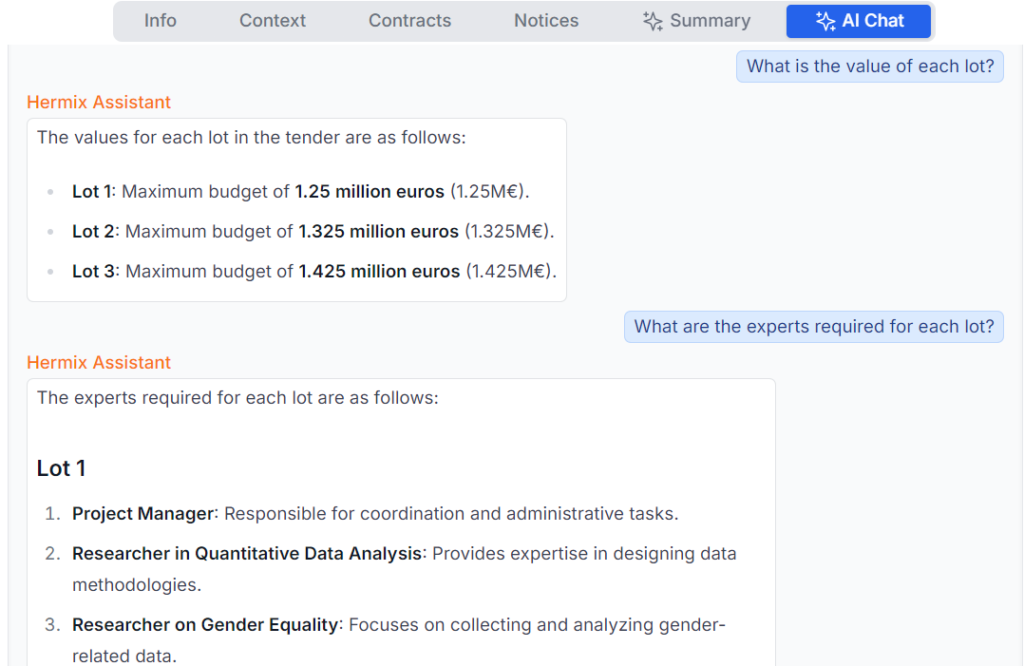
Not every tender is the right fit. Hermix’s AI features, including Tender Summarization and AI Chat, help companies determine which tenders align best with their strengths. The platform provides insights into past public procurement winners, highlights key competitors, and even predicts potential success rates, allowing users to optimize their bidding strategies in procurement contracts.

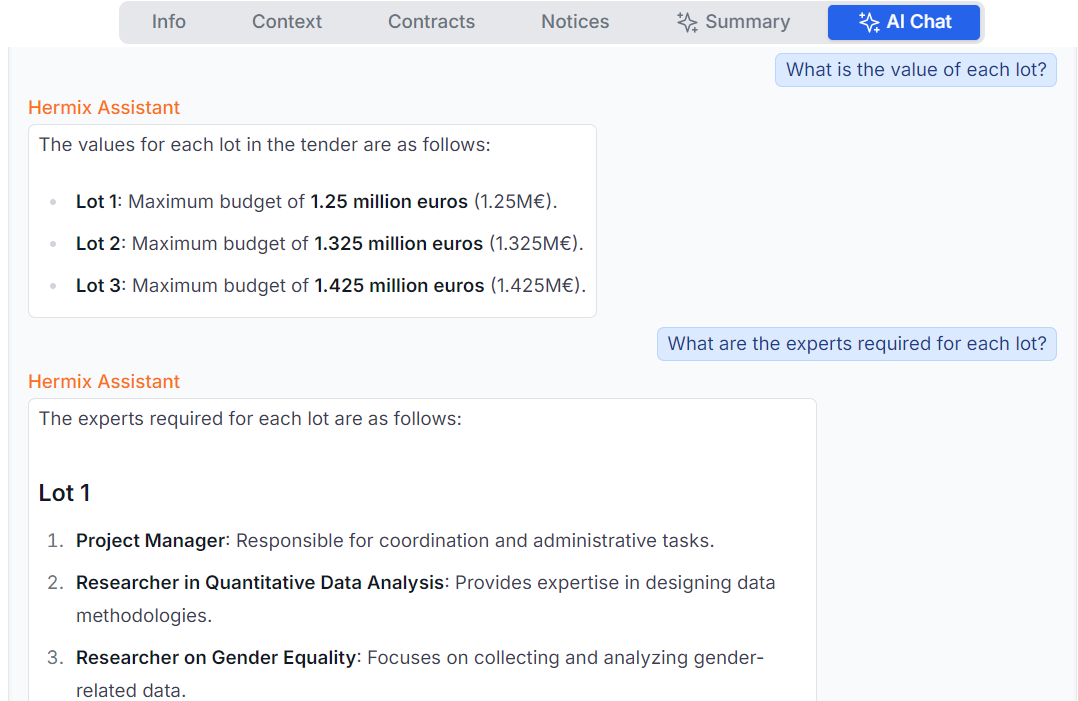
AI Tender Chat

3. Understand the public procurement market to beat your competitors

Hermix provides detailed analytics on public sector spending, major suppliers, and procurement trends across Europe. These insights help you identify new opportunities and refine your strategy.

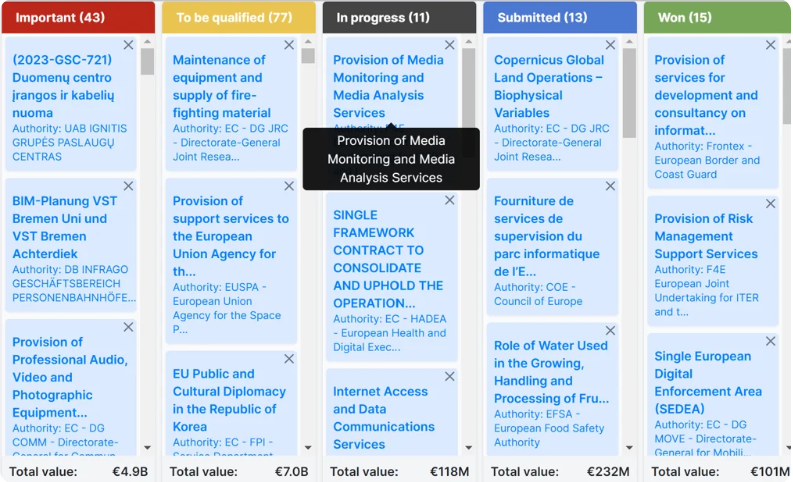
The most popular feature for better organization is the Flags Board. It helps you and your team members manage the flagged opportunities of their organization, in a Kanban board.

Flags board

4. Explore EU Spending for bigger opportunities

The European Commission allocates billions in funding for various projects. Understanding how and where the money is spent can open doors for businesses looking to secure EU public procurement opportunities. Hermix provides in-depth data on government procurement trends, key suppliers, and industry-specific spending patterns, helping businesses align their strategies with emerging funding opportunities.

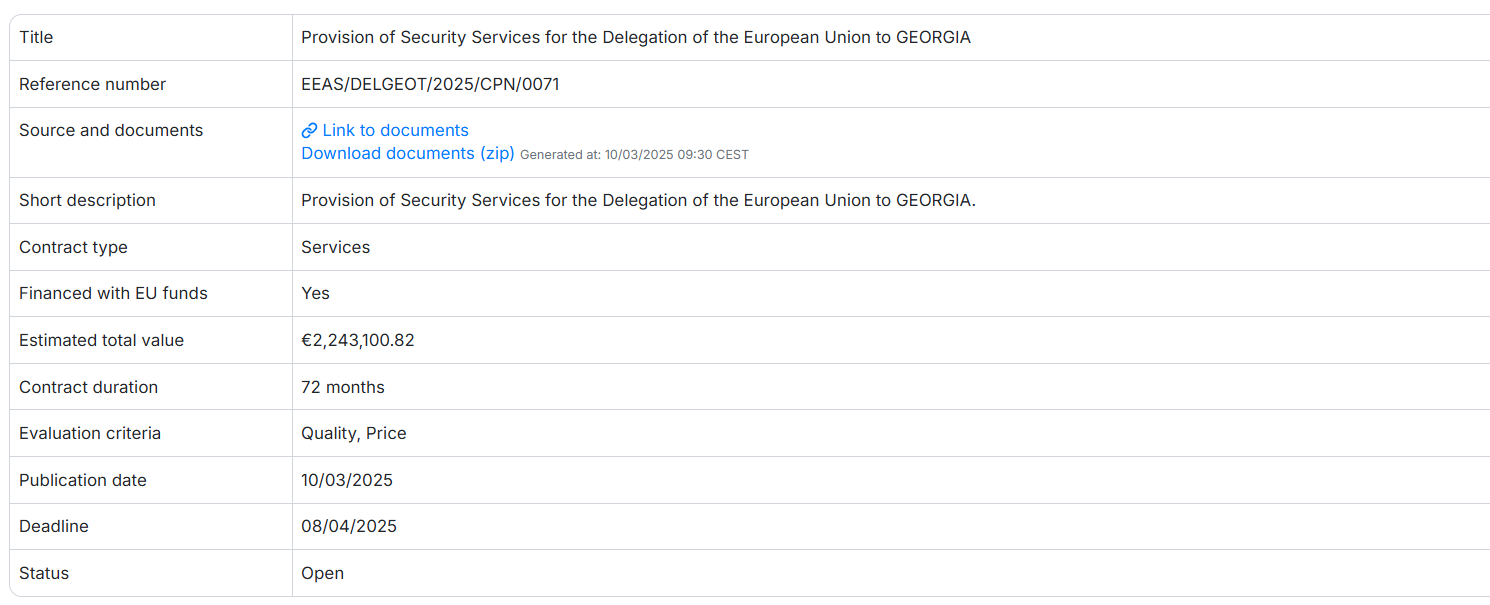
Good to know: You can download all EC tender files as a single ZIP, streamlining workflows.

download all documents EC tender files as a single ZIP

5. Work with team collaboration tools

Public procurement is a team effort. Hermix simplifies this process with collaboration tools like Kanban boards and shared workspaces. These features enable teams to track tenders, assign tasks, and ensure seamless communication throughout the procurement procedure.

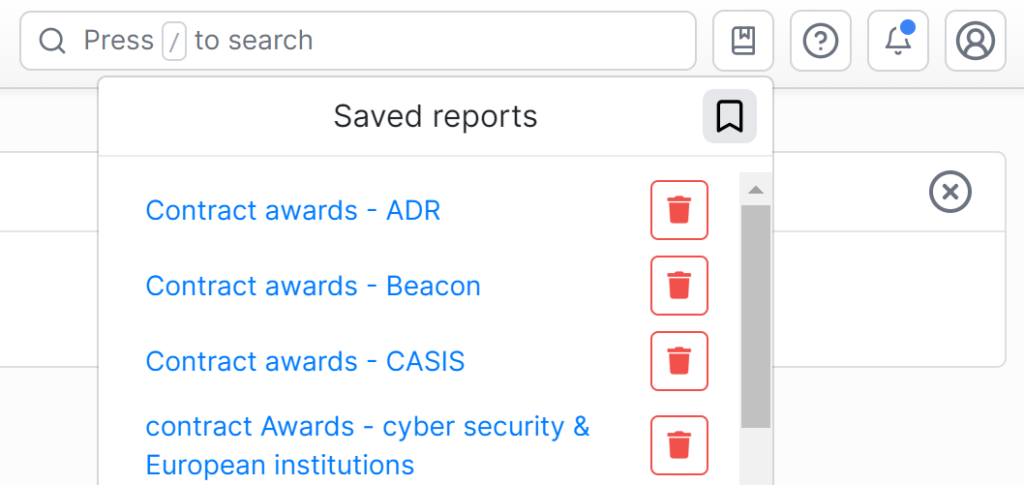
Tip:  Saved reports feature can now be shared with colleagues.

Saved reports

Conclusion

By implementing these five strategies, companies can maximize the benefits of Hermix and enhance their success in public procurement. With AI features, tender monitoring, in-depth market intelligence, collaboration tools, and email alerts, Hermix helps organizations stay ahead in the competitive public procurement market.


Public sector sales innovation with AI: The Hermix case

Introduction

Public procurement and contracts represent a huge €2 trillion market in the European Union (EU), yet it is complex and difficult to access. Despite significant policy efforts, the market is still skewed, with access dominated by a few large, specialized players. Modern technology, such as AI, ML, and LLM tools, offers significant opportunities to improve the efficiency of public tenders, boosting success rates and delivery quality. Tools like Hermix are transforming this space by supporting tender monitoring, opportunity analysis, bid preparation, and proposal generation.

Pains in public sector sales

Public sector sales, involving large corporations, SMEs, consultancies, and academia, are challenging. Suppliers spend a significant amount of time monitoring tenders and qualifying them, with presales managers dedicating up to 50% of their time to tender reading and qualification. Writing tenders is expensive, often costing up to 2% of the total contract value, or even 6% of revenues for SMEs. The effort put into tender processes often does not align with the value of the tender or the success rate. Public procurement is also marked by high entry barriers and inefficiencies, with only 1.3% of EU companies accessing public contracts.

Opportunities in public procurement with Hermix AI

  • Smart tender monitoring and alerts
  • Smart market intelligence, insights and opportunity matching
  • Opportunity qualification based on customer budgets, past projects, competition analysis, requirements analysis, analysis of skills, competences, certifications, experts
  • Proposal automation, bid preparation, preparing drafts with AI/GPT tools

Introducing Hermix

Hermix helps companies win public contracts with AI-driven tender monitoring, bid automation, and market intelligence. Used by major companies like  Capgemini, Fujitsu, Indra, Atos-Eviden, Publicis-Sapient, Arhs (Accenture), Aricoma, Intellera (former PwC, now Accenture), Unisys, Vass, Technopolis, Engineering, Unisystems, OTE (Cosmote), Brayton, Zitec, Eau de web, Mindit, Edda, Luminess, Axians (Vinci), etc. it boosts efficiency, success rates, and access to public contracts.

Benefits of Hermix

  • Cost efficiency – Upgrading the bid/presales team from data entry to data analysis.
  • Efficiency, focus – Increase proposal success rates to 60-70%.
  • Delivery quality -choose the best technology and partners.
  • Sustainable, repeatable sales.

Impact on the Public Sector

Hermix’s AI-driven approach aligns with core European values such as transparency, efficiency, and competition. It helps democratize access to public procurement, lowering entry barriers for SMEs, startups, and new entrants. Public authorities also benefit by gaining a better understanding of their supplier ecosystem, improving procurement planning, and enhancing synergies between projects and initiatives.

Conclusion

The B2G market requires disruptive technologies like AI and ML to improve efficiency and accessibility. Hermix provides a practical solution for public sector sales, offering cost efficiency, higher success rates, and improved proposal quality. With AI tools like Hermix, public procurement can become more transparent, efficient, and inclusive, benefiting both suppliers and authorities.

This insight is based on the article published by Stefan Morcov, CEO of Hermix, and Michel Bosco, PhD Eng – EuropIA, MAM, Associate Professor at Université Côte d’Azur, in the book L’intelligence artificielle – Institut Europia, published by Ovadia Publishing House.


2024: A fantastic year

After an incredible 2024, Hermix celebrates a year of achievements, innovation, and strong client partnerships.

2024 A fantastic year

Product highlights

  • Tender Summarization with AI: Analyze tenders and generate proposals automatically. Quickly review project scope, eligibility, and evaluation criteria, saving hours for presales managers.
  • AI Tender Chat: Customize questions and get personal insights from tenders in seconds. Navigate complex documents effortlessly.
  • Download all documents: Users can now download EC tender files as a single ZIP, streamlining workflows.
  • Flags board: A Kanban-style tool for tracking and managing opportunities visually and effectively.

AI Chat

Events and webinars

In 2024, Hermix participated in over 10 major conferences and events, including the Public Sector Summit by Amazon Web Services, Nexus 2050, and many more. 

Additionally, we hosted our events, such as webinars on AI in public procurement and sales, featuring industry leaders like Arian Turhani (VP Capgemini – Client Partner for European Institutions) and Rudolf de Schipper (General Manager at Unisys).  See the video recordings here.

Awards and recognition

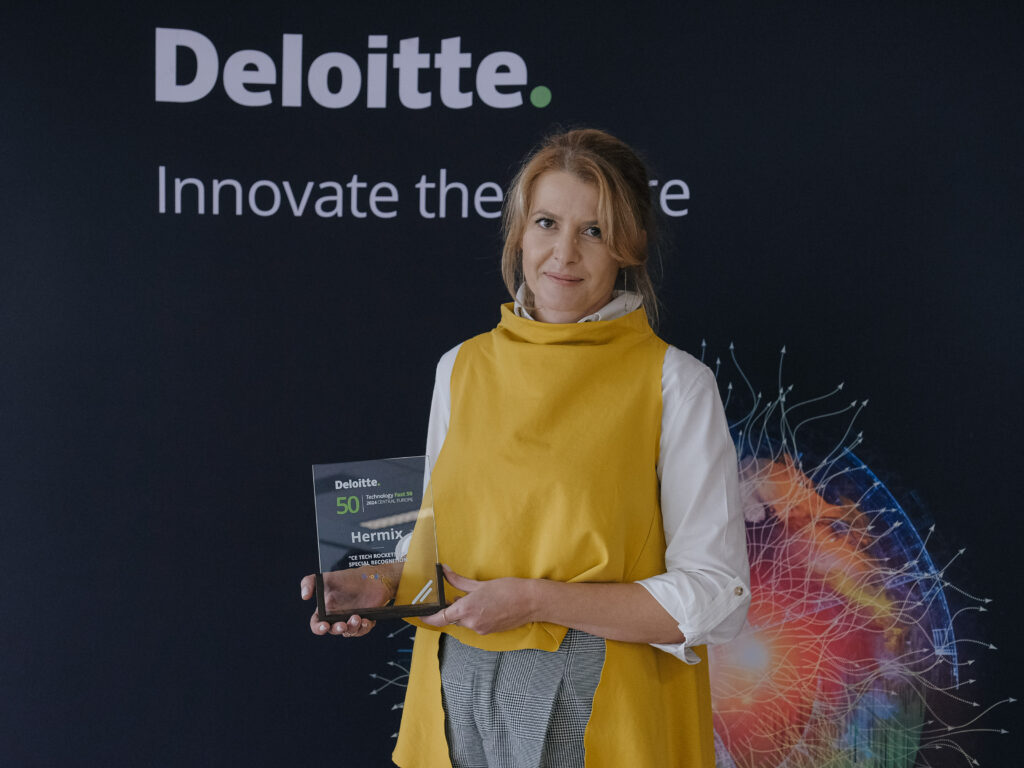
Hermix won the “CE Tech Rocketship!” 2024 Award for the second year from Deloitte and Google Cloud, in the Technology Fast 50 CE competition 2024. 

Additionally, Hermix secured a prestigious Eureka Eurostars grant worth €920K, recognizing its AI-driven procurement innovation and collaboration with institutions like the University of Luxembourg.

Strong partnerships and client growth

In 2024, Hermix welcomed major clients, including Fujitsu and Cancom, while strengthening long-standing collaborations with academic institutions like KU Leuven, the University of Luxembourg, the University of Bucharest, as well as Romlux and Măgurele Science Park.

Client success story

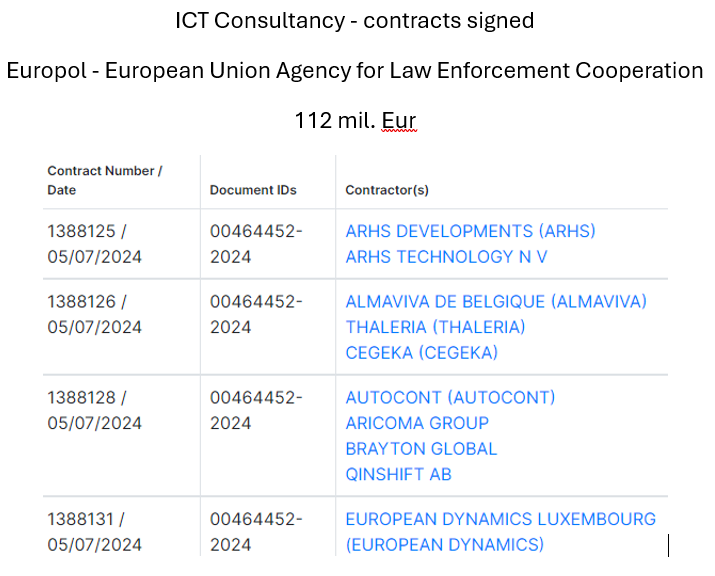
Hermix tools helped secure key contracts, including five of eight winners of a Europol consultancy tender. Clients praised the platform for its ease of use, precision, and impact.

Client testimonials

Hermix received strong feedback from its users and clients in 2024:

“Hermix is easy to use, with great features like auto email alerts and direct links to tender documents.” said Vincent Peeters, Senior Hybrid IT Infrastructure Architect, Cancom GmbH

“A must-have tool—easy to use with a pragmatic, business-driven approach.” said Olivier Jacmart, Sales Director European Institutions, Indra Minsait

“Hermix is a game-changer! Amazing platform that helps me win calls for tender. It is user-friendly with excellent support. The data is accurate and very precise, helping me seal deals.” said Nicolas Vande Kerckhove, EU Account Manager, Capgemini

Our team is the most important asset for us

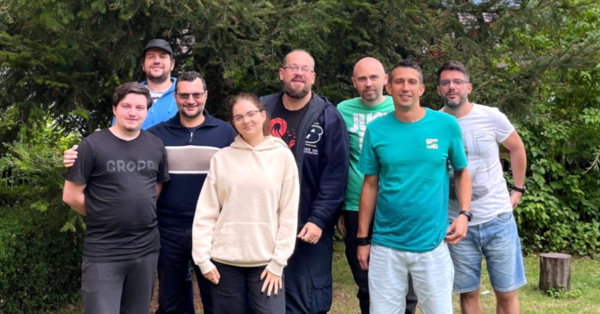
We organized an unforgettable team-building experience on the mountain trails. The experience allowed team members to step away from their daily tasks, bond in a unique setting, and strengthen their collaboration through outdoor challenges. This experience reinforced the importance of working together, fostering a sense of unity that will drive Hermix forward in 2025.

Hermix team - Busteni Teambuilding 2024

Looking ahead

Hermix enters 2025 with ambitious plans to redefine public procurement. By expanding AI capabilities, introducing more user-focused features, and strengthening partnerships, Hermix aims to deliver even greater value to its clients. 


AI for public sector sales automation and analytics with Hermix webinar

AI for public sector sales automation and analytics with Hermix live webinar

Video transcript

Stefan Morcov – Hermix: What we want to do now is tackle the case of technology and Artificial Intelligence, and how they impact public procurement and sales. We will discuss very practical applications, what works, and what doesn’t work, along with opportunities and challenges through practical examples. Obviously, I cannot help but talk about Hermix as well, and what we do in these particular areas. Some are more aspirational, while others are already in production with hundreds of users involved.

These are the things we are currently doing in Hermix: analyzing data, utilizing machine learning for tender analysis, market intelligence, competition profiling, as well as GPT text analysis, tender specification analysis, and bid automation.

We are all looking with extreme interest at how Artificial Intelligence will impact writing proposals. At this moment, I would like to introduce our guest, Rudolf, who is the general manager of Unisys, Belgium. We’ve known each other for quite a while, and he has managed various initiatives for several years.

Rudolf de Schipper: I’ll do my best to keep the interest high, and we’ll see where it leads us. Of course, Artificial Intelligence is garnering a lot of attention these days—almost for the past few years. It’s still very hard to predict where it will lead us, as there is a lot of investigation and exploration going on, along with many doubts. Will this be the end of humanity? I guess we’ll touch on almost everything during this call.

To start, I am fascinated by technology. I’ve been monitoring GPT and using it for over three years since it began. It has created quite a hype, especially with the rise of ChatGPT, which is becoming very strong.

Stefan Morcov – Hermix: As Rudolf mentioned just a couple of days ago, many companies are starting to take it seriously. There was a hype; some have high expectations and have conducted numerous tests, while others are understandably reluctant. I attended a conference this morning where I was asked what I think is the biggest barrier to adoption. I believe it is the lack of trust and confidence.

At the same time, it is transformative. There are certain technologies in society that are abruptly changing the world. A famous example is the horse: exactly a hundred years ago, Ford invented and put into production the Ford Model T. Within a few years, Ford cars replaced hundreds of thousands of horses in every city in the modern world.

Transportation didn’t change; rather, the method of transportation changed. You still travel, but it’s faster and completely different. We also have very recent examples. For instance, 50 years ago, we were sending letters. Twenty-five years ago, we were sending emails. Now, you have your phone, and whether you’re in your car or on the metro, you’re reading and sending emails, all because Steve Jobs thought, “Okay, we have the technology; let’s use it differently.”

Another example is Google Docs, which we have been using for collaborating on writing proposals.

Stefan Morcov – Hermix: We have technology transforming public sector procurement and sales. For instance, we’re currently utilizing big data and data science for smart matching between tenders, monitoring tenders, and understanding key questions in any commercial context:

  1. Do I want to pursue this tender?
  2. How should I approach it? What kind of partners or technology should I propose?

In Hermix, we have around 8 million public sector contracts across Europe, along with about 1.2 million company profiles and 170,000 buyer profiles. This wealth of data allows for strategic planning, pipeline creation, commercial qualification of tenders, and competition analysis. We can also evaluate potential partners based on their previous deliveries and market knowledge.

A significant area of focus is price analysis, which faces challenges due to the confidentiality of financial and technical proposals. We have to navigate what data we have versus what we don’t.

For example, we perform technical and commercial tender analysis using publicly available data. This includes assessing companies participating in tenders, analyzing their previous contract wins, and understanding market dynamics.

The analysis we conduct includes market trends, such as contract volumes and values, as well as details about buyers and their tendering history.

Regarding pricing, we had an interesting discussion earlier, and I think Rudolf might want to elaborate on that point.

Rudolf de Schipper: Absolutely. It’s important to underline that the information we provide is publicly available. There’s no magic here; it’s about organizing and analyzing the data to derive insights efficiently.

With data analysis and machine learning, we can reveal patterns that would require extensive time and effort to uncover manually. The key challenge now is knowing how to ask the right questions when engaging with these tools.

Recently, we’ve seen the emergence of roles like “prompt engineers,” who specialize in formulating effective questions to get the best results from AI.

Another critical aspect to consider is validating the answers we receive from AI systems. For example, with GitHub Copilot, a coding assistant, many users find that approximately 40% of the generated code is incorrect. This can lead to back-and-forth interactions, where you have to correct the AI and engage in discussions about the output.

Rudolf de Schipper: Yeah, but it’s a typical situation you don’t want to face when you’re answering an RFP because you have one shot. You can’t tell the client, “We had the RFP written by AI, and it actually gave me a wrong answer.” We’re entering an interesting dynamic here, and I think it’s something we can discuss further. What are, let’s say, the strong and weak points of employing AI today when answering RFPs?

Stefan Morcov – Hermix: Absolutely. I was thinking of leaving questions for last, but this is a good one and directly related to what we discussed earlier. So I will take it now. Can you see what contracts those companies have won specifically? Yes, the answer is yes, and actually, I can show you. Why wouldn’t I show you live? I have it open now. [shares screen]

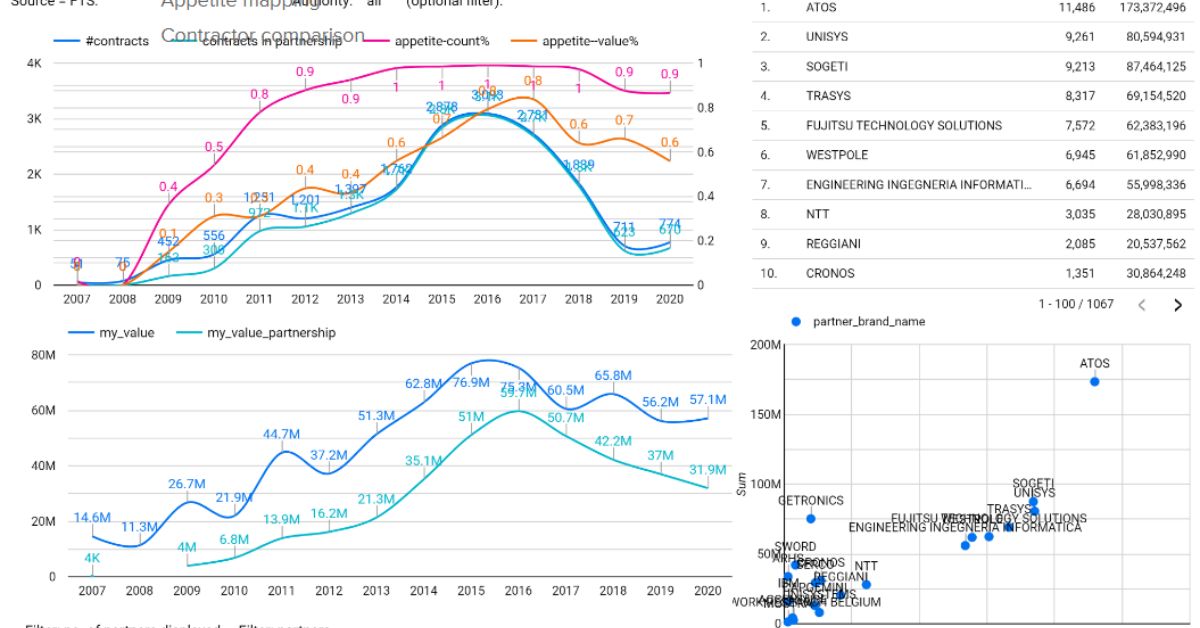
So, I’m showing you that for a particular tender, you can look at what contracts were won before, who won them, and so on—the number and value of contracts that were won by each company. You also have the geographic distribution of where those suppliers are coming from. In this case, Luxembourg and Belgium are the main places where suppliers are located.

You can also look at the previous relevant projects—what exact projects were tendered before, when they were tendered, the duration, the budgets, and the winners. You can drill down; you can click on a tender and see all the details of this tender.

More than that, if you click on one of these numbers, like, say, 8 contracts signed by an entity… And I opened a report showing this live. It’s quite fast; usually, our application is faster than I’m talking. I remember a speech where a guy said he would try to speak even faster than our cars, which is never possible.

So, these are the 8 contracts that were won in the last 8 years by the entity group. These are the companies in the group that signed contracts, their values, the years, and you can go into details for each of them to see what exact contracts were signed. For instance, this is Cordis. This is the portal for research, and you have here the tab for contracts.

So, I pretty much already answered this question. I would suggest moving on to the second interesting part because Rudolf already opened the door.

We are living in the world of GPT, right? Large language models. There are, I believe, four types of applications that we could consider: technical qualification of tenders, analyzing requirements, technical requirements, bid automation, and writing proposals. Indeed, it’s an interesting topic. How much do you rely on GPT and automated analysis? It’s the same, by the way, in data cleanup. We use machine learning tools to clean up data, and it’s never 100% clean.

Reading documents is a bit the same. A lot of our users have told us that they would not rely 100% on the analysis that we provide. I encourage that. Using a tool to automate is like reading an abstract for a scientific paper. You read the abstract or a review of a book, but if you really want to use that information in your PhD thesis, you actually need to read the book and the article. It’s similar with specifications. You might get a one-page summary of a tender. We provide this as well, and you can see in two minutes if it makes sense to participate in that tender.

But the question is, actually, I can even show you. Why not?

Stefan Morcov – Hermix: For the same proposal.

Rudolf de Schipper: As you say, Stefan, generating a quick abstract from an RFP is often extremely helpful for getting a quick glance. Is this something we’d be interested in? The human eye is very sensitive to discrepancies, and the brain is also very sensitive to discrepancies.

Rudolf de Schipper: When reading something that looks odd, you tend to look further. This is a very interesting aspect of using AI—to draw your attention to something that may look funny.

Stefan Morcov – Hermix: We have quite a high level of accuracy for tender analysis. Our templates and models are around 98-99% accurate. However, we’ve noticed some issues with context. For instance, sometimes you need broader context to understand and analyze some information.

Stefan Morcov – Hermix: Here’s an example of the same tender. This is the technical tender summary. We answer questions quickly like: What are the objectives? What’s the budget? What are the award criteria? Instead of searching through 500 pages of annexes, you can find the required experts and even the formatting requirements, such as Calibri font size 11. For this proposal, the place of performance is Luxembourg. As I mentioned earlier, the deliverables and the economic and financial capacity require a turnover of 3.5 million. So, you get a short summary instead of spending 30 minutes or 2 hours reading tender documents.

Stefan Morcov – Hermix: The accuracy for our tools is now super high. We’ve tested several languages, providing tender summarization and analysis. I’ve tested Slovene, French, and, of course, English, where the accuracy is also higher. We download tender notices and documents covering all of Europe, including European institutions, through portals like TED, the EU funding portal, e-tendering, the Belgium procurement portal, and a few others.

Stefan Morcov – Hermix: When you decide to work on a tender, it’s important to read the tender yourself. Recently, we deployed a chat feature where you can customize your own questions and information.

Stefan Morcov – Hermix: You can ask questions like, “How many CVs must be presented in the technical proposal?” These are standard inquiries, or you can drill down and ask specific questions like, “What are the requirements for these experts?” or “In which work packages is this person involved?” You can even extract numerical information, like asking for the minimum turnover. For example, “What is the minimum turnover?” The answer is 3.5 million.

Stefan Morcov – Hermix: Playing and experimenting with prompt engineering has become a hobby for me. I even asked for a joke related to this standard. Here’s one: “Why did the machine learning engineer refuse to participate in this standard? Because every time they tried to submit a proposal, the documents kept getting overfitted.”

Rudolf de Schipper: I guess the AI finds it funny.

Stefan Morcov – Hermix: Yes, exactly. Here’s another: “Why do public sector sales bring letters to meetings? Because they always want to reach new heights in bureaucracy.” This might be a little offensive to some.

Stefan Morcov – Hermix: I think this is an interesting addition to the tool because often, when replying to an RFP, you come up with impromptu questions. At the beginning, typical questions arise like, “How many CVs do we need?” If you have that question, you can get a quick answer.

Rudolf de Schipper: Even further along, after writing your proposal, you might have questions like, “Are we actually addressing this requirement?” You could ask the AI for clarification on requirements from the RFP.

Rudolf de Schipper: Many participants in this webinar might have faced unexpected questions during approvals. It would be beneficial to ask the AI for answers based on the RFP. For example, if someone asks, “What’s the place of delivery?” it may not always be straightforward if there are multiple locations involved.

Rudolf de Schipper: Quick access to data, as well as interpreted data, is essential. As you said, sifting through 25 annexes isn’t productive. While it may be done with good intentions by the buyer, it’s not always easy to utilize all the information present in an RFP.

Rudolf de Schipper: There are multiple small AI solutions in this ecosystem. We have one that creates summaries and a bot you can interact with. It’s not one massive AI system; it’s a collection of smaller tools. For now, this is how the industry is addressing these challenges.

Rudolf de Schipper: So, maybe we shouldn’t worry too much about AI taking over.

Stefan Morcov – Hermix: I fully support this. I agree that the biggest challenge in public sector sales, and in large, complex proposals, is the significant investment required to write them.

Stefan Morcov – Hermix: For instance, when trying to sell to a big corporation like Vodafone, you invest similarly as you would when writing a 50 million proposal for the European Commission.

Stefan Morcov – Hermix: One major challenge we face is that writing a proposal can require an investment of tens of thousands of euros. A customer I spoke with mentioned they had proposals where they invested €200,000. Writing proposals often involves multiple people working together over several months, which is extremely expensive.

Stefan Morcov – Hermix: Even before that, screening proposals can be a daily task. If you’re in a niche market, you might get 2-3 relevant proposals daily. In a larger market, we screen around 2,000 proposals per day with Hermix. Imagine receiving 5 notices from whatever system you’re using, maybe Hermix or another one. You then need to assess whether you should pursue that tender, which can take 30 minutes to 2 hours to understand the technical requirements.

Stefan Morcov – Hermix: Additionally, understanding the commercial environment and competition can take 2 hours or even 2 days. You want to target tenders with low competition and substantial budgets, following the blue ocean strategy—you want to be the biggest or only shark in an ocean full of tuna.

Stefan Morcov – Hermix: So, how do you find the part of the ocean with significant funds, large budgets, and minimal competition?

Stefan Morcov – Hermix: I was working on a regular tender for about 2 hours, maybe 2 to 3 days for a more important tender to fully understand the context and nuances.

I agree with your points. The costs involved are significant. As for solving these types of problems, there is no silver bullet—no one solution that fixes everything overnight. However, we can integrate various tools, each designed to address specific issues and automate certain processes. This is what we mean by “fit for purpose.”

Regarding data cleanup, I’ll quickly address a question that was raised: how we handle data cleanup and whether we use machine learning or just basic data analysis. The answer is that we use both approaches. Traditional SQL performs many useful functions, and we still rely on it heavily. We also utilize scoring methods, such as Levenshtein distance, alongside more advanced techniques like semantic context summarization and translation.

For instance, our tool can translate requirements, and I’ve tested it successfully with tender documents in Slovene and French, translating them into English. Traditional SQL alone cannot handle this level of complexity. We also conduct graph analysis to understand the relationships between entities, modeling the market as a large graph where nodes represent clients, suppliers, buyers, and contracts. This allows us to detect anomalies and understand partnerships within consortia.

Additionally, we leverage machine learning with our cleaned-up data. We’re collaborating with the University of Luxembourg on an Eureka project, focusing on specific datasets to extract actionable intelligence. So, it’s very much a combination of traditional and modern methods.

As for how partnerships and consortia are displayed, let me demonstrate. 

Here’s an analysis of the market, showing contract values and geographic client locations. For example, I’m examining a company in Luxembourg called Anthrop, and you can see their top clients here. We provide partnership analysis that tracks history over the last 8 years, highlighting key partnerships and associated contracts.

We also feature configurable graph displays, allowing you to select depth levels and the number of partners displayed. This helps manage the complexity of the information, ensuring readability.

Now, addressing another question: the tool for analyzing standard documents currently works only for publicly available tenders. Our platform indexes and analyzes these documents four times a day. We are working on adding functionality for users to upload their own documents, but that’s still in the prototype stage.

Most public information about submitted proposals is typically not disclosed, especially for unsuccessful bids. This means we often don’t have access to that data.

Rudolf de Schipper: We’re exploring the future of AI in this domain. Currently, we focus on summarizing RFPs and extracting requirements. The next logical step could be using AI to write RFPs. We’re experimenting with generating coherent text based on our needs.

However, generating impactful text is still a challenge. Clients will likely also employ AI to evaluate our proposals, which could create a cycle where AI drives both proposal writing and evaluation, potentially reducing the focus on quality in favor of automation.

The concern arises: will contracts be awarded based on the quality of AI used in proposal writing, or will it revert to a purely price-based market?

There’s also the question of whether AI can help us develop pricing strategies, a topic worth revisiting in the future as we gain more insights into these technologies.

Stefan Morcov – Hermix: It’s an interesting discussion about the move towards price-only evaluations. We are witnessing this trend in tenders, as exemplified by a recent tender from Digita Suit, which is entirely price-based.

With AI increasingly generating corporate messages on platforms like LinkedIn, we find ourselves in a situation where proposal quality may decline if everyone relies on AI to write them. Historically, long, unwieldy proposals were rarely read, and now there’s a push for conciseness and clarity, aided by technological advancements.

We find ourselves at a crossroads: on one hand, envisioning a future where AI alleviates manual tasks, and on the other, confronting the potential dystopian outcome where automation leads to a purely transactional market devoid of substance.

Stefan Morcov – Hermix: Automatically generated text. They have a set of rules, a few hundred or thousand lines that combine in reports. Accounting is a very clear science. Not all technologies are useful for everything.

Rudolf de Schipper: An interesting remark by Laura Price: this only applies to standard goods and services. I wholeheartedly agree with that.

Stefan Morcov – Hermix: Yes, I agree! Great observation. It makes you think about what the client has in mind when they do a price-only RFP. This likely means they consider what they want to buy as a standard good or service—very procedural, as you mentioned, a bunch of rules and nothing else. For creative and strategic services, price-only evaluations may not lead to quality.

Rudolf de Schipper: The word “creative” struck me. We discussed this yesterday, Stefan: what does “creative” mean when AI generates beautiful pictures? Is it something we would call creative, or is it merely rehashing existing material in a way we’ve never seen before?

Stefan Morcov – Hermix: Absolutely. There are two points to this. First, I fully agree that you can apply pricing and price evaluation to standard goods and services. This is where public procurement balances more towards technical evaluation over price evaluation, especially for creative, strategic, or complex projects. Evaluating prices for non-standard creative or complex environments is challenging.

Secondly, AI is only as good as the humans managing it. I believe artificial intelligence is just a tool; it can be used for good or bad, as with any technology. Even a tractor can be misused.

When discussing creativity and technology, it’s important to note that technology is used as a tool to achieve objectives like winning tenders and having the best proposals.

Stefan Morcov – Hermix: If the tender requirements and proposals are generated by AI, how do you differentiate? I believe differentiation comes from creativity. You need human minds—teams of smart people, technical architects, and visionaries who can generate original ideas and intelligent architectures. Tools can assist in putting these ideas on paper, but the original concepts must come from humans.

There is a common misconception that AI creates solutions. While it may seem creative at times, it’s essentially compiling existing text. We are transitioning from “Let me Google this for you” to “Let me ask ChatGPT this for you.” AI answers many queries accurately, but it compiles existing information rather than creating original content.

Stefan Morcov – Hermix: Regarding graph analysis, it’s a topic I learned in high school and university—calculating distances in nodes, greedy algorithms, and so on. We can assess the distance between two nodes based on contracts signed between partners and their values, leading to scoring.

Stefan Morcov – Hermix: There are many questions coming in. For instance, is AI forbidden by organizations for proposal reductions? I don’t think so. There was a brief attempt to restrict AI in Italy when ChatGPT first emerged, and in New York, public schools banned it for a month. However, in organizations, I have not heard of prohibitions. AI is a useful tool, and we use it daily without realizing it.

Stefan Morcov – Hermix: Technologies like automatic transcriptions and translations in Zoom are forms of AI. We are already employing AI in our daily activities. I do not know of organizations forbidding AI in proposals. I encourage using AI, though I don’t believe it is creative or smart enough on its own to understand context.

Stefan Morcov – Hermix: A comment from Roswan: indeed, the publications office for open tenders is a modern public buyer embracing AI for efficient public services. It’s commendable. We learn from their integration of AI, both internally and externally.

Stefan Morcov – Hermix: The private sector tends to move faster for various reasons.

Stefan Morcov – Hermix: We have a few more questions. What is the current position of EU procurement towards AI-generated tenders? Honestly, I don’t know. If anyone has insights, please share. I suspect there is no consensus on this matter.

Rudolf de Schipper: I agree there is no general consensus. From the perspective of an objective buyer, if you can offer the best proposal using AI, go for it. However, a more human-centric buyer might prefer you to sweat over the RFP.

AI for public sector sales automation and analytics with Hermix live webinar 22 October 2024 - webinar

Happy Hermix day!

Happy Hermix day!

Celebrating 2 years of helping companies to succeed in Public Sector sales

Hermix helps companies

Win public contracts with tender monitoring, analysis, and market intelligence based on AI.

How we started 2 years ago?

Hermix was created by IT people with 60+ years’ of total experience in IT and public procurement. We know the market, and we understand its needs.

The Business-to-government sector is great, and it worked very well for us: stable market, lots of money, and lots of information – if you know where to look and how to read.

2 years changed Hermix a lot, and this is what we, the people behind this platform, feel about it:

We are thankful for our clients and users

During these 2 years, Hermix customers and users have helped us to grow enormously. They were our supporters and the ones who inspired us to keep innovating.

We work with reputed customers, such as Capgemini, Indra, Atos-Eviden, Publicis-Sapient, Arhs (Accenture), Aricoma, Intellera (former PwC, now Accenture), Unisys, Vass, Technopolis, Engineering, Unisystems, OTE (Cosmote), Brayton, Zitec, Eau de web, Mindit, Edda, Luminess, Axians (Vinci), etc. We are part of Microsoft for Startups, Amazon AWS Activate, NVidia Inception, and we partner with the Universities of Luxembourg, of Bucharest, and KU Leuven.

Our client’s success is our success

This year we felt this way many times. Most of the winners of the 112 mil. Europol tender for ICT consultancy were our partners (5 companies out of 8). 

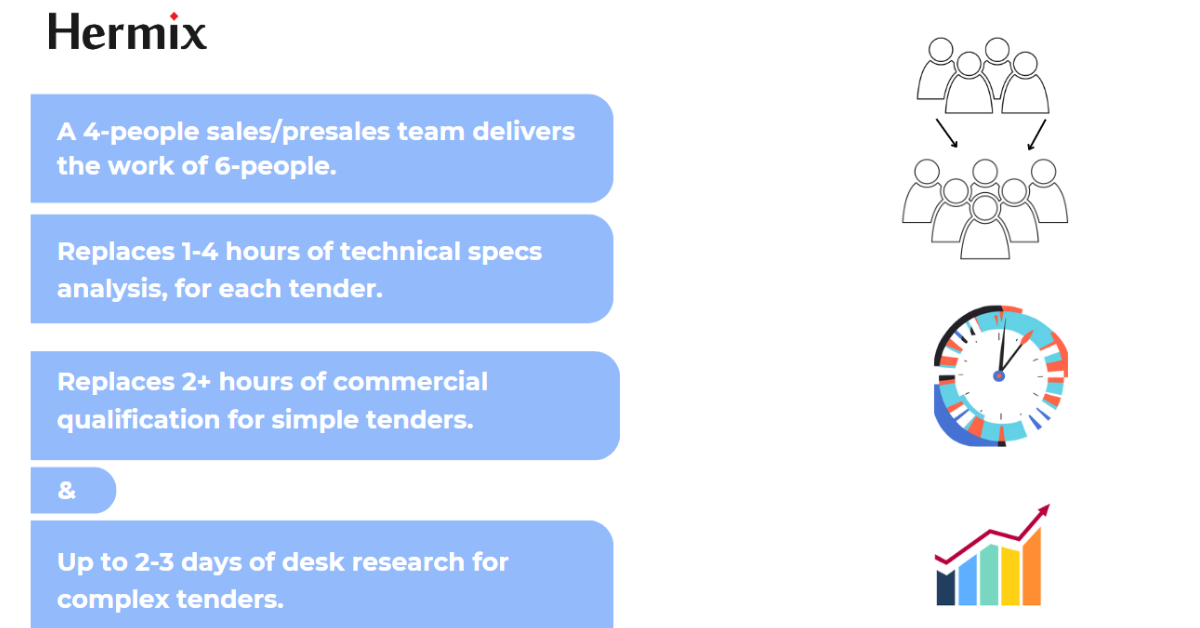
Hermix increases the efficiency of a sales/presales team by 50%. With Hermix, a 4-people sales/presales team delivers the work of 6-people. Hermix replaces 1-4 hours of technical specs analysis, for each tender. Hermix replaces 2+ hours of commercial qualification for simple tenders, and up to 2-3 days of desk research for complex tenders.

Nothing compares with our user’s feedback and (love)

”Hermix is a game-changer! Amazing platform that helps me win calls for tender. It is user-friendly with excellent support. The data is accurate and very precise, helping me seal deals.” said Nicolas Vande Kerckhove, EU Account Manager, Capgemini

”Hermix provides easy access to EU public procurement information in a user-friendly interface. Instead of watching TED, digging through the Financial Transparency System, Hermix combines the information in one tool. Analysis of competition and potential partners for tenders is also easier with Hermix. ” said Marc Salm, Bid Director at Arhs

”Hermix is the perfect tool to save time when responding to calls for tender on TED. It streamlines our tender response process, allowing us to focus on crafting compelling proposals. An essential tool for any company looking to efficiently manage tenders.” said Frédéric Ribordy-Moullec, Managing Director at CTG

Every feature & improvement changes everything

We’ve launched amazing features during these 2 years like  LLM/AI tool for public tenders, download QA as a single ZIP, and create a collaboration section that improves work between you and your team members.

  • With LLM/AI tool you can analyze tenders and generate proposals automatically. The tool allows you to check:  project scope, eligibility criteria, and evaluation criteria in minutes saving hours for presales managers in their daily tasks.
  • Download tender documents and clarifications (Q&As) as a single ZIP archive/PDF document
    • Download all tender documents as a single ZIP archive, Download Q&As as a single PDF file (for EU institutions tenders).
    • Monitor and receive email notifications when new documents or Q&A are published for a tender.

Now we are working on Tender AI chat,  another AI tool that will supplement the LLM/AI feature.

Competition motivates us

We received international recognition. We won 1st place at the EU Datathon 2022 competition which took place in Brussels in October 2022. 

We are also happy that our work was awarded twice by Deloitte & Google: Deloitte’s Impact Star award in November 2022 & Deloitte’s CE Tech Rocketship in November 2023.

Team & meetings are important

Innovation cannot exist without a good team. Each member brings added value to our project and product. We are glad that we managed to form a team with high potential that is involved in the updates and evolution of our app daily, and most important thing that is passionate about technology.

We also love sailing, walks in nature, and insightful conversations.

To many more years of Hermix!


50% increase in the efficiency of your sales/presales teams, with Hermix

With Hermix, a 4-people sales/presales team delivers the work of 6-people

50% increase in the efficiency of your salespresales teams, with Hermix

Key take-aways

  • Hermix helps companies win public contracts, with tender monitoring, analysis, and market intelligence based on AI.
  • Hermix replaces 1-4 hours of technical specs analysis, for each tender. 
  • Hermix replaces 2+ hours of commercial qualification for simple tenders, and up to 2-3 days of desk research for complex tenders.

Challenges in the public procurement market

The public procurement market (B2G) is huge, complex, and difficult to access. Suppliers and beneficiaries of public contracts, such as large corporations, SMEs, consultancies, academia are facing huge pains in B2G sales. Presales managers spend about 50% of their time on tender reading and qualification, highlighting inefficiencies in the process.

High cost of tendering

Writing tenders or proposals in the public sector is very expensive, with contractors spending up to 2% of the total contract value on bid processes, and even up to 6% of revenues for SMEs. Moreover, the effort for participating in tenders is not proportional to the value of each tender, nor to their success rate. According to a survey of 179 UK construction firms, those winning one in every five projects could be spending as much as 22% of operational turnover on sales and presales effort.

Suppliers and beneficiaries of public contracts have a critical need to understand their ecosystem and automate their processes to increase the efficiency of their sales process, produce high quality and successful proposals/bids, and reduce the cost of sales. New, disruptive technologies and methods (AI, ML, LLM) are available but not used in the B2G market.

Hermix streamlines the sales process in the B2G market by 50%

Hermix increases the efficiency of your sales/presales team by 50%. With Hermix, a 4-people sales/presales team delivers the work of 6-people. Hermix replaces 1-4 hours of technical specs analysis, for each tender. Hermix replaces 2+ hours of commercial qualification for simple tenders, and up to 2-3 days of desk research for complex tenders.

Based on case studies we have run till today with our partners, as well as on the feedback we have received from paying customers, Hermix streamlines the sales process in the B2G market. More specifically, our value proposition for our primary group of target customers, i.e. public funds contractors includes:

1. Market intelligence including market research, opportunity qualification, and lead generation

  • 87% reduction in the time spent on market research activities.
  • 85% reduction in the time spent on tender summary analysis.
  • 75% reduction in the time for tender detailed analysis.
  • 200% increase in the number of qualified leads generated through strategic market research. 
  • 50% increase in the identification of relevant opportunities.
  • 2. Proposal generation and bid automation:
  • +10% compliance of proposals with tender requirements.
  • 60% reduction in the time needed for proposal writing. For a scenario of a team of 5 sales employees with an average daily rate of €300 and 1 presale manager with an average daily rate of €400 that they work 8 days with Hermix for the preparation of the proposal instead of 20 days (in the case the proposal if fully written by hand) this is translated to €22,800 savings.

2. Proposal generation and bid automation:

  • +10% compliance of proposals with tender requirements.
  • 60% reduction in the time needed for proposal writing. For a scenario of a team of 5 sales employees with an average daily rate of €300 and 1 presale manager with an average daily rate of €400 that they work 8 days with Hermix for the preparation of the proposal instead of 20 days (in the case the proposal if fully written by hand) this is translated to €22,800 savings.

Win more public contracts with Hermix

Hermix saves hundreds of hours of effort for you and your colleagues every month, making it easier for your sales and presales teams to succeed in the B2G market. While increasing efficiency by 50%, Hermix helps you save time, reduce costs, and secure more public contracts.

Try Hermix for FREE