Insights

Follow us and subscribe to our newsletter to keep in touch

Hermix team on mountain trails

A breath of fresh air

Last week, Hermix team enjoyed a breath of fresh air in the mountains of Bușteni. For three days, we admired the stunning views of the Bucegi Plateau, generously offered by the location of the cabin where we stayed. Throughout these days, we can confidently say we let ourselves be inspired.

We alternated moments of relaxation and discussions with outdoor planning sessions, which allowed us to connect better with nature and each other. Every conversation seemed to take shape naturally, and ideas flowed more easily, as if the mountain air had a positive effect on everyone.
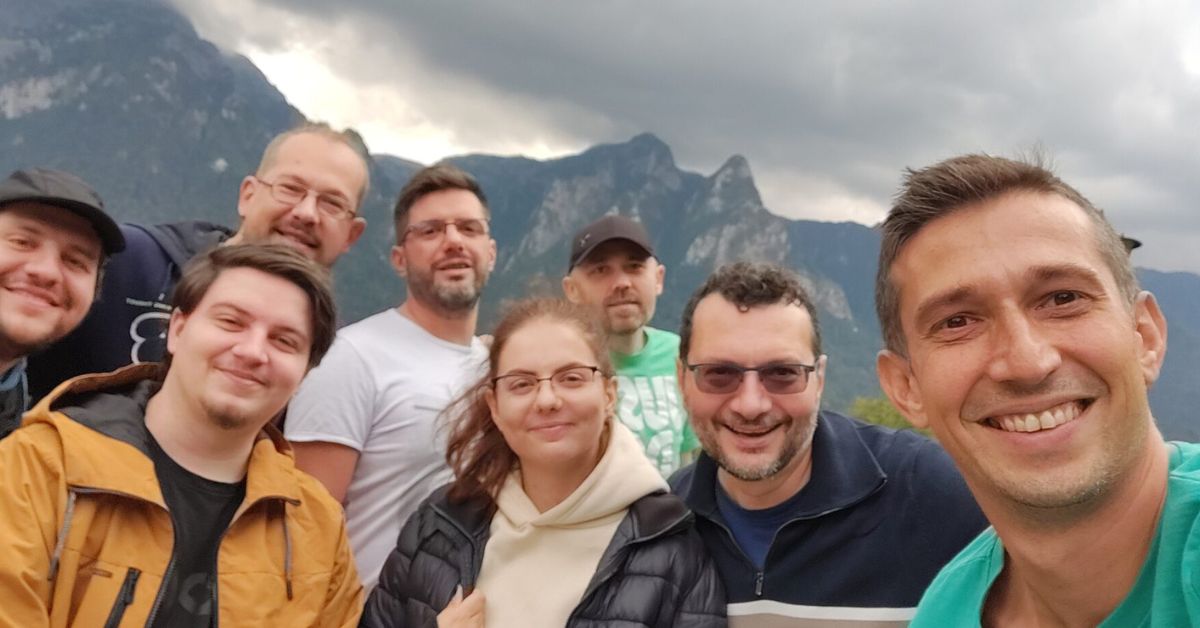
Hermix team Busteni 2024

Balancing work and relaxation

After achieving our planning objectives, we took a well-deserved break with a walk to Cantacuzino Castle, one of the most famous attractions in the area. It was a relaxing moment where we recharged our batteries and took many photos to capture these special memories. Our colleague Stefan was always ready with his phone, making sure no detail was missed.

In addition to focusing on Hermix and what we’ll innovate next—what new features we’ll bring—this experience helped us get to know each other better. We discovered something new about each team member, which strengthened our sense of unity.

The mountain teambuilding was an experience we will remember, and one we will surely repeat in the future.
Hermix analyzes public sector sales data

Hermix analyzes public sector sales data

Hermix is the first market analytics platform for public sector sales. It helps you win public contracts with tender monitoring, modern analytics, and technology-enhanced automation, powered by AI.

Hermix’s updated insights and statistics

The Business-to-Government market is huge & relevant. The public sector is 54% of the EU’s GDP. Public tendering is 14% of GDP.

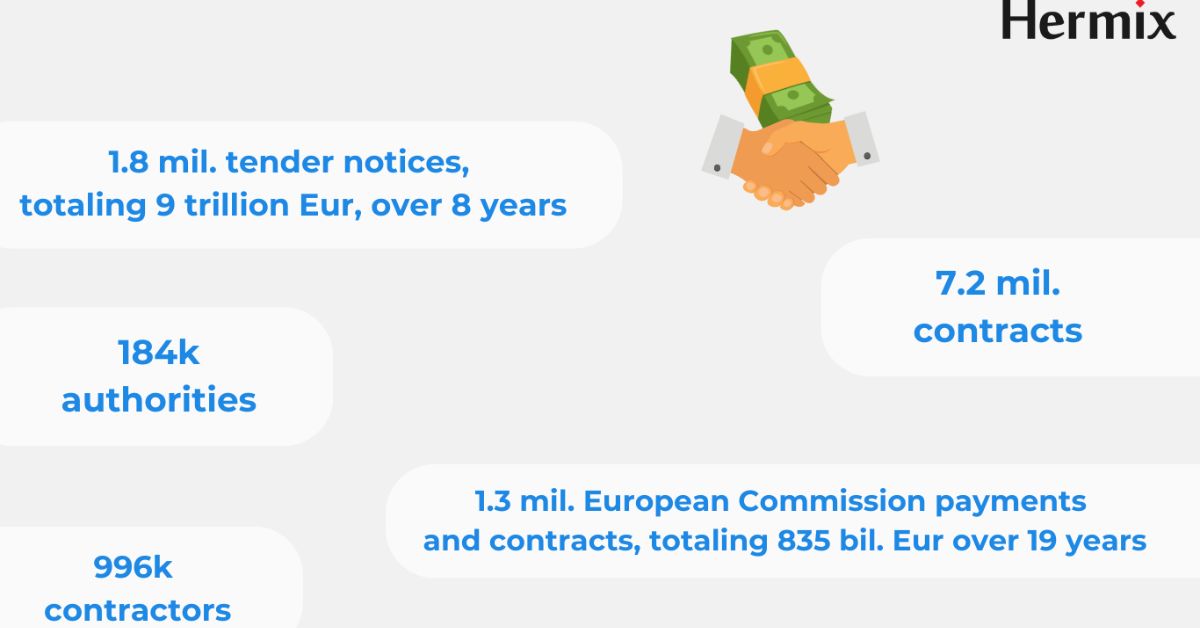
  • 1.8 mil. tender notices, totaling 9 trillion Eur, over 8 years
  • 7.2 mil. contracts
  • 184k buyers
  • 996k contractors
  • 1.3 mil. European Commission payments and contracts, totaling 835 bil. Eur over 19 years

We are here to make your public sector work easier!

Join us or test our platform for free!


Hermix – 6 months in review

6-months-in-review

It’s mid-July, and Hermix has over 800 users, such as Capgemini, Eviden, Unisys, Indra, Seidor, ARHS. 

We’ve launched amazing features like the LLM/AI tool for EU tenders, Download QA as a single ZIP, and improved team collaboration within the platform. 

We were also invited to many insightful events where we met extraordinary people,  won a €920k Eureka Eurostars grant, and hosted our first webinars.

The first half of the year has been incredible. Excited for what’s next!


Win public contracts, with tender monitoring and market intelligence based on AI

Win public contracts, with tender monitoring and market intelligence based on AI

Hermix helps companies win public contracts, with tender monitoring, market intelligence, and proposal automation. We use AI/ML and LLM to automate public sector sales. 

Big data and automation are already used heavily in retail, consumer, B2C/B2B. Hermix brings modern analytics and proposal generation to B2G – Business-to-government. We bring B2G to the 21st century.

We support day-to-day sales, bid, and presales:

• Tender monitoring, and email notifications. 

* Automated tender summaries, with AI/LLM.

• Opportunity qualification: budgets, competition, gaps. 

• Deep market intelligence: where are the money, who buys & sells, what, when, where, how – with AI/ML.

We help you grow your business in an amazing, huge, stable market: public sector.

• Public sector is 53% of the EU’s GDP.

• Public tendering is 14% of the GDP: €2 trillion in EU, 14 trillion worldwide.

We offer:

• Detailed B2G market analysis, segmentation, forecasting, using governmentgraphics.

• Understanding the market: future opportunities, partnerships.

• Actionable data and infographics.

• Drill-down & drill-up.

• Smart market-watch.

Immediate benefits:

* Cost: upgrade your team from data entry to data analysis.

* Efficiency, focus. Increase proposal success rates to 60-70%.

* Delivery quality: choose the best technology and partners.

* Sustainable, repeatable sales.

We are a team of experts with significant expertise in IT, AI/ML, big data, deep-tech, product development, public procurement, and governance.

We are passionate. We strive to make a difference.


Hyper-optimizing public tendering with AI

Article summarizing the discussions from the webinar organized on 18 Apr 2024, hosts being Stefan Morcov, CEO Hermix & Michael Mathieu, Sales Director at Westpole Benelux

Hyper optimizing public tendering with AI live webinar

The B2G – Business-to-Government market is relevant and different from other markets such as B2B or B2C – retail, consumer. The B2G market is huge, stable, and distinct. The public sector represents 53% of the global GDP, and public procurement represents 14% of GDP. We’re in a huge market that keeps getting bigger and busier. To stay ahead, you need more competitive advantages. But here’s the thing: even though it’s getting more competitive, it’s still really hard to get into. Our analysis shows that only 1.3% of European companies access public contracts. That’s surprising considering that European governments spend 54% of their money, totaling 2 trillion per year, through 250,000 buyers. According to a World Bank study last year, 25% of this money is lost due to inefficiencies.

Our solution

At Hermix, our mission is clear: we provide an innovative online platform designed to assist companies in securing public contracts effectively. Our commitment lies in bolstering businesses across three key domains: tender monitoring, tender analysis, and market intelligence.

  • Tender monitoring forms the backbone of our service, delivering daily updates on new tenders, alterations to existing ones, alongside essential documents and Q&A sessions. Drawing insights from various reputable sources like the Belgian procurement portal and the European Commission’s funding portal, we ensure our clients remain informed and prepared.
  • Moving on to tender analysis, we delve into both the commercial and technical realms, leveraging cutting-edge conversational AI technology to streamline processes. From understanding complex tender requirements to automating tedious tasks, our platform empowers businesses to navigate the procurement landscape with ease.
  • Finally, our market intelligence segment focuses on positioning companies strategically within their chosen markets. By providing in-depth analysis and insights, we enable our clients to make informed decisions and seize lucrative opportunities.

In essence, Hermix is more than just a platform – it’s a trusted ally for businesses seeking to thrive in the competitive world of public contracting.

Challenges we face

At Hermix, we tackle a big challenge: sorting through loads of data in the public sector. There’s so much information that companies are overwhelmed. Our goal is to make sense of it all. Take, for example, the European Parliament’s changes in their IT contracts. This shows why it’s crucial to understand active contracts. There used to be 1 tender with several lots, then some lots were transformed into independent tenders, and then some split again. Now there are a lot of past and future IT tenders and EP, with many lots and many winners. Shifting through all this information is very difficult. We need a single place to organize all this information, and this is what Hermix does.
With the help of AI, we can automate tasks and streamline document creation, saving time for companies. We aggregate context information and provide insights to help companies make informed decisions. For instance, we offer profiles of buyers, previous contract awards, and supplier information.

The key for success in public sector

Strategy. A company, however large, has limited resources, and tendering in the public sector is expensive. This is why it is crucial to understand the market and to know where to concentrate your efforts. The best strategy is to position in the market with the biggest budgets and with the lowest competition. It’s like the strategy of Napoleon of “defeat in detail”: a good general concentrates all of his forces where the enemy is weakest. Hermix supports this by analyzing and aggregating big-data from various sources to provide a comprehensive, holistic picture of the entire market.

Tender analysis. In public sector sales, analyzing tenders from both commercial and technical perspectives is vital. Understanding market dynamics, strategic positioning, and prioritizing impactful opportunities are key. Leveraging technology and data analytics can boost competitiveness and contract-winning chances.

Presales and bid management. Another crucial aspect is pre-sales. In public sector tendering, it’s like taking an exam; you’re evaluated based on what you write, not what you know. Therefore, pre-sales activities are critical. Many tasks in pre-sales can be automated, starting from understanding tender requirements to summarizing them and even generating tender proposals.

Sales. Actual sales include having a physical presence. Boots-on-the-ground is always important.

Technical excellence. Delivering high-quality services and/or products establishes brand and reputation. 

This comprehensive approach, from understanding the market to monitoring tenders, qualifying, and writing proposals, is what leads to success in the public sector.

Why AI?

Having access to organized, cleaned-up data, i.e. intelligence, is essential for developing an effective strategy. This data allows you to analyze your clients, competitors, and market trends, helping you make informed decisions. The use of AI can further enhance your strategy by providing insights and suggestions based on your data usage patterns.

By leveraging tools like AI and data analytics, you can gain a competitive edge in the public sector market. These tools enable you to streamline processes, analyze vast amounts of data, and make strategic decisions that drive growth and success.

Our vision for using AI

We launched a great feature based on AI: the automated summarization of technical specifications and tender documents. You can analyze and summarize thousands of public tenders with AI in Hermix. 

The tool allows users to check, in a matter of minutes, which is

  • The scope and objective of a project, 
  • The eligibility and financial selection criteria, such as turnover and certifications,
  • The technical and professional selection criteria such as CVs, and references for similar projects.
  • Or the award and evaluation grid.

We use several generative LLM tools, such as ChatGPT, Mistral, LlaMa, and PrivateGPT. We are part of the Microsoft Startup programme, accessing tools such as OpenAI.

Looking forward, we’re exploring advanced AI applications like price analysis and proposal generation. While AI holds great promise, it’s crucial to stay practical and focus on solving specific, practical problems. Our approach involves creating a framework with specialized services, or agents, that work together to solve individual issues and produce valuable outcomes.

We prioritize transparency

In terms of data coverage, our platform includes European institutions as well as national, federal, regional, and local buyers across Europe. We’re always expanding our coverage to include more agencies and sources.

We prioritize transparency by showing the source of our data, which was based on user feedback. With just one click, users can access the original source of the extracted information. We’ve made efforts to ensure accuracy and avoid errors in data extraction. We tested and worked with various language models, with GPT-4 being the most reliable for the tasks we perform. While AI has its strengths, it may struggle with complex topics and nuances, so we’re mindful of its limitations.

Our accomplishments

With over 800 users and approximately 30 customers across Europe, we’re honored to collaborate with esteemed clients like Indra, Unisys, Capgemini, Luminess, Euroforce, Vass, Westpole, and Technopolis. Our platform offers access to extensive data, empowering users to analyze diverse dimensions and make informed decisions.

Remarks from Michael Mathieu – Sales Director at Westpole

”Hermix helps me tremendously, to build a pipeline and receive reminders, especially for tenders I may have forgotten about or didn’t have time to look at. It also allows me to discuss with partners or competitors to better understand their position in the market and their market share. I can also conduct vertical analysis by client and sector, which used to take hours and hours of work. I remember when I first started, it took me six months just to get familiar with the main product we used, Ted. It took me six months of full-time dedication to understand what was available in the market and to establish a pipeline for the next five years. Your product is truly invaluable in supporting both pre-sales and sales efforts.”

Reach out to us for any questions or assistance.

The article is based on the topics presented at the webinar “Hyper-optimizing public tendering with AI.

See the video recording.


Hyper-Optimize Public Tendering with AI- Webinar video recording

Hyper optimizing public tendering with AI live webinar


Last week was fantastic for Hermix. We hosted our first webinar on ‘Hyper-optimizing public tendering with AI’. We want to thank everyone who participated and left us with over 30 questions and great feedback.

We covered topics such as:

• 2 trillion Euro per year in public contracts: Where is all the money?

• How to get public contracts. Secret ingredients for a competitive advantage in B2G – Business-to-Government

• Artificial Intelligence and analytics to win public tenders

Video recording:

In case you missed it or want to revisit any key topics, here’s the recording: 

We hope you enjoyed it as much as we did.

Until next time, don’t forget to:

• Try Hermix, the #1 product to help you make sense of EU public sector sales data.

• Sign up for our AI Tender Summaries Beta Program.

The next webinar is in progress. Leave us suggestions for the topics you’d like to see next. See you there!


Video tutorials, tips & tricks

Hermix vision 2024

Video transcript:

Hermix helps companies win public contracts, with tender monitoring, proposal automation, and market analytics, based on Artificial Intelligence.

The public sector is huge – probably the largest market there is.
Stable. Solid. There are amazing opportunities.
But it is also mostly manual, unpredictable, opportunistic. And very expensive.
Public sector sales is still in the stone-age, compared to consumer, retail, or B2B. Where you have big-data and analytics about everything related to customers, like – firmographics, demographics, education, employment, children, or holidays.
In the public sector, we still collect and analyze data manually, with Google search, emails, and… in excel files.

With Hermix:

  • I can monitor relevant daily opportunities.
  • I can use artificial intelligence to extract and summarize, in seconds, the technical requirements of a project, the evaluation criteria, budgets, the economic and financial capacity requirements, the experts, deliverables, and even the formatting requirements for my technical proposal.
  • I can search and download tender documents; check clarifications, and monitor changes in deadlines and budgets.
  • I have instantly a report with the commercial context of each tender. The client history, budgets, technologies, previous relevant projects, and past suppliers.
  • I flag and I organize my projects; collaborate with my team; add comments and notes. I can assign tenders, and check their progress on the kanban board.

Hermix provides full market monitoring and intelligence for the public sector market.
We analyzed millions of tenders, contracts and documents.
We have advanced market analysis reports, to understand clients, partners, competition, and affinities. Where is the money. Who buys and sells. What, where, why, when, how.
I can forecast future revenues based on historical data of past spending, and ensure sustainable growth.
I can create my strategy and manage my pipelines.

Hundreds of users from all over Europe use Hermix intelligence every day to optimize their sales and presales.

With Hermix, a 4 people team can perform the work of 6.
For every tender, Hermix saves you up to 20 hours of manual work.
That’s at least 50% increase in efficiency, and even more on proposal quality and success rates.

We help companies win public contracts, with AI.

Monitor new public sector opportunities

Video transcript:


The daily struggle when you do public sector sales is to monitor tenders every day, looking at what tender appeared today for your particular market, then analyzing that tender and understanding if it is relevant for you or not. And obviously, this is also what Hermix is doing. 
 
The platform remembers the filters that you have used the last time. You can save your reports and your filters in your personal profile, and you can see all the opportunities that appeared for your market, you can export all the data, and save the report. When you save a report it will be available in the list of your reports, that you can see every day. You can set up notifications for these reports and receive emails in your inbox every day or every week, or every month with what happened in your market.


Besides tender notifications, you can also have a look at contract awards, who signed, what contracts at prior information notices that announce future tenders that have not been issued yet, but also renewals. 


Renewals are tenders that are going to be launched, most probably because their contracts expired, and you can see also their history of who won, and what before for that contract that is going to be renewed.

Opportunity qualification

Video transcript:


In public sector sales every day we scan for new tenders, and when we find a new potentially interesting tender what we need to do is to understand the context of this project. Let’s say I’m interested in this project for example: the European Commission publications Office of the European Union, 58 million contracts with a deadline in February for project management for IT services. So we have the typical information deadline, budget, and so on. 


Hermix provides you something that is not available in any other platform, the context,  because we cleaned up seven years of history for the entire European public sector as well as 16 years for the European Commission. This means that I have information about the winners of similar contracts,  84 companies that signed contracts for the same type of services for this authority.  I can see them with one click, for instance, these are the 21 contracts signed by Aris for the publications office for this type of services. 


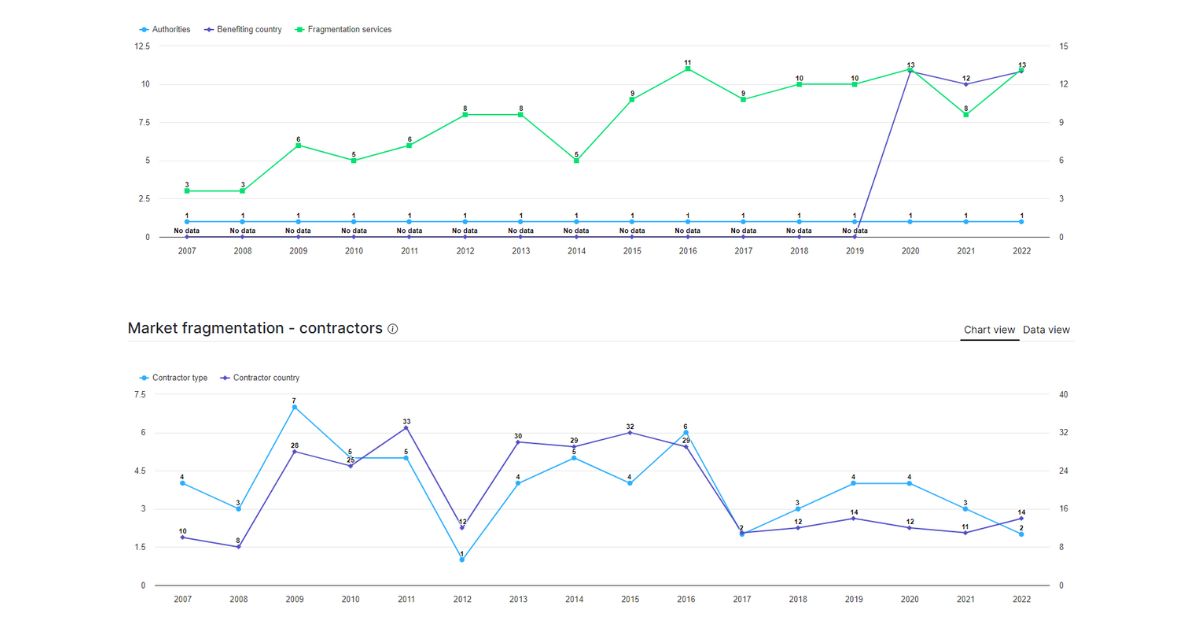
I can see the profile of every company with one click. I can have a look at all the previous contracts, 181 in similar services. I can see if there are contracts that are going to be renewed and if there are other tenders that are being opened for the same authority. I can also have a look at the profile of this authority, and potential customers in the publications office. I can see the contact points, emails, phone numbers, and addresses. I have an overview of its business for my particular type  IT, but I can look also at other types of services. I have a history of services that have been tendered both as charts and data. I can have a look at the market that provided these services per country, the history, the six and seven years of history of contracts, numbers as well as fragmentation of the market. I can see their past contracts and for the European Commission, I can also see the 16 years of history of payments, both for IT as well as for other services, both as a chart view or as a data view per year, per country of the suppliers and beneficiaries, per type of services, type of contract with values, fragmentation, diversification and their main suppliers and beneficiaries, as well as per year. And I can even look at the details.

Flags

Video transcript:


The European public sector market is huge. There are thousands of tenders published every day and even if you monitor only for your specific market, for your specific type of authorities, countries, or industry, there are still tens, hundreds of open tenders that might be of interest. 


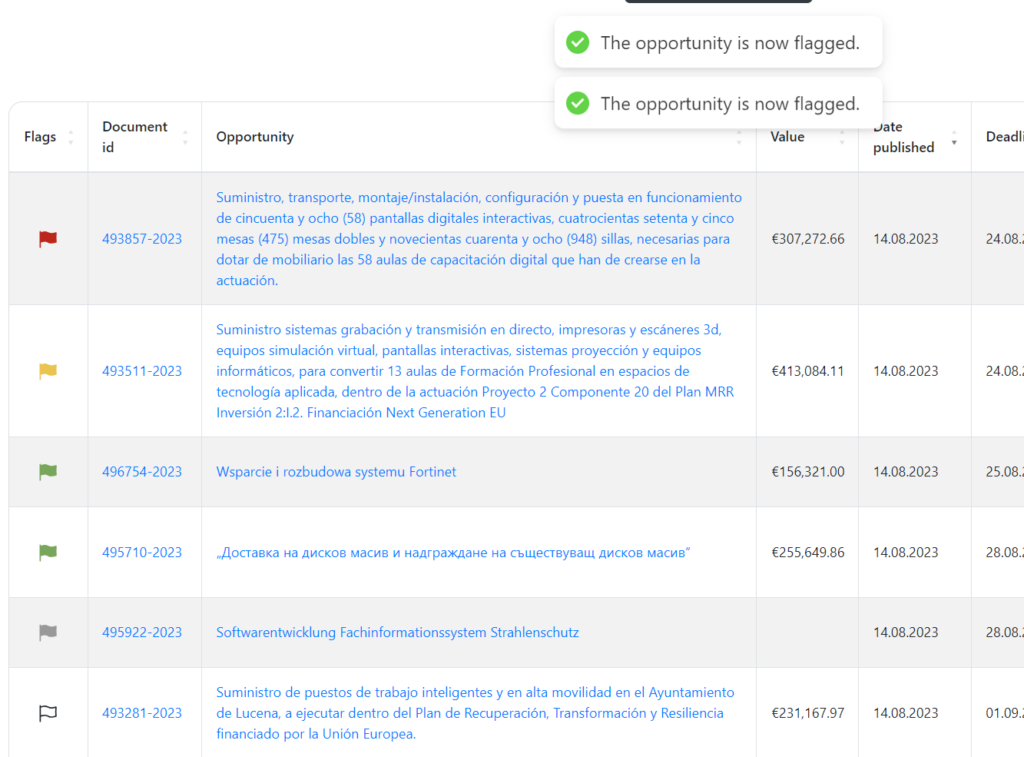
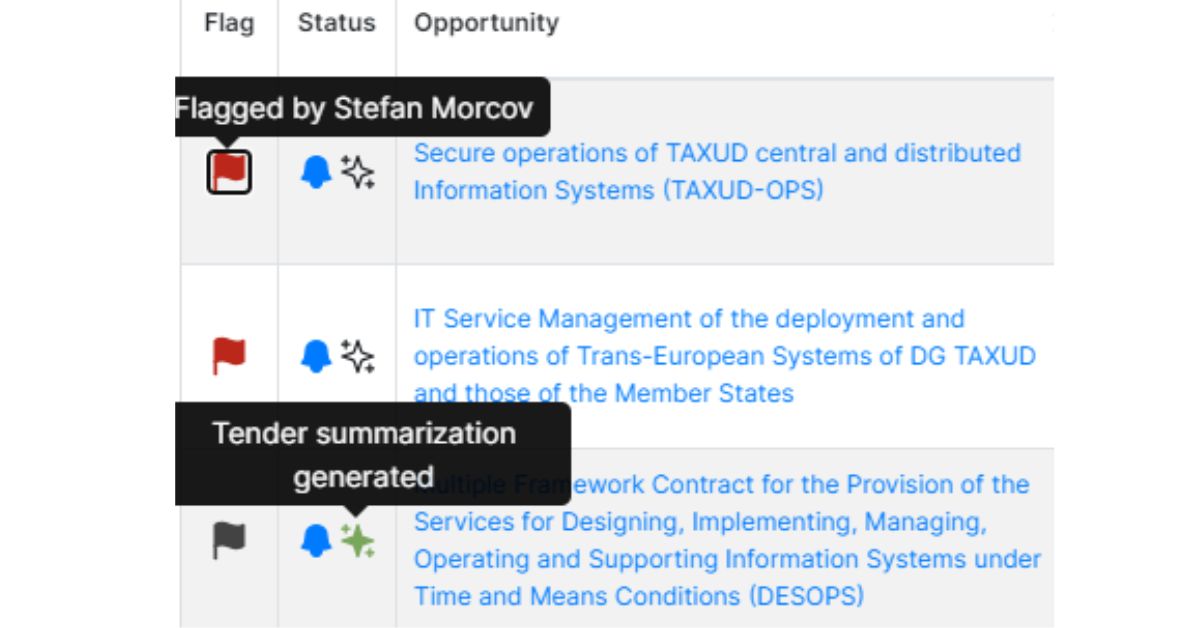
So what do you do? You look at them and you see which tender is of interest to you, with Hermix you can also flag these opportunities. When you flag an opportunity to be qualified, this setting is remembered by the platform and it will be shared between your colleagues. 


Your colleagues will be able to see that some tenders need to be reviewed and seen, and so on. On your dashboard, you have your list of flagged opportunities or contracts, or awards. With one click you can see for your organization which are the flagged opportunities, what flags have been set, and who set the flag. 


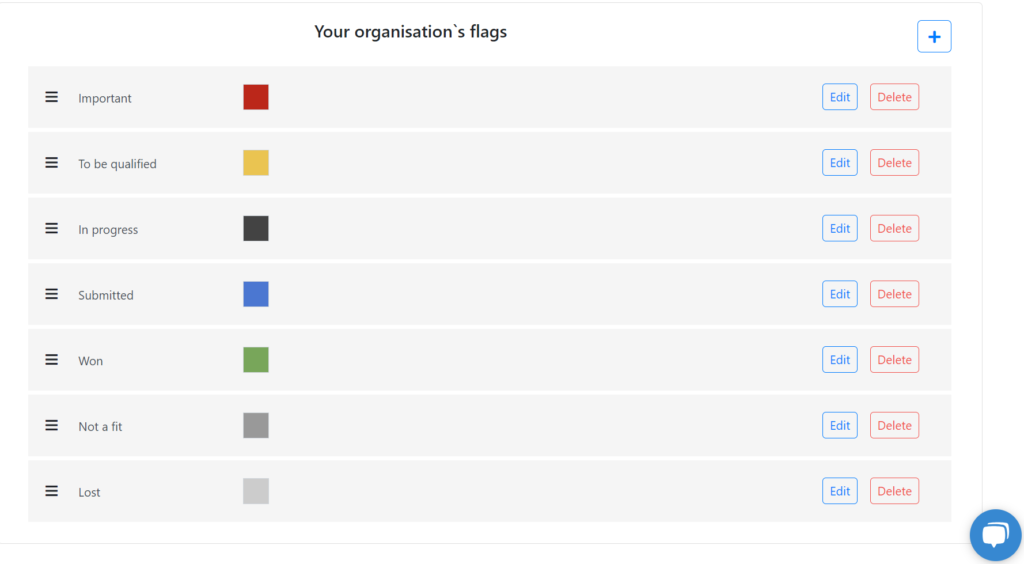
This flag can also be customized. If you go to your personal profile, you can set up your own flags with your own specific labels, order, priority, and color.

Tips and tricks 2024

Video transcript:


Here are some tips and tricks on how to work with tables and reports in Hermix. We will start from the home page. 


Let’s say I want to see the list of open tenders that are relevant to me. The filters that I see on this screen are the ones that I used the last time, but I can clear the filters with one click, or I can reset the filters to my default filters which have been saved in my personal profile.


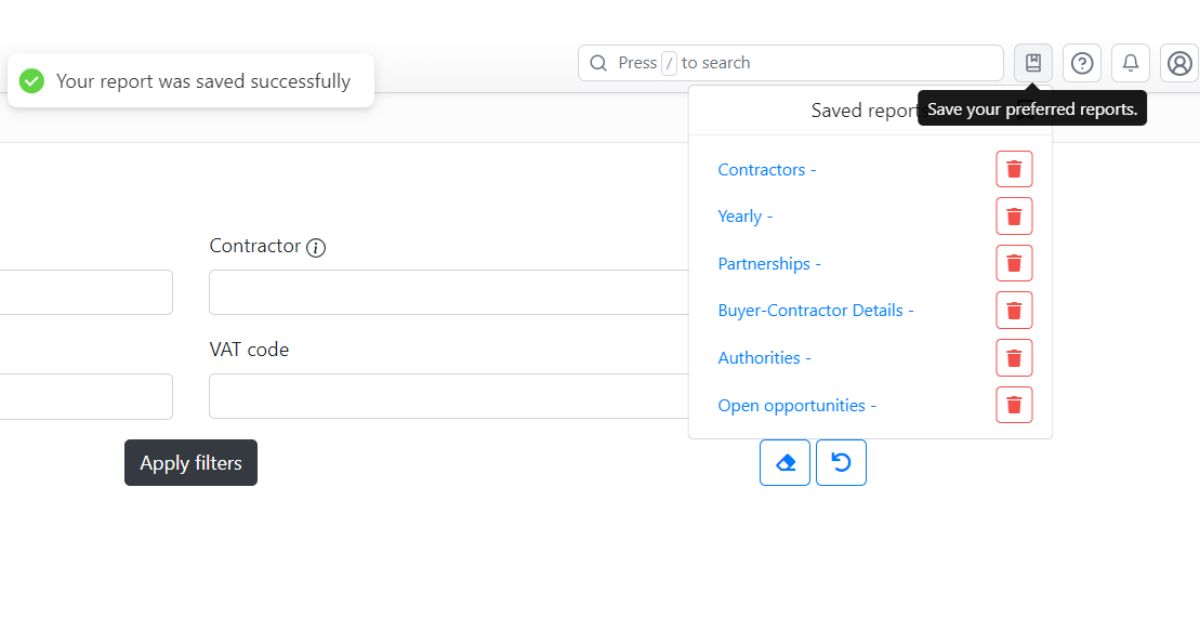
I can save this report for further reference and then it will appear here in the list of my preferred reports, and I can access it with one click. I can create a notification and at that moment I will receive daily or weekly or monthly emails with these relevant tenders. But let’s have a look at the report itself.


By default, this report is sorted by deadline and date published, but I can change this sorting order with one click on the column name. If I keep shift pressed I can sort by multiple columns at the same time. Every report can be customized. I can select what columns to be displayed or hidden. 


Let’s say I want to show also the industry and the authority type and I can select the number of rows to be displayed. For example, I want to see 25 or 100. Or let’s say I want to see the next page. All the reports can be exported in Excel file or in CSV file. You can always reach out to us by clicking on the chat button in the bottom right corner.

Implementation of a Business-to-Government (B2G) Sales Analytics Tool – Hermix

Implementation of a Business-to-Government (B2G) Sales Analytics Tool – Hermix

Published as: Morcov, S., & Puiu, A.M. (2023). Implementation of a Business-to-Government (B2G) Sales Analytics Tool – Hermix. Economic Insights – Trends and Challenges, 12(4), 61-69. doi:10.51865/EITC.2023.04.05

Abstract: The public sector sales market, i.e. Business-to-Government
(B2G) market is large and relevant. It is similar, yet differs in several key aspects from other markets such as retail, consumer (B2C), or Business-to-Business (B2B). B2G is huge, at 2 trillion Euro per year in Europe, but insufficiently researched and it lacks proper tools and methods. Public
contracts are difficult to access and require specialized expertise and a significant initial investment. This paper explores the implementation and
evaluation of an IT platform that supports and automates public sector sales, Hermix, in a large company. This study had a qualitative
longitudinal approach. It consisted of 7 workshops and 2 interviews with 8 case study participants, performed over the duration of a year. It
highlights the implementation steps and results. Hermix automated a set of public sector sales processes for the host company, including: tender
monitoring with email notifications, opportunity qualification, and market research, i.e. the analysis of the tactical and strategic context: buyers
(public buyers), budgets, competition, partnership affinities, groups of interest, trends. It uses advanced data analytics, big-data and machine
learning to provide market intelligence such as governmentgraphics, firmographics, geographics and monetary segmentation. Implementing
public sector sales automation tools provides direct benefits to companies, related to: cost and time efficiency, improved proposal success rates, and strategic planning optimization. Indirect benefits for companies refer to delivery quality. Data analytics tools also support overall public procurement transparency, public spending efficiency and better public governance.

Keywords: Public Procurement; Business-to-Government B2G; Public
Sector Sales; Market Research; Analytics.

Introduction

Public sector sales, or Business-to-Government (B2G), is the marketing and sales of products, services, and works to public sector organizations (Cambridge Dictionary).

B2G is similar, but distinct from other markets, such as retail, consumer, Business-to-Consumer (B2C) or Business-to-Business (B2B) (Kenton, 2021). According to the European Commission (EC) and Eurostat, the public sector is 53% of the Gross Domestic Product (GDP) of the European Union (EU) (Eurostat, 2022). In the US, public spending amounts to 47% of the GDP. Public sector procurement forms a significant part of the public sector spending, estimated at more than 14% of the global GDP. In Europe, the EC estimates the size of public sector procurement at 2 trillion Euro, and the number of public buyers at 250k. These include public institutions at international, European, national, federal, regional, or local level.

A significant number of companies are active on the B2G market. The EC estimates that 400k companies are engaged in public contracts. Worldwide, 60% of Fortune 1000 companies are engaged in public sector contracts. In general, having government business has a positive impact on a firm’s value. The impact varies depending on factors such as company size and the variety of its customers (Josephson et al., 2019).

The public sector sales market is not yet analyzed, studied or defined formally. Even the terminology is still being defined. Thus, there are various alternative names used for the domain, such as Business-to-Government (B2G), public sector (PS), public procurement (PP), Business-to-Public-Administration (B2PA), or Business-to-Public-Sector (B2PS).

There are insufficient tools or methods for supporting this market. There are no specialized tools for analysis, market research, or for sales. Public sector sales relies on manual data analysis and general data management tools, such as business intelligence (BI) or Customer relationship management (CRM).

Hermix is a new platform that aims to automate and support public sales and access to public funds. Hermix helps companies to understand and win public contracts. It offers functionality such as:

  • Tender monitoring, such as email notifications and in-app notifications;
  • Opportunity qualification of tenders, such as analysis of customer budgets, similar projects,competition, previous winners, potential partners, similar buyers;
  • Deep market intelligence and market segmentation, with big-data analytics and AI/ML:reports with information about where is the money, who buys & sells, what, when, how, where, and how much, for each market.

The sources of the data of Hermix are mostly public, such as the European public procurement portal (TED), Eurostat, the European Central Bank (ECB), the European Commission (EC), the European Open Data portal.

During the past 2 years, the technology and business case of Hermix were tested for evaluation and validation purposes in cca. 600 workshops, with 350 users, experts, and researchers, including 22 pre commercial customers.

One of the major case studies that was used for the evaluation and validation of the implementation, results, and benefits of Hermix was implemented together with a European software engineering company, a subsidiary of a global IT and communications company headquartered in Europe, but with a global business. The company has a significant IT service business for the European Commission and other European institutions, services clients such as the Directorate-General for Communications Networks, Content and Technology, the Directorate-General for Education and Culture, the Directorate-General for Digital Services, the Directorate-General for Research and Innovation, the Joint Research Centre of the EU, the European Environment Agency, the European Food Safety Buyer. The project was partially funded by the Bucharest-Ilfov Regional Development Agency.

Background

The European public procurement market (Business-to-Government, B2G) is huge (€2 trillion), complex, and difficult to access. Buyers and contractors have a critical need to understand their ecosystem and automate their processes.

Vast amounts of open multilingual data are available, but lack standardization, integration and semantic quality, thus being not exploited sufficiently. Accessing public funds and tenders is a manual process that requires incredible investment, effort and resources. The market is therefore dominated by a few specialized actors.

New, disruptive technologies and methods (artificial intelligence, machine learning, large language models) are not yet being used on the B2G market. Thus, there is a huge gap between B2C/B2B technologies and methods used, vs. the public sector sales.

Business-to-Government B2G

The public sector market, a.k.a. Business-to-Government or B2G, is huge, distinct and relevant. Public funds solve critical economic and social needs. For instance, the EC already disbursed €807 bil. via the Recovery and Resilience Facility. The EU’s infrastructure, education, transportation, health, social care, and research are largely publicly funded. A huge amount of these projects are executed through public procurement.

At the same time, despite significant policy and regulatory efforts, access to public funds is still an elitist affair, dominated by a few large, specialized players. The market is skewed. Only 400k companies, i.e. 1.3% of the total 30 mil. EU companies, access public contracts (Eurostat,2022). Based on our analysis of data from the Financial Transparency System (FTS) of the European Commission, only 1.5% of the beneficiaries of EC R&D grants receive 57% of the total EC R&D budget.

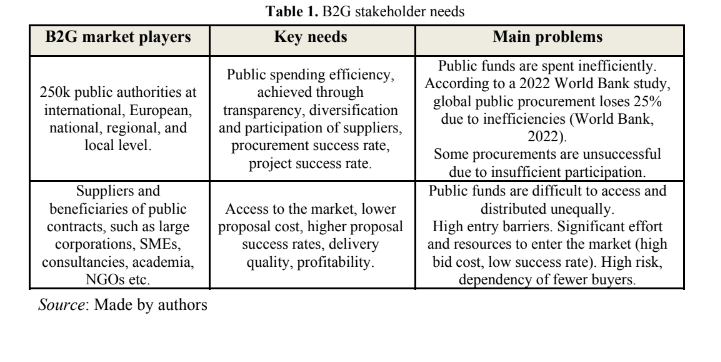
Unlike B2B and B2C, there are no automation or analytics tools to support B2G stakeholders. Table 1 presents the core needs and main problems faced by B2G actors.

The Public Sector Sales Analytics Platform Implemented – Hermix

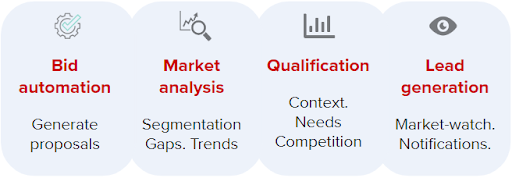
Hermix supports companies to win public contracts. It offers functionalities such as monitoring the market and providing market research reports. It offers features covering:

  1. Strategic market research, positioning, targeting, prediction and decision-support, withadvanced infographics, using traditional segmentation (such as firmographics, geographics,demographics, monetary), as well as innovative segmentation: government graphics, affinity maps (Morcov, 2022).
  2. Intelligent opportunity qualification. Analysis of probable winners, patterns of behavior,
    abnormal behavior.
  3. Lead generation, identification of relevant opportunities, smart market watch (Hermix,
    2023).

A summary of Hermix’ modules is presented in Figure 1.

Fig 1. Hermix main modules
Source: Made by authors based on Hermix product descriptions (Hermix, 2023)

Methods

This paper studies the impact of implementing a specialized market analytics and sales enablement tool, Hermix, for supporting public sector sales in a large IT company.

It is a longitudinal study, based on a single case-study, consisting of the implementation of the platform Hermix for a large IT software business.

This research was executed as a single, longitudinal case study. Besides the implementation of the platform, it consisted of a set of 7 workshops and 2 interviews with a total of 8 participants from the host company.

Case study research is a qualitative, exploratory research method. Qualitative research, and especially case study research, can help researchers to develop initial understandings in new domains, such as B2G, which is a domain insufficiently analyzed and understood (Levitt et al.,2018; Gummesson, 2000). This methodology is particularly useful in the design, building, as well as in the external validation of new theories (Gibbert & Ruigrok, 2010).

The case study research methodology employed included data collection through workshops and interviews, as well as the application and evaluation of the implemented tool (Yin, 2011).

The data was collected through 7 online workshops and 2 interviews, with 8 participants. Offline written questionnaires or data collection tools were not applied. Live interviews are typical tools used in qualitative and in case-study research, as they help uncover new insights through open discussions and especially open questions. They are also helpful in clarifying the terminology, considering that the terms used in B2G are sometimes overloaded and not sufficiently defined nor specific. During the workshops and interviews, stronger importance was placed on negative responses and feedback, rather than on positive. The workshops had as purpose to discover arguments, potential causality between arguments, as well as to analyze the larger context of the case study and of the host organization (Wieringa, 2014).

The discussions during the workshops and interviews were not recorded due to confidentiality reasons, but notes were taken and the answers were documented in writing, for further in-depth text and feedback analysis, and to ensure construct validity.

The research for the case study consisted of the following main activities, detailed below.

  1. The research design activity consisted of defining the research methods, designing the structure of the workshops and interviews, and selecting the case study and its participants.

The participants involved represented several functions and organizational levels:

  • 4 sales managers and executives;
  • 1 presales manager;
  • 1 presales/bid expert;
  • 2 executive managers.

The participants have a personal involvement, i.e. skin in the game. This ensures their involvement and interest in the direct results of the research.

2. The case study execution consisted of:

a) preliminary desk research;
b) 7 workshops with project case participants.

Starting with 24 Oct. 2022, the modules of Hermix were made available incrementally, for testing and evaluation, to a team of account and presales manager from the company. Hermix supported the team of the IT company to automate several key sales and bid processes, as described above. The pilot provided key insights. During the pilot, 7 workshops were held, for extracting feedback and validating the product, functionality and business case.

  1. The analysis and interpretation of the research results was qualitative. Card-sorting was used
    for analyzing the data (Spencer & Warfel, 2004).

Limitations, Validity, and Reliability

In case study and in general in qualitative research, the researcher has an active role, playing also the role of a consultant. Often, there is no clear demarcation between these 2 roles. This effect is that qualitative case study research is usually a personal journey, often impacted by the personal contribution and subjectivity of the researchers and of the participants. Management research acknowledges this phenomenon as ”the action research paradigm” (Gummesson,2000).

At the same time, this poses specific limitations, e.g. construct validity and reliability. To enhance them, multiple sources of data were used, to ensure triangulation, e.g. there were 8 participants, in 7 workshops and 2 interviews. This supported ensuring the convergence of the results, but also exploring possible additional, divergent paths and insights.

A chain of evidence was established and documented. Meeting notes are kept for each meeting and workshop. Standard configuration management is used, i.e. Google Docs for managing document versions, Hubspot for organizing, managing and documenting meetings.

The external validity of the research methodology might be affected by limitations related to the case-study context. A single case-study, deployed in a single organization, could have limited relevance. The case study, the host organization, as well as the participants were selected based on convenience, i.e. they volunteered for participation. The results of this research might therefore pose difficulties for generalization to other types of organizations, to other roles, or to other industry sectors. In order to enhance generalizability and external validity, further research should be conducted, including analyzing additional case-studies, in other organizations.

The research was qualitative. No quantitative methods were used. The analysis and interpretation of the data were qualitative, and explored elements such as the type of arguments used by participants. The characteristics of the participants and the specific organizational context was taken into consideration.

Results and Discussion

The company that is analyzed in the case study is based in Europe, but it is part of a large global corporation. Their main business is software development and related services. Their public sector business targets clients such as the European Commission and EU agencies in various European countries such as Belgium, Luxembourg, Italy, Denmark, Netherlands and Spain. It has 500-1000 employees. It has a team of 3 sales managers involved in public sector sales, and 5 presales and bid experts.

The main processes that the company uses for public sector sales are the following:

  1. Strategic planning, i.e. defining the market strategy and building long-term pipelines. This is done yearly, and updated quarterly, in slides, spreadsheets, diagramming applications.
  2. The market research requires 2-3 weeks of effort per year.
  3. Monitoring tenders. This is done daily. Before Hermix, this was done with monitoring
    portals such as TED and UNGM. Relevant tenders are recorded in the company’s CRM,
    but only after an initial pre-qualification.
  4. Commercial qualification of tenders. This is performed daily. It results in a bid / no-bid
    decision. Before Hermix, this was done by searching for relevant information in TED, with
    Google or reading the customer website and social media. This was a process that required
    between 30 minutes (for simple small tenders) up to 2+ days (for critical, complex tenders).
    Data was collected manually and analyzed in Excel files.
  5. Technical qualification of tenders. This is done daily, in conjunction with the commercial
    qualification, and also results in a bid / no-bid decision. The technical analysis is being
    done by reading the tender specifications, and requires between 2-3 hours per tender for the
    initial preliminary analysis, and 2+ days for a later detailed analysis. The analysis is
    registered in a standard template. Selected tenders are recorded in the CRM.
  6. Finding and validating partners. This is a task similar to the commercial qualification of
    tenders. It is done only for pre-qualified tenders. Data was obtained from public search
    engines, company websites, official registers of companies, as well as from commercial
    databases of companies.
  7. Proposal preparation. The proposal process and workflow is managed using tools such as
    Jira or custom tools. The files are organized on document management tools such as MS
    OneDrive/Office 365 or Google Drive/Apps.

The results of the implementation of Hermix were the following, for each key process:

  1. For the Strategic planning process: Hermix successfully automated this process, by providing already aggregated market research data, in visual reports and tables.
  2. For Monitoring daily tenders process: Hermix successfully automated this process, by
    providing collaborative features such as opportunity flags and sending emails.
  3. For Commercial qualification of tenders. Hermix automated a part of this process,
    presenting reports with relevant information regarding the background of a tender or
    buyer. The reports are not entirely automated; some filters and parameters need manual
    adjustment to fine-tune the reports.

The following key processes were not automated. These could be the topic of further research, development, and evaluation:

  • Automating the technical qualification of tenders, i.e. analysis of tender specifications and additional context documents, such as work programs, methodologies, policy documents, and strategic plans. While Hermix indexes the tender documentation and allows searching in tender specifications, the qualification process is still mostly manual.
  • Automating the proposal preparation. Hermix does not support this process at the time of the execution of the case study.

Overall, the impact of Hermix in the organization and processes of the company was positive.
Examples of the qualitative feedback received during the workshops are presented in short below:

  • Hermix delivers relevant information daily, by email;
  • Hermix allows to prioritize tenders based on market intelligence;
  • It allows tracking and managing tender qualification status;
  • The platform aims to become a single authoritative source of intelligence related to European public procurement;
  • The tender qualification report and the market analytics reports aggregate data from
  • multiple cleaned up sources of raw data;
  • Hermix offers information about the public procurement landscape on competitors and on
  • public buyers;
  • The learning curve of using Hermix is steep due to the amount of data, so the first experience may be overwhelming, requiring a period of accommodation;
  • Future useful features could relate to extracting info from tender documents.

Amongst the direct impact of the implementation of sales analytics tools we can enumerate:

  • Cost: automating a part of the effort spent with manual search and manual data aggregation and interpretation using Excel files. The market research, sales, and presales teams can re-focus their efforts from data entry to data analysis.
  • Efficiency: better selection of the opportunities in which to invest.
  • Increase proposal success rates, with a better alignment of prices and proposals to client needs and requirements.
  • Increase delivery quality by better choices for the technology and partners.
  • Better medium- and long-term strategy alignment, by using big-data analysis of the market, customers, competitors, and partners.

Besides direct implications to public contractors, data analytics tools also show indirect impact:

  • Societal impact: opening markets to SMEs, new smaller players, innovation;
  • Better public governance: increasing transparency and public spending efficiency.

Conclusions

The paper presents a case study for implementing a public sector sales analytics tool in a large IT company, for automating and supporting processes related to sales. The case study was analyzed from multiple perspectives, with multiple participants, for triangulation. The research approach was longitudinal, consisting of 7 workshops and 2 interviews, over one year, with 8 participants.

We analyzed the impact of a public sector sales analytics platform in the organization.

The tool has demonstrated its capability to enhance and streamline sales processes for the public
sector – B2G.

The major benefits of implementing the tools relate to cost efficiency, increased success rates, real-time awareness, strategic planning optimization, real-time tender monitoring, more efficient qualification processes, and improved partner validation and proposal preparation.

Indirect benefits relate to enhanced delivery quality, due to a better alignment of the proposals with the requirements and needs of customers.

Future directions of research could focus on quantitative analysis of the benefits of implementing automation and analytics tools in public sector sales, and comparison with the tools that are already deployed in B2C and B2B sales.

Future directions of research and development could focus on extracting and summarizing information from tender specifications and other documents, and on automating the proposal
preparation process.

References

  1. Cambridge Dictionary (n.d.). B2G | English meaning. Retrieved March 22, 2023, from https://dictionary.cambridge.org/dictionary/english/b2g
  2. European Commission (n.d.). Public Procurement. Retrieved March 22, 2023, from https://single-
    market-economy.ec.europa.eu/single-market/public-procurement_en
  3. European Commission (2021). An analysis of SMEs’ needs in public procurement. Internal Market, Industry, Entrepreneurship and SMEs. Retrieved June 16, 2022, from https://single-market-economy.ec.europa.eu/publications/analysis-smes-needs-public-procurement_en
  4. Eurostat (2022). Government expenditure by function – COFOG. Eurostat – Statistics Explained. Retrieved June 16, 2022, from https://ec.europa.eu/eurostat/statistics- explained/index.php?title=Government_expenditure_by_function_%E2%80%93_COFOG
  5. Gibbert, M., & Ruigrok, W. (2010). The ‘‘What’’ and ‘‘How’’ of Case Study Rigor: Three
    Strategies Based on Published Work. Organizational Research Methods, 13(4), 710-737.
    https://doi.org/10.1177/1094428109351319
  6. Gummesson, E. (2000). Qualitative Methods in Management Research. Sage.
  7. Hermix (2023). Hermix – Public sector – Business-to-Government. Retrieved October 6, 2023, from
    www.hermix.com
  8. Josephson, B. W., Lee, J.-Y., Mariadoss, B. J., & Johnson, J. L. (2019). Uncle Sam Rising:
    Performance Implications of Business-to-Government Relationships. Journal of Marketing, 83(1),
    51-72. https://doi.org/10.1177/0022242918814254
  9. Kenton, W. (2021, August 30). Business to Government (B2G): Selling to The Government. Investopedia. Retrieved on October 10, 2023, from https://www.investopedia.com/terms/b/business-to-government.asp
  10. Levitt, H. M., Bamberg, M., Creswell, J. W., Frost, D. M., Josselson, R., & Suárez-Orozco, C.
    (2018). Journal article reporting standards for qualitative primary, qualitative meta-analytic, and
    mixed methods research in psychology: The APA Publications and Communications Board task
    force report. American Psychologist, 73(1), 26–46. https://doi.org/10.1037/amp0000151
  11. Morcov, S. (2022). The B2G Manifesto: Structured approach to Business-to-Government marketing
    and public sector market segmentation. https://doi.org/10.13140/RG.2.2.22267.39203/2
  12. Morcov, S., Pintalon, L., & Kusters, R. J. (2021). A Practical Assessment of Modern IT Project
    Complexity Management Tools: Taming Positive, Appropriate, Negative Complexity. International
    Journal of Information Technology Project Management (IJITPM), 12(3), 90-108. Article 6.
    https://doi.org/10.4018/ijitpm.2021070106
  13. SMB Guide (2021, October 7). What is Business to Government (B2G)? The SMB Guide. Retrieved
    on October 10, 2023, from https://www.thesmbguide.com/business-to-government
  14. Statista (2020). Public spending ratio in the member states of the European Union in 2020.Retrieved June 16, 2022, from https://www.statista.com/statistics/263220/public-spending-ratio-in-eu-countries/
  15. Trading Economics (n.d.). European Union | EUROSTAT Indicators: GDP and main components.Retrieved June 16, 2022, from https://tradingeconomics.com/european-union/indicators-eurostat-data.html?g=gdp+and+main+components
  16. Wieringa, R. J. (2014). Design Science Methodology for Information Systems and Software
    Engineering. Springer.
  17. World Bank (2022). A Global Procurement Partnership for Sustainable Development: An
    International Stocktaking of Developments in Public Procurement. Retrieved on October 10, 2023 from https://www.worldbank.org/en/events/2022/01/06/a-global-procurement-partnership-for-sustainable-development-an-international-stocktaking-of-developments-in-public-proc
  18. Yin, R. K. (2011). Qualitative Research from Start to Finish. Guilford.

Clever Hermix features: Did you know you could do this?

Clever Hermix features Did you know you could do this

Hermix helps you win more public sector projects with these great ideas

Working in the Public Sector can be challenging and filled with obstacles if you don’t organize efficiently your work and your information. Hermix streamlines and automates your daily public sector sales.

Flag your opportunities

You can prioritize your opportunities according to your preferences and custom process. This handy tool allows you to create an organized view of your tenders that perfectly aligns with your specific needs and interests.

These labels are easily shared among all members of the organization, ensuring seamless collaboration and efficient management of opportunities. It’s a versatile and user-friendly way to stay on top of what matters most to you and your organization.

Save your reports

You can easily save your reports.

You can save the contracts that were signed by a specific buyer in a particular domain – e.g. all the IT contracts of the European Parliament. You can save the analytics report about the security business in Belgium or Germany, what buyers are buying, which contractors are selling, and how much. You can access with one click the list of prior tender notices for a region or for a domain.

It’s a convenient and time-saving way to stay organized and have your most important reports at your fingertips whenever you need them.

Notifications

You can receive daily or weekly emails, with the tenders or contract awards that are interesting to you.

With this feature, you can set up notifications to receive updates every morning, ensuring you’re always in the loop about new opportunities. 

The criteria for the notifications can be specific keywords, industries, domains, topics of interest, country, name of the buyers, or name of the contractors. 

Additionally, you can tailor the frequency of email notifications to your liking, with options for daily, weekly, bi-weekly, or monthly updates.


Understanding B2G: Navigating Public Sector Sales and Government Procurement

Understanding B2G Navigating Public Sector Sales and Government Procurement

In the realm of business-to-government (B2G) commerce, the public sector serves as a significant market for companies seeking to provide products and services to government entities and public buyers. This unique business model, distinct from traditional business-to-business (B2B) or business-to-consumer (B2C) interactions, requires a specialized approach and understanding of the public sector landscape.

Defining B2G and its significance

B2G, or business-to-government, refers to the transactions and interactions between private-sector businesses and government entities. Unlike B2B or B2C transactions, B2G focuses on the provision of goods, services, and solutions to government agencies, public buyers, and other institutions operating within the public sector. This niche market presents unique challenges and opportunities for businesses looking to engage in lucrative partnerships with the government.

Market and Target Customers in B2G

The B2G market encompasses a diverse array of government agencies, local buyers, public utilities, and non-profit organizations. These entities have a wide range of needs, from procuring essential goods and services to implementing complex technological solutions. As a B2G specialist, identifying the right market segment is crucial. Public sector customers seek reliability, efficiency, and compliance with regulatory frameworks.

Understanding the decision-making process within public sector entities is pivotal. B2G sales often involve multiple stakeholders, intricate approval processes, and compliance with stringent procurement regulations. Therefore, successful B2G engagement necessitates a thorough comprehension of the bureaucratic landscape and building strong relationships with key decision-makers.

Government E-Procurement Platforms: Catalysts for B2G Success

In recent years, the digital transformation of government procurement has revolutionized the B2G landscape. Government e-procurement platforms have emerged as central hubs for procurement processes, providing a streamlined and transparent avenue for businesses to participate in bidding and proposal submissions.

E-procurement platforms offer several advantages for B2G specialists:

  • Visibility: These platforms provide businesses with access to a vast marketplace of public sector opportunities, ranging from infrastructure projects to service contracts.
  • Efficiency: B2G specialists can electronically submit bids, proposals, and documentation, reducing administrative burdens and improving the efficiency of the procurement process.
  • Transparency: E-procurement platforms promote transparency and fairness, ensuring that all participating businesses have equal access to information and opportunities.
  • Compliance: Government e-procurement platforms often integrate regulatory and compliance requirements, assisting B2G specialists in adhering to complex procurement regulations.
  • Cost-Effectiveness: Digital platforms reduce the need for physical paperwork, leading to cost savings for both businesses and government entities.

Hermix is an intelligent solution

Hermix helps companies win public contracts, through AI-driven tender monitoring, analysis, and real-time market intelligence.

What you can do:

  • Monitor public tenders across Europe, with tailored alerts
  • Summarize complex tender documents instantly with AI
  • Qualify opportunities based on budgets, buyers, competition, and past awards
  • Gain deep market intelligence: understand who buys, who wins, what, when, where, and how
  • Use segmentation, forecasting, and drill-downs via our governmentgraphics engine
  • See detailed partner and competitor profiles
  • Adopt a faster, clearer, and more strategic B2G sales process

It’s based on our own 20+ years of experience in public IT tendering – including building successful EU businesses.

Big data is already used heavily in retail, consumer, and B2C/B2B.

With Hermix, modern analytics is also available to B2G – Business-to-government.

To excel in B2G sales, sales, and presales experts should adopt the following best practices:

  • In-depth research: Thoroughly research the target government entity’s needs, objectives, and procurement procedures to tailor your offerings effectively.
  • Build Relationships: Cultivate relationships with government decision-makers, procurement officials, and key influencers to enhance credibility and trust.
  • Strategic Positioning: Clearly articulate how your products or services align with the government’s goals, compliance requirements, and societal benefits.
  • Adaptability: Stay informed about changing government policies, regulations, and technological advancements that impact the B2G landscape.
  • Digital Proficiency: Leverage e-procurement platforms to maximize visibility and streamline the bidding process, ensuring timely and accurate submissions.

Engaging in B2G sales requires a nuanced understanding of the public sector, a strategic approach to target customers, and adept utilization of government e-procurement platforms. B2G specialists play a pivotal role in bridging the gap between the private sector and government entities, contributing to efficient public service delivery and fostering innovation. By embracing the intricacies of B2G interactions and adhering to best practices, businesses can unlock the vast potential of the public sector market while ensuring mutually beneficial partnerships with government buyers.

Hermix provides an intelligent solution for navigating the B2G market. Try it NOW for free