Tender Analysis

Follow us and subscribe to our newsletter to keep in touch

Belgian Socialist Mutual Insurance Network Awards €30M Insurance Portfolio Framework

The Union Nationale des Mutualités Socialistes (Solidaris) has launched an open tender for comprehensive insurance coverage across its nationwide network of socialist mutual insurance organizations. This 12-month framework agreement worth €30 million covers property, liability, accident, vehicle, and travel insurance for the entire Belgian socialist mutual sector.

Executive Summary

Solidaris, Belgium’s national union of socialist mutual insurance companies, seeks insurance providers to renew multiple insurance portfolios covering the organization and its network of provincial mutuals and associated entities across Belgium. The framework agreement spans €30 million over 12 months, with bids due October 10, 2025. This procurement consolidates insurance coverage for fire and related perils, IT risks, civil liability, school activities, work accidents, vehicles, and collective travel insurance. The tender reflects recent structural changes in the francophone mutual sector, where multiple organizations merged in 2022 to form Mutualité Solidaris Wallonie while maintaining distinct territorial units. Insurance providers must offer coverage across all Belgian provinces where socialist mutuals operate, accommodating both unified legal entities and territorial distinctions in policy structures.

Create your free account and start winning public contracts, easier.

Tender Overview

Basic Information

Document ID: 00629154-2025 Reference Number: 2025-085-UNMS-MP Publication Date: September 25, 2025 Deadline: October 10, 2025 Status: Open Source: TED BOSA

Financial Summary

Total Estimated Value: €30,000,000.00 Contract Duration: 12 months EU Funding: No

The procurement consists of a single lot covering all insurance categories for the entire Solidaris network.

Budget Breakdown

The framework agreement covers distinct insurance policies for each participating legal entity across the following risk categories:

Property Damage Insurance:

  • Fire and related perils (named perils and all risks except)
  • All risks IT equipment
  • Stay and transport of valuables
  • All risks artworks and exhibitions
  • All risks wheelchairs
  • All risks signage

Civil Liability and Legal Protection:

  • General civil liability and objective fire/explosion liability (excluding hospital and polyclinic activities)
  • Civil liability and objective fire/explosion liability for hospital and polyclinic activities
  • Directors’ liability
  • Civil liability for temporary activity organization

Combined School and Activity Insurance:

  • Combined school insurance
  • Associations coverage
  • Volunteer organization coverage in welfare, public health, and family policy domains
  • Sports federations

Work Accident and Collective Accident Insurance:

  • Work accidents
  • Private life accidents
  • Bodily injury accidents (miscellaneous)

Vehicle Insurance:

  • Vehicle coverage
  • Comprehensive mission coverage

Collective Travel Insurance

The tender documentation does not provide specific budget allocations per insurance category.

Buyer Profile Analysis

Organizational Background

Solidaris – Union Nationale des Mutualités Socialistes represents the umbrella organization for all socialist mutuals (health insurance mutuals) across Belgian territory. A socialist mutual operates in each Belgian province, providing health insurance and related services to members.

Both Solidaris U.N.M.S. and the individual provincial socialist mutuals maintain their own networks of associated organizations. Within this procurement framework, Solidaris U.N.M.S. and the socialist mutuals represent umbrella entities, each covering multiple associations beneath them.

A significant structural change occurred on January 1, 2022, when several francophone mutuals merged to form Mutualité Solidaris Wallonie (Solidaris Wallonie). This merger created a single legal entity while maintaining distinct establishment units corresponding to the territories of the current mutuals. Insurance policies for these mutuals will be subscribed in the name of Solidaris Wallonie but must specify the relevant territory each time.

The tender documentation indicates that starting January 1, 2026, certain policies may be established solely in the name of Solidaris Wallonie without territory distinctions. Dialogue on this transition will occur after contract conclusion. Precise contact and billing details will be transmitted at the time of individual policy conclusion.

Procurement History

The buyer’s procurement data shows:

Previous Contract Winners:

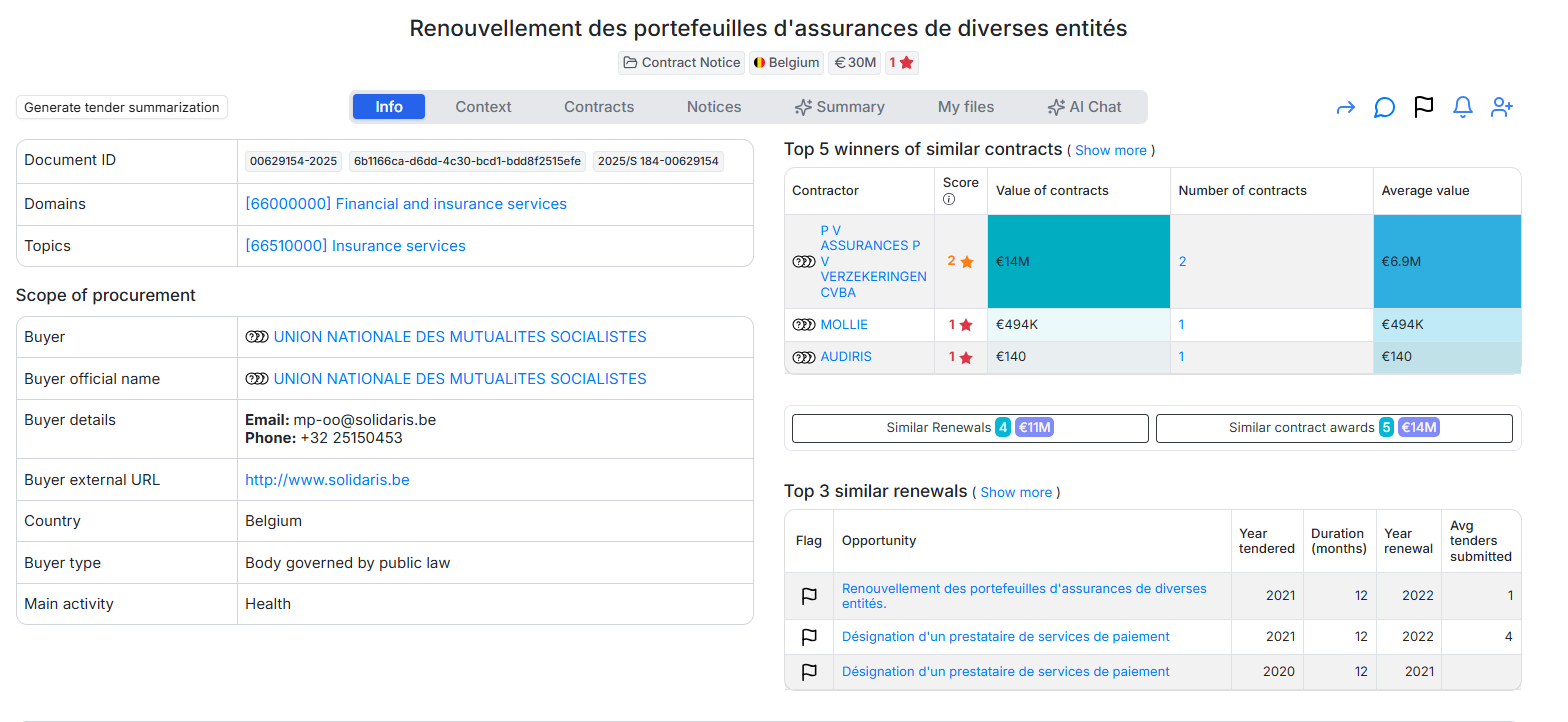
  • P V ASSURANCES P V VERZEKERINGEN CVBA: €14M across 2 contracts, average €6.9M per contract
  • MOLLIE: €494K for 1 contract
  • AUDIRIS: €140 for 1 contract

Previous winners are predominantly Belgian firms, with one contractor from the Netherlands (MOLLIE at €494K).

Total procurement activity:

  • 171 contract awards worth €244M total
  • 5 similar contract awards worth €14M
  • 4 similar renewals worth €11M
  • 70 total renewals worth €218M

The procurement data shows 392 other buyers with similar insurance projects valued at €599M across Belgium, indicating substantial activity in public sector insurance procurement.

Working Relationship Indicators

The procurement follows a negotiated procedure with prior publication of a call for competition. This approach allows for dialogue and negotiation during the evaluation process.

Evaluation criteria combine price and quality, though specific weightings are not disclosed in the available documentation. Given the healthcare sector context and the need to serve vulnerable populations, quality factors related to claims handling, service responsiveness, and coverage comprehensiveness will be important.

The framework agreement structure means individual insurance policies will be concluded separately for each participating legal entity as needs arise. The buyer emphasizes that precise contact and billing details will be provided at the time each specific policy is established.

Language requirements accommodate Belgium’s linguistic diversity, accepting offers in both French and Flemish.

Scope and Requirements Analysis

Service Categories

The framework agreement establishes the structure for concluding distinct insurance policies in the name of each participating legal entity for specific risk categories. Insurers must provide coverage across all specified insurance types, though individual policies will be issued separately.

Property Damage Insurance Requirements

Fire and Related Perils: Coverage on both named perils and all risks except basis IT Equipment: Comprehensive all risks coverage for information technology assets Valuables: Stay and transport coverage for valuable items Artworks and Exhibitions: All risks coverage for art collections and exhibition materials Wheelchairs: Comprehensive coverage for wheelchair equipment Signage: All risks coverage for organizational signage and displays

Civil Liability and Legal Protection Requirements

General Civil Liability: Coverage excluding hospital and polyclinic activities, including objective fire/explosion liability Hospital and Polyclinic Liability: Specialized coverage for healthcare facility operations, including objective fire/explosion liability Directors’ Liability: Protection for organizational leadership decisions and governance Temporary Activities: Civil liability coverage for organization of temporary events and activities

Combined School and Activity Insurance Requirements

School Insurance: Combined coverage for educational activities Association Coverage: Insurance for associated organizations within the network Volunteer Organizations: Coverage for volunteers working in welfare, public health, and family policy domains Sports Federations: Insurance for affiliated sports organizations

Work Accident and Collective Accident Requirements

Work Accidents: Statutory work accident insurance coverage Private Life Accidents: Coverage for accidents outside work contexts Bodily Injury: Miscellaneous bodily injury accident coverage

Vehicle Insurance Requirements

Vehicle Coverage: Standard vehicle insurance Comprehensive Mission Coverage: Enhanced coverage for vehicles used in organizational missions

Collective Travel Insurance Requirements

Group travel coverage for organizational trips and activities

Technical Requirements

The tender does not specify detailed technical requirements such as coverage limits, deductibles, or specific policy terms. These details are addressed during the negotiation process and individual policy establishment.

The structural complexity of the buyer organization requires insurers to accommodate:

  • Multiple legal entities with distinct coverage needs
  • Territorial distinctions within merged entities (Solidaris Wallonie)
  • Transition planning for policy consolidation from January 1, 2026
  • Flexible policy structures accommodating organizational evolution

Geographic Coverage

Coverage extends across all Belgian provinces where socialist mutuals operate. The exact number and locations of facilities, offices, and operational sites are detailed in the competition documentation.

The buyer organization operates throughout Belgium, serving both francophone and Dutch-speaking regions, reflected in the dual-language tender requirements.

Market Opportunity Assessment

Target Businesses

This procurement targets:

Multi-line Insurance Providers: Firms capable of offering the full range of property, liability, accident, vehicle, and travel insurance products

Public Sector Insurance Experience: Understanding of public law body requirements and health sector operations

Belgian Market Knowledge: Familiarity with Belgian insurance regulations, mutual insurance sector, and healthcare system context

Scale Capability: Capacity to handle €30 million in annual premiums across multiple entities and coverage types

Bilingual Service: Ability to operate in both French and Flemish to serve all network entities

Claims Management: Robust claims handling systems for healthcare organizations with diverse risk profiles

Multi-site Coverage: Experience providing insurance across multiple locations and organizational structures

The comprehensive scope favors established insurance companies or consortiums with broad product portfolios rather than specialist providers focused on single insurance lines.

Competition Analysis

The market data reveals:

  • P V ASSURANCES P V VERZEKERINGEN CVBA dominates historical awards with €14M across 2 contracts
  • 392 buyers with similar insurance projects worth €599M across Belgium
  • 5 similar historical contract awards from this buyer worth €14M
  • 4 similar renewal opportunities worth €11M

The buyer has 70 total renewal opportunities worth €218M, suggesting regular procurement cycles for various insurance needs. The €30 million value of this single tender represents a significant consolidation of insurance purchasing.

The presence of both Belgian and international providers (Netherlands) in historical awards indicates openness to cross-border suppliers within the EU market.

Barriers to Entry

Belgian Market Presence: Practical need for local operations to serve facilities across all provinces

Multi-line Capability: Single-line specialists cannot meet the comprehensive coverage requirements

Language Capacity: Bilingual service delivery in French and Flemish

Healthcare Sector Knowledge: Understanding of hospital operations, healthcare risks, and public health organization structures

Claims Infrastructure: Robust systems for handling diverse claim types across multiple locations

Regulatory Compliance: Knowledge of Belgian insurance regulations and public procurement rules

Financial Capacity: Sufficient underwriting capacity for €30 million annual premium volume

Strategic Insights

Key Success Factors

Successful bids will demonstrate:

  1. Comprehensive insurance portfolio covering all required lines without gaps or exclusions
  2. Experience with Belgian health sector organizations and mutual insurance companies
  3. Bilingual service capabilities accommodating both francophone and Dutch-speaking entities
  4. Understanding of the Solidaris organizational structure, including the 2022 merger creating Solidaris Wallonie
  5. Flexible policy structures accommodating territorial distinctions within unified legal entities
  6. Transition management capability for the January 2026 policy consolidation
  7. Claims handling expertise across diverse risk categories from property damage to professional liability
  8. Competitive pricing balanced with comprehensive coverage and service quality
  9. References from comparable public health or mutual insurance organizations
  10. Proposal addressing both immediate needs and longer-term organizational evolution

The evaluation criteria combining price and quality suggest that lowest cost alone will not win. Insurers must balance competitive premiums with demonstrated service capability and coverage comprehensiveness.

Risk Assessment

Potential challenges include:

Organizational Complexity: The buyer structure includes an umbrella organization (Solidaris U.N.M.S.), provincial mutuals, and associated entities beneath each. Insurers must navigate this multi-layered structure and understand which legal entity requires coverage for which risks.

Merger Transition: The 2022 creation of Solidaris Wallonie as a unified legal entity with distinct territorial units creates policy structuring complexity. Insurers must accommodate current territorial distinctions while preparing for potential full consolidation from January 2026.

Healthcare Risk Profile: Hospital and polyclinic activities present higher liability risks requiring specialized underwriting expertise. Mixing these higher-risk activities with standard organizational insurance complicates risk assessment and pricing.

Geographic Scope: Providing consistent service across all Belgian provinces requires substantial local presence or network partnerships.

Multi-line Coordination: Coordinating multiple insurance types across numerous entities demands sophisticated policy administration and claims systems.

Claims Volume: The large membership base of Belgian socialist mutuals generates substantial claims volume requiring efficient processing capability.

Regulatory Environment: Belgian insurance regulations and public procurement rules create compliance requirements throughout contract execution.

Premium Adequacy: The 12-month contract duration with €30 million value suggests high annual premium volume. Insurers must ensure pricing adequacy without long-term rate guarantees.

Regulatory Considerations

All coverage must comply with:

  • Belgian insurance regulations and solvency requirements
  • Public sector procurement rules under Belgian law
  • Healthcare facility insurance standards
  • Work accident insurance statutory requirements
  • Vehicle insurance mandatory coverage laws
  • Data protection regulations for handling member information

Actionable Recommendations

For Potential Bidders

Firms interested in bidding should:

  1. Review the complete tender documentation available through the official sources (TED and BOSA platforms)
  2. Assess internal capability across all required insurance lines, forming partnerships if gaps exist in the product portfolio
  3. Prepare detailed service proposals for each insurance category, emphasizing healthcare sector experience
  4. Document bilingual service capability with evidence of French and Flemish language support
  5. Develop pricing models accommodating both the current territorial structure and potential 2026 consolidation
  6. Gather references from Belgian health sector clients or comparable mutual insurance organizations
  7. Prepare claims handling protocols appropriate for healthcare organizations with multiple sites
  8. Calculate risk-adjusted pricing considering the mix of standard organizational risks and higher-risk hospital activities
  9. Develop policy structures flexible enough to accommodate organizational evolution without requiring complete renegotiation
  10. Contact the buyer (mp-oo@solidaris.be) to clarify questions about entity structures and coverage coordination
  11. Submit offers in the appropriate language (French or Flemish) by October 10, 2025

Bidders should emphasize value beyond price, including service quality, claims expertise, and understanding of the buyer’s unique organizational structure.

For Industry Observers

This tender reveals several significant trends:

Consolidation of Public Sector Insurance Purchasing: The €30 million single framework agreement consolidates multiple insurance lines for an entire organizational network. This trend favors large insurance providers over smaller specialists.

Organizational Evolution Impact: The 2022 merger creating Solidaris Wallonie demonstrates ongoing consolidation in Belgium’s mutual insurance sector. Insurance providers must adapt to evolving organizational structures while maintaining service continuity.

Healthcare Sector Specialization: The separation of hospital/polyclinic liability from general organizational liability recognizes distinct risk profiles requiring specialized underwriting.

Multi-line Bundling: Combining property, liability, accident, vehicle, and travel insurance in a single framework reflects buyer preference for coordinated coverage from fewer providers.

Language Requirements: The bilingual service requirement (French and Flemish) reflects Belgium’s linguistic diversity and limits practical market access to insurers with multilingual capabilities.

Related Opportunities

The tender documentation does not reference any corrigenda or related notices beyond the original contract notice published September 25, 2025.

The buyer’s procurement profile shows:

  • 70 total renewal opportunities worth €218M
  • 4 similar renewal opportunities worth €11M

This suggests regular insurance procurement cycles. Firms should monitor Solidaris procurement notices for related opportunities in specialized insurance lines or geographic subdivisions.

Similar opportunities exist with 392 other buyers in comparable sectors, with total market value of €599M across Belgium. The Belgian public health sector and mutual insurance organizations provide consistent demand for comprehensive insurance coverage.

Insurers should monitor:

  • Solidaris procurement platform for related opportunities
  • Belgian public procurement portals (TED and BOSA) for similar health sector insurance tenders
  • Provincial mutual organizations for local insurance needs
  • Associated entities within the Solidaris network for specialized coverage requirements

Want to see the full documentation and other relevant public tenders, sign-up for free on Hermix, here: https://hermix.com/sign-up/

No credit card required, not questions asked. 

PS: This analysis is based on publicly available tender documentation and data provided by the contracting authority. While we strive to provide accurate information, users are responsible for verifying all details against official tender documents before making any procurement decisions.
Renouvellement des portefeuilles d'assurances de diverses entités - tender opportunity


German Federal Employment Agency Awards €83.7M Architecture Contract for Western Region Properties

The German Federal Employment Agency has issued a major procurement notice for comprehensive architectural and engineering services across its Western Region properties. This 23-month framework agreement represents one of the largest public infrastructure maintenance contracts in Germany’s social protection sector.

Executive Summary

The Bundesagentur für Arbeit, represented by BA Gebäude-, Bau- und Immobilienmanagement GmbH, seeks qualified architecture and engineering firms for building maintenance and small construction projects across its Western Region properties. The contract spans €83,679,514.34 over 23 months, divided into seven geographic lots. With a submission deadline of October 2, 2025, this tender targets firms experienced in public sector construction regulations and capable of managing projects from small maintenance interventions up to €6 million. The buyer explicitly permits awarding up to two firms per lot to maintain flexibility and accelerate project delivery. Architecture and engineering firms with proven track records in public building standards should prioritize this opportunity.

Create your free account and start winning public contracts, easier.

Tender Overview

Basic Information

Document ID: 00553323-2025 Reference Number: 173687 Publication Date: August 25, 2025 Deadline: October 2, 2025 Status: Closed Source: TED (Tenders Electronic Daily)

Financial Summary

Total Estimated Value: €83,679,514.34 Contract Duration: 23 months EU Funding: No

The contract divides into seven lots with values ranging from €4,971,312.62 to €18,455,911.19. Each lot covers specific geographic territories within the Western Region of Germany.

Budget Breakdown

Lot 1: €18,201,013.42 Lot 2: €18,455,911.19 Lot 3: €4,971,312.62 Lot 4: €7,500,789.77 Lot 5: €11,997,286.87 Lot 6: €11,945,304.31 Lot 7: €10,607,896.16

The tender document indicates that approximately 60% of individual measures fall below €150,000, with cost group 300 (construction work) representing about 60% and cost group 400 (technical building equipment) representing about 40% of project scope.

Buyer Profile Analysis

Organization Overview

Official Name: BUNDESAGENTUR FÜR ARBEIT VERTRETEN DURCH BA GEBÄUDE BAU UND IMMOBILIENMANAGEMENT Contact: BA-Gebäude-, Bau- und Immobilienmanagement GmbH Address: Lina-Ammon-Strasse 9, 90471 Nürnberg, Germany Email: h.helmolt@bi-mangement.de Phone: +49 911-98872941 External URL: http://evergabe-online.de

Buyer Type: Body governed by public law Main Activity: Social protection Country: Germany

Organizational Background

The Bundesagentur für Arbeit (Federal Employment Agency) operates as Germany’s primary public employment service organization. The agency manages employment offices and job centers across the country, requiring extensive real estate infrastructure. BA-Gebäude-, Bau- und Immobilienmanagement GmbH serves as the dedicated building and property management subsidiary, handling all construction, maintenance, and facility management operations for the agency’s nationwide property portfolio.

Procurement History

According to the tender documentation, the buyer has awarded similar contracts to multiple firms:

Previous Contract Winners:

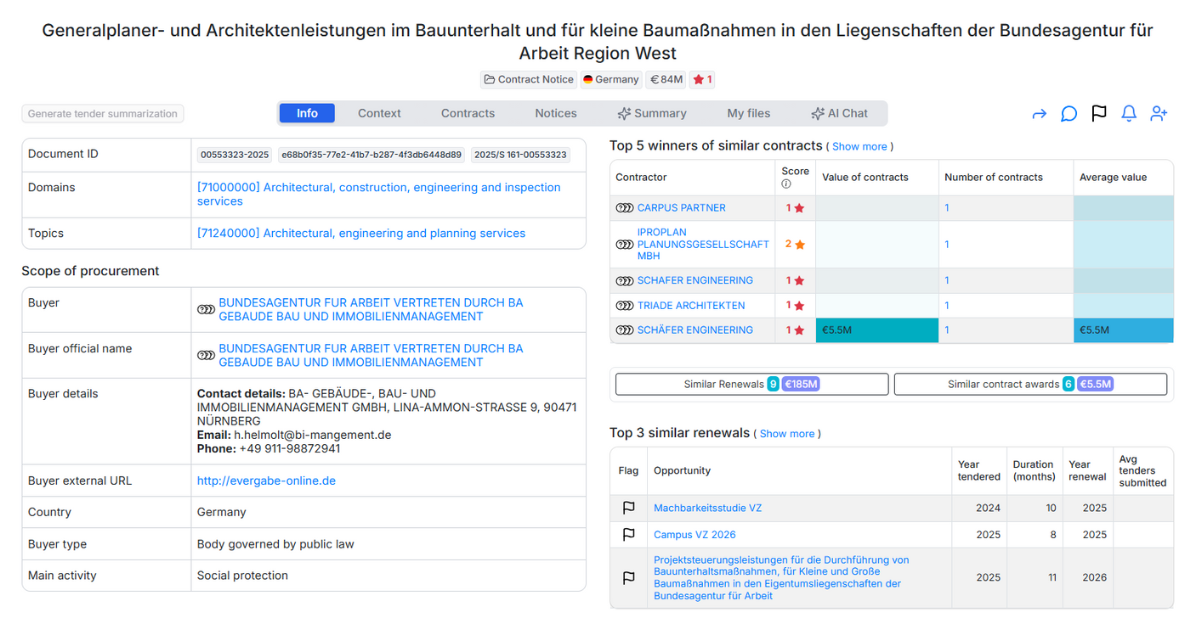
  • CARPUS PARTNER: 1 contract (value not disclosed)
  • IPROPLAN PLANUNGSGESELLSCHAFT MBH: 1 contract (value not disclosed)
  • SCHÄFER ENGINEERING: 1 contract valued at €5.5M
  • TRIADE ARCHITEKTEN: 1 contract (value not disclosed)

The tender data shows 77 total contract awards worth €12M, with 6 similar contract awards totaling €5.5M. The buyer’s procurement platform indicates 3 similar open tenders worth €87M and 9 similar renewals valued at €185M, demonstrating consistent demand for architectural and engineering services.

Working Relationship Indicators

The tender explicitly states that contractors have no claim to exclusive assignment or guaranteed revenue volumes within their assigned lots. The buyer reserves the right to award up to two architecture or engineering firms per lot to increase flexibility and accelerate project implementation.
Project management and client representation occurs through BA-Gebäude-, Bau- und Immobilienmanagement GmbH. Local contacts for site access and building clearance issues come from RIM (Regional Infrastructure Management), an organizational unit of the Federal Employment Agency.
The procurement procedure follows a negotiated procedure with prior publication, allowing for competitive dialogue before final award. Evaluation criteria combine quality and price, though specific weightings are not disclosed in the available documentation.

Scope and Requirements Analysis

Service Categories

The tender covers services according to HOAI (German Fee Structure for Architects and Engineers):

Part 3, Section 1: Primarily phases 1-3 and 5-9 (planning and construction supervision) Part 4, Section 2: Technical building services (TGA)

Projects fall into two categories:

  1. Building maintenance (BUN)
  2. Small new construction, conversion, and expansion projects (KLB)

Contractors must also provide special services on request, including:

  • Existing condition surveys
  • Technical substance investigation
  • Structural engineering
  • Fire protection planning
  • Building physics analysis

Technical Requirements

The tender specifies that individual measures typically fall below €150,000 (approximately 60% of projects). Small construction projects extend up to €6 million, while building maintenance projects exceed this threshold when necessary.

Cost distribution follows DIN 276 standards:

  • Cost Group 300 (construction work): approximately 60%
  • Cost Group 400 (technical building equipment): approximately 40%

The buyer cannot provide exact volumes because annual requirements are determined yearly, and unforeseen emergency repairs and disruptions add to the baseline workload.

Geographic Coverage

All seven lots cover properties within the Western Region of Germany. The tender document references accompanying lot maps (Loskarte) for precise geographic boundaries, though these maps are not included in the procurement notice itself.

Project locations consist primarily of properties owned by the Federal Employment Agency, though the tender acknowledges that some projects occur on leased or third-party properties when necessary.

Market Opportunity Assessment

Target Businesses

The buyer explicitly seeks architecture or engineering firms meeting these criteria:

Professional qualifications: Registered architects or engineers authorized to practice in Germany Regulatory knowledge: Familiarity with public building regulations and standards Project scale capacity: Ability to handle small projects (building maintenance) and larger projects up to €6 million Quality standards: Proven ability to meet agreed quality, cost, and schedule requirements Public sector experience: Understanding of public procurement processes and compliance requirements

The tender language emphasizes reliability in project execution and supervision capability across multiple concurrent small-scale interventions.

Competition Analysis

The procurement data reveals 14,000 other buyers with similar projects valued at €11 billion, indicating substantial market activity in public building services across Germany.

For this specific tender:

  • 3 similar open tenders worth €87M
  • 6 similar contract awards worth €5.5M
  • 9 similar renewals worth €185M

The buyer’s decision to potentially award two firms per lot suggests anticipation of strong competition and desire for backup capacity. This approach reduces individual firm market share per lot but increases overall award probability for qualified bidders.

Barriers to Entry

Language requirements: All offers must be submitted in German Regulatory knowledge: Deep familiarity with HOAI fee structures and public building regulations Local presence: Practical need for firms to respond quickly to site issues and maintain regular contact with RIM staff Scale flexibility: Firms must handle numerous small interventions efficiently while maintaining capacity for occasional larger projects

Strategic Insights

Key Success Factors

Winning bids require demonstration of:

  1. Public sector construction expertise, particularly familiarity with Federal Employment Agency building standards
  2. Capacity to manage fragmented workloads with multiple small simultaneous projects
  3. Flexible staffing to handle unpredictable emergency repairs alongside planned maintenance
  4. Geographic proximity or established presence in the Western Region for rapid response
  5. Experience with HOAI phases 1-3 and 5-9, with technical building services capability
  6. Quality control systems for maintaining standards across numerous small interventions

The evaluation criteria combine quality and price, though the tender does not specify exact weightings. Given the emphasis on reliability, schedule adherence, and quality standards in the requirement description, bidders should expect quality factors to carry substantial weight.

Risk Assessment

Potential challenges include:

Unpredictable workload: The tender explicitly states that annual requirements vary and emergency repairs occur without warning. Firms must maintain capacity for surge demand while accepting variable utilization.

No revenue guarantees: The buyer offers no minimum workload commitments. Contract award provides opportunity but not guaranteed income.

Multiple small projects: Managing numerous interventions below €150,000 requires efficient project administration systems. Overhead costs for small projects can erode profitability without proper systems.

Shared lot awards: Up to two firms per lot means splitting available work and competing with another contractor who knows the buyer’s preferences equally well.

Framework contract structure: Services are called off as needed rather than assigned upfront, creating planning uncertainty for contractors.

Regulatory Considerations

Actionable Recommendations

For Potential Bidders

Firms interested in bidding should:

  1. Review lot geographic boundaries in the referenced Loskarte maps to identify optimal lots based on existing regional presence
  2. Assess internal capacity to handle 60% of workload in sub-€150,000 increments efficiently
  3. Prepare evidence of previous public sector building maintenance contracts, emphasizing reliability metrics
  4. Document familiarity with HOAI phases and Federal Employment Agency building standards if available
  5. Build partnerships with specialized fire protection, building physics, and structural engineering consultants if these capabilities are not in-house
  6. Calculate overhead costs for managing numerous small projects to ensure bid pricing maintains profitability
  7. Contact the buyer (h.helmolt@bi-mangement.de, +49 911-98872941) to clarify evaluation criteria weightings
  8. Prepare quality management documentation showing systems for maintaining standards across fragmented project portfolios

Note: This tender has closed as of October 2, 2025. Interested firms should monitor the buyer’s procurement platform (http://evergabe-online.de) for contract award announcements and future opportunities.

For Industry Observers

This tender reveals several significant trends:

German public infrastructure maintenance continues shifting toward framework contracts with multiple potential suppliers per lot. This approach prioritizes buyer flexibility over contractor exclusivity.

The scale distribution (60% of projects under €150,000) indicates preference for engaging established architectural firms for routine maintenance rather than managing small contractors directly. This creates opportunities for mid-sized firms with efficient project management systems.

The buyer’s explicit reservation of rights to award up to two firms per lot signals concerns about capacity constraints in the regional market. This procurement strategy may become more common as public building maintenance backlogs grow.

Create your free account and start winning public contracts, easier.

Related Opportunities

The tender documentation references a corrigendum published September 11, 2025 (Document 00592408-2025), indicating amendments to the original procurement notice. Interested parties should review both documents for complete requirements.

The buyer’s procurement profile shows 37 total contract renewals worth €308M, suggesting consistent long-term demand beyond this specific tender. Firms establishing relationships through smaller initial contracts position themselves for future opportunities.

Similar opportunities exist with 14,000 other buyers in comparable sectors, with total market value of €11 billion in Germany. The Federal Employment Agency’s approach to bundling maintenance into geographic framework contracts may provide a model for other public sector organizations.

Want to see the full documentation and other relevant public tenders, sign-up for free on Hermix, here: https://hermix.com/sign-up/

No credit card required, not questions asked. 

PS: This analysis is based on publicly available tender documentation and data provided by the contracting authority. While we strive to provide accurate information, users are responsible for verifying all details against official tender documents before making any procurement decisions.
Generalplaner- und Architektenleistungen im Bauunterhalt und für kleine Baumaßnahmen in den Liegenschaften der Bundesagentur für Arbeit Region West - tender opportunity


3 years of Hermix, building the future of Public Sector sales with AI

Three years ago, we started a bold journey: to help companies win public contracts through AI-driven tender monitoring, analysis, and real-time market intelligence.

From idea to impact

Hermix was created by IT people with 60+ years’ of total experience in IT and public procurement. We know the market, and we understand its needs.

The Business-to-government (B2G) sector is great, and it worked very well for us: stable market, lots of money, and lots of information, if you know where to look and how to read.

Create your free account and start winning public contracts, easier.

3 years changed Hermix a lot, and this is what we, the people behind this platform, feel about it:

We are deeply grateful to our clients and users

Our newest clients are Kyndryl, Serco, NRB (Trasys), Deep – Post Telecom, QUALCO, Fujitsu, SopraSteria, Unisys, Intrasoft, Cancom, and Nova ICT. See all clients

We are proud to be part of Microsoft for Startups, Amazon AWS Activate, the NVIDIA Inception program, and Eureka Eurostars, and to partner with prestigious institutions such as the University of Luxembourg, the University of Bucharest, and KU Leuven. Through these collaborations, we achieved a significant milestone: winning a €920K grant from Eureka Eurostars in partnership with the University of Luxembourg.

Our client’s success is our success

  • Our clients Capgemini and Unisystems won a €6.6 million contract for IT Operations, Engineering, and Evolution services.
  • Hermix’s clients, ARHS, Aricoma (Qinshift), Fincons, Thaleria, Unisys, Westpole, and VASS are among the companies awarded the contract for “Provision of external service providers for DG TAXUD.”
  • Eight of the companies awarded the contract for “IT services: consulting, software development, Internet, and support European Parliament”,  Aricoma, Cleverlance Autocont, Engineering Group, Fincons, Qualco, Seidor, and Trasys – Network Research Belgium, are Hermix’s clients.

These used Hermix to help them find and win this public tender. With Hermix’s AI-powered tools, they could track opportunities, understand the market, and make better decisions in real time. This helped them stand out and succeed in a competitive process.

Clients love is everything 

“Hermix makes our work easier, especially when analyzing past years of public data across clients, providers, or subjects. It’s clear, visual, and gives us a strong starting point for AI-driven analysis and tender preparation,”  said Arian Turhani, Vice President and Client partner for European Institutions at Capgemini

”An amazing, powerful platform that stands as a solid improvement over all other tools for public sector work,” said Erik Francq, Account Director European Institutions at Fujitsu

Every feature & improvement changes everything

Over the past three years, we’ve launched powerful features such as AI Tender summarization, AI Chat, AI-powered Q&A classification, and added new data sources for improved efficiency and deeper market insights.

  • AI Tender Summarization: Summarize thousands of public tender documents with AI. You can summarize tender documents from multiple countries, including Belgium, Norway, Romania, and the Netherlands, e-licitatie, EU Funding portal with just one click.
  • AI Chat: Customize your questions and obtain personal insights from a specific tender opportunity in just a few seconds. It helps you navigate complex documents effortlessly. It supplements the AI tender summarization.
  • AI-powered Q&A classification: AI organizes and classifies Q&As to make key questions and answers easier to find and read. You can export the results as PDF, Excel, or HTML files.
  • We added new data sources. We now monitor tenders and clean-up data from TED (EU-wide tenders, European and international institutions), e-tendering, the EU funding portal, various European institutions websites, NATO, Eurostat, ECB, as well as national portals from Belgium, the Netherlands, Norway, Romania, Germany, UK, NATO, Spain, France, and more. See all features

Competition fuels our growth

We received international recognition. We won 1st place at the EU Datathon 2022 competition, which took place in Brussels in October 2022. 

We are also happy that our work was awarded three times in a row by Deloitte & Google: Deloitte’s Impact Star award in November 2022 & Deloitte’s CE Tech Rocketship in November 2023 and 2024.

Collaboration is key

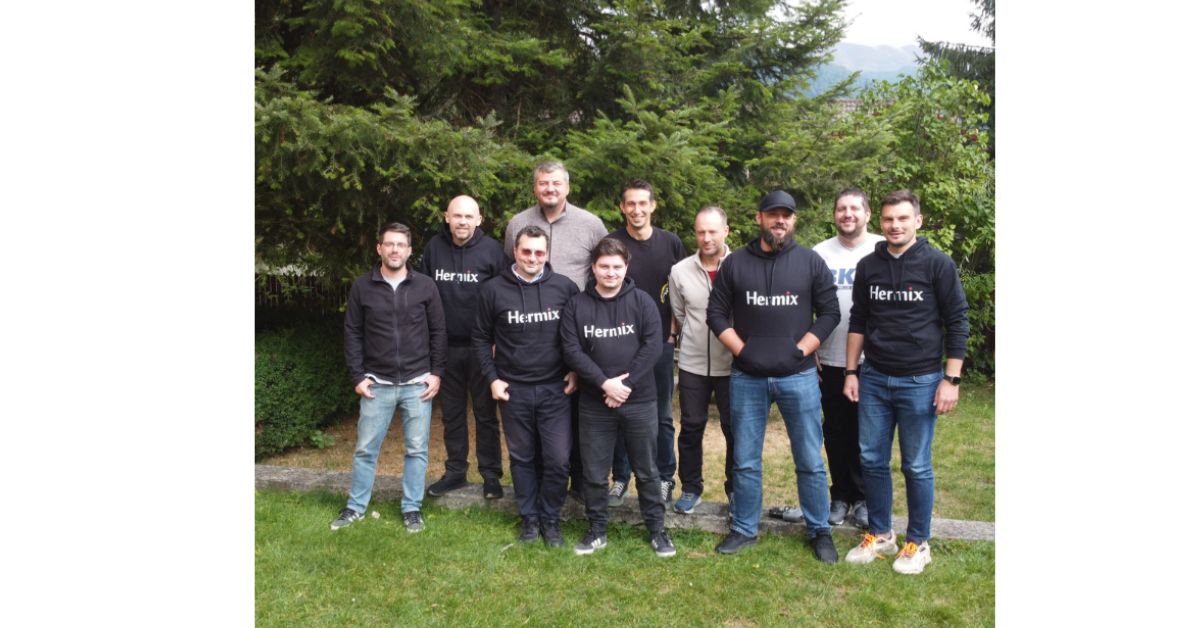
Year after year, we value our team and meetings more and more, as they help us better understand each other’s perspectives and contribute together to Hermix’s innovation.

To many more years of Hermix!

Sign up now  to Test Hermix for free: https://hermix.com/sign-up/

Hermix teambuilding 2025

Create your free account and start winning public contracts, easier.


Growth Operations Manager

Hermix is a SaaS platform that helps companies win public contracts, with tender monitoring, automation, and market intelligence based on AI.

Join us and become a unicorn with Hermix, where we use AI magic to revolutionize public sector sales.

Send us a CV and a short cover letter with your relevant experience and why you are excited about joining us.

Details: https://www.hermix.eu/join-us/

We are:

An international team, tech-savvy, obsessed about IT and innovation.

We use the latest technologies to:

  • Crunch tens of millions of data points.
  • Clean-up and understand data, with data engineering, data science, AI/ML.
  • Compute and visualize advanced infographics.
  • Generate tender summaries and proposals with LLM / conversational AI.

Our clients are international companies from Belgium, Netherlands, Luxembourg, Spain, Portugal, Italy, Greece, France, UK, Germany, etc.

We are looking for a Growth Operations Manager to support us with:

  • Organize and manage marketing & sales campaigns (B2B), using tools such as LinkedIn and Hubspot.
  • Identify, qualify and manage leads.
  • Organize participation in international events and tradeshows.
  • Manage partnerships and affiliations.
  • Track sales and marketing campaigns in CRM.
  • Collaborate with our tech and sales teams to innovate and drive exponential growth.

Requirements:

  • BA in business, marketing, IT, or a related field.
  • Based in Europe.
  • Attention to detail.
  • Excellent communication skills.
  • Perfect English.
  • Able to think strategically about complex issues, implement action plans and campaigns.
  • Excellent computer skills. Passion for technology and innovation. Good understanding of new tech: digital, AI, LLM, CRM, automation.
  • Highly motivated, with a proactive and positive attitude.
  • Open to learn and adapt to a fast-paced innovative work environment.

We offer:

  • Great learning and collaboration environment.
  • Incredible opportunities: become a unicorn with us.
  • Work with the newest methods and automation tools: Hubspot, Google Analytics, Tags, WordPress, Apollo, Linkedin, Clearbit, AI.
  • Work from anywhere.

We are an equal-opportunity employer.

Details: https://www.hermix.eu/join-us/

Please send us your CV and a cover letter.

Create your free account and start winning public contracts, easier.


AI for Public Sector Sales Automation and Analytics: Insights from Industry Experts

AI for public sector sales automation and analytics - insight

The integration of artificial intelligence (AI) and advanced data analytics into public sector sales and procurement is reshaping how companies interact with complex tendering processes. This transformation is not just about automation but about leveraging smart technology to gain competitive advantages in a market traditionally marked by intricate regulations, voluminous documentation, and high-stakes decision-making. 

Beyond automation and efficiency, a growing debate is emerging: Is generative AI the beginning of the end or the dawn of a new era in the way we work? While some envision a utopia of effortless productivity, others fear a dystopian world where AI replaces human judgment. For public sector professionals, the truth likely lies in between navigating risks while embracing extraordinary opportunities.

In this comprehensive article, we take a closer look at a recent live webinar hosted by Hermix, a leader in public sector sales analytics, with Rudolf de Schipper, General Manager at Unisys Belgium, and Stefan Morcov, CEO of Hermix. Together, they discuss how AI-driven tools are revolutionizing tender analysis, bid automation, market intelligence, and proposal writing in public procurement.

Drawing on decades of combined expertise in public procurement, software development, project management, and sales, Stefan and Rudolf provide practical insights into the current capabilities, challenges, and future directions of AI in this specialized field. Whether you are a business leader, a sales professional, or a public procurement specialist, this article will help you understand how to harness AI for smarter decision-making and enhanced efficiency in public sector sales.

Table of Contents

  1. Understanding the Impact of AI in Public Sector Procurement and Sales
  2. Data-Driven Analytics: Big Data and Machine Learning in Tender Analysis
  3. GPT and Large Language Models for Tender Document Analysis and Proposal Writing
  4. Practical Applications and Real-World Examples from Hermix
  5. Challenges and Limitations in AI Adoption
  6. Future Trends and Ethical Considerations in AI for Public Procurement
  7. Frequently Asked Questions
  8. Conclusion

About speakers

Rudolf de Schipper

General Manager at Unisys Belgium has extensive experience managing European and international public sector business.

Stefan Morcov

CEO of Hermix, with over 20 years of experience in complex IT projects for EU institutions across Europe.

Create your free account and start winning public contracts, easier.

Understanding the Impact of AI in Public Sector Procurement and Sales

Artificial intelligence is no longer a futuristic concept limited to research labs or science fiction. It is actively transforming industries worldwide, and public sector procurement is no exception. AI and related technologies are reshaping how companies identify tender opportunities, analyze market data, qualify bids, and even write proposals.

This transformative power of AI can be compared to historic technological shifts such as the replacement of horses by the Ford Model T or the evolution from paper-based communication to instant digital messaging. Just like Excel revolutionized spreadsheets, or the iPhone changed how we work on the go, AI is enhancing how sales teams handle complexity and volume.

While AI is gaining attention, it is still challenging to predict its long-term impact. The technology is evolving fast, and the industry is in a phase of exploration, balancing enthusiasm with caution. The human element continues to play a crucial role, particularly in framing the right questions for AI systems and validating their outputs.

The Dual Role of AI: Automation and Augmentation

A key theme is the dual role of AI in public sector sales: automating repetitive tasks and enhancing human decision-making. AI can automate tender monitoring, data cleanup, and initial qualification, saving valuable time for sales teams to focus on strategy and relationship-building. At the same time, AI augments human capabilities by providing deep insights into market trends, competitor behavior, and partner networks.

Public sector sales involve answering two fundamental questions:

  • Do I want to pursue this tender? (Qualification)
  • How should I approach this tender? (Strategy and execution)

AI tools assist in answering these questions by analyzing vast datasets, summarizing complex tender documents, and providing competitive intelligence. This blend of automation and augmentation is critical to navigating the complexity and volume of public procurement opportunities.

Utopias, Dystopias, and Practical Realities

While the benefits of AI are clear, so are the concerns. Two opposing narratives dominate public discussion: the utopian view of AI as a liberator from boring work, and the dystopian fear of AI as a savior or destroyer, like Messiah vs Skynet; Terminator or Matrix. Technologically plausible? Yes. Desirable or fair? Not necessarily. This underlines the importance of human oversight and ethical frameworks.

Imagine a world where:

  • Authorities write RFPs with AI
  • Companies write proposals with AI
  • Evaluations are done by AI
  • Winners are picked based on price alone

In public procurement, the practical reality is somewhere in the middle. AI helps us do a significantly smarter work, more efficiently, and increase our win-rate.

Data-Driven Analytics: Big Data and Machine Learning in Tender Analysis

At the core of the AI revolution in public sector sales is the use of big data and machine learning to analyze procurement markets. With Hermix providing access to a clean dataset of over eight million public contracts across Europe, along with detailed company profiles and authority records, it becomes possible to perform advanced analyses that were once either impossible or far too time-consuming.

Key Data Analytics Capabilities

Some of the core data-driven analytics capabilities include:

  • Smart Tender Matching: Identifying tenders that closely align with a company’s capabilities and strategic goals.
  • Market Intelligence: Assessing the size, value, and trends within specific markets or sectors, such as IT contracts in Luxembourg.
  • Competition Analysis: Profiling competitors by analyzing their past contract awards, partnership histories, and geographic footprints.
  • Partner Identification: Discovering and evaluating potential consortium partners based on historical collaboration data.
  • Price Analysis: Evaluating pricing trends and benchmarking offers, although limited by confidentiality constraints on financial data.

Graph Analysis and Network Mapping

Graph analysis is an emerging technique used to model relationships between clients, suppliers, and contracts in public procurement. By representing entities as nodes and contracts as links, Hermix is able to detect subgraphs, identify frequent partnerships, and uncover anomalies. This approach provides a visual and quantitative understanding of market ecosystems, helping companies optimize their consortium strategies and competitive positioning.

Although the underlying data is publicly available, the true value lies in how it is cleaned, structured, and analyzed to generate actionable insights. Additionally, a new discipline is gaining importance: prompt engineering. Crafting precise questions for AI systems is becoming a key skill for extracting relevant and meaningful information from complex datasets.

GPT and Large Language Models for Tender Document Analysis and Proposal Writing

One of the most exciting developments in AI for public sector sales is the application of large language models (LLMs) like GPT for analyzing tender documents and assisting with proposal writing. These AI models can process complex, multi-page tender documents to generate concise summaries, answer specific questions, and even produce draft proposal content.

Automated Tender Summarization and Chat

Hermix includes an AI-powered tender summarization feature that extracts key information such as objectives, budget, award criteria, deliverables, and eligibility requirements. This helps sales teams quickly assess whether a tender is worth pursuing, without the need to manually read through hundreds of pages.

Additionally, Hermix offers an AI tender chat function that allows users to ask natural language questions about specific tender requirements. For example, users can inquire about expert qualifications, work package details, or financial thresholds and receive instant, accurate responses. This interactive tool enhances understanding and speeds up decision-making.

Proposal Writing and Bid Automation

AI has the potential to assist in writing proposals by generating coherent and well-structured text. However, AI-generated content should not be blindly trusted. The technology excels at compiling existing knowledge but lacks true creativity and contextual understanding.

AI-generated tender abstracts can be compared to book summaries, helpful for a quick overview, but not sufficient for deep analysis. Final proposal documents still require human review, interpretation, and original input to ensure quality, compliance, and clear differentiation.

Create your free account and start winning public contracts, easier.

Practical Applications and Real-World Examples from Hermix

Before diving into specific use cases, it’s important to understand what Hermix brings to the table.  Built for public sector sales and bid teams, Hermix combines AI and data analytics to simplify the complexities of public procurement. It helps teams track tenders across Europe, analyze markets, understand competitors, and make informed decisions quickly and confidently. 

The platform is already used by leading companies across multiple countries and industries, like Fujitsu, Capgemini, Indra, Atos-Eviden, Publicis-Sapient,  Intellera (formerly PwC, currently Accenture), Unisys, Technopolis, Kyndryl, Mindit, and more, helping them win more by working smarter.

Hermix has clients from Belgium, Luxembourg, Italy, Germany, UK, Spain, Greece, Portugal, France, US, India, Netherlands, Sweden, Romania, Poland, Czechia.

It provides clear examples of how AI and data analytics help public sector sales professionals in their daily work. These include:

Strategic Planning & Market Intelligence

This typically involves defining annual market strategies, building long-term pipelines, and analyzing large datasets of procurement activity. This task is done yearly and updated quarterly, in slides, spreadsheets, and diagramming applications. The market research requires 2-3 weeks of effort per year. The process relies on heavy data processing, analysis, and interpretation, suitable for data engineering and data science tools, especially based on AI/ML.

Tender Monitoring and Qualification

Hermix continuously downloads, indexes, and analyzes tender notices from multiple European portals, including TED (Tenders Electronic Daily), EU funding portals, e-tendering, EC, Eurostat, ECB, national portals: Belgium, Netherlands, Norway, Romania, Spain, France, Luxembourg, Germany, UK (Gov.UK – Contracts finder, Find a tender; Scottish Government; Sell2Wales), and NATO public procurement. Users receive alerts for new tenders that match their criteria and can quickly qualify opportunities based on AI-generated summaries and commercial intelligence.

Market and Competition Analysis

Using cleaned and comprehensive datasets, Hermix visualizes market trends, contract volumes, and values by country and sector. The platform also profiles competitors, showing their contract histories, geographic presence, and partnership networks. This enables users to identify “blue ocean” opportunities with high budgets and low competition.

Commercial qualification of tenders

This is performed daily and leads to a bid or no-bid decision. The process usually takes about 30 minutes but involves 4-5 days of manual effort per tender. It relies on analyzing large amounts of historical data, as well as client and company profiles. Smart tools are needed for intelligent technical and commercial analysis. New technologies like AI/ML, graph analysis, and anomaly detection are very useful for handling this kind of data processing.

Consortium and Partnership Insights

Hermix displays detailed partnership histories, allowing companies to evaluate potential consortium members. Users can view the number and value of contracts won together, the nature of collaborations, and graphical representations of partnership networks. This information helps in forming winning consortia tailored to specific tenders.

Price Analysis

Price analysis is based on historical data about budgets, competition, and pricing, along with a 100% financial evaluation using Taxud/Timea. 

Hermix already covers tender commercial context, client and company profiles, and market analysis. It uses analytics, data cleanup, graph analysis, predictive analysis, anomaly detection, machine learning, and GPT. There is a lot of data, and it’s not easy to find. Hermix shows where the money is, who is buying and selling, when, and how.

Technical qualification

It requires reading and understanding hundreds or even thousands of pages of specifications and technical annexes. This process can take anywhere from 30 minutes to 3 or 4 days per tender. However, the task can be significantly simplified with AI, especially with tools like LLMs and GPT.

Proposal automation and generation

This is a heavy task that involves preparing hundreds or even thousands of forms, such as CVs and references, along with detailed technical proposals, budgets, and project plans. For each tender, this effort can add up to hundreds or thousands of workdays. AI tools like GPT are extremely useful for automating forms, checking style, spelling, and formatting, and generating summaries, images, and diagrams such as Gantt charts, organizational charts, company profiles, and expert lists. 

However, current GPT tools do not generate original ideas and may miss contextual information, so human supervision remains critical. Hermix already provides tender summaries and Tender Chat using LLM/GPT tools. The approach is pragmatic: automate the critical repetitive tasks.

Challenges and Limitations in AI Adoption

AI brings important advantages, but it also comes with clear limitations and challenges, especially for public sector sales professionals:

Lack of Trust and Validation

One of the biggest barriers to AI adoption is skepticism about the accuracy and reliability of AI outputs.  For example, GitHub Copilot generated incorrect code 40% of the time, highlighting the need for human validation. In public procurement, where errors can jeopardize multi-million-euro contracts, trust in AI is paramount.

Contextual Understanding and Creativity

AI struggles with complex contextual nuances that are often critical in tender analysis and proposal writing. While AI can summarize requirements, understanding broader strategic implications or crafting innovative solutions remains a human domain. AI is a tool to assist, not replace, human creativity and judgment.

Data Confidentiality and Completeness

Public procurement data is extensive but incomplete, especially regarding unsuccessful bids and financial proposals. This limits AI’s ability to provide a full picture, particularly in price analysis and competitive intelligence.

Fragmented AI Ecosystem

AI landscape consists of multiple specialized tools rather than a single comprehensive solution. Organizations must integrate various AI applications, such as summarization, chatbots, and data analytics, to create effective workflows. This piecemeal approach requires careful orchestration and expertise.

Ethical and Regulatory Considerations

The webinar briefly touches on concerns about whether AI-generated proposals are acceptable within public procurement rules. While no widespread bans exist, the lack of clear policies creates uncertainty. Organizations must navigate evolving regulations and societal expectations regarding AI use.

Future Trends and Ethical Considerations in AI for Public Procurement

AI is expected to further transform public sector sales and procurement by enabling smarter automation, deeper insights, and more strategic, data-driven decision-making.

AI-Generated RFPs and Bid Evaluations

AI not only assists in responding to requests for proposals (RFPs) but also creates them. This could build a circular ecosystem where AI tools generate RFPs, bids, and evaluations. While intriguing, this raises questions about fairness, transparency, and the human role in procurement processes.

Price-Only Evaluations and Market Impacts

There is a growing trend toward price-only tender evaluations for standard goods and services. While efficient, this approach risks undermining quality and innovation, particularly for complex or creative projects. AI might exacerbate this by standardizing proposals, making differentiation more challenging.

Human-AI Collaboration and the Role of Creativity

Human skills like human creativity, strategic thinking, and domain expertise remain irreplaceable. AI should be seen as an enabler that automates routine tasks and enhances decision-making, but does not supplant the unique contributions of skilled professionals.

Industry Adoption and Societal Acceptance

Public sector organizations vary in their readiness to embrace AI. Early adopters like the Publications Office of the European Union are integrating AI to improve service efficiency. Wider acceptance will depend on demonstrating trust, transparency, and tangible benefits.

Frequently Asked Questions

Is AI currently allowed in public sector proposal writing?

There is no general prohibition against using AI in proposal writing for public tenders. However, organizations should be mindful of transparency and ensure that AI-generated content is reviewed and validated by humans.

Can AI analyze all tender documents, including confidential ones?

Most AI tools currently focus on publicly published tenders. Confidential documents, such as second-stage procedures or internal requests, require different handling and are often not accessible for AI analysis.

How accurate are AI-generated tender summaries?

AI tender summarization tools like those used by Hermix achieve high accuracy rates (around 98-99%) for extracting key information. Nonetheless, final decisions should always involve human verification.

Can AI help with pricing strategies in tenders?

AI can provide price trend analysis based on available data, but it is limited by the confidentiality of financial proposals. Pricing decisions should consider market intelligence alongside human judgment.

What is prompt engineering, and why is it important?

Prompt engineering involves crafting precise and effective questions or commands to AI systems to get accurate and useful responses. It is an emerging skill critical to maximizing AI’s value in public sector sales.

Are there risks of AI replacing jobs in the public sector sales?

AI automates routine tasks but is unlikely to replace roles that require creativity, strategic thinking, and human judgment. Instead, it enables professionals to focus on higher-value activities.

What if everyone starts using AI? Won’t all proposals look the same?

That’s a valid concern. Generic tools may produce similar outputs. The difference lies in how tools are used and how human experts personalize and strategize on top of AI-generated content.

What about AI hallucinations? Can we trust the outputs?

Hermix has performed extensive testing and validation. In our experience, hallucinations are nearly non-existent, with accuracy rates of 95–98%. Still, we always recommend a human-in-the-loop approach.

How do you differentiate from general tools like ChatGPT?

Hermix combines cutting-edge AI with domain specific expertise in public procurement. While general purpose tools lack business context, Hermix is built specifically for sales and bid professionals.

Conclusion

The integration of artificial intelligence into public sector sales and procurement represents a profound shift in how companies approach tendering and contract management. As demonstrated by the insightful discussion between Stefan Morcov and Rudolf de Schipper, AI-powered tools are already enabling faster, smarter, and more strategic decision-making. From big data analytics and graph-based market intelligence to GPT-driven document summarization and bid assistance, the capabilities are advancing fast.

While AI is powerful, it is not a silver bullet. Winning public tenders still requires strategic planning, creativity, and deep understanding of both the client and the market. AI can generate a good proposal, but not a winning one,  that remains a human achievement.

At Hermix, we take a pragmatic approach: combining advanced AI and LLM tools with deep public sector sales experience. Our goal is not to replace professionals, but to help them work faster, better, and smarter and ultimately, to help companies win more public contracts.

For those interested in exploring these technologies further, Hermix offers free trial accounts and personalized demonstrations, inviting companies to experience firsthand the power of AI in public procurement analytics and automation.

This article was created following the AI for public sector sales automation and analytics live webinar, hosted by Rudolf de Schipper and Stefan Morcov. 

AI for Public Sector and Sales automation and analytics


Public tenders analysis: French Authorities Open €2.1M Solar Village Project in Réunion

Contract ID: 00476351-2025 reveals some interesting patterns in France’s remote area electrification efforts and local contractor dominance.

The Remote Island Opportunity

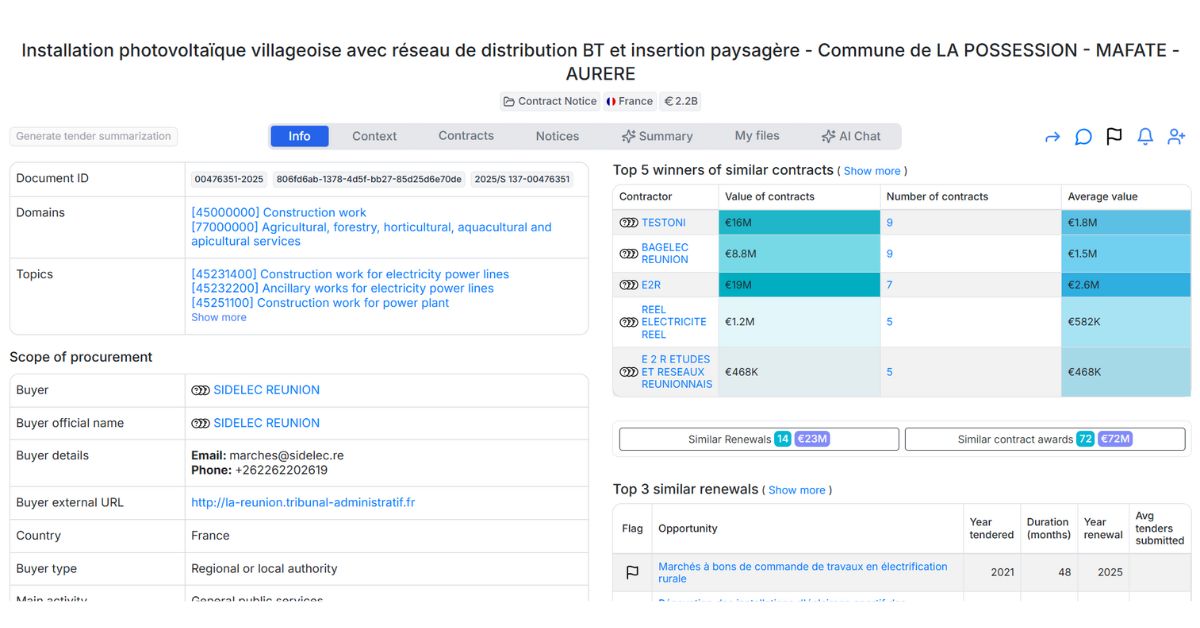
SIDELEC REUNION has issued a tender for a specialized photovoltaic installation in Mafate, one of the most remote areas of La Possession commune in Réunion. The project combines solar power generation with underground distribution networks and landscape integration, valued at €2.15M across four distinct lots.

The contract covers installation of an autonomous photovoltaic system with lithium-iron-phosphate battery storage, buried low-voltage distribution networks along hiking trails, and environmental integration of the solar facility. This reveals France’s commitment to bringing sustainable energy to its most challenging locations.

Authority Profile Shows Consistent Investment

SIDELEC REUNION operates as a regional authority with substantial renewable energy procurement activity. Our analysis shows they have awarded 72 similar contracts worth €72M, with 28 potential renewals valued at €25M in their pipeline.

The authority demonstrates clear preference for multi-lot structures and quality-price evaluation criteria, allowing specialized contractors to bid on specific technical components while maintaining overall project coherence.

Local Expertise Dominates Market

The competitive landscape reveals strong French contractor preference. TESTONI leads with €16M across 9 contracts averaging €1.8M each. BAGELEC REUNION and E2R follow with significant market shares, showing how regional knowledge and established relationships drive success in remote island projects.

All winning contractors are France-based, with a 100% domestic success rate. This pattern mirrors other EU remote territory projects where local expertise in logistics, environmental regulations, and specialized installation techniques provides decisive advantages.

Create your free account and start winning public contracts, easier.

Technical Complexity Drives Premium Pricing

The four-lot structure separates photovoltaic works (€1.18M), technical building construction (€135K), low-voltage network installation (€705K), and landscaping (€126K). This segmentation allows specialized contractors to compete efficiently while maintaining technical integration.

The underground cable installation along hiking trails and battery storage requirements reflect the unique challenges of powering remote island communities without disrupting sensitive environmental areas.

Market Intelligence for Renewable Contractors

For companies targeting French renewable energy public projects, this tender shows several strategic insights. SIDELEC REUNION’s procurement pattern suggests systematic infrastructure upgrades across Réunion’s remote areas, with similar projects likely in their €25M renewal pipeline.

The consistent preference for French contractors, combined with technical complexity requirements, indicates that success requires local partnerships and proven experience with island-specific challenges rather than lowest-cost approaches.

The timing patterns suggest multi-year investment cycles, making this market segment predictable for companies positioned correctly with French operations and renewable energy expertise.

This public tender shows how France approaches sustainable development in its overseas territories through systematic, locally sourced infrastructure improvements that balance technical requirements with environmental protection.

Create your demo account to see all the relevant public tender bids for you, here: https://hermix.com/sign-up/

Installation photovoltaïque villageoise avec réseau de distribution BT et insertion paysagère - Commune de LA POSSESSION - MAFATE - AURERE - tender opportunity


Public tenders analysis:Italy’s CONSIP Opens €6.5B Food Service Dynamic Purchasing System

The country’s central procurement body establishes one of its largest frameworks for public sector catering and food supplies, showing strategic insights for food service contractors.

Understanding Dynamic Purchasing Systems in Italy

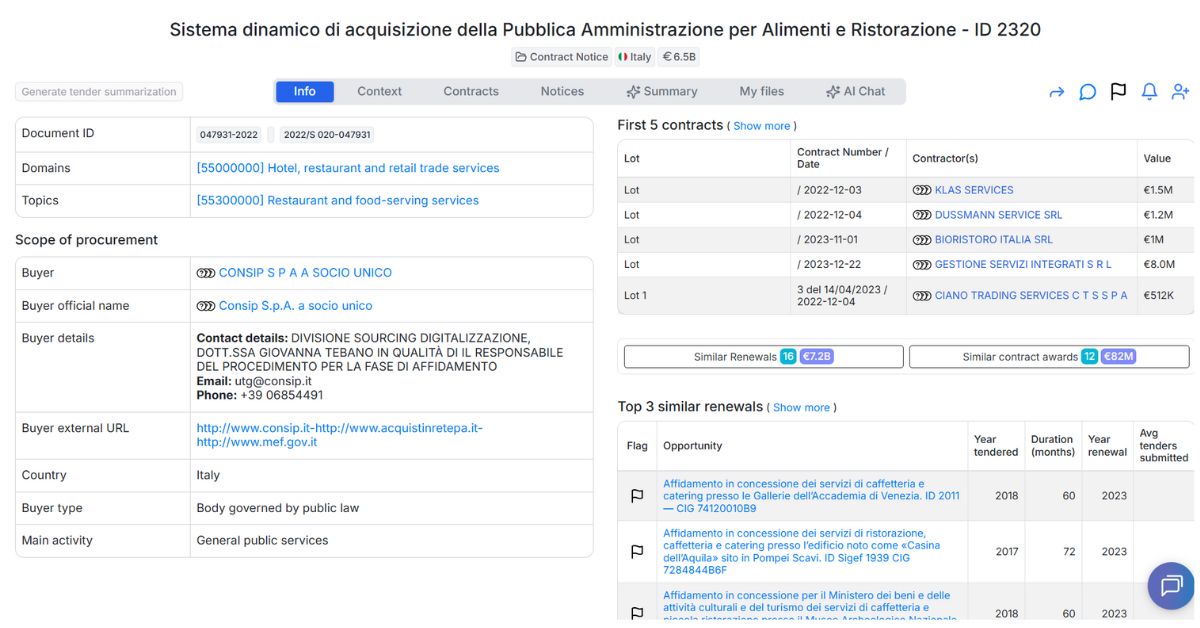
CONSIP S.p.A., Italy’s central purchasing body established in 1997 and owned by the Ministry of Economy and Finance, has launched its most ambitious food service procurement initiative. The Sistema dinamico di acquisizione (Dynamic Purchasing System) for food and catering services represents a €6.5B framework designed to modernize how Italian public administrations procure food services.

This system operates as a two-phase electronic process, staying open for the entire validity period to any economic operator meeting the selection criteria. Unlike traditional tenders, qualified suppliers can join at any time during the 48-month duration, making it more accessible for food service companies.

Authority Profile Shows Procurement Leadership

CONSIP operates as Italy’s sole national central purchasing body among approximately 35,000 contracting authorities. With 433 employees and ISO 9001:2008 certification, CONSIP manages procurement for all central government bodies through its “in-house” model.

Their procurement data reveals substantial food service activity, with 3,700 contract awards totaling €111B across all categories, and 453 potential renewals worth €184B in their pipeline. For food-specific procurement, CONSIP shows 12 similar contract awards worth €82M, indicating consistent investment in public sector nutrition services.

Create your free account and start winning public contracts, easier.

Limited Competition Creates Clear Winners

The tender results show concerning competitive patterns. Most lots received only single bids, with some receiving no bids at all. Of 30 lots, 12 were not awarded, while successful lots averaged just 1.4 tenders per competition.

RICCI S.R.L. FORNITURE ALIMENTARI emerged as the dominant player, winning multiple lots totaling over €6M across different product categories. FRIGOFRUTTA S.R.L. secured significant contracts worth €4.2M, while smaller regional players like PETRAZZUOLO ALFONSO GENNARO formed consortia to compete.

The low competition levels suggest high barriers to entry, potentially related to the complex qualification requirements for supplying diverse public sector entities across Italy’s entire national territory.

Geographic Coverage Drives Market Segmentation

The system covers “l’intero territorio nazionale” (entire national territory), with specific administrations and locations detailed in individual procurement calls. This nationwide scope requires suppliers to demonstrate logistical capabilities across Italy’s varied geography, from Alpine regions to southern islands.

The most economically advantageous tender criterion suggests price remains the primary evaluation factor, but the geographic coverage requirements and quality standards create natural barriers favoring established national distributors.

Strategic Implications for Food Service Contractors

For companies targeting Italian public sector food services, this framework reveals several critical success factors. CONSIP’s €184B renewal pipeline indicates sustained procurement activity, with food services representing a stable, recurring market segment.

The 48-month duration and open admission process allows food service companies to qualify at any time, but the limited competition suggests that successful players build sustainable competitive advantages through logistics networks, regulatory compliance, and relationship management.

International food service companies should note the 100% Italian winner rate and consider partnership strategies with established domestic players rather than direct market entry approaches. The system’s complexity favors suppliers with deep understanding of Italian public sector requirements and proven capabilities across diverse institutional settings.

This procurement framework demonstrates Italy’s approach to centralizing public sector purchasing while maintaining competitive access for qualified suppliers, though actual competition levels remain surprisingly limited given the market size.

Create your demo account to see all the relevant public tender bids for you, here: https://hermix.com/sign-up/

Sistema dinamico di acquisizione della Pubblica Amministrazione per Alimenti e Ristorazione - tender opportunity


How to win public sector contracts using Hermix

How-to-win-public-sector-contracts-using-Hermix - Insight

Winning public sector contracts can be a game-changer for companies looking to expand their business, especially in Europe’s vast and growing public sector market. However, navigating this complex market requires more than just submitting a bid, it demands a strategic approach, building a brand, understanding the market, deep market insight, and the intelligent use of data and technology. In this comprehensive guide, we explore the unique characteristics of public tenders, best practices for success, and how artificial intelligence (AI) is revolutionizing the way companies monitor, qualify, and win these contracts. 

This article draws on insights from Stefan Morcov, an experienced software engineer, public sector expert, and founder of Hermix, a pioneering data-driven platform designed to help companies win public sector contracts. With decades of experience in complex IT projects and public sector sales, Stefan shares his expertise on market dynamics, strategic tendering, and the transformative impact of AI-enabled tools on public procurement.

Understanding the Public Sector Market

The public sector is unique and distinct from other markets like retail or business-to-business (B2B). Governments continue to invest in essential services and infrastructure regardless of economic downturns. This makes the public sector a stable and recession-resilient market. They also operate with a societal mission that extends beyond pure economic goals. This social dimension shapes the way public tenders are issued, evaluated, and awarded.

The scale and stability of Public Sector spending

One of the most striking features of the public sector market is its sheer size and stability. Public spending covers a wide range of essential infrastructure and services, including airports, hospitals, schools, research institutions, and more. Almost everything that impacts daily life in a community is, in some way, connected to public sector contracts.

Despite occasional economic downturns, public sector budgets tend to grow steadily over time. For example, the European Commission’s budget has expanded from 11 billion euros per year 20 years ago to around 200 billion euros today. Even during crises such as the 2009-2010 financial downturn or the COVID-19 pandemic, public spending often increases as governments inject funds to stabilize and stimulate the economy.

This stability and growth make the public sector an attractive market for companies seeking reliable, long-term contracts. Unlike private sector markets where competition can be fierce and volatile, public tenders often feature fewer competitors, typically two to three bids per project, even for contracts worth hundreds of millions of euros.

The complexity and regulations of Public Tenders

Public tenders operate under strict regulations designed to ensure transparency, fairness, and competition. These rules can create barriers to entry, especially for smaller companies unfamiliar with the tendering process. The effort required to prepare a competitive bid is significant, often involving months of work by large teams and costs that can reach hundreds of thousands of euros. They have to create a consistent strategy, determine a price, identify the partners they need, and write the tender.

In addition to the high stakes, tender documents are frequently complex and voluminous. They include detailed technical specifications, legal requirements, evaluation criteria, and contract conditions. Understanding and responding accurately to these requirements is crucial for success.

Create your free account and start winning public contracts, easier.

The Role of SMEs and Emerging Trends

Public policies increasingly encourage the participation of small and medium-sized enterprises (SMEs) to enhance competition and innovation. Transparency and data availability have improved markedly, making it easier for new entrants to identify opportunities and understand market dynamics.

Moreover, with the rise of digital platforms and data analytics, there is a growing revolution underway in how public tenders are monitored and managed. This shift presents exciting opportunities for companies that leverage technology to gain a competitive edge.

Best Practices for Winning Public Tenders

Winning a public tender is much more than submitting the lowest bid. It requires a well-thought-out strategy that combines market knowledge, tactical execution, and meticulous proposal preparation.

Adopt a Strategic Approach

Before diving into tender opportunities, companies should adopt a strategic mindset. This involves:

  • Market understanding: Identify which public sector markets and segments align with your company’s strengths, capabilities, and growth ambitions. For example, IT equipment for schools in Northern Europe or health equipment machinery in Belgium are distinct markets with their dynamics.
  • Brand positioning: Build a strong reputation and brand presence in chosen markets. Public sector buyers value reliability, past performance, and proven expertise.
  • Partnerships and consortia: Evaluate potential partners to form consortia that can strengthen your bid. Collaborative approaches often increase the chances of winning large contracts.
  • Delivery strategy: Decide on the delivery model, including where and how services or goods will be provided. This can influence pricing, timelines, and compliance.

Strategic planning involves analyzing historical data, market trends, and customer needs. However, doing this manually through spreadsheets and fragmented data sources is time-consuming and prone to errors.

Monitor and Qualify Tender Opportunities Daily

On the tactical level, success depends on vigilant monitoring of tender portals and public procurement platforms. Key steps include:

  • Daily monitoring: Keep track of new tenders published across relevant platforms to avoid missing opportunities.
  • Qualification: Assess whether a tender is a good fit based on your company’s capabilities, strategic goals, and resource availability.
  • Bid preparation: Organize the tender response, including compiling technical documents, financial data, CVs, certifications, and compliance information.

Given the complexity and volume of information, this process can take months and involves significant resource investment. Therefore, companies must focus their efforts on tenders with the highest potential for success and profitability.

Develop a Winning Proposal

A winning proposal must address all requirements precisely while demonstrating value beyond price. Essential elements include:

  • Understanding award criteria: Price, technical merit, experience, and financial capacity often weigh differently in evaluations. Tailor your proposal accordingly.
  • Clear structuring: Present information logically and clearly, making it easy for evaluators to assess your bid.
  • Compliance: Ensure all mandatory requirements such as certifications, legal documents, and deliverables are included.
  • Quality and innovation: Highlight how your solution meets or exceeds expectations and offers innovative benefits.

Because writing proposals is resource-intensive, increasing efficiency and accuracy is critical. This is where technology and AI-enabled tools become invaluable.

The role of Data and Technology in Tendering

Public procurement generates vast amounts of data, like tender notices, contract awards, supplier information, budgets, technical specifications, and more. However, this data is often scattered across multiple sources, inconsistent, and unstructured.

Data as a Strategic Asset

Harnessing data effectively can transform how companies identify opportunities, understand competitors, and prepare bids. Key advantages include:

  • Market intelligence: Analyze historical contract awards, typical suppliers, and partnership patterns to inform strategic decisions.
  • Trend analysis: Monitor market size, growth, and budget trends to prioritize efforts.
  • Bid qualification: Use data to quickly assess whether a tender matches your capabilities and strategic goals.
  • Competitive insights: Understand who the main competitors are, their strengths, and how to differentiate your offer.

Create your free account and start winning public contracts, easier.

Challenges of Manual Data Handling

Traditionally, companies rely heavily on manual processes like Excel spreadsheets to gather and analyze tender data. This approach has many drawbacks:

  • Time-consuming and labor-intensive
  • High risk of errors and inconsistencies
  • Lack of real-time updates and alerts
  • Difficulty in integrating data with CRM and project management tools

Therefore, there is a strong need for automated, intelligent platforms that can aggregate, clean, and analyze procurement data efficiently.

Hermix: A Data-Driven Solution

Hermix is a pioneering platform designed to address these challenges. It systematically collects and curates tender data across Europe, covering:

  • European Union procurement portals, e-tendering, EC, Eurostat, ECB. National portals: Belgium, Netherlands, Norway, Romania, Germany, UK (Gov.UK – Contracts finder, Find a tender; Scottish Government; Sell2Wales), and NATO public procurement.
  • Contract award notices
  • Supplier profiles and market segmentation
  • Historical spending and project outcomes

Hermix cleans and organizes this data to provide actionable insights, such as:

  • Which tenders are a good fit for your company
  • Typical award criteria and scoring breakdowns
  • Previous suppliers and their winning strategies
  • Market size and growth trends in specific sectors and countries
  • Partner and competitor analysis

By leveraging this platform, companies can make informed decisions, focus resources on the most promising tenders, and prepare more competitive proposals.

AI and Its Impact on Public Sector Tendering

Artificial intelligence tools are transforming how tenders are discovered, written, and submitted. While data science and analytics have been evolving for years, recent advances in AI, particularly machine learning and large language models like GPT, are accelerating innovation.

From Data Cleanup to Intelligent Analysis

AI enables more than just data aggregation; it transforms raw, messy data into meaningful intelligence. Key AI-enabled capabilities include:

  • Automated data cleaning: Correcting errors, standardizing formats, and validating supplier information.
  • Natural language processing (NLP): Parsing complex tender documents to extract requirements, award criteria, deliverables, and timelines.
  • Contextual understanding: Linking tenders to previous contracts, suppliers, and market conditions to provide a holistic view.
  • Recommendation engines: Suggesting whether to bid on a tender, potential partners to include, and optimal pricing strategies.

AI-Powered Proposal Assistance

Preparing a tender proposal is a monumental task involving multiple documents, teams, and deadlines. AI tools can:

  • Structure and organize proposal content based on tender requirements.
  • Provide instant answers to complex questions such as “Do I need a data science expert?” or “What certifications are mandatory?”
  • Assist with drafting and editing proposal text for clarity and compliance.
  • Track progress and manage tasks through integrated project management features like Kanban boards.

This assistance reduces the manual burden on bid teams, enhances accuracy, and increases the likelihood of submitting winning proposals on time.

Hermix helps companies win public contracts with AI-powered tender insights and market intelligence

Hermix brings smart data and intelligent insights to public procurement with powerful AI tools. With AI Tender Summarization and AI Tender Chat, you can quickly understand the key points of any tender, such as project details, who can apply, and how bids are evaluated. This saves hours of work for presales teams. The AI Tender Chat provides fast and clear answers about a specific tender, helping you find what you need in complex documents within seconds. Hermix also improved tender automation and generation with AI to make it easier to create proposals, stay consistent, and increase your chances of winning. In addition, you can upload your own documents for custom AI analysis using our built-in summarization and chat features to get clear and helpful insights.

Balancing Innovation and Precision

While AI offers tremendous potential, caution is essential, especially given the high stakes in public tenders. Large contracts worth millions require absolute precision, security, and trust in the data and recommendations provided.
Therefore, AI implementations in this space focus on rigorous data validation, transparent algorithms, and human oversight to ensure reliability and compliance.

Future Trends and Opportunities in Public Sector Projects

The public procurement landscape is evolving rapidly, shaped by economic, technological, and policy factors.

Economic Cycles and Government Spending

Historically, governments increase public spending during economic downturns to stimulate growth and provide stability. For example, following the 2008 financial crisis and the recent COVID-19 pandemic, public sector budgets expanded significantly with initiatives like the European recovery and resilience plan.

This counter-cyclical nature of public spending makes the sector particularly attractive during uncertain economic times, as companies can rely on government contracts when private sector demand may falter.

New Market Relationships and Geographic Expansion

Globalization and shifting economic dynamics are prompting companies to explore new markets and partnerships. Public sector buyers are also seeking suppliers with diverse geographic footprints and specialized expertise.

For companies engaged in import-export or cross-border trade, understanding which public sector markets to enter and how to position themselves strategically is crucial. Tools that provide detailed market intelligence and competitor analysis are invaluable in this process.

Integration of Advanced Technologies

The integration of AI, machine learning, and cloud computing will continue to disrupt traditional procurement processes. The future may see:

  • Fully automated tender monitoring and qualification systems
  • AI-driven proposal writing assistants capable of generating tailored responses
  • Enhanced collaboration platforms for bid teams with real-time data and insights
  • Greater transparency and accessibility for SMEs and new entrants

How to get started and leverage technology for success

For companies looking to break into or strengthen their position in the public sector tender market, the journey begins with informed decisions and smart use of technology.

Steps to Take:

  1. Understand your market: Use data and market intelligence tools to identify where your company can compete effectively.
  2. Monitor tenders daily: Stay informed about new opportunities and quickly qualify them based on fit and potential.
  3. Build strategic partnerships: Collaborate with other companies to enhance your offering and increase chances of success.
  4. Invest in technology: Adopt platforms that automate data collection, analysis, and proposal management to reduce manual workload and improve accuracy.
  5. Leverage AI tools: Use AI-enabled assistants to understand tender requirements, manage workflows, and draft winning proposals.
  6. Focus on quality and compliance: Ensure your bids meet all technical, financial, and legal criteria to avoid disqualification.

Reaching Out for Support

Platforms like Hermix offer tailored solutions for companies at different stages of their public procurement journey. It provides transparent access to market data, tutorials, and support, enabling businesses to sign up and start exploring opportunities immediately.

Engaging with such tools and experts can dramatically increase the odds of winning public contracts and help companies navigate the complexities of this specialized market.

Conclusion

The public sector market in Europe and beyond offers immense opportunities for companies willing to invest the time and resources to understand its unique dynamics. With stable and growing budgets, fewer competitors per tender, and increasing transparency, it is an attractive environment for sustainable business growth.

However, the complexity and effort involved in winning tenders require a strategic approach combined with tactical excellence. Leveraging data and technology, particularly AI-enabled tools, is no longer optional but essential to staying competitive.

By adopting platforms like Hermix, companies can transform raw, fragmented procurement data into actionable market intelligence, automate tedious processes, and focus their energies on crafting winning proposals. The future of public tendering lies at the intersection of human expertise and cutting-edge technology, a synergy that can unlock unprecedented success in this vital sector.

For companies ready to explore these opportunities, embracing innovation and strategic planning is the key to turning public tenders into growth engines for their business.

This article was created following the podcast hosted by Thomas Wittig and Stefan Morcov.


What is a Tender in the Public Sector? – Hermix

What is a Tender in the Public Sector - Hermix - Knowledge base

Whether you’re a supplier trying to win your next public contract or just trying to decode procurement jargon, you’ve probably stumbled across the term “tender” or “public tender” more times than you can count. But what is it, really? What does it mean to submit a bid? And how does this all fit into the broader procurement puzzle?

Our article breaks it down for you: from the tender definition to how the entire tender process works, including documents, evaluations, deadlines, and what it takes to win. If you’ve ever been confused by the difference between a tender and a bid, wondered how public sector procurement works, or struggled to get, read, analyze, understand, and process the documents required for construction tenders, this one is for you.

As a side quest, we’ll also show you how platforms like Hermix use AI to make the whole process not just bearable, but simpler, more strategic, and surprisingly smart.

Let’s start, shall we?

1. What is a tender? The real meaning of tender in procurement

The term “tender” in business is referred to as a formal offer to supply goods or services at a specified price. In the process, when an organization needs a product, service, or project completed, it will issue a request for tender (RFT). Companies or individuals then submit a bid, also called a tender offer, in response to that request.

In simpler terms, a tender is usually a formal invitation to do business. It’s the entire structured process that helps organizations, especially in the public sector, find the most suitable supplier based on price, quality, experience, and other evaluation criteria.Knowing the tender definition helps clarify a lot of the bureaucratic noise. A tender is a formal process, designed to be fair and transparent. Whether it’s an open tender or a call for bids, the aim is to ensure that every bidder competes on equal ground.

2. What’s the difference between a tender and a bid?

Here’s a classic confusion: is a tender the same as a bid?

Short answer: not exactly.

  • A tender is the entire process: from the initial invitation to tender, to the submission, evaluation, and awarding of the contract.
  • A bid is the response: the actual proposal or offer submitted by a company or individual.

So, the bid must follow the requirements of the tender. While the buyer’s organisation publishes a tender, it’s the bidder (or supplier) who submits a bid. The key is that every tender document defines the rules, scope, and expectations, and your bid follows that structure.

Understanding the difference between tender and bid helps you approach the bidding process with the right mindset and strategy.

3. How does the tender process actually work?

The tender process typically involves multiple steps:

  1. Tender notice or advertisement: The organisation issues a tender notice, often on dedicated portals.
  2. Request for information (RFI) or expressions of interest may be published to assess market readiness.
  3. Request for tender (RFT): Full details and documents are made available.
  4. Tender submission: Interested suppliers submit their bids within a specified deadline.
  5. Evaluation of tender submissions: Bids are scored based on evaluation criteria.
  6. Awarded the contract: The winner is chosen and notified.

The process is governed by rules meant to ensure the process is fair, especially when it comes to public tenders. The public procurement process can also involve a pre-qualification questionnaire (PQQ) for more complex contracts.

Modern tender processes have grown increasingly sophisticated, making use of procurement portals and sometimes even automated evaluation systems. The process involves multiple stakeholders, including procurement professionals, technical experts, and decision-makers who collectively assess each submission against predetermined criteria. This collaborative approach ensures that the winning tender represents the optimal combination of technical capability, commercial competitiveness, and overall value proposition.

Timing is crucial. Miss a deadline, and your tender response may be disqualified, even if it’s perfect. 

Create your free account and start winning public contracts, easier.

4. What is included in a tender document?

A tender document is a bundle of everything a supplier needs to know and respond to. It typically includes:

  • Scope of works or services
  • Contract conditions
  • Evaluation criteria
  • Documents required (like certifications or past project examples)
  • Bid price expectations
  • Deadline and submission format

Think of it as the blueprint. Your response is the architectural design that must fit the blueprint exactly. A mistake in understanding the terms of the documents required can cost you the contract.

Hermix simplifies this step using AI-based tender summarization, pulling out key points from 500-page technical annexes into one smart overview.

5. What makes a tender offer competitive?

A competitive tender offer distinguishes itself through a combination of technical excellence, commercial competitiveness, and strategic positioning. The most successful tender offers demonstrate a clear understanding of the client’s needs while presenting innovative solutions that deliver exceptional value for money. Developing a winning tender offer requires careful analysis of evaluation criteria and strategic alignment of your organisation’s capabilities with the client’s requirements.

The offer must address all aspects of the evaluation criteria while highlighting your organisation’s unique strengths and competitive advantages. This includes showing relevant experience, technical capability, financial stability, and commitment to quality assurance. The formal offer should present a compelling narrative that positions your organisation as the ideal partner for delivering the required outcomes.

Creating a standout tender offer also involves understanding the broader context of the specific needs, including the client’s strategic objectives, operational challenges, and long-term goals. The most successful tender offers go beyond simply meeting the minimum requirements to propose value-added solutions that enhance the client’s operations and deliver measurable benefits. This approach demonstrates strategic thinking and positions your organisation as a trusted partner rather than just another supplier.

Simpler said, to stand out in a sea of tender offers, your bid needs:

  • A clear value for money proposition
  • Strong unique selling points
  • Strict compliance with every requirement in the tender documentation
  • Proper quality assurance processes
  • Clear articulation of your bid strategy

A competitive offer also means understanding the buyer’s priorities, aligning your tender response with the evaluation criteria, and showing how your solution meets the contract value in both price and quality.

Platforms like Hermix can help identify historical price ranges, past winners, and contract sizes, helping you sharpen your bid strategy.

6. How to prepare a tender response that wins

Crafting a winning response takes time, clarity, and structure:

  1. Read the tender documents carefully. Use tools like Hermix to generate AI summaries if you’re short on time.
  2. Structure your response according to the format requested.
  3. Use a professional bid writer or expert in full tender writing, especially for complex or high-value tenders.
  4. Highlight your success rate, past projects, and how you meet the requirements of the tender.
  5. Attach all documents required, formatted and labelled properly.

Many companies invest heavily in bid management and bid writing to improve outcomes. The better your understanding of the tender is evaluated, the stronger your chances of creating a winning tender.

7. What is competitive tendering and why is it important?

Competitive tendering is the practice of inviting multiple suppliers to submit their offers for the same project or contract. It ensures that the process becomes transparent and cost-effective.

Why is it important?

  • It ensures best value for money
  • Encourages innovation and quality
  • Opens access to contract opportunities for SMEs
  • Builds trust in the procurement process

The process may include an open tender, restricted tender, or negotiated procedures depending on the context. Competitive tendering allows both large and small firms to bid for contracts, assuming they meet the criteria.

8. How does public sector procurement differ from the private sector?

Here, the rules are stricter, transparency is a must, and the procurement in construction or other services follows formal laws (like the EU Procurement Directive).

Key differences:

  • Public sector requires publishing every tender advertisement
  • Tenders must be evaluated using pre-published criteria
  • There’s emphasis on social value, sustainability, and non-discrimination
  • Every submission is subject to audit and public record

In the private sector, there’s more flexibility and often direct negotiation. But the lack of formal processes can lead to inconsistency.

For B2G sales, understanding these nuances is crucial. Hermix specializes in public sector analysis and helps companies optimize their process within this more rigid framework.

Create your free account and start winning public contracts, easier.

9. Why are construction tenders so detailed?

The construction sector is one of the most document-heavy industries when it comes to procurement. Why?

  • Complex design and build requirements
  • Risk mitigation through detailed specifications
  • Legal obligations for safety, compliance, and sustainability
  • Large contract values requiring robust planning

A construction contract might involve dozens of annexes, technical drawings, and safety compliance clauses. Tendering allows contractors to submit their bids based on these documents, with accuracy being vital.

Using Hermix, construction firms can streamline this overload: AI can extract and summarize technical requirements, and past construction tenders can be used to benchmark pricing and team requirements.

10. How can Hermix simplify the tender process for you?

Let’s face it: the traditional tender process is tedious. Companies spend hours reading, evaluating, and writing tender offers that might never get awarded.

Hermix.com flips the game:

  • Smart monitoring: Get notified about relevant tender opportunities across the EU.
  • AI tender summarization: Understand a tender in 2 minutes, not 2 hours.
  • Market intelligence: Analyze your competition, top suppliers, and pricing trends.
  • Opportunity qualification: Predict win chances based on your profile, skills, and past winners.
  • Bid automation: Draft structured responses aligned with tender requirements, including compliance checklists and reminders.

Hermix is the platform built by people who’ve done public sales for decades and are tired of doing it the hard way.

It helps organizations of all sizes (not just big corporations) improve the way they bid in the public sector and increase their success rate through smarter tools and actionable insights.

Key takeaways

  • A tender is a formal procurement process where organizations invite suppliers to submit a formal offer (or bid) for a product, service, or project.
  • The difference between tender and bid lies in who initiates it: the organisation issues a tender; the bidder submits a bid.
  • The tender process includes notices, submission, evaluation, and award and can be open, restricted, or negotiated.
  • Tender documents include everything from scope to evaluation criteria. They’re complex, but vital.
  • Your tender offer must meet all requirements and stand out by showing value for money and unique strengths.
  • Competitive tendering ensures fairness, access, and quality.
  • Public sector procurement is strict, transparent, and favors process over improvisation.
  • Construction tenders are detailed due to safety, compliance, and high values.
  • Hermix simplifies it all: monitoring, summarization, qualification, bid generation, and analytics, all under one roof.
  • With Hermix, you get the opportunity to win, save time, and compete smarter in public procurement.

If you want to stop drowning in documents and start winning contracts, it’s time to use Hermix. Visit Hermix.com to learn more or sign up for a free trial.


News – Happy spring from Hermix

Happy spring! We’ve been working on some pretty cool stuff, and we’re excited to share.

Here’s what’s new:

  • Germany local, regional, national tenders. We now cover German public procurement, together with other data sources such as TED (including all EU countries and institutions), e-tendering, EU Funding portal, Belgium BOSA, Netherlands TenderNed, Romania, Norway, and others.
  • Export Q&As as Excel – for local processing.
  • Filter reports by Place of performance (Country, Region) to get a clearer view of where the projects are happening.
  • Alerts. You can now set up and receive multiple alerts per day. Configure this from your profile notifications settings.

Create a free account now!

Save the date: webinar rescheduled for 5 May!

Our webinar, Data governance and AI in the public sector & procurement, with Joep Crompvoets, Prof. Dr. Eng. (Public Governance Institute, KU Leuven),  and Michel Bosco, PhD Eng. (EuropIA, MAM, Associate Professor at Université Côte d’Azur) has been rescheduled to May 5th at 11 AM CET.

Topics

  • The intersection of AI policies and data governance.
  • How these tools are transforming public procurement.
  • Practical strategies to turn challenges into opportunities.
  • How can you use technology to increase the quality of your tenders, while you spend less time.

We would love to see you!

Register now!

Data-Governance-AI-in-Public-Sector-Procurement Webinar

Hermix is part of the NVIDIA Inception Program

We are super proud to join the NVIDIA Inception program. This will help accelerate Hermix’s growth with advanced GPU tech, expert support, and valuable resources. NVIDIA Inception supports startups during key stages of product development, prototyping, and deployment.

Why use Hermix:

“A valuable tool for public sector procurement. It goes beyond just providing raw data by offering cleaned insights and utilizing AI to analyze and summarize tender specifications.” said Ludovic Mayot, Consulting leader at Arhs – an Accenture company.

More testimonials here.

Get your free account here!