The standard complaint about public sector sales is that tenders are hard to find. The more honest complaint, once a team has been doing this for a year or two, is that finding and bidding on tenders gets expensive really fast. At the end of the day, anyone can subscribe to a portal and get an alert. But the work that actually matters is what happens after the notice lands in the inbox, when someone has to decide quickly, and with imperfect information, whether the opportunity is the right opportunity for your use case specifically.
The cost of getting that decision wrong is rarely small. Industry analysis puts the total cost of B2G sales at somewhere between 2 to 6 percent of contract value, and roughly half of presales effort is consumed by the work of finding, reading, and qualifying tenders. A single misjudged opportunity often eats 2 to 3 weeks of senior presales time, in some cases maybe even more.
By the time the team realises the incumbent was always going to renew, or that the buyer’s actual budget is half what was assumed, the bid is well underway and the cost is sunk. Multiply that across a year, and a meaningful share of the commercial budget has been spent on contracts that were never available.
That is the real economics of public sector sales, and it is the reason discovery and qualification deserve more thought than they usually get. The harder question, and the one this article is about, is how to identify which tenders deserve serious effort, and how to know early enough to act on the answer.
Where the portals stop being enough
At the surface, the tender landscape is straightforward. Public buyers publish opportunities through official channels. TED publishes the notices required by the EU procurement directives, with around 3,000 going live every working day and the total contract value above the EU thresholds running at roughly €815 billion a year. The UK has Find a Tender for higher value procurements and Contracts Finder for the rest. National portals such as BOSA in Belgium, Doffin in Norway, and the equivalent systems in Germany, the Netherlands, Romania, and elsewhere handle the layers below the EU thresholds. The EU Funding Portal and eTendering cover the European institutions themselves.
That part is easy to describe and easy to set up. The harder point, and the one that explains why so many suppliers underperform in public sales, is that live tenders are only one layer of the market. Award notices reveal who has been winning and where the incumbents are strong. Prior information notices signal future demand months before a formal tender goes live. Framework activity shows where future call offs may sit. Expiring contracts indicate where the next opening is likely to appear.
Teams that monitor only live notices end up working with a fraction of the available intelligence. By the time the tender is visible to everyone, the suppliers who prepared in advance have already been studying the buyer, the category, the likely competition, and the history behind the requirement. They arrive at submission several months into a deliberate position, and the gap rarely becomes visible to a reactive competitor until the contract is awarded.
What “worth it” actually means
Before talking about how to find good tenders, it helps to be specific about what a good tender actually looks like for a given supplier. In practice, senior bid leaders weigh five things, sometimes in different orders, but always the same five.
The first is the tender budget fit.
The relevant question is not whether the contract value looks attractive in the abstract, but whether the buyer’s historical spending pattern in this category matches the company’s pricing range. A team built around €500K projects does not belong in a buyer’s pipeline of €80K contracts, and the reverse is just as true. A buyer profile in Hermix shows the average award value for any given category against the company’s own pricing range, which often answers the budget fit question in seconds.
The second is incumbent risk.
Public sector contracts often run for three to five years, and many categories show a strong pattern of repeat winners. If the last four contracts of this type went to the same supplier, particularly one already on a framework, the realistic chance of unseating them is low, regardless of how good the bid is. Incumbent risk is the single most common reason teams waste effort on tenders they were never likely to win.
The third is implementation capability match.
Mandatory eligibility requirements, scope coverage, language demands, and certifications either fit or they do not. Reading the tender against the company’s actual track record, rather than against the version of the company that lives in the marketing deck, saves weeks of work later.
The fourth is the contract timing.
A 40-day deadline on a tender that needs reference letters from three countries, a translated capability statement, and two partnership commitments is a 40-day deadline only in name. The relevant question is whether the team has the runway between now and submission, not whether the deadline is theoretically achievable.
The fifth is the public tender strategic fit.
Even a winnable tender can be a poor use of a quarter, if winning it does not open a market, build a credible reference, or create follow-on work. A contract that consumes delivery capacity without strengthening positioning is a tax on the next year of bidding.
Public tender qualification is the disciplined application of these five lenses to every opportunity, and it is what separates teams running 60 percent win rates from teams running 10 percent win rates.
The point of discovery is to gather enough evidence, early enough, to apply that discipline before bid resources have been committed.
The four signals that carry the answer
Four signals carry most of that evidence. Each one is a category of public data that is available in principle, and is rarely combined into a workable view in practice.
The live public tender is the first signal.
It is the visible opening, the point where the market formally moves, and obviously it cannot be ignored. On its own, though, the tender notice is the least informative document in the qualification process, because it tells you what the buyer is asking for today without telling you anything about what they have bought before, what they paid, or who they trusted to deliver.
The buyer’s history is the second signal, and the one most often underused.
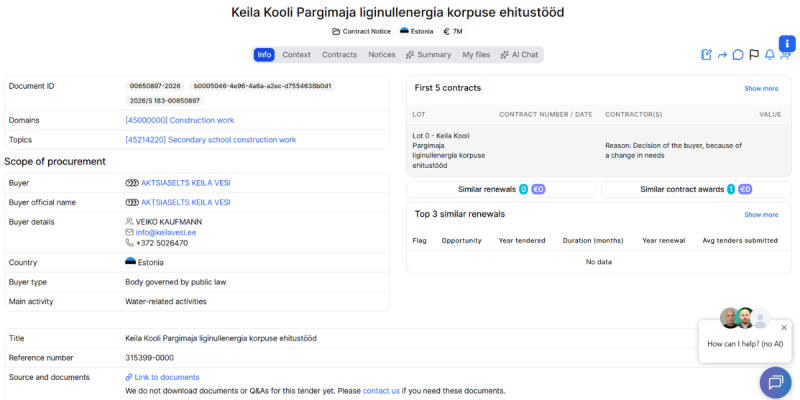
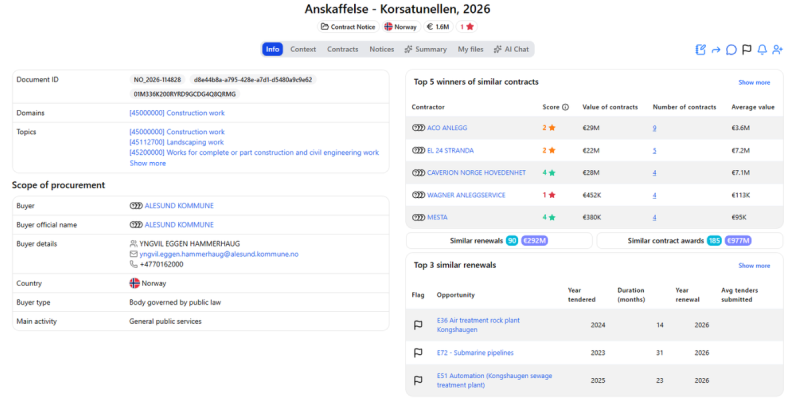
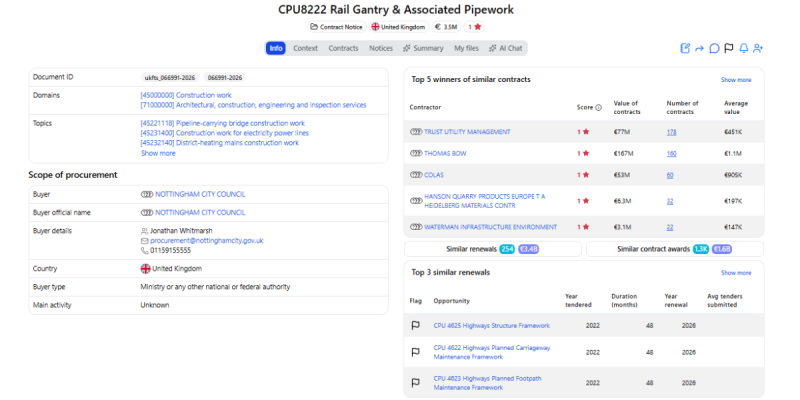
Past awards, repeat suppliers, contract sizes, and purchasing patterns frequently say more than the headline notice ever will. A supplier that understands how an authority has bought over the last three years is in a far stronger position than one who only reads the current tender pack. Hermix’s authority profiles surface this directly, giving the reader the full procurement history of a buyer in a single view, including the categories they procure most often, the value bands they pay in, and the suppliers they consistently award to.
Future demand is the third signal.
Prior information notices, framework developments, contract renewal forecasts, and expiring contracts often reveal where the next opportunity is forming. A PIN is a six to twelve month early warning. An expiring multi-year contract is a near certain recompetition. A framework being assembled now will define who can sell to that buyer for the next three to five years. Teams that watch these signals start preparing months before the eventual notice appears, and they show up at submission with a clearer position than competitors who only react to the live tender.
Competitive context is the fourth signal.
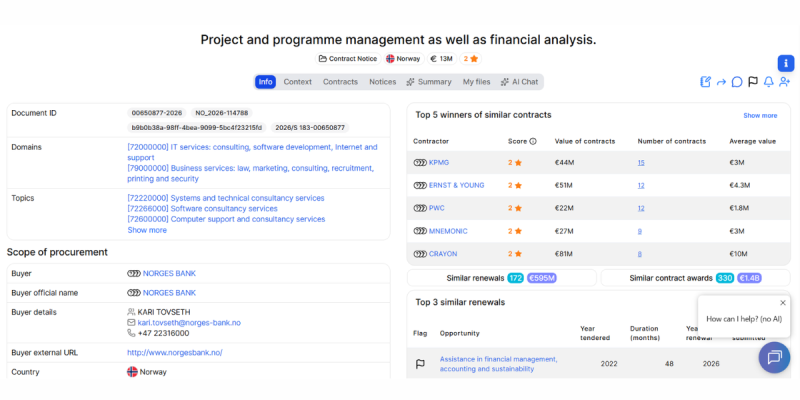
Knowing who keeps showing up, where they are strong, where partnerships shape the market, and where a contract may look open on paper but is effectively closed in practice changes the qualification decision more than almost any other input. A tender with a likely winner already visible in the data is a different proposition from a tender with a genuinely open field, and treating both the same way is one of the more expensive habits in public sales.
Used together, these four signals turn a raw notice into a qualified opportunity, with most of the answer to “is this worth it” sitting in the data around the tender rather than in the tender itself.
How the market itself has changed
It is worth saying that the structure of European public procurement has shifted over the last decade in ways that make qualification harder, not easier.
Frameworks and dynamic purchasing systems now carry a growing share of public spending. Winning a framework matters more than winning any single call off, because losing the framework means losing access to that buyer for years. Teams that qualify each call off individually, without thinking about the framework position behind it, often misjudge what is at stake.
The framework decision is the real strategic moment. The call offs that follow are operational.
Partnerships and consortia have become a more decisive variable in parallel. Major contracts are increasingly won by teams rather than by single suppliers, and the relevant qualification question is rarely whether the company can win alone. It is more often who would credibly bid with us, and what do past partnership patterns suggest about who is already talking to whom.
A buyer that consistently awards to consortia is a different proposition from a buyer that consistently awards to single suppliers, and a disciplined qualification process sees that pattern early.
Procurement data has also become significantly more accessible, particularly in the EU, where TED, the EU Funding Portal, eTendering, and national open data initiatives have made award histories and spending patterns visible at a level that was unimaginable ten years ago.
The information is there. The bottleneck is the work of assembling it into a usable view for a specific commercial decision.
But we already do this manually
Many experienced B2G teams will read this and say, fairly, that they already do all of it. They read the notices carefully. They check who won the last contract. They look at the renewal pipeline. They ask their network about the incumbent. No one is suggesting that experienced teams skip this work. The harder claim is that doing it manually, at the volume the market now requires, has become expensive, slow, and selective.
Manual tender qualification scales badly.
A team of four senior presales people can rigorously qualify perhaps thirty to forty tenders a month, which is a small fraction of what the market actually publishes in any given category. The rest get qualified by gut feel, by partial reading, or by no reading at all. The good opportunities that get missed are invisible by definition. They show up later as someone else’s contract award.
Manual qualification is also inconsistent.
Different team members weigh budget fit, incumbent risk, and capability match differently. A tender qualified by the strongest reviewer on a Tuesday morning gets a different score than the same tender qualified by a tired reviewer on a Friday afternoon. Over a year, that inconsistency adds up to a meaningful portion of the bid budget being spent on opportunities that more disciplined review would have parked.
The case for structured intelligence rests on a simpler observation.
Careful reading without context is still expensive guesswork, and the cost compounds across a year of bidding.
How Hermix changes the work
Hermix approaches public sector growth as a qualification and intelligence problem, alongside the more obvious discovery problem. The platform monitors live opportunities, prior information notices, contract awards, and likely renewals across TED, the EU Funding Portal, eTendering, Find a Tender, and the national portals in Belgium, Norway, Germany, the Netherlands, Romania, and elsewhere. The notices themselves are only one layer.
Around each opportunity, Hermix surfaces the buyer’s full procurement history, contractor profiles for the likely competition, partnership affinity data showing who has worked with whom, similar contract awards with their actual values, and the renewal calendar that signals what is coming next. AI-assisted tender summarization turns a 300-page specification into a five-minute commercial read. AI Chat allows targeted questions against the full tender document set.
The effect on the team is structural. Instead of jumping from one raw notice to the next, a reader can see each opportunity together with the evidence that makes qualification possible. The five lenses (budget fit, incumbent risk, capability match, timing, strategic fit) all become answerable in the same view. Hermix users typically report cutting tender analysis time by around 75 percent and market research time by around 87 percent, with the recovered hours redirected to higher value work on the opportunities that survive qualification.
Saved reports, flags, shared comments, ownership features, and a kanban board allow commercial and bid teams to work from the same view of the market, rather than forwarding links to each other and piecing decisions together in spreadsheets and inboxes.
What disciplined qualification actually buys
The best suppliers in public procurement do not win because they saw more notices than everyone else. They win because they understand which signals matter, which contracts are worth pursuing, and when to move. Teams that adopt a disciplined qualification process typically see win rates move from the 10 to 20 percent range into the 60 to 70 percent range over a year or two. The improvement comes from bidding selectively on opportunities that match the company’s actual position, with the remaining effort redirected to fewer, better placed bids.
The team submits fewer bids, converts more of them, and spends less senior time on contracts that were never available in the first place. A clearer view emerges of which buyers, which categories, and which partnerships deserve sustained attention, and which should be left to the suppliers who already own them.
Need help winning more public tenders, faster?
If a company’s current process still depends on jumping between portals, reading every notice manually, and sorting promising contracts from poor fit ones by instinct alone, the problem is rarely that the team needs one more alert. The problem is that the discovery process stops too early. The visible part of the market, the part that anyone with an email address can subscribe to, is the easy part. The work that decides whether a bid is worth writing sits behind the notice, in the buyer’s history, the competitive pattern, the renewal calendar, and the disciplined application of five qualification lenses to opportunities that look attractive on the surface.
Hermix is built to carry that work further. It helps teams find public sector tenders, understand the market behind them, and focus effort where there is a real chance to win. In a €2 trillion market, that gap is what separates a year of activity from a year of measurable progress.