
Submitting more bids does not necessarily mean winning more contracts. Bid teams often lose time on opportunities that are unsuitable, already shaped around a strong incumbent or impossible to deliver profitably.
That is important in a market where EU public authorities spend approximately 15% of GDP through procurement. The European Commission’s 2025 evaluation also found that competition remains uneven, average bid numbers have fallen and direct cross-border participation is still limited.
Winning more tenders means selecting markets where you can compete credibly, qualifying each opportunity with evidence, understanding buyer and competitor history, digesting requirements quickly, forming the right delivery team and continuously learning from new notices, awards and renewals.
Hermix supports this process through a six-stage approach: understand the market, qualify the opportunity, digest the documents, study previous winners, position your company and keep monitoring the market.
1. Understand the public procurement landscape
The first step is not searching for a tender. It is deciding where your company has a realistic right to win.
Public procurement is not one uniform European market. The purchasing behaviour of a European institution may differ substantially from that of a Belgian municipality, a Romanian ministry, a Norwegian county or a Luxembourg public agency. Each buyer has its own budgets, procurement cycles, preferred contract structures, incumbent suppliers and tolerance for new entrants.
The European Commission’s 2025 assessment shows why this market-level view matters. Although SMEs win a significant share of contracts, competition has become less predictable, average bids per procedure have fallen and participation across national borders remains limited.
Hermix lets teams explore buyer and supplier profiles enriched with AI and segment the market by:
- Country and buyer type
- National, federal, regional or local administration
- European and international institutions
- Industry, domain, topic and CPV classification
- Contract value, year and procurement activity
- Past suppliers, partnerships and spending patterns
The platform’s company-provided dataset includes 16 million contracts representing €20 trillion in value, four million indexed tender specifications, approximately 3,000 new tenders each day, 260,000 buyer profiles and 1.24 million contractor profiles. These figures make it possible to investigate markets as connected commercial ecosystems rather than isolated procurement notices.
This segmentation approach is sometimes described as governmentgraphics: profiling public organisations by level, mandate, geography, budget, behaviour and spending history. It is the B2G equivalent of using demographics or firmographics in consumer and commercial markets.
Start by answering four questions:
- Which countries and public organisations regularly purchase what we sell?
- What contract values and delivery models fit our capacity?
- Which buyers are open to suppliers with our profile?
- Where do we have references, relationships or complementary partners?
The result should be a defined target market—not an unlimited collection of keywords.
2. How to win more tenders by qualifying each opportunity
The most important tender decision is often whether to bid at all.
Every proposal consumes sales, technical, legal, financial and management capacity. A weak bid/no-bid process leads teams to pursue attractive-looking contract values without understanding eligibility requirements, buyer behaviour, incumbent strength or delivery risk.
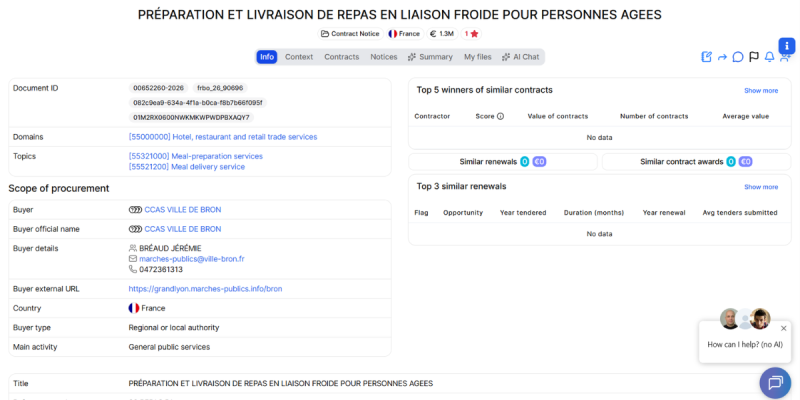
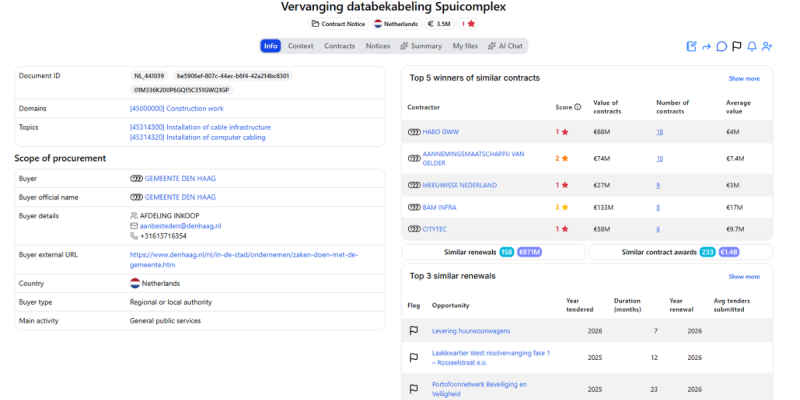
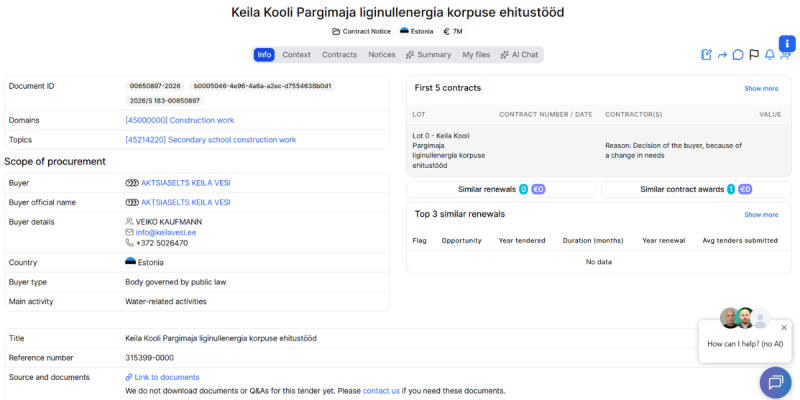
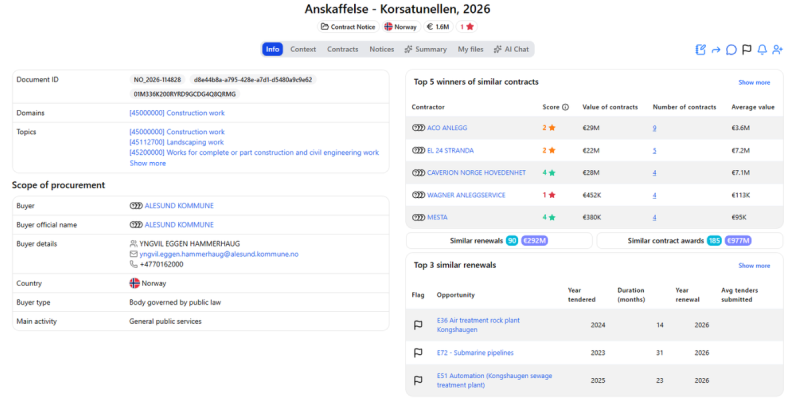
Hermix provides a commercial opportunity analysis that can include:
- Likely competitors or winners based on similar awards
- Previous contracts for the same buyer
- Comparable contracts for related products and services
- Countries and profiles of previous winners
- Current contracts approaching renewal
- Other buyers running similar projects
- Related open tenders from the same organisation
Historical results should never be presented as a guarantee of who will win. They are evidence for assessing competitive conditions, incumbent risk and the credibility of your approach.
A practical qualification scorecard can use 100 points:
| Qualification factor | Weight |
| Mandatory eligibility and compliance | 20 |
| Fit with products, services and references | 20 |
| Buyer relationship and market knowledge | 15 |
| Competitive position and incumbent risk | 15 |
| Delivery capacity and commercial viability | 10 |
| Partner and consortium readiness | 10 |
| Strategic value and follow-on potential | 10 |
Set a minimum score before allocating proposal resources. A strategically important opportunity may justify an exception, but that exception should be explicitly approved.
The 2026 Hermix qualification methodology recommends examining budget fit, incumbent risk, implementation capability, available preparation time and long-term strategic value. It argues that the work deciding whether a bid is worth writing sits behind the notice—in buyer history, competitive patterns and renewal data.
Teams can then export opportunity analysis to PDF or Excel, share it internally and assign the opportunity to a responsible colleague. Flags, comments and ownership fields create an auditable decision trail.
This turns bid qualification from an informal conversation into a repeatable commercial process.
3. Digest tender documents with AI Summary and Tender Chat
A tender notice is rarely the complete opportunity. The decisive requirements may be distributed across technical specifications, contractual conditions, annexes, spreadsheets, clarification documents and response templates.
Hermix can summarize tender documents from sources that include Belgium, Norway, Romania, the Netherlands, e-licitatie and the EU Funding & Tenders Portal. Teams can also upload private PDFs and documents for analysis, subject to the organisation’s security and configuration requirements.
AI-generated summaries can extract information such as:
- Scope and objectives
- Budget and contract duration
- Submission deadlines
- Selection and award criteria
- Minimum turnover and insurance
- Required certifications
- Expert and CV requirements
- Deliverables, work packages and locations
- Formatting and submission instructions
Tender Chat supplements the fixed summary. Users can ask opportunity-specific questions such as:
- Which requirements are mandatory?
- How many experts or CVs are needed?
- What experience must the project manager demonstrate?
- Is subcontracting permitted?
- Which documents require a signature?
- Where will the services be performed?
- How is quality weighted against price?
The OECD’s 2025 digital procurement report supports this combination of integrated workflows, emerging technologies and better use of data. However, it also identifies fragmented systems, skills gaps and change resistance as persistent constraints.
The correct operating model is therefore AI-assisted, human-verified.
Stefan Morcov, CEO & Founder at Hermix describes the boundary directly: “AI is a tool. A powerful one when used correctly. A liability when treated as a black box.”
Use AI to accelerate triage, extraction, translation and navigation. Before submission, subject every answer, number and compliance statement to expert review against the original procurement documents and clarifications.
4. Study who wins, what they win and how they win
Past contract awards reveal information that the live opportunity cannot show on its own.
They indicate which suppliers know the buyer, which companies frequently bid together, what contract values the authority normally awards and whether one incumbent dominates the category.
Hermix allows teams to search award history by:
- Buyer, country, activity and buyer type
- Contractor and contractor country
- Keyword, industry, domain and CPV code
- Award date and contract nature
- EU-funded or non-EU-funded status
- Products and services purchased
- Contract amounts and durations
- Winning contractors and consortia
Look beyond a simple list of winners. Investigate the pattern.
A supplier that has won one small contract five years ago presents a different competitive risk from a contractor that has secured four consecutive frameworks with the buyer. Similarly, repeated consortium awards may indicate that no single company possesses all the necessary financial, geographic or technical capacity.
Study at least five dimensions:
- Recency: Who won the most recent comparable contracts?
- Frequency: Are the same companies repeatedly successful?
- Value: Which suppliers win the largest contracts?
- Partnerships: Which consortium combinations appear regularly?
- Buyer concentration: Does the authority depend heavily on a small supplier group?
Contract-award alerts can notify your team when a competitor wins, a buyer appoints a new provider or an adjacent market begins to grow.
The 2025 Single Market Scoreboard reported an increase in single-bidder procedures and direct awards. For suppliers, this makes it even more important to understand whether low competition represents an accessible market gap or an environment shaped by structural barriers and entrenched incumbency.
The objective is not to imitate the previous winner. It is to identify what the buyer appears to value and then develop a more relevant, credible and differentiated offer.
5. Position your company, competitors and partners strategically
Tender success is often determined before the procurement notice is published.
Companies that begin building relevant references, relationships, partnerships and market knowledge early are better prepared than competitors reacting to an alert shortly before the deadline.
Our analysis of B2G procurement software describes the strategic shift clearly: consolidating buyer data, tenders, awards and qualification workflows allows teams to stop spending most of their time hunting for opportunities and start concentrating on winning them.
That is useful positioning advice. Public-sector proposals should prioritise evidence, delivery confidence, transparency and relevance rather than unsupported superlatives.
Use Hermix contractor and partnership profiles to examine:
- Who competes in your target category
- Which buyers each competitor serves
- Where competitors are geographically strong
- Which companies join consortia together
- Which partners bring missing certifications or references
- Where your capabilities complement rather than duplicate another supplier
Stefan Morcov’s 2025 consortium guidance recommends assessing customer relationships, price flexibility, complementary capacity, proposal-writing commitment, delivery ability, previous collaboration and compliance.
Inside Hermix, opportunity flags and the Kanban-style board can translate this intelligence into workflow stages such as:
Watch → Qualify → Partner Search → Bid Approved → Proposal → Submitted → Won/Lost
Karel Maes, Senior Engagement Manager and Head of Presales European Institutions at Fujitsu, highlighted the practical combination: “What stood out with Hermix was the renewals tracking, the AI functionality, and the export features.”
Positioning is therefore not merely brand messaging. It is the deliberate creation of buyer relevance, delivery credibility and partnership strength.
6. Stay ahead through alerts and continuous learning
A one-time search cannot support a sustainable public-sector pipeline.
Hermix alerts can monitor:
- New tender opportunities
- Prior information notices
- Contract awards
- Changes to selected opportunities
- New documents and clarifications
- Expected contract renewals
- Activity from selected buyers or competitors
The platform monitors European and international sources as well as national portals, including TED, the EU Funding & Tenders Portal, Belgium’s BOSA ecosystem, Romania’s SEAP, Norway’s Doffin and other national procurement systems.
Create separate alert groups for:
- Immediate opportunities matching current services
- Strategic buyers that should be monitored continuously
- Prior notices and expected renewals
- Competitor and award intelligence
- Adjacent markets where you may need a partner
Do not judge the alert system by the number of emails produced. Measure whether it generates qualified opportunities.
A weekly B2G review should examine new opportunities, qualification decisions, approaching deadlines, buyer changes, competitor awards and upcoming renewals. A monthly review should identify which alerts created useful leads and which filters need adjustment.
After each award decision, capture why the bid was won or lost. Update your buyer profile, competitor intelligence, qualification criteria, evidence library and partner strategy.
This closes the Hermix Tender Advantage Loop:
Understand → Qualify → Digest → Learn → Position → Track
Then repeat the process with better evidence.
Frequently asked questions
How can a company win more public tenders?
Winning more public tenders requires selective bidding, not simply greater bid volume. Define the right markets and buyers, apply a consistent bid/no-bid scorecard, research previous awards, validate mandatory requirements, select complementary partners and continuously track renewals, clarifications and competitor activity.
What is the best tender platform?
The best tender platform depends on geography, sector and workflow. Official portals remain essential for authoritative notices and submissions. A commercial intelligence platform should add multi-source monitoring, document analysis, buyer and supplier profiles, award history, renewal intelligence, collaboration and export capabilities.
What is the threshold for a public tender in the EU?
EU procurement thresholds depend on the buyer, contract category and applicable rules, and they are periodically revised. Suppliers should confirm the current threshold and procedure using official EU guidance and the procurement documents rather than relying on an old fixed amount.
Can AI write a complete tender response?
AI can support extraction, summarisation, translation, first drafts and compliance checks. It should not independently determine strategy, make unsupported claims or approve the final response. Human experts remain responsible for technical accuracy, commercial commitments, differentiation and compliance.
Conclusion
The European public-sector market offers substantial, stable opportunities, but winning requires more than finding a notice and writing a persuasive response.
Companies need to understand where demand exists, qualify each opportunity before committing resources, navigate complex documents efficiently, learn from previous awards, choose partners deliberately and keep monitoring the market after each submission.
Hermix brings these activities into one connected B2G workflow. Its market intelligence, buyer and contractor profiles, AI document analysis, Tender Chat, award history, partnership data, collaboration tools and automated alerts help convert fragmented procurement information into practical commercial decisions.
The objective is not to automate judgment or submit the largest possible number of bids. It is to create a faster, clearer and more strategic public-sector sales process—one that concentrates resources on contracts the company can genuinely win and successfully deliver.