Tender Analysis

Follow us and subscribe to our newsletter to keep in touch

Public tenders analysis: French Authorities Open €2.1M Solar Village Project in Réunion

Contract ID: 00476351-2025 reveals some interesting patterns in France’s remote area electrification efforts and local contractor dominance.

The Remote Island Opportunity

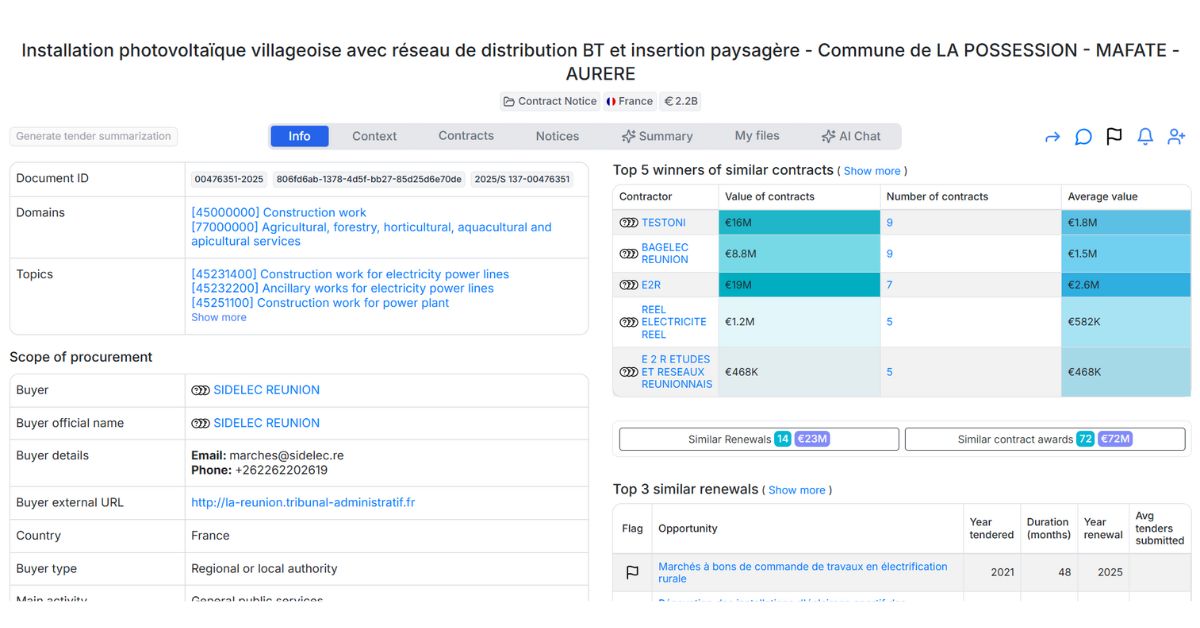
SIDELEC REUNION has issued a tender for a specialized photovoltaic installation in Mafate, one of the most remote areas of La Possession commune in Réunion. The project combines solar power generation with underground distribution networks and landscape integration, valued at €2.15M across four distinct lots.

The contract covers installation of an autonomous photovoltaic system with lithium-iron-phosphate battery storage, buried low-voltage distribution networks along hiking trails, and environmental integration of the solar facility. This reveals France’s commitment to bringing sustainable energy to its most challenging locations.

Authority Profile Shows Consistent Investment

SIDELEC REUNION operates as a regional authority with substantial renewable energy procurement activity. Our analysis shows they have awarded 72 similar contracts worth €72M, with 28 potential renewals valued at €25M in their pipeline.

The authority demonstrates clear preference for multi-lot structures and quality-price evaluation criteria, allowing specialized contractors to bid on specific technical components while maintaining overall project coherence.

Local Expertise Dominates Market

The competitive landscape reveals strong French contractor preference. TESTONI leads with €16M across 9 contracts averaging €1.8M each. BAGELEC REUNION and E2R follow with significant market shares, showing how regional knowledge and established relationships drive success in remote island projects.

All winning contractors are France-based, with a 100% domestic success rate. This pattern mirrors other EU remote territory projects where local expertise in logistics, environmental regulations, and specialized installation techniques provides decisive advantages.

Create your free account and start winning public contracts, easier.

Technical Complexity Drives Premium Pricing

The four-lot structure separates photovoltaic works (€1.18M), technical building construction (€135K), low-voltage network installation (€705K), and landscaping (€126K). This segmentation allows specialized contractors to compete efficiently while maintaining technical integration.

The underground cable installation along hiking trails and battery storage requirements reflect the unique challenges of powering remote island communities without disrupting sensitive environmental areas.

Market Intelligence for Renewable Contractors

For companies targeting French renewable energy public projects, this tender shows several strategic insights. SIDELEC REUNION’s procurement pattern suggests systematic infrastructure upgrades across Réunion’s remote areas, with similar projects likely in their €25M renewal pipeline.

The consistent preference for French contractors, combined with technical complexity requirements, indicates that success requires local partnerships and proven experience with island-specific challenges rather than lowest-cost approaches.

The timing patterns suggest multi-year investment cycles, making this market segment predictable for companies positioned correctly with French operations and renewable energy expertise.

This public tender shows how France approaches sustainable development in its overseas territories through systematic, locally sourced infrastructure improvements that balance technical requirements with environmental protection.

Create your demo account to see all the relevant public tender bids for you, here: https://hermix.com/sign-up/
Installation photovoltaïque villageoise avec réseau de distribution BT et insertion paysagère - Commune de LA POSSESSION - MAFATE - AURERE - tender opportunity


How to Summarize Tender Documentation in Seconds

Applies to: All Hermix plans and features
Reading Time: 5 min
Last Updated: July 22 2025

Skip the 300-Page Grind

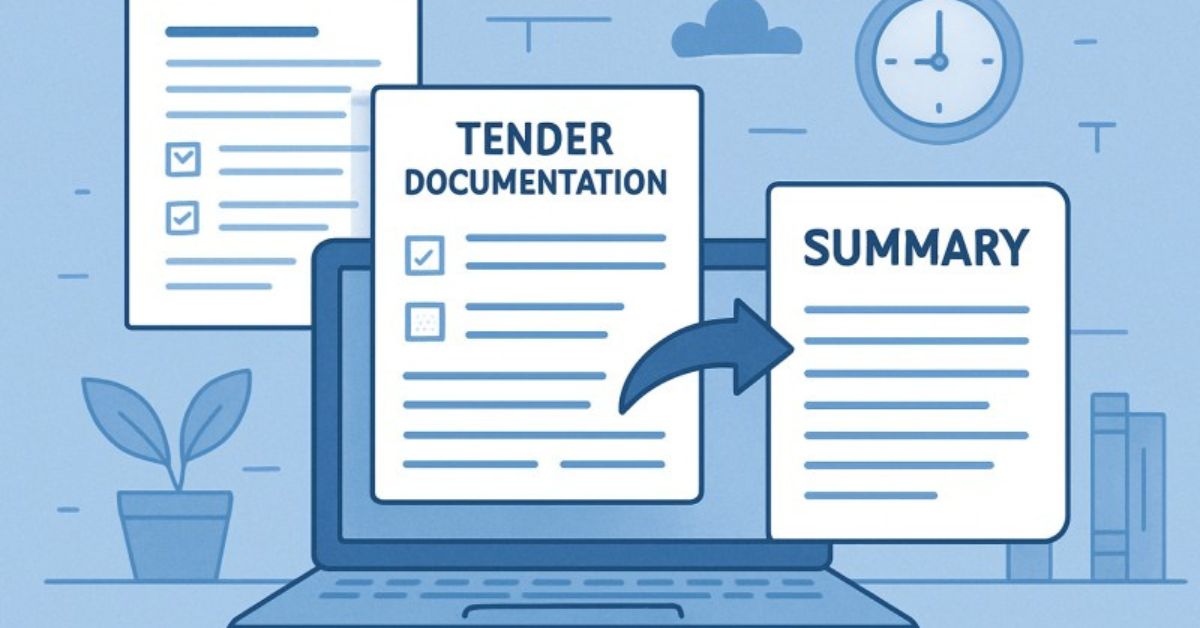
Tender specifications can run beyond 300 pages. They overflow with legal references, annexes, and specialist jargon that bury the details you actually need. Reading them cover to cover steals hours from proposal work. Hermix’s AI Tender Summarization feature gives those hours back.

What You’ll Learn

By the end of this article, you’ll know how to use AI summaries to scan any tender in seconds and decide what deserves deeper attention.

What You Need

A Hermix account unlocks the summarization button on every opportunity. Start a free trial at hermix.com/sign-up if you want to follow along.

Key Takeaways

  • Generate concise summaries that highlight scope, budget, and eligibility.
  • Cut preliminary document review time by up to 85 percent.
  • Share AI summaries with teammates so everyone starts on the same page.

Why Manual Reading Fails

Traditional tender review looks like this:

  1. Download a multi-hundred-page PDF.
  2. Skim for keywords.
  3. Copy sections into a note.
  4. Hope nothing critical slips past tired eyes.

Teams often assign a senior consultant to this task, which delays higher-value work. Hermix automates the first pass so specialists can focus on strategy instead of sifting text.

Create your free account and start winning public contracts, easier.

How AI Tender Summarization Works

  1. Document Ingest
    Hermix pulls the full tender file directly from the portal. No manual downloads.
  2. Natural-Language Processing
    Our model reads the document end-to-end, extracts core elements, and flags mandatory requirements.
  3. Structured Output
    The summary lists scope, budget range, key deadlines, evaluation criteria, and eligibility checkpoints in plain language.

Accuracy tests across English, French, and Slovene tenders show 98–99 percent precision on these fields.

Three-Step Quick Scan

  1. Open any opportunity inside Hermix.
  2. Click Tender summarization.
  3. Read the summary that appears beneath the document viewer.

That is it. Super simple, right?

Practical Use Cases

  • Bid/No-Bid Triage
    Decide within minutes whether the tender suits your capabilities and price point.
  • Team Briefings
    Email the summary to legal, finance, and technical leads so everyone starts with the same facts.
  • Delegation
    Junior team members can run summaries and escalate only the tenders that match strategic criteria.

Real-World Impact

Users report saving two to three hours per medium-size tender and up to eight hours on large framework notices. Over a quarter, those hours translate into more proposals submitted and sharper qualification decisions.

Best Practices

  • Run the summary before downloading annexes.
  • Cross-check any critical figure (budget, contract length) against the source page when the tender is a top priority.
  • Store summaries in My Files so new team members see past decisions instantly.

Common Pitfalls

  • Ignoring context: always pair the summary with buyer history from the Context tab.
  • Copy-paste bids: a summary is a starting point, not a replacement for tailored proposals.
  • Single-language searches: Hermix summarises in the document’s original language, so keep multilingual skills handy for final reviews.

Measuring Success

Track:

  • Average time from tender release to initial decision.
  • Number of high-quality bid/no-bid calls made per month.
  • Team hours reallocated from reading to solution design.

Aim for an 80 percent cut in preliminary reading within your first month.

Test It Now

Open any tender in your Hermix dashboard, press Tender summarization, and see how fast clarity arrives.

Related Resources

Next Steps

  • Next knowledge base article

Advanced Features

How-to-Summarize-Tender-Documentation-in-Seconds - knowledge base

How to Know if a Public Tender Is Worth It

Applies to: All Hermix plans and features
Reading Time: 6 min
Last Updated: July 22, 2025

The Hidden Cost of Bidding Blind

Most sales teams burn weeks and sizable budgets chasing tenders that were never a realistic fit. They open 300-page specs, scramble for background data, guess the odds, then submit bids that quietly fail.

Hermix changes the starting line. Commercial qualification turns a three-day desk-research marathon into a five-minute confidence check, showing you, up front, whether an opportunity deserves the full bid treatment or a polite pass.

What You’ll Learn

By the end of this article, you’ll see how Hermix surfaces buyer history, budget signals, and competitive context so you can pursue only high-fit tenders, without reading every annex first.

What You Need

A Hermix account unlocks full qualification insights. Create a free trial at hermix.com/sign-up to follow the examples.

Key Takeaways

  • Compare every new notice with winner history, buyer spend, and pricing benchmarks.
  • Estimate win probability before committing bid resources.
  • Reclaim up to 80% of the time usually lost on low-fit tenders.

Why Most Teams Waste Time Here

Qualification is where enthusiasm collides with reality. Teams skim a summary, sense a “maybe,” and plunge into writing mode. 

Hours later, they discover:

  • The authority favours incumbent suppliers.
  • Budget caps don’t match their pricing.
  • Similar projects were recently awarded to a multi-year framework.

Late discoveries kill margins and morale. 

Hermix flips the order: information first, decision after.

How Hermix Commercial Qualification Works

1. Winner History

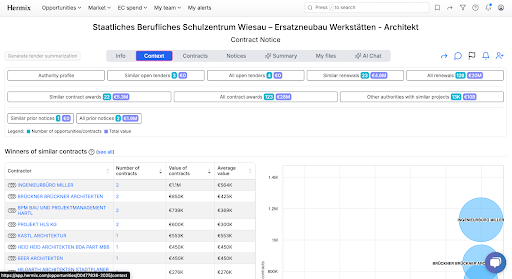
See which suppliers won comparable contracts, how often, and at what value. A pattern of repeat winners signals a tight incumbent grip.

2. Buyer Preferences & Budgets

Authority profiles reveal spending trends, typical contract sizes, and procurement cycles. If the buyer’s average award is €200,000 and your standard deal starts at €2 million, you know instantly it’s a mismatch.

3. Pricing Benchmarks

Hermix aggregates past award values so you can position your offer within realistic ranges, no more guess-and-stretch pricing.

4. Realistic Win Probability

By blending scope similarity, budget fit, and competitive density, Hermix estimates your chance of success. Low scores? Move on early and redeploy resources where odds are higher.

From Intake to Insight in Three Clicks

  1. Open any opportunity in your dashboard.
  2. Select the “Context” tab.
  3. Review Winners of similar contracts, Authority profile, and Similar contract awards for an instant viability snapshot.
From Intake to Insight in Three Clicks

If numbers add up, green-light the bid. If they don’t, park it and focus on higher-probability work.

Advanced Qualification Moves

  • Geo-filter competitor analysis to spot markets where local suppliers dominate.
  • Compare renewal timelines to target contracts coming off incumbents.
  • Overlay funding-source flags (EU grants vs. national budget) to tailor pricing strategy.

Real-World Impact

Teams using Hermix cut qualification time by up to 85% and double their pipeline of high-fit tenders after one quarter.

Best Practices

  • Start broad, refine fast: run winner history first, then tighten filters.
  • Log every “no-bid” reason: over time, you’ll see patterns that sharpen future monitors.
  • Pair qualification with AI summaries: confirm technical fit while commercial checks run in parallel.

Common Mistakes to Avoid

  • Chasing tenders where past awards show a single long-term supplier.
  • Ignoring budget ceilings that conflict with minimum viable pricing.
  • Treating every positive keyword hit as a green light.

Measuring Success

Track these metrics to validate your new discipline:

  • Percentage of bids submitted vs. tenders reviewed.
  • Win rate on bids pursued post-qualification.
  • Hours saved per tender by skipping low-fit opportunities.

Aim for 50% fewer bids with 30% higher win rates after your first quarter of data-driven qualification.

Explore Your Qualification Insights

Ready to see if today’s tender is worth tomorrow’s budget? Open any opportunity, switch to “Context,” and let the data decide.

Your pipeline (and your team) will thank you.

Related Resources

Next Steps

  • Next knowledge base article

Advanced Features

How to Know if a Public Tender Is Worth It - Knowledge base