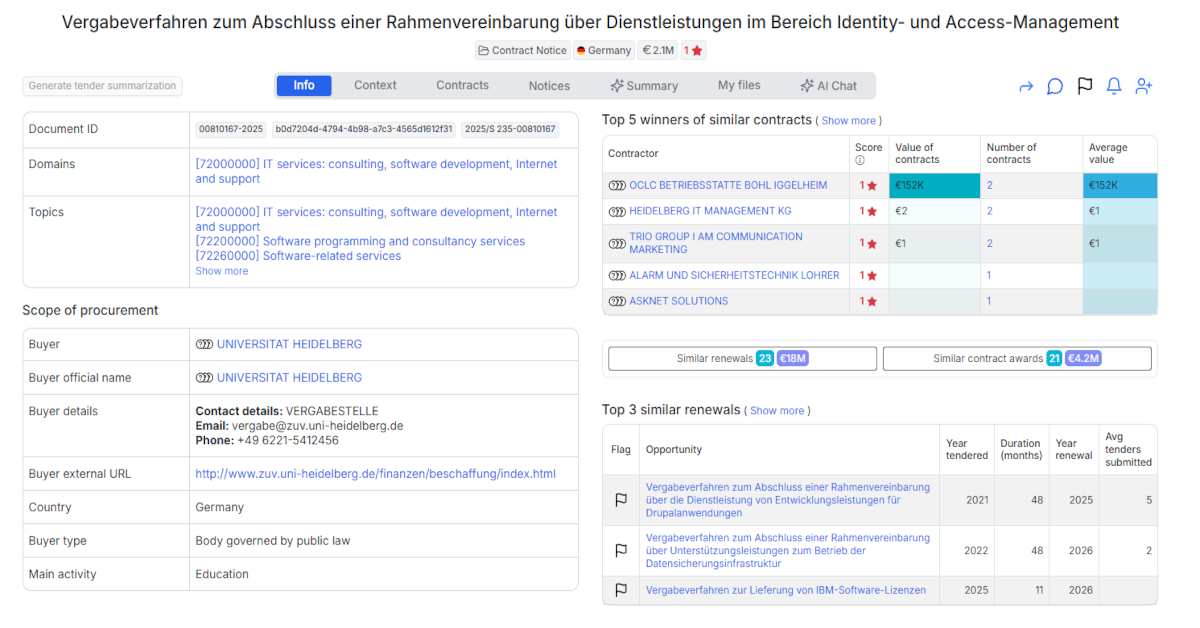
Germany’s oldest university seeks comprehensive IAM implementation based on open-source MidPoint software, with a 48-month framework covering initial deployment, ongoing development, and maintenance services.
Universität Heidelberg, one of Europe’s most prestigious research institutions, has published a €2.1 million framework agreement for Identity and Access Management (IAM) services. With a deadline of January 27, 2026, this procurement mandates implementation of the open-source MidPoint platform from Evolveum s.r.o., covering everything from initial system configuration through long-term maintenance and enhancement. The framework’s three-part structure—initial implementation, development services, and ongoing maintenance—signals strategic commitment to modernizing identity governance across the university’s complex, multi-campus IT infrastructure.
The tender explicitly requires on-premises deployment on university-owned infrastructure, prohibiting cloud-based solutions—a significant constraint reflecting German academic sector data sovereignty requirements. With 187 historical contracts worth €18 million and 193 renewals valued at €162 million approaching, this represents both immediate opportunity and potential positioning within Germany’s university IT services market.
Opportunity Overview
Contracting Authority: Universität Heidelberg (Heidelberg University)
Reference Number: Uni-HD.2025.1591_RV_Dienstleistungen_Identity_und_Access_Management_URZ
Tender Title: Framework agreement for services in the area of Identity and Access Management
Scope of Work:
The framework encompasses comprehensive IAM implementation structured in three distinct parts:
Part A: Open-Source Software Adaptation (Initial Implementation)
- MidPoint software installation and configuration
- System environment setup (minimum three environments: development, test, production)
- Integration of source and target systems
- Basic module and interface customization
- Technical and operational documentation
- Delivery of functional IAM base platform
Part B: Development Services (Ongoing Enhancement) Available after first six months on call-off basis:
- Process consulting and new use case implementation
- Migration concepts for LDAP systems
- Data and role concept development
- Joiner-Mover-Leaver process consulting
- User interface extensions with additional functions
- Operational support and optimization
Part C: Maintenance Services (Ongoing Support)
- Continuous maintenance and support
- Updates and security patches
- Error corrections and bug fixes
- Stability and functionality assurance
Technical Requirements:
- Must use MidPoint open-source software (Evolveum s.r.o.)
- Deployment on university’s virtualized servers (NOT cloud-based)
- Minimum three environments required (dev, test, production)
- Automated management of user accounts, groups, roles, and permissions
- Self-service portal for decentralized IT administrators
- Integration with existing university IT systems
Location: Mannheim and Heidelberg, Germany
Estimated Value: €1,400,000 baseline, with optional increase up to €2,100,000 (50% increase)
Contract Duration: 48 months OR until maximum contract value reached, whichever occurs first
Contract Type: Services
Procedure Type: Open
Award Criteria: Price only
Key Dates:
- Publication: December 5, 2025
- Submission Deadline: January 27, 2026 (53 days)
- Tender Opening: January 27, 2026
Language Requirements: German (implicit from tender language)
EU Funding: No
Contact Details:
- Department: Vergabestelle (Procurement Office)
- Email: vergabe@zuv.uni-heidelberg.de
- Phone: +49 6221-5412452
Track German university IT tenders effortlessly.
Create your free Hermix account at https://hermix.com/sign-up/ for AI-powered monitoring of German academic procurement, automated translations, and competitive intelligence across Europe’s €11 billion university IT services market.
Authority Profile: Universität Heidelberg
Founded in 1386, Universität Heidelberg (Heidelberg University) is Germany’s oldest university and consistently ranks among Europe’s top research institutions. As a body governed by public law focused on education, the university operates multiple campuses across Heidelberg and Mannheim, serving approximately 30,000 students and employing over 15,000 staff members including world-leading researchers across sciences, medicine, humanities, and law.
Overall Procurement Activity:
- Total Contract Awards: 187 contracts worth €18 million (average: €96K per contract)
- Active Tender Pipeline: 1 open tender valued at €10 million
- Renewal Forecast: 193 potential renewals worth €162 million
IT Services and Software:
- Similar Contract Awards: 21 contracts totaling €4.2 million (average: €200K per contract)
- Similar Open Tenders: None currently (this is the only active IAM procurement)
- Similar Renewals: 23 upcoming renewals worth €18 million (average: €783K per contract)
Market Context:
Heidelberg University operates within Germany’s higher education IT landscape where 5,600 similar institutions collectively represent €11 billion in IT services procurement. The university’s substantial renewal pipeline (€162M across 193 contracts) indicates systematic procurement cycling, with this IAM investment representing approximately 1.3% of upcoming renewal activity—a significant allocation for specialized identity management infrastructure.
The jump from historical similar contract average (€200K) to this framework’s potential value (€2.1M) signals strategic consolidation toward comprehensive, long-term service relationships rather than fragmented project-based engagements.
Competitive Landscape: Specialized Security Providers Lead
Historical contract awards reveal a market dominated by German IT security and services providers, with notable concentration in cybersecurity and infrastructure management.
Top Contract Winners (Similar Services):
- GREENBONE NETWORKS – €4M for 1 contract
- OCLC BETRIEBSSTATTE BOHL IGGELHEIM – €152K across 2 contracts (€76K average)
- HEIDELBERG IT MANAGEMENT KG – €2 across 2 contracts (€1 average)
- TRIO GROUP IAM COMMUNICATION MARKETING – €1 across 2 contracts
- XSUITE GROUP – 1 contract (value not disclosed)
Additional single-contract winners: ASKNET SOLUTIONS, NEWPORT SPECTRA PHYSICS, PCO KG, SVA SYSTEM VERTRIEB ALEXANDER, ALARM UND SICHERHEITSTECHNIK LOHRER
Key Competitive Observations:
Greenbone Networks Dominance: The single €4M contract secured by Greenbone Networks dwarfs all other similar awards, representing 95% of the visible €4.2M market. Greenbone specializes in vulnerability management and security solutions, suggesting this may have been a comprehensive security infrastructure contract rather than pure IAM services.
IAM-Specific Provider Presence: TRIO GROUP IAM COMMUNICATION MARKETING’s name explicitly references IAM, indicating specialized identity and access management expertise. Despite modest contract values shown (€1), their presence signals relevant sector experience.
100% German Market: All 18 visible contracts (€4.2M total, average €415K) were awarded exclusively to German companies. This indicates either explicit requirements for German language/presence, data sovereignty considerations for academic institutions, or practical necessities around on-site support and compliance with German data protection frameworks.
MidPoint Expertise Scarcity: This tender mandates Evolveum MidPoint—a specialized open-source IAM platform with limited deployment base compared to commercial alternatives like SailPoint, Okta, or Microsoft Identity Manager. The competitive field will likely narrow to:
- Evolveum certified partners in Germany
- Open-source IAM specialists with MidPoint expertise
- IT consultancies with proven academic sector MidPoint implementations
Value Comparison: The €2.1M framework significantly exceeds the historical average (€200K), suggesting either broader scope, longer term, or that previous contracts were smaller project-based engagements rather than comprehensive IAM transformations.
Commercial and Procedural Signals
Price-Only Evaluation:
Unlike most complex IT services tenders that weigh quality and price, this procurement evaluates on price alone. This unusual approach for a sophisticated IAM implementation suggests either:
- Extremely detailed technical specifications eliminating quality variation
- Pre-qualification stage ensuring only capable bidders proceed
- University’s confidence that MidPoint platform standardization ensures baseline quality
- Potential cost-optimization pressure within university budget constraints
Bidders must balance competitive pricing against realistic effort estimates for complex IAM transformation—underpricing risks project failure and relationship damage.
MidPoint Platform Mandate:
Requiring Evolveum MidPoint open-source software creates vendor-specific constraint limiting competition to firms with:
- Proven MidPoint implementation experience
- Certified MidPoint technical staff
- Evolveum partnership or direct relationship for support escalation
- Understanding of MidPoint’s specific capabilities and limitations versus commercial IAM platforms
This effectively narrows the competitive field but ensures specialized expertise.
On-Premises Deployment Requirement:
The explicit prohibition of cloud-based delivery (“Es ist nicht zulässig die Software auf einer Cloud Umgebung des Auftragnehmers dem Auftraggeber zur Verfügung zu stellen”) reflects:
- German data protection regulations (BDSG/DSGVO) and academic sector sensitivity
- University’s existing infrastructure investment in virtualized server environment
- Control requirements over student and research staff personal data
- Potential resistance to dependency on external cloud providers for identity infrastructure
Three-Part Framework Structure:
The division into initial implementation (Part A), ongoing development (Part B), and maintenance (Part C) provides:
- Flexibility to scale services based on actual needs
- Reduced financial commitment risk (no guaranteed minimum spend)
- Ability to adjust scope after initial six months based on Part A outcomes
- Predictable budgeting for university finance planning
Contract Duration Flexibility:
The framework ends at 48 months OR €2.1M total spend, whichever comes first. At baseline estimate (€1.4M over 48 months = €29K monthly), the framework would run full term. The 50% optional increase provides headroom for expanded scope without re-tendering.
Strategic Context and Practical Takeaways
University IAM Modernization Driver:
Heidelberg University’s investment signals broader German academic sector trend toward professional identity governance meeting IT security, GDPR compliance, and operational efficiency requirements. Universities face unique IAM complexity: student lifecycle management, guest researcher access, multi-tenant research groups, and federated identity requirements for inter-university collaboration.
Open-Source Strategic Choice:
Selecting MidPoint over commercial IAM platforms reflects:
- Cost optimization (no per-user licensing fees)
- Customization flexibility for academic-specific requirements
- Vendor independence and community-driven development
- Alignment with open-source academic values
However, it requires specialized implementation expertise—hence this substantial services framework.
Hermix Advantage for German Academic Tenders:
Hermix users gain immediate competitive intelligence on Heidelberg’s 187 historical contracts, automated monitoring of 193 upcoming renewals (€162M), and AI-powered German-to-English translation eliminating language barriers. The platform connects this tender to broader patterns across 5,600 similar institutions (€11B market), transforming isolated opportunities into strategic market positioning.
Who This Tender Suits:
- German IT consultancies with MidPoint implementation expertise
- Identity and access management specialists serving academic sector
- Evolveum certified partners with German language capability
- Firms with proven track record in German university IT projects
- Open-source IAM practitioners with LDAP migration experience
Critical Success Factors:
MidPoint Certification and References: Demonstrate proven MidPoint deployments, ideally within German academic institutions. Include specific examples of LDAP integration, role modeling, and joiner-mover-leaver process automation using MidPoint.
German Academic Sector Knowledge: Understanding university-specific IAM requirements: student account lifecycle management, research group isolation, guest researcher workflows, federated identity (DFN-AAI), and compliance with state-level data protection officers.
Competitive Pricing Strategy: With price-only evaluation, your bid must be financially competitive while realistic about effort. Under-pricing a complex 48-month IAM transformation risks project failure. Ensure adequate contingency for university’s complex, legacy IT landscape.
On-Site Delivery Capability: Heidelberg and Mannheim presence or willingness to establish local project teams. Remote-only delivery is unlikely to succeed for transformation requiring deep stakeholder engagement across multiple university departments.
Conclusion
Universität Heidelberg’s €2.1 million IAM framework exemplifies specialized, strategically important procurement characterizing German academic IT modernization. The authority’s 187 historical contracts (€18M) and 193 approaching renewals (€162M) signal mature procurement operations where specialized technical expertise and competitive pricing drive selection.
The MidPoint platform mandate and on-premises requirement favor German IT consultancies with deep open-source IAM expertise and proven academic sector experience. For firms seeking entry into Germany’s university IT market or expanding within the €11B education technology landscape, this framework offers substantial opportunity and positioning for future engagements.
Hermix transforms German procurement complexity into opportunity. Access instant AI-powered translations, automated monitoring, and competitive intelligence.
Create your free account at https://hermix.com/sign-up/ and win more public contracts across Europe’s multilingual B2G landscape.
PS: This analysis is based on publicly available tender documentation and data provided by the contracting authority. While we strive to provide accurate information, users are responsible for verifying all details against official tender documents before making any procurement decisions.