Tender Analysis

Follow us and subscribe to our newsletter to keep in touch

Bergen Municipality Public Tender for Cloud Procurement System Replacement

A 60-month contract for comprehensive eProcurement platform replacement signals Norway’s second-largest city’s commitment to modern, cloud-based purchasing infrastructure serving municipal operations.

Create a free account and see the full public tender details here: https://app.hermix.com/opportunities/00025283-2026

Bergen Municipality Launches Cloud Procurement System Replacement Tender

A 60-month contract for comprehensive eProcurement platform replacement signals Norway’s second-largest city’s commitment to modern, cloud-based purchasing infrastructure serving municipal operations.
Bergen Kommune, Norway’s second-largest municipality, has published a qualification-phase tender for a new cloud-based procurement system to replace its current UNIT4 ERP ordering platform. With a February 16, 2026 deadline and a five-year contract term, this procurement represents a strategic shift toward independent, integrated eProcurement infrastructure serving Bergen’s extensive municipal operations across Vestland county.
The tender seeks a complete procurement-to-pay solution covering requisitioning, ordering, goods receipt, and reporting—delivered as a cloud service with comprehensive implementation, training, ongoing support, and integration services. Bergen Kommune’s procurement history of 837 contracts worth €2 billion, combined with 1,100 upcoming renewals valued at €3.3 billion, positions this within a sophisticated municipal IT procurement operation where vendor relationships and proven cloud platform expertise drive long-term partnerships.

Create your free account and start winning public contracts, easier.

Opportunity Overview

Contracting Authority: Bergen Kommune (City of Bergen)
Reference Number: 2025/271119
Tender Title: Qualification phase – IK-EEA 2026-010 Procurement of a new Procurement System
Service Scope:
Bergen Kommune requires a comprehensive cloud-based procurement system (eCommerce/ordering platform) replacing the current UNIT4 ERP UBW Economy/e-Procurement system implemented in 2022.
Current System Context:
The existing UNIT4 ERP ordering module is integrated within Bergen’s financial system. The new procurement seeks an independent procurement platform with data exchange managed through integrations, allowing greater flexibility and specialized functionality beyond embedded ERP ordering modules.

Core System Requirements:

Requisitioning and Procurement Lists:

  • Registration of procurement needs
  • Use of procurement lists and catalogs
  • Requirement approval workflows

Order Management:

  • Order creation, modification, follow-up, and approval
  • Automatic order generation from approved requisitions
  • Order tracking and status management

Goods Receipt:

  • Registration of received goods and services
  • Matching goods receipts against purchase orders
  • Returns management and processing

Reporting and Analysis:

  • Procurement analytics and dashboards
  • Spending analysis by category, supplier, department
  • Compliance and exception reporting

EHF Format Support (Norwegian Electronic Invoicing Standard):

  • EHF Catalogue integration
  • EHF Orders transmission
  • EHF Invoice reception
  • EHF Punchout for supplier catalogs
  • EHF Order Confirmation
  • EHF Pakkseddel (delivery notes)

Technical Requirements:

  • Mobile device support (smartphones, tablets)
  • Role-based user interfaces tailored to different user groups
  • Integration capabilities with Bergen’s financial system and other municipal systems
  • Data exchange and information synchronization across platforms

Scope Boundaries:

The procurement system covers need-to-receipt processes. Invoice processing, invoice matching, and payment execution remain within Bergen Kommune’s existing financial system.

Contract Inclusions:

  • Implementation and system setup
  • Training for municipal staff across departments
  • Integration development and maintenance
  • Ongoing operation and management
  • Continuous development and enhancement
  • User support services
  • Optional: Additional consultancy services and expanded support

Estimated Contract Value: Not disclosed
Contract Duration: 60 months (5 years)
Procedure Type: Negotiated with prior publication of call for competition
Award Criteria: Quality and Price (weightings not disclosed)

Key Dates:

  • Publication: January 14, 2026
  • Submission Deadline: February 16, 2026 (33 days from publication)

Location: Vestland, Norway (Bergen municipality)
Language Requirements: Norwegian only
EU Funding: No
Contact Details:
Contact Person: Kevin Tobin
Email: kevin.tobin@bergen.kommune.no
Phone: +47 05556
Submission Portal: https://permalink.mercell.com/261120912.aspx

Ready to win Norwegian public sector IT contracts?

Create your free Hermix account at https://hermix.com/sign-up/ and access AI-powered tender analysis, automated monitoring of Norwegian procurement portals, and competitive intelligence across Scandinavia’s public procurement market.

Authority Profile: Bergen Kommune’s Digital Transformation

Bergen Kommune serves Norway’s second-largest city with approximately 285,000 residents across Vestland county. As a body governed by public law responsible for extensive general public services, the municipality operates complex procurement infrastructure supporting education, healthcare, social services, infrastructure, and administrative operations.

The decision to replace a recently implemented UNIT4 ERP ordering system (deployed in 2022) signals Bergen’s recognition that embedded ERP procurement modules, while functional, lack the specialized capabilities required for modern, efficient municipal purchasing operations. This strategic move toward best-of-breed procurement platforms reflects broader Scandinavian public sector trends prioritizing user experience, mobile accessibility, and advanced analytics.

Overall Procurement Activity:

  • Total Contract Awards: 837 contracts worth €2 billion
  • Active Tender Pipeline: 31 open tenders valued at €104 million
  • Renewal Forecast: 1,100 potential renewals worth €3.3 billion

IT Services and Software Procurement:

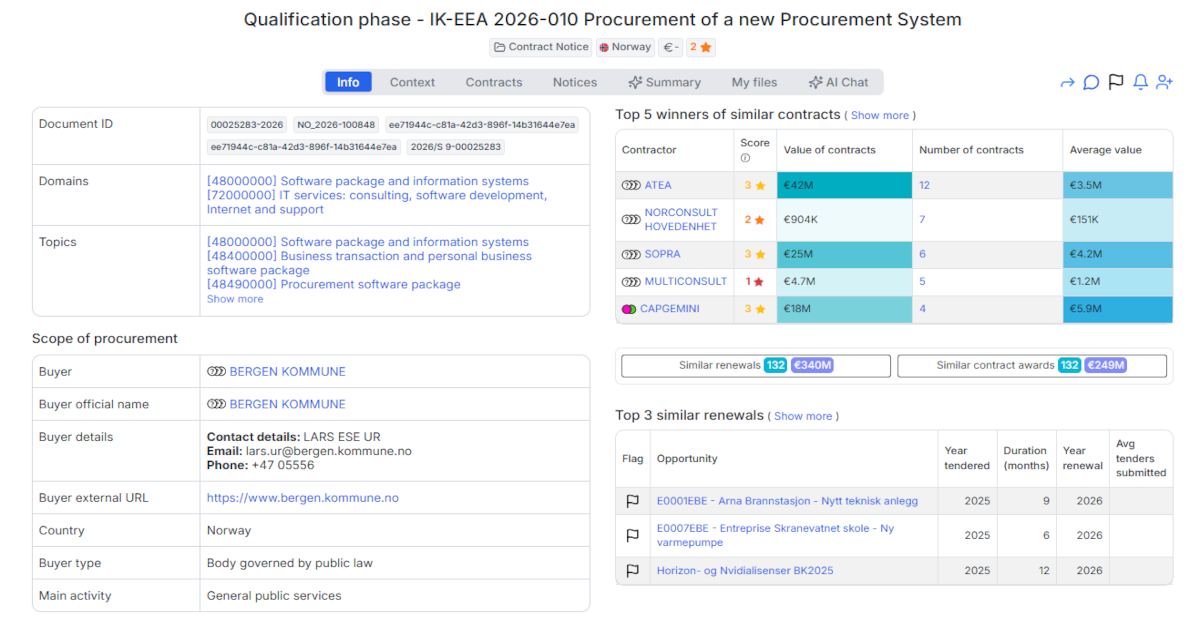
  • Similar Contract Awards: 131 contracts totaling €247 million (average: €2.2M per contract)
  • Similar Open Tenders: 8 current opportunities worth €9.8 million
  • Similar Renewals: 132 upcoming renewals worth €340 million

Bergen Kommune operates within Norway’s sophisticated municipal IT procurement ecosystem where 2,300 similar authorities collectively represent €10 billion in software and IT services procurement. Success with Bergen positions vendors for relationships across Norwegian kommuner (municipalities) and potentially broader Nordic public sector opportunities.

Competitive Landscape: IT Services Giants and Nordic Specialists

Historical contract awards for similar software and IT services reveal a competitive market dominated by established IT services providers with strong Norwegian public sector presence.

Top Contract Winners (Similar Services):

  1. ATEA – €42M across 12 contracts (€3.5M average)
  2. SOPRA – €25M across 6 contracts (€4.2M average)
  3. CAPGEMINI – €18M across 4 contracts (€5.9M average)
  4. KPMG – €18M across 3 contracts (€5.9M average)
  5. CRAYON – €8M across 3 contracts (€2.7M average)
  6. TELIA – €6.5M across 3 contracts (€2.2M average)
  7. MULTICONSULT – €4.7M across 5 contracts (€1.2M average)
  8. BDO HOVEDENHET – €3.3M across 4 contracts (€821K average)
  9. NORCONSULT HOVEDENHET – €904K across 7 contracts (€151K average)
  10. SWECO NORGE HOVEDENHET – €685K across 4 contracts (€228K average)

Key Competitive Observations:

Norwegian Market Dominance: Of 119 similar contracts totaling €247M, all but one (€157K to an Italian contractor) went to Norwegian companies. This overwhelming domestic preference suggests either explicit language and local presence requirements, practical necessities around on-site implementation support in Norwegian, or deep relationships between Norwegian IT providers and municipal procurement teams.

ATEA’s Repeat Business Leadership: With 12 contracts worth €42M (€3.5M average), ATEA demonstrates sustained relationships with Bergen Kommune across multiple IT procurement cycles. This repeat business indicates proven municipal IT capability and likely positions them as a strong contender for this procurement platform replacement.

Software Implementation Specialists: SOPRA’s €25M across 6 contracts (€4.2M average) suggests substantial software implementation projects, potentially including ERP, procurement, or other enterprise systems—directly relevant experience for this tender.

Consultancy Firm Presence: KPMG (€18M), BDO (€3.3M), and multiple Norwegian consultancies indicate Bergen’s willingness to engage advisory firms for IT strategy, implementation oversight, and change management—relevant for bidders considering partnership approaches.

Average Contract Scale: The €2.2M average for similar contracts provides context for likely contract value expectations, though this specific tender’s value remains undisclosed during the qualification phase.

Commercial and Procedural Signals

Qualification Phase Structure:
This tender uses a two-stage procedure beginning with qualification, allowing Bergen Kommune to pre-qualify capable bidders before inviting detailed proposals. Only qualified suppliers will proceed to the negotiated dialogue phase, reducing evaluation workload while ensuring only serious, capable providers compete.

Negotiated Procedure:
The competitive negotiation approach enables Bergen to engage in dialogue with qualified bidders to refine technical solutions, integration approaches, implementation methodologies, and commercial terms—particularly important for complex cloud platform procurement requiring tailored approaches.

Norwegian Language Requirement:
Submissions must be in Norwegian, creating significant barriers for non-Nordic providers. This extends beyond proposal language to encompass product user interfaces, documentation, training materials, and ongoing support—all requiring Norwegian language capability.

Undisclosed Contract Value:
Bergen has not published estimated contract value during qualification phase, likely to avoid anchoring bids and enable flexible negotiation during dialogue stage. Based on similar contracts averaging €2.2M, realistic expectations likely range from €3-8M over five years depending on scope and user count.

Quality and Price Evaluation:
Without disclosed weightings, bidders should balance competitive pricing with strong quality demonstration across functionality, user experience, implementation methodology, integration capability, and ongoing support models.

Strategic Context: Municipal Procurement Modernization

This tender reflects Bergen Kommune’s recognition that efficient procurement processes directly impact municipal operational effectiveness and budget optimization across all departments.

The Replacement Decision:
Bergen’s choice to replace a system implemented just four years ago (2022) signals either significant functional gaps in the UNIT4 ERP embedded procurement module, user adoption challenges, or strategic vision for best-of-breed procurement capabilities unavailable in integrated ERP platforms.

Cloud-First Approach:
Mandating cloud service delivery aligns with Norwegian public sector digital strategies prioritizing operational flexibility, automatic updates, reduced IT infrastructure burden, and disaster recovery resilience through geographically distributed cloud architectures.

Integration Over Integration:
By seeking an independent procurement system integrated with the financial system rather than embedded functionality, Bergen gains specialized procurement capabilities while maintaining financial system investment—a pragmatic approach increasingly common in European municipalities.

Hermix users analyzing Norwegian public tenders gain decisive advantages. The platform delivers instant competitive intelligence on all 10 historical contractors, automated Norwegian-language tender monitoring, and procurement pattern analysis across Bergen’s €2B contract history. Rather than manually navigating Norwegian procurement portals and translating technical specifications, Hermix provides AI-powered insights that help international providers consistently qualify opportunities and win Nordic public sector contracts.

Create your free account and start winning public contracts, easier.

Practical Takeaways for Bidders

Who This Tender Suits:

  • Procurement software vendors with cloud-native eProcurement platforms
  • Norwegian IT service providers with municipal sector experience
  • European providers with Norwegian language capabilities and Nordic presence
  • Companies with proven EHF format integration expertise
  • Vendors offering comprehensive implementation and change management services

Critical Attention Points:
Norwegian Language Imperative: Beyond proposal translation, success requires Norwegian-language user interfaces, documentation, training materials, help desk support, and implementation consultants. Partner with Norwegian firms if lacking native capabilities.

EHF Format Integration: Norway’s electronic invoicing standards (EHF) are non-negotiable requirements. Demonstrate proven EHF catalogue, order, invoice, punchout, confirmation, and delivery note integrations with Norwegian suppliers and systems.

UNIT4 ERP Migration Experience: Understanding why Bergen is replacing UNIT4 and demonstrating smooth migration from embedded ERP procurement to independent platforms will strengthen your position. Emphasize data migration, user transition, and change management capabilities.

Financial System Integration: Bergen’s financial system handles invoice processing and payment. Detail your integration architecture, data synchronization approaches, and proven connectors to common Norwegian municipal financial platforms.

Municipal Sector References: Norwegian public sector buyers value domestic references. Prioritize showcasing successful implementations for Norwegian kommuner, particularly those of comparable size or complexity to Bergen.

SSA-Cloud Compliance: Familiarize yourself with Norway’s standard cloud services agreement terms, security requirements, and data residency expectations. Demonstrate compliance and willingness to operate under these frameworks.

Mobile-First Design: Norwegian municipal workforces increasingly work remotely or on mobile devices. Emphasize responsive design, native mobile apps, offline capabilities, and user experiences optimized for smartphones and tablets.

Create your free Hermix account today at https://hermix.com/sign-up/ and transform Norwegian public sector tender analysis from days of manual work into minutes of AI-powered competitive intelligence that wins more Nordic contracts.
Bergen Municipality Public Tender for Cloud Procurement System Replacement

UK Eastbourne Borough Council Construction Tender: £30 Million Mixed-Use Housing Development

A 24-month design-and-build contract for 100 new dwellings and commercial space at a former depot site signals Eastbourne’s commitment to affordable housing delivery and brownfield regeneration

Create a free account and see the full public tender details here: https://app.hermix.com/opportunities/ukfts_004056-2026

Eastbourne Borough Council has published a £30 million (€35.4M) construction tender for a major mixed-use development at the former Bedfordwell Road Depot in East Sussex. With a February 16, 2026 deadline and a two-year build program, this procurement represents one of the largest current housing construction opportunities in the UK’s southeast coastal region.

The scheme encompasses design and construction of 100 new dwellings—80 for affordable rent and 20 for shared ownership—alongside a commercial shell-and-core unit and the sympathetic refurbishment of an existing historic pump house. The authority’s procurement track record of 17 historical contracts worth £48 billion (€57B), combined with 32 upcoming renewals valued at £367 million (€435M), positions this as a significant opportunity within a broader pipeline of local authority construction activity.

Create your free account and start winning public contracts, easier.

Opportunity Overview

Contracting Authority: Eastbourne Borough Council
Reference Number: ocds-h6vhtk-060803
Tender Title: EBBC – Bedfordwell Road Development
Scope of Work:
The scheme requires comprehensive design-and-build services for a mixed-tenure residential development with heritage and commercial components:

Residential Construction:

  • 100 new build dwellings total
    • 80 dwellings for affordable rent
    • 20 dwellings for shared ownership
  • Housing types and configurations to be designed and built

Commercial Development:

  • 1 commercial shell-and-core unit for future fit-out

Heritage Component:

  • Repair and refurbishment of retained elements of existing pump house structure
  • Conservation-sensitive approach to historic building integration

Site Infrastructure:

  • Site remediation works (former depot site)
  • Highways works and access improvements
  • Hard and soft landscaping throughout development
  • Services installation and connections
  • All necessary on-site and off-site enabling works

Location: Bedfordwell Road Depot, Eastbourne, East Sussex, BN22 8XD
Estimated Total Value: €35,435,023.98 (approximately £30M)
Lot Value: €7,547,359.68 (approximately £6.4M)
Contract Duration: 24 months
Procedure Type: Competitive flexible procedure
Award Criteria: Price (simple description)

Key Dates:

  • Publication: January 16, 2026
  • Submission Deadline: February 16, 2026 (31 days from publication)
  • Tender Opening: February 16, 2026

EU Funding: No

Contact Details:

  • Email: james.white@lewes-eastbourne.gov.uk

Ready to identify and qualify UK housing construction opportunities faster?

Create your free Hermix account at https://hermix.com/sign-up/ and access AI-powered tender analysis, competitive intelligence, and automated monitoring across the UK’s public sector construction market.

Authority Profile: Eastbourne Borough Council’s Housing Delivery Program

Eastbourne Borough Council serves the seaside town of Eastbourne in East Sussex, on England’s south coast. As a ministry or national/federal authority operating within the UK’s local government framework, the council is actively pursuing housing delivery objectives to address local affordable housing needs and regenerate underutilized brownfield sites.

The Bedfordwell Road site represents a strategic regeneration opportunity—transforming a former municipal depot into much-needed housing while preserving heritage elements of the existing pump house structure.

Overall Procurement Activity:

  • Total Contract Awards: 17 contracts worth €57 billion
  • Active Tender Pipeline: Currently no other open tenders visible in available data
  • Renewal Forecast: 32 potential contract renewals worth €435 million

Construction and Housing Development:

  • Similar Contract Awards: 5 contracts totaling €57 billion (noting apparent data anomalies discussed below)
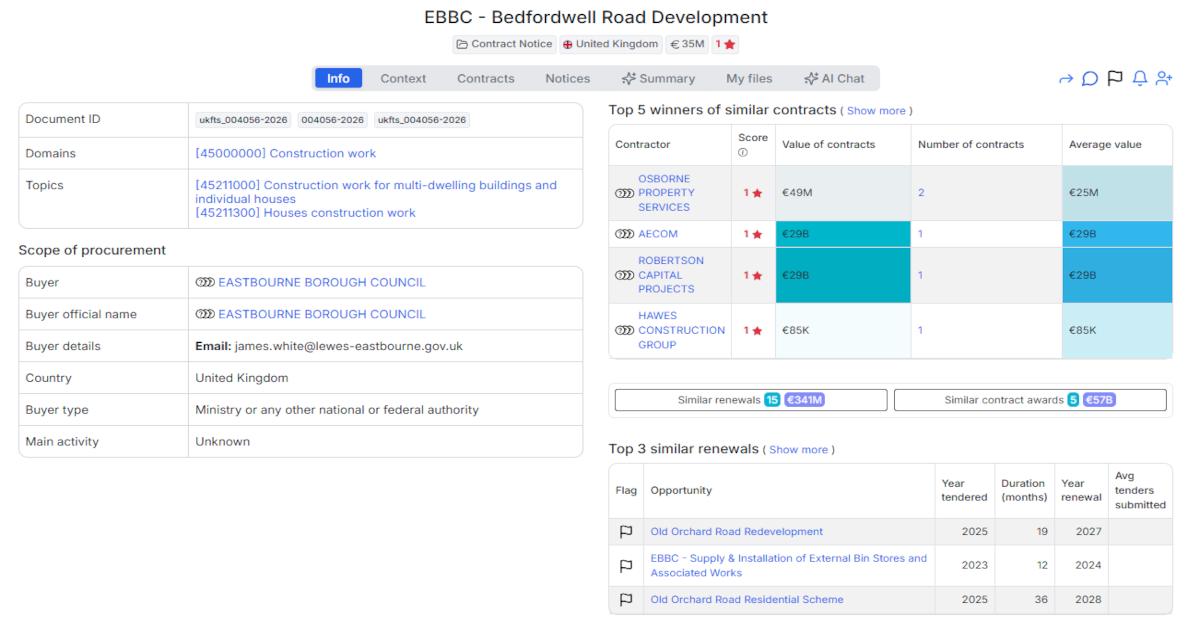
  • Similar Renewals: 15 upcoming renewals worth €341 million
  • No Similar Open Tenders: This is currently the only active major housing construction procurement

The council operates within a broader UK local authority housing construction market where 3,300 similar authorities have residential development needs, collectively representing £528 billion (€625B) in related procurement activity. Successful performance on this Bedfordwell Road scheme could position contractors for future phases of Eastbourne’s housing delivery program and relationships with neighboring East Sussex councils.

Competitive Landscape: Mixed Market with Anomalous Data

Historical contract awards for similar housing construction reveal a small number of completed projects, though data quality issues require careful interpretation.

Winners of Similar Contracts:

  1. CARDO SOUTH – €49M across 2 contracts (€25M average per contract)
  2. AECOM – €29B for 1 contract (€29B) [Data anomaly noted]
  3. ROBERTSON CAPITAL PROJECTS – €29B for 1 contract (€29B) [Data anomaly noted]
  4. HAWES CONSTRUCTION GROUP – €85K for 1 contract

Key Competitive Observations:

Data Quality Note: The reported contract values for AECOM and Robertson Capital Projects (€29 billion each) appear to be data entry or system errors, as these figures vastly exceed reasonable valuations for local authority housing projects. These anomalies likely represent misplaced decimal points or incorrect currency conversions. The realistic competitive landscape focuses on CARDO SOUTH and HAWES CONSTRUCTION GROUP.

Cardo South’s Track Record: With €49 million across 2 contracts averaging €25M each, Cardo South demonstrates proven capability delivering mid-sized housing developments for Eastbourne or similar UK authorities. This places them as the most credible historical benchmark for this £30M Bedfordwell Road scheme.

100% UK Contractor Base: All historical awards (excluding anomalous data) went to UK-based construction firms, indicating either explicit British supply chain preferences, practical requirements for local construction knowledge and building regulations compliance, or simply the competitive dynamics of UK residential construction procurement.

Scale Variation: The presence of both substantial projects (Cardo South’s €25M average) and very small contracts (Hawes Construction Group’s €85K) suggests Eastbourne procures housing construction across varying scales, from major developments to minor refurbishment or enabling works.

Commercial and Procedural Signals

Competitive Flexible Procedure:
This procurement uses the UK’s competitive flexible procedure, allowing the contracting authority to structure the competitive process with flexibility in evaluation stages, negotiation opportunities, and selection methodology. This often enables discussion with bidders to refine proposals around technical delivery, program timing, or value engineering opportunities.

Price-Based Award:
The award criteria specified as “simple description (price)” indicates this contract will be awarded primarily or entirely on pricing rather than quality considerations. For a design-and-build housing scheme, this suggests either:

  • The council has very detailed technical specifications leaving limited room for quality differentiation
  • Price competitiveness is the dominant selection factor
  • The flexible procedure may incorporate quality checks at pre-qualification stage, with price determining the final award among qualified bidders

Bidders should prepare highly competitive pricing while ensuring full compliance with all technical, quality, and regulatory requirements embedded in the specification.

24-Month Build Program:
The two-year contract duration for 100 dwellings plus commercial and heritage components indicates an intensive construction program requiring:

  • Rapid site mobilization and enabling works completion
  • Efficient procurement of materials and subcontractors
  • Parallel work streams to maintain program momentum
  • Careful coordination of heritage refurbishment alongside new-build construction

Lot Structure and Value Discrepancy:
The tender shows an estimated total value of €35.4M but a lot value of only €7.5M. This significant discrepancy may indicate:

  • The lot value represents an initial phase or portion of overall development
  • Multiple lots exist beyond the single lot visible in available documentation
  • Estimated total value includes options, variations, or future phases
  • Data inconsistency in reporting systems

Bidders should seek clarification on the full scope covered by the advertised lot and whether additional work packages or phases are anticipated.

31-Day Procurement Window:
The deadline of February 16 provides 31 days from publication for bid preparation. For a £30M+ design-and-build scheme, this requires immediate mobilization including:

  • Site visits to assess existing conditions and pump house heritage constraints
  • Design team engagement for concept development
  • Subcontractor and supply chain pricing
  • Affordable housing delivery and shared ownership model understanding
  • Remediation strategy development for former depot site

Strategic Context: Affordable Housing and Brownfield Regeneration

This Bedfordwell Road development exemplifies current UK local authority housing delivery priorities: maximizing affordable housing supply while regenerating brownfield sites and respecting heritage assets.

The Affordable Housing Focus:
With 80 of 100 dwellings designated for affordable rent, this scheme directly addresses Eastbourne’s social housing needs. The additional 20 shared ownership units provide intermediate housing options, creating a genuinely mixed-tenure community rather than purely social housing.

Brownfield Regeneration:
Transforming a former municipal depot into housing represents efficient land use, avoiding greenfield development while bringing underutilized brownfield land back into productive use. The remediation component suggests potential contamination or infrastructure challenges typical of former industrial/municipal sites.

Heritage Integration:
The requirement to repair and refurbish retained elements of the existing pump house demonstrates the council’s commitment to preserving local heritage assets within new developments. This adds complexity requiring specialist conservation skills alongside modern housebuilding expertise.

Hermix users analyzing UK housing tenders gain decisive competitive advantages. Rather than manually monitoring Find a Tender Service, researching council procurement histories, and attempting to understand local housing delivery contexts, Hermix delivers instant analysis including historical contractor performance, authority spending patterns, and renewal pipeline intelligence. The platform helps construction firms consistently qualify the right opportunities and win more public sector housing contracts across the UK’s £528 billion local authority construction market.

Create your free account and start winning public contracts, easier.

Practical Takeaways for Bidders

Who This Tender Suits:

  • UK housebuilders with affordable housing delivery track records
  • Design-and-build contractors experienced in mixed-tenure schemes
  • Firms with heritage refurbishment capabilities alongside modern construction
  • Companies with brownfield remediation and site enabling works expertise
  • Contractors with established presence in southeast England construction markets

Critical Attention Points:

Price Competitiveness: With award based on price, your bid must be highly competitive while maintaining realistic margins for risk, program delivery, and quality compliance. Understand that lowest price wins, but ensure you can deliver profitably.

Affordable Housing Standards: The 80 rental units likely require compliance with Homes England affordable housing standards, including space standards, accessibility requirements, and energy performance criteria. Ensure full understanding of all applicable regulatory frameworks.

Heritage Sensitivity: The pump house refurbishment demands specialist conservation expertise. Partner with or employ heritage construction specialists if this isn’t your core strength. Demonstrate understanding of listed building or locally listed structure requirements if applicable.

Remediation Planning: Former depot sites typically present contamination, underground infrastructure, or foundation challenges. Conduct thorough site investigation analysis and price realistic remediation scope with appropriate contingencies.

Program Delivery: Twenty-four months for 100 dwellings requires 4+ completions monthly once construction is underway. Demonstrate robust program planning, subcontractor coordination, and materials procurement strategies to achieve this pace.

Shared Ownership Delivery: The 20 shared ownership units require understanding of this tenure model’s legal, financial, and administrative requirements. Ensure you can coordinate with shared ownership housing providers and comply with relevant schemes.

Create your free Hermix account today at https://hermix.com/sign-up/ and access AI-powered intelligence that transforms UK public sector tender analysis from hours of research into minutes of actionable insight.

UK Eastbourne Borough Council Construction Tender - £30 Million Mixed-Use Housing Development

Wakefield Council UK Public Tender for Care Leavers and Vulnerable Young People Accommodation

A ten-year open framework for 16-25 year olds leaving care accommodation and support services accepts quarterly applications with no supplier limit or contract value guarantees.

Create a free account and see the full public tender details here: https://app.hermix.com/opportunities/ukcf_72f9d15a-071e-45d2-9d83-79233dc7ca49-575671

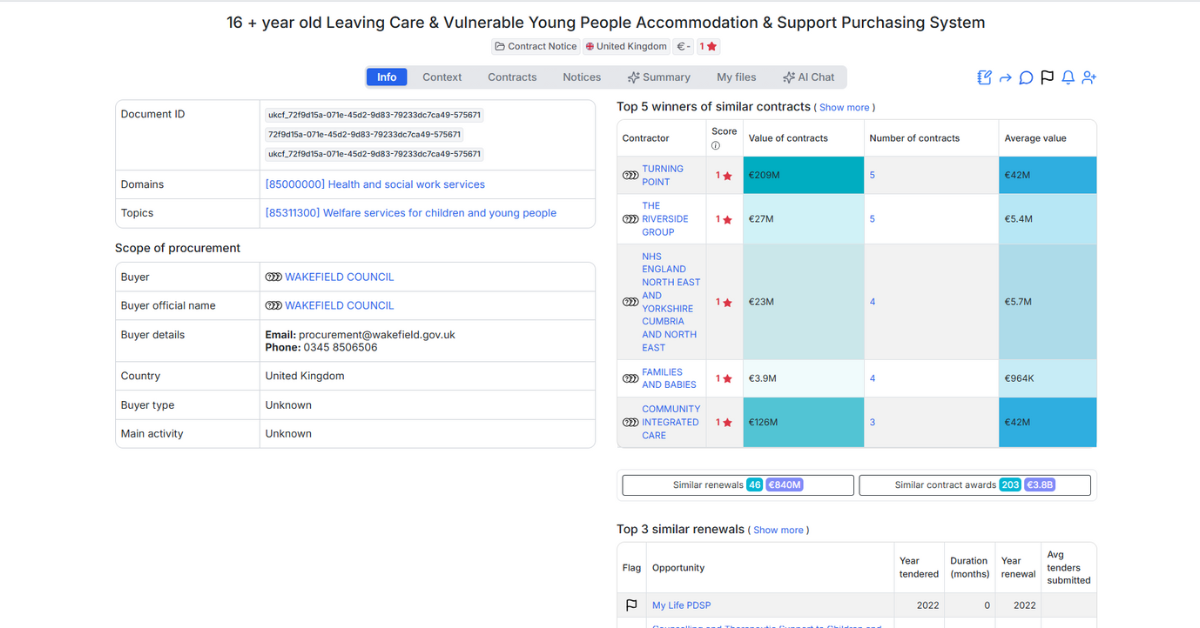
UK public tender: Wakefield Council has established a Pseudo Dynamic Purchasing System for 16-25 Years Leaving Care and Vulnerable Young People Accommodation and Support Services. Published September 28, 2022 with applications accepted until December 31, 2032, this framework secures local provision within Wakefield district and selective neighbouring areas. The PDPS operates in two phases: initial 30-day establishment period for service commencement January 1, 2023, followed by ongoing quarterly application assessments (April, July, October, January). The framework runs initially for five years with an option to extend for an additional five-year period. All applicants meeting qualification criteria for this public tender in UK will be admitted with no competitive process or supplier limit, though admission does not guarantee financial provision.

Create your free account and start winning public contracts, easier.

Opportunity Overview

Contracting Authority: Wakefield Council
Reference Number: 20220928160427-104123
Framework Title: 16 + year old Leaving Care & Vulnerable Young People Accommodation & Support Purchasing System

Framework Structure: Pseudo Dynamic Purchasing System (PDPS) for approved supplier list providing accommodation and support services

Service Scope:

16-25 Years Leaving Care and Vulnerable Young People Accommodation and Support Services within:

  • Wakefield district
  • Selective neighbouring areas

Application Process:

Phase 1 – Initial Establishment:

In the first instance, the Council shall advertise the opportunity to be appointed to a Pseudo DPS for the provision of the 16-25 Years Leaving Care and Vulnerable Young People Accommodation and Support Services.

In order to be appointed, the Applicant must fulfil a range of criteria that assesses their ability to deliver the type of required services. This will include (but is not limited to):

  • Universal requirements such as appropriate Insurance and Financial compliance
  • Request for information regarding the proposed services to be delivered under the 16-25 Years Leaving Care and Vulnerable Young People Accommodation and Support PDPS

Applicants will have 30 days to respond accordingly to the opportunity during the initial establishment of the PDPS, in preparation for the provision of the 16-25 Years Leaving Care and Vulnerable Young People Accommodation and Support Services; to commence on 1st January 2023.

Phase 2 – Ongoing Applications:

Once the PDPS goes live, applications can be submitted HOWEVER it should be noted that applications will be assessed on a quarterly basis – April, July, October and January.

Qualification Requirements:

All Applicants who meet and pass the Application criteria will be admitted to the PDPS.

Important Framework Characteristics:

  • This is not a competitive process
  • There is no limit to the number of Applicants who can be appointed
  • Applicants who are successfully admitted on to the PDPS are not guaranteed to be awarded any financial provision for the duration of this arrangement

Framework Duration: Initially 5 years with option to extend for additional 5 years
Total Potential Duration: 10 years
Service Commencement: January 1, 2023
Contract Type: Services
Procurement Procedure: Other
Contract Duration: 0 months (framework arrangement)
Estimated Total Value: Unknown

Key Dates:

  • Publication: September 28, 2022
  • Application Deadline: December 31, 2032
  • Service Commencement: January 1, 2023
  • Tender Opening: December 31, 2032
  • Status: Open

Application Assessment Schedule:
Quarterly assessments – April, July, October, and January

Contact: procurement@wakefield.gov.uk
Phone: 0345 8506506
Country: United Kingdom
EU Funding: No

Track UK care leavers and vulnerable young people accommodation frameworks automatically. Create your free Hermix account at https://hermix.com/sign-up/ for AI-powered monitoring across social care and accommodation services opportunities.

Buyer Profile and Procurement Activity

Contracting Authority: Wakefield Council
Primary Service Category: Health and social work services
Specific Service Focus: Welfare services for children and young people

Historical Procurement Activity:

  • Total Contract Awards: 668 contracts worth €4.4 billion
  • Similar Contract Awards: 203 contracts totaling €3.8 billion (average: €19M per contract)
  • All Renewals: 147 upcoming renewals worth €1 billion
  • Similar Renewals: 46 upcoming renewals worth €840 million
  • Similar Open Tenders: 4 opportunities worth €161 million
  • All Open Tenders: 4 opportunities worth €161 million
  • Similar Prior Notices: 23 notices worth €358 million
  • All Prior Notices: 65 notices worth €373 million

Competitive Landscape

Historical contract awards show significant contractor participation in health and social work services.

Top Contract Winners:

  1. TURNING POINT – €209M across 5 contracts (€42M average)
  2. COMMUNITY INTEGRATED CARE – €126M across 3 contracts (€42M average)
  3. 1ST ENABLE – €121M across 3 contracts (€40M average)
  4. TURNING POINT SERVICES – €100M across 3 contracts (€33M average)
  5. THE RIVERSIDE GROUP – €27M across 5 contracts (€5.4M average)
  6. NHS ENGLAND NORTH EAST AND YORKSHIRE CUMBRIA AND NORTH EAST – €23M across 4 contracts (€5.7M average)
  7. NOVA WAKEFIELD DISTRICT – €10M across 3 contracts (€3.3M average)
  8. FAMILIES AND BABIES – €3.9M across 4 contracts (€964K average)
  9. CONEXUS HEALTHCARE – €3M across 3 contracts (€990K average)
  10. WELL – €222K across 3 contracts (€74K average)

Contractor Geography:
All 201 similar contract awards (€3.8B total, €19M average) were awarded to United Kingdom-based contractors.

Framework Structure and Application Process

Pseudo Dynamic Purchasing System Characteristics:

Wakefield Council is looking to establish its own Pseudo DPS to secure local provision of accommodation and support within the Wakefield district and selective neighbouring areas.

Two-Phase Implementation:

Phase 1: Initial Establishment

The Council shall advertise the opportunity to be appointed to a Pseudo DPS for the provision of the 16-25 Years Leaving Care and Vulnerable Young People Accommodation and Support Services.

Applicants will have 30 days to respond accordingly to the opportunity during the initial establishment of the PDPS, in preparation for the provision of the 16-25 Years Leaving Care and Vulnerable Young People Accommodation and Support Services; to commence on 1st January 2023.

Phase 2: Ongoing Applications

Once the PDPS goes live, applications can be submitted HOWEVER it should be noted that applications will be assessed on a quarterly basis – April, July, October and January.

Qualification Process:

In order to be appointed, the Applicant must fulfil a range of criteria that assesses their ability to deliver the type of required services. This will include (but is not limited to):

  • Universal requirements such as appropriate Insurance and Financial compliance
  • Request for information regarding the proposed services to be delivered under the 16-25 Years Leaving Care and Vulnerable Young People Accommodation and Support PDPS

All Applicants who meet and pass the Application criteria will be admitted to the PDPS.

Critical Framework Features:

  • This is not a competitive process
  • There is no limit to the number of Applicants who can be appointed
  • Applicants who are successfully admitted on to the PDPS are not guaranteed to be awarded any financial provision for the duration of this arrangement

Framework Duration:

The PDPS will initially run for a period of 5 years with the option to extend for an additional 5 year period.

Service Requirements

Target Population:

16-25 Years Leaving Care and Vulnerable Young People

Service Categories:

Accommodation and Support Services

Geographic Coverage:

  • Wakefield district
  • Selective neighbouring areas

Service Delivery Requirements:

Applicant must fulfil a range of criteria that assesses their ability to deliver the type of required services.

Application Considerations

Timing:

Applications assessed on a quarterly basis following initial establishment:

  • April
  • July
  • October
  • January

Qualification Criteria:

Universal requirements such as appropriate Insurance and Financial compliance, plus information regarding proposed services to be delivered.

Non-Competitive Nature:

This is not a competitive process and there is no limit to the number of Applicants who can be appointed.

Financial Provision:

Applicants who are successfully admitted on to the PDPS are not guaranteed to be awarded any financial provision for the duration of this arrangement.

Framework Access:

All Applicants who meet and pass the Application criteria will be admitted to the PDPS.

Conclusion

Wakefield Council’s Pseudo Dynamic Purchasing System for 16-25 Years Leaving Care and Vulnerable Young People Accommodation and Support Services provides open access framework opportunity for accommodation and support service providers. The non-competitive qualification process with no supplier limit enables all qualifying organizations to join the approved supplier list, though framework admission does not guarantee financial provision. The quarterly application assessment schedule (April, July, October, January) provides ongoing access throughout the potential ten-year framework lifespan.

Hermix simplifies tracking of UK care leavers and vulnerable young people accommodation opportunities. Access automated monitoring and framework alerts. Create your free account at https://hermix.com/sign-up/ and secure more social care contracts.

16 + year old Leaving Care & Vulnerable Young People Accommodation & Support Purchasing System


Midland Heart Public Tender: €44 Million Dynamic Purchasing System for Housing Maintenance Services

A €44 million nine-year framework across seven maintenance categories accepts ongoing supplier applications until July 2029 for three-year contract awards.

Create a free account and see the full public tender details here: https://app.hermix.com/opportunities/325161-2020/summary

Midland Heart has established a €44,408,227 Dynamic Purchasing System for In House Maintenance Team and Assets support. Published July 10, 2020 with applications accepted until July 30, 2029, this framework creates an approved supplier list across seven lots covering cleaning, general repairs, glazing, electrical, drainage, roofing, and groundworks services. The DPS structure allows suppliers to apply at any time while the framework remains live, with unsuccessful applicants permitted to reapply if circumstances change. Individual contracts of three years will be competed and awarded through the DPS, with values based on historic spend patterns.

Create your free account and start winning public contracts, easier.

Opportunity Overview

Contracting Authority: Midland Heart
Official Name: Midland Heart Dynamic Purchasing System (DPS) — Contracting services for the In House Maintenance team
Reference Number: MHL-DPS1
Framework Structure: Dynamic Purchasing System forming approved supplier list for reactive and planned asset management support

Lot Breakdown:

Lot 1 – Clean and Clearance: €4,552,096.21
Historic annual spend: Approximately £450,000 (excl. VAT)
Scope: External clearance, internal cleaning and clearance, disposal of previous customers waste/rubbish, external communal clearance, graffiti removal, environmental cleaning, prior to let cleaning

Lot 2 – General Repairs and Void Works: €19,219,961.78
Historic annual spend: Approximately £1,900,000 (incl. VAT)
Scope: Responsive repairs including empty properties (voids), however not major works. General building maintenance contractors undertaking all types of internal and low level external domestic repairs including:

  • Plumbing
  • Joinery and carpentry (including UPVC) (first and second fix)
  • Plastering and rendering
  • Flooring
  • Tiling
  • Masonry and brick/blockwork (ground level/internal)

Lot 3 – Glazing and UPVC: €2,427,784.65
Historic annual spend: Approximately £240,000 (excl. VAT)
Scope: Responsive repairs including empty properties (voids). All types of internal and external glazing repairs including making safe and boarding over, single pane re-glazing, double glazed units, perspex and protective film. UPVC maintenance and responsive repairs including all UPVC joinery and carpentry.

Lot 4 – Electrical: €5,563,673.15
Historic annual spend: Approximately £550,000 (excl. VAT)
Scope: Responsive repairs including empty properties (voids). Day to day general repairs to all types of domestic electrical installations including:

  • Electric space, point and water heating appliances
  • Electrical appliances
  • Electric ventilation
  • Lighting and power circuits
  • Final circuits
  • Light fittings
  • Electrical accessories
  • Alarms and other installations
  • Communal lighting
  • Temporary connections
  • Earthing
  • Testing

Lot 5 – Drainage: €3,034,730.81
Historic annual spend: Approximately £300,000 (excl. VAT)
Scope: Responsive repairs including empty properties (voids). Drainage contractors undertaking all types of internal and external drainage repairs, jetting and CCTV surveys.

Lot 6 – Roofing: €8,092,615.49
Historic annual spend: Approximately £800,000 (excl. VAT)
Scope: Responsive repairs including empty properties (voids). Roofing maintenance contractor undertaking remedial repairs to pitched and flat roofs and all types of repairs for both tiled and felt roofs.

Lot 7 – Ground Works: €1,517,365.40
Historic annual spend: Approximately £150,000 (excl. VAT)
Scope: Contractors completing ground works at Midland Heart occupied and unoccupied sites (voids) including:

  • Fencing repairs
  • Laying of slabs
  • Wall repair or rebuild

Total Framework Value: €44,408,227.49
Framework Duration: 108 months (July 2020 – July 2029)
Individual Contract Duration: 3 years (awarded through the DPS)
Contract Type: Services
Procurement Procedure: Restricted
Award Criteria: The most economic tender
Place of Performance: United Kingdom

Key Dates:

  • Publication: July 10, 2020
  • Application Deadline: July 30, 2029
  • Status: Open

Application Process:
Complete and submit the DPS standard questionnaire through In-Tend. Suppliers will be advised if they have been approved onto the DPS or not through the In-Tend portal. Suppliers can apply at any time to be an approved supplier while the DPS is live. If a supplier is unsuccessful they can re-apply if their circumstances change. Approved suppliers can bid for contracts advertised through the DPS.

Contact: Emily Rogers
Email: emily.rogers@midlandheart.org.uk
Website: https://www.midlandheart.org.uk/about-us/supply-to-us/

Buyer Type: Body governed by public law
Main Activity: Housing and community amenities
EU Funding: No

Important Disclaimer: The estimated contract value is for the life of the DPS. Contracts of 3 years will be competed and awarded through the DPS. The values indicated are based on historic spend and Midland Heart does not guarantee the value of contracted work.

Track UK housing maintenance framework opportunities automatically.

Create your free Hermix account at https://hermix.com/sign-up/ for AI-powered monitoring across social housing maintenance contracts.

Buyer Profile and Procurement Activity

Contracting Authority: Midland Heart
Buyer Classification: Body governed by public law
Primary Activity: Housing and community amenities

Historical Procurement Activity:

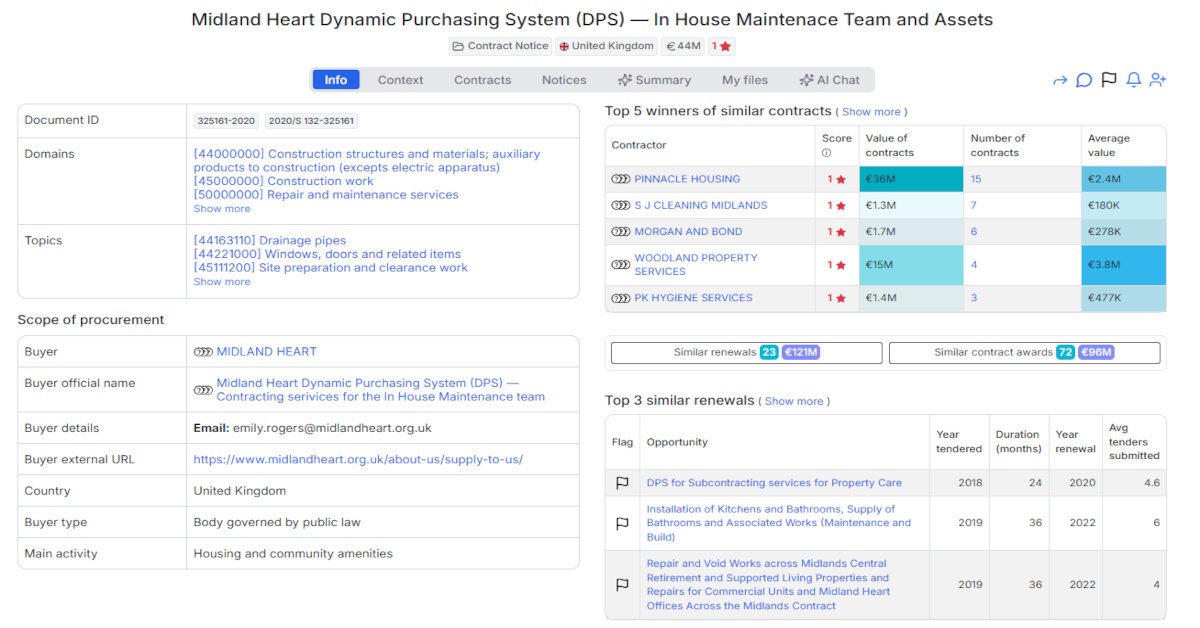
  • Total Contract Awards: 195 contracts worth €210 million
  • Similar Contract Awards: 72 contracts totaling €96 million (average: €1.3M per contract)
  • All Renewals: 46 upcoming renewals worth €286 million
  • Similar Renewals: 23 upcoming renewals worth €121 million
  • Similar Prior Notices: 25 notices worth €659 million
  • All Prior Notices: 30 notices worth €671 million

Competitive Landscape

Historical contract awards show diverse contractor participation across maintenance categories.

Top Contract Winners:

  • PINNACLE HOUSING – €36M across 15 contracts (€2.4M average)
  • WOODLAND PROPERTY SERVICES – €15M across 4 contracts (€3.8M average)
  • J TOMLINSON – €9M across 1 contract
  • STEBRO FLOORING COMPANY – €3.4M across 2 contracts (€1.7M average)
  • MORGAN AND BOND – €1.7M across 6 contracts (€278K average)
  • PK HYGIENE SERVICES – €1.4M across 3 contracts (€477K average)
  • S J CLEANING MIDLANDS – €1.3M across 7 contracts (€180K average)
  • FORTEM SOLUTIONS – €1M across 2 contracts (€513K average)
  • LAKER BUILDING MANAGEMENT SOLUTIONS – €283K across 2 contracts (€141K average)
  • ASTOR BANNERMAN MEDICAL – €122K across 2 contracts (€61K average)

Contractor Geography:
All 72 similar contract awards (€96M total, €1.3M average) were awarded to United Kingdom-based contractors.

Framework Structure and Award Process

Dynamic Purchasing System Characteristics:

The DPS remains live until July 2029. Suppliers can apply at any time to be an approved supplier while the DPS is live. If a supplier is unsuccessful they can re-apply if their circumstances change.

Contract Award Process:

Midland Heart will compete and award contracts of 3 years through the DPS. Approved suppliers can bid for contracts advertised through the DPS. Award criteria is “the most economic tender” for all seven lots.

Framework Timeline:

The framework was published July 10, 2020 and accepts applications until July 30, 2029—a 108-month period. Five years into the nine-year term, suppliers can still apply for approval and compete for upcoming three-year contract awards.

Lot-Specific Details

Lot 1 – Clean and Clearance (€4,552,096.21)

Midland Heart’s In House Maintenance Team has typically spent around £450,000 (excl. VAT) per year.

This lot is all clearance work including but not limited to:

  • External clearance
  • Internal cleaning and clearance
  • Disposal of previous customers waste/rubbish
  • External communal clearance
  • Graffiti removal
  • Environmental cleaning
  • Prior to let cleaning

Place of performance: United Kingdom
Award criteria: The most economic tender

Lot 2 – General Repairs and Void Works (€19,219,961.78)

Midland Heart’s In-House Maintenance Team has historically spent around £1,900,000 (including VAT) per year on general building maintenance contractors’ services.

This work contains responsive repairs including empty properties (voids), however not major works. General building maintenance contractors who can undertake all types of internal and low level external domestic repairs. These contractors will provide additional resources to In House Maintenance team.

The following types of day to day and general repairs to domestic properties are expected to be required:

  • Plumbing
  • Joinery and carpentry (including UPVC) (first and second fix)
  • Plastering and rendering
  • Flooring
  • Tiling
  • Masonry and brick/blockwork (ground level/internal)

Place of performance: United Kingdom
Award criteria: The most economic tender

Lot 3 – Glazing and UPVC (€2,427,784.65)

Midland Heart’s In House Maintenance teams has historically spent around £240,000 (excl. VAT) per year on both UPVC and glazing services.

This is for responsive repairs which will include empty properties (voids). Midland Heart require contractors who can undertake all type of internal and external glazing repairs such as:

  • Making safe and boarding over
  • Single pane re-glazing
  • Double glazed units
  • Perspex and protective film

Contractors will also need to be able to undertake UPVC maintenance and responsive repairs including all UPVC joinery and carpentry.

Place of performance: United Kingdom
Award criteria: The most economic tender

Lot 4 – Electrical (€5,563,673.15)

Midland Heart’s In House Maintenance Team has historically spent approximately £550,000 per year on electrical contractors’ services (excl. VAT).

This works is for responsive repairs including empty properties (voids). Midland Heart requires day to day general repairs to all types of domestic electrical installations including but not limited to:

  • Electric space, point and water heating appliances
  • Electrical appliances
  • Electric ventilation
  • Lighting and power circuits
  • Final circuits
  • Light fittings
  • Electrical accessories
  • Alarms and other installations
  • Communal lighting
  • Temporary connections
  • Earthing
  • Testing

Place of performance: United Kingdom
Award criteria: The most economic tender

Lot 5 – Drainage (€3,034,730.81)

Midland Heart’s In House Maintenance Team has historically spent approximately £300,000 (excl. VAT) per year on drainage services.

This work contains responsive repairs including empty properties (voids) requiring drainage contractors who can undertake all types of internal and external drainage repairs, jetting and CCTV surveys.

Place of performance: United Kingdom
Award criteria: The most economic tender

Lot 6 – Roofing (€8,092,615.49)

Midland Heart’s In House Maintenance Team has typically spent around £800,000 (excl. VAT) per year on roofing repairs services.

The works are responsive repairs including empty properties (voids). Midland Heart requires a roofing maintenance contractor who can undertake remedial repairs to pitched and flat roofs and all types of repairs for both tiled and felt roofs.

Place of performance: United Kingdom
Award criteria: The most economic tender

Lot 7 – Ground Works (€1,517,365.40)

Midland Heart’s In House Maintenance Team requires contractors to complete ground works at Midland Heart occupied and unoccupied sites (voids). The anticipated value per year is approximated at £150,000 (excl. VAT)

Midland Heart’s In House Maintenance Team requires contractors to complete works such as:

  • Fencing repairs
  • Laying of slabs
  • Wall repair or rebuild

Place of performance: United Kingdom
Award criteria: The most economic tender

Practical Considerations for Suppliers

Application Timing:

Suppliers can apply at any time to be an approved supplier while the DPS is live. The framework accepts applications until July 30, 2029.

Re-application Rights:

If a supplier is unsuccessful they can re-apply if their circumstances change.

Contract Participation:

Approved suppliers can bid for contracts advertised through the DPS. Contracts of 3 years will be competed and awarded through the DPS.

Value Guarantee:

The values indicated are based on historic spend and Midland Heart does not guarantee the value of contracted work.

Submission Portal:

Complete and submit the DPS standard questionnaire through In-Tend. Suppliers will be advised if they have been approved onto the DPS or not through the In-Tend portal.

Create your free account and start winning public contracts, easier.

Conclusion

Midland Heart’s €44,408,227 Dynamic Purchasing System provides ongoing access to housing maintenance contracts across seven specialist service categories. The framework remains open for applications until July 2029, with three-year contracts awarded through competitive mini-competitions among approved suppliers. Historic annual spend patterns range from £150,000 for ground works to £1.9 million for general repairs and void works, though Midland Heart does not guarantee contracted work values.

Hermix simplifies tracking of UK housing association frameworks and maintenance opportunities. Access automated monitoring and competitive intelligence. Create your free account at https://hermix.com/sign-up/ and secure more public sector contracts.

Midland Heart Public Tender - €44 Million - Dynamic Purchasing System for Housing - Maintenance Services

NHS South East Healthcare Public Tender: £13.5 Million Specialist Eye Care Service

An 84-month framework across five regional lots signals strategic NHS investment in reducing health inequalities for children with special educational needs through school-based sight testing and spectacle dispensing.

Create a free account and see the full public tender details here: https://app.hermix.com/opportunities/ukcf_7736a3c3-2b23-4327-a6d8-20fa5c6a813f-877944

NHS South, Central and West Commissioning Support Unit has published a £13.5 million (€18.9M) tender for comprehensive sight testing and spectacle dispensing services targeting children and young people with Special Educational Needs and Disabilities (SEND) across southeast England. With a February 6, 2026 deadline and contracts running for up to seven years, this procurement represents one of the UK’s most significant investments in accessible ophthalmology services for vulnerable young people.

The framework encompasses five geographic lots covering Thames Valley, Hampshire and Isle of Wight, Kent and Medway, Surrey, and Sussex, providing services directly within Special Educational Settings rather than requiring families to navigate traditional high-street optometry. The commissioning unit’s procurement history of 987 contracts worth £1.7 billion (€2.0B), combined with 119 upcoming renewals valued at £2.5 billion (€3B), positions this as part of a broader NHS commitment to reducing health inequalities through innovative service delivery models.

Create your free account and start winning public contracts, easier.

Opportunity Overview

Contracting Authority: NHS South, Central and West Commissioning Support Unit
Reference Number: C401955
Tender Title: Sight Testing and Dispensing of Spectacles to Children and Young People in Special Educational Settings across the South East

Service Scope:
Providers will deliver annual sight testing and spectacle dispensing services directly within Special Educational Settings for children and young people with autism and/or learning disabilities. Evidence from the 2021 NHS England Proof of Concept programme demonstrated this in-school delivery model is both effective and impactful for populations facing significant barriers to accessing routine eye care.

Service Components:

  • Annual sight tests for eligible SEND children in school settings (unless clinically inappropriate)
  • Spectacle dispensing and fitting services delivered on-site
  • Timely identification and management of vision needs
  • Coordination with educational staff and healthcare professionals
  • Reduction of health inequalities through accessible service delivery

Geographic Coverage (5 Lots):

Lot 1: Thames Valley
Buckinghamshire, Oxfordshire, Berkshire West, Berkshire East

  • 5-year value: £2,355,000
  • 7-year value (with extension): £3,297,000

Lot 2: Hampshire and Isle of Wight
Including North East Hampshire

  • 5-year value: £2,180,000
  • 7-year value (with extension): £3,052,000

Lot 3: Kent and Medway

  • 5-year value: £3,265,000
  • 7-year value (with extension): £4,571,000

Lot 4: Surrey
Including Surrey Heath and Farnham

  • 5-year value: £1,625,000
  • 7-year value (with extension): £2,275,000

Lot 5: Sussex

  • 5-year value: £1,980,000
  • 7-year value (with extension): £2,772,000

Total Framework Value: £11,405,000 (5 years) / £15,967,000 (with 2-year extension) = €18,859,700.93

Contract Duration: 60 months initial term with optional 24-month extension (84 months total)
Service Commencement: 2026
Procedure Type: Open procedure (above threshold)

Key Dates:

  • Publication: January 5, 2026
  • Submission Deadline: February 6, 2026 at 12:00 noon (32 days from publication)
  • Tender Opening: February 6, 2026

EU Funding: No

Submission Portal: Atamis e-procurement system at https://health-family.force.com/s/Welcome

Looking to win NHS healthcare service contracts faster? Create your free Hermix account at https://hermix.com/sign-up/ and access AI-powered tender analysis, competitive intelligence, and automated monitoring across the UK’s NHS procurement market.

Authority Profile: NHS Commissioning and SEND Service Innovation

NHS South, Central and West Commissioning Support Unit operates as a specialized procurement and commissioning body serving multiple Integrated Care Boards (ICBs) across southeast England. This tender supports six ICBs currently, consolidating to four from April 1, 2026, through planned mergers: NHS Thames Valley ICB, Hampshire and Isle of Wight ICB, Kent and Medway ICB, and Surrey and Sussex ICB.

Overall Procurement Activity:

  • Total Contract Awards: 987 contracts worth €2.0 billion
  • Active Tender Pipeline: 1 open tender valued at €5,600
  • Renewal Forecast: 119 potential renewals worth €3 billion

Health Services Procurement:

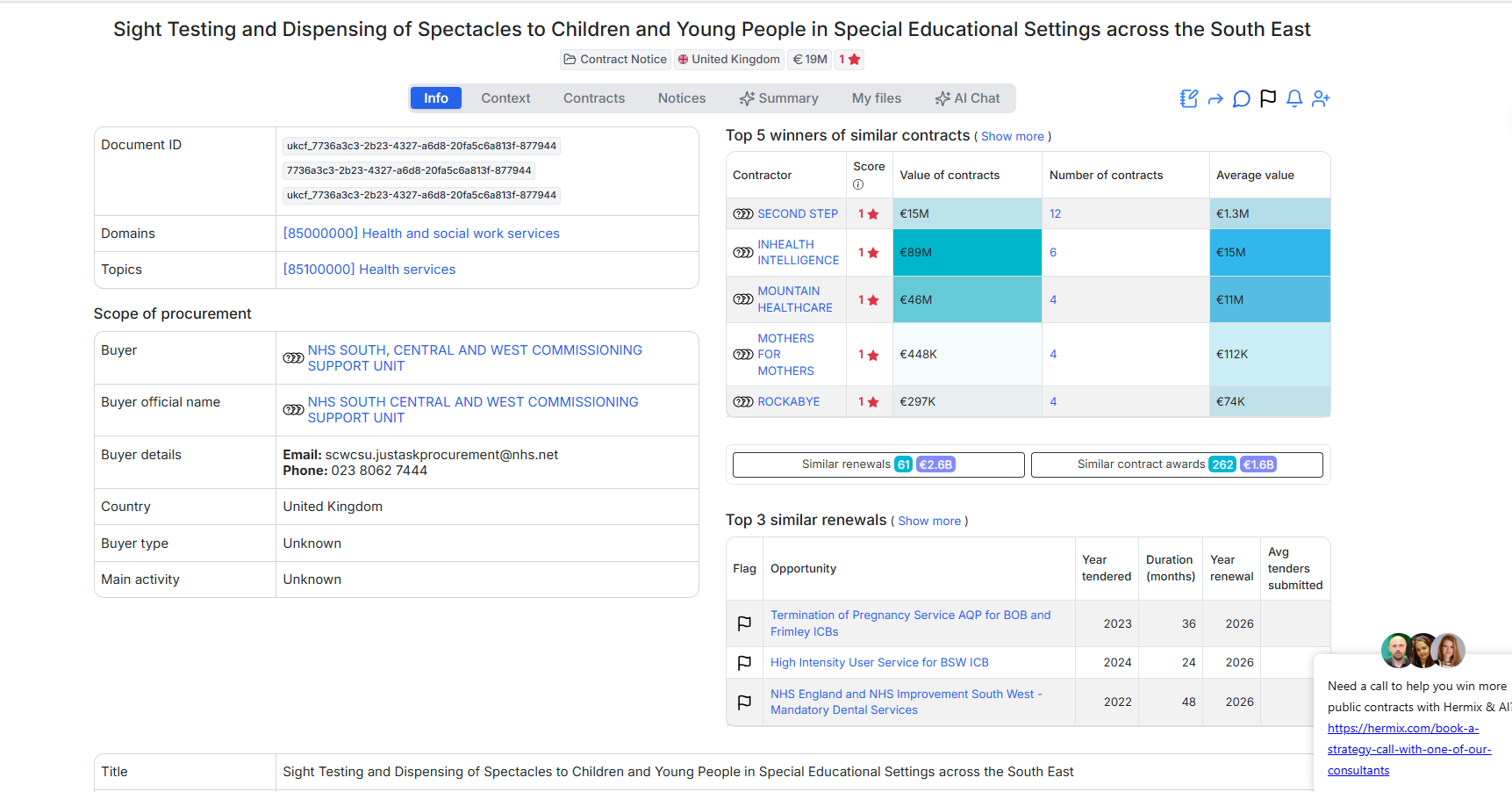
  • Similar Contract Awards: 262 contracts totaling €1.6 billion (average: €6.1M per contract)
  • Similar Renewals: 60 upcoming renewals worth €2.6 billion
  • Prior Notices: 86 similar prior notices worth €65 million

The commissioning unit operates within a broader UK NHS health services market where 5,700 similar authorities have ophthalmology and SEND service needs, collectively representing £570 billion (€675B) in related procurement. This positions successful bidders not only for this southeast framework but potentially for similar SEND eye care services being rolled out nationally following the 2021 Proof of Concept programme.

Competitive Landscape: Diverse Healthcare and Social Service Providers

Historical contract awards for similar health services reveal a mixed market of NHS trusts, private healthcare providers, and specialized social care organizations.

Top Contract Winners (Similar Services):

  1. SECOND STEP – €15M across 12 contracts (€1.3M average)
  2. INHEALTH INTELLIGENCE – €89M across 6 contracts (€15M average)
  3. MOUNTAIN HEALTHCARE – €46M across 4 contracts (€11M average)
  4. MOTHERS FOR MOTHERS – €448K across 4 contracts (€112K average)
  5. ROCKABYE – €297K across 4 contracts (€74K average)
  6. OXLEAS NHS FOUNDATION TRUST – €347M across 3 contracts (€116M average)
  7. SOMERSET NHS FOUNDATION TRUST – €27M across 3 contracts (€9.1M average)
  8. NEC SOFTWARE SOLUTIONS UK – €26M across 3 contracts (€8.8M average)
  9. ST MUNGO’S – €4.7M across 3 contracts (€1.6M average)
  10. EPIC CONSULTANTS – €786K across 3 contracts (€262K average)

Key Competitive Observations:

Diverse Provider Types: The competitive landscape includes NHS Foundation Trusts (Oxleas, Somerset), private healthcare companies (InHealth Intelligence, Mountain Healthcare), social care charities (Second Step, St Mungo’s), and maternity/family support organizations (Mothers for Mothers, Rockabye). This diversity suggests the commissioning unit values different organizational models for different service types.

Scale Variation: Contract values range from under €500K (Mothers for Mothers, Rockabye) to over €300M (Oxleas NHS Foundation Trust), indicating procurement across vastly different service scopes. For this SEND eye care tender, mid-tier healthcare providers like InHealth Intelligence (€15M average) or Mountain Healthcare (€11M average) represent the most relevant benchmarks.

100% UK Provider Base: All 262historical contractors are UK-based, with an average contract value of €6.1M. This suggests strong domestic supply chain preferences, regulatory requirements favoring UK-registered healthcare providers, or practical necessities around CQC registration and NHS operational integration.

Repeat Business Patterns: Second Step’s 12 contracts and InHealth Intelligence’s 6 contracts demonstrate sustained relationships with the commissioning unit, suggesting performance quality and contract compliance drive renewal opportunities.

Commercial and Procedural Signals

Open Procedure Above Threshold: This tender follows standard EU-derived UK public procurement rules for healthcare services above financial thresholds, ensuring transparent, non-discriminatory competition open to all qualified providers.

General Ophthalmic Additional Services Model Contract: The tender specifies use of this NHS standard contract for Special Educational Settings, providing established terms, conditions, and service level frameworks. Bidders should familiarize themselves with this model contract’s requirements before submission.

TUPE Assessment: The commissioners state their view that Transfer of Undertakings (Protection of Employment) Regulations 2006 do not apply, as this represents new service provision rather than transfer of existing staff. However, bidders must conduct independent TUPE assessments and price accordingly.

Multi-Lot Bidding Strategy: Providers can bid for one, several, or all five lots. Geographic presence, service capacity, and optometry workforce availability across the southeast will determine optimal lot selection strategies.

Contract Amendment Flexibility: The tender explicitly notes contracts may be amended during the term to reflect co-commissioning arrangements, mandated directives, or service changes with associated funding adjustments, providing flexibility for service evolution.

Tight Deadline: The 32-day window from publication (January 5) to deadline (February 6 at noon) requires immediate mobilization including understanding SEND populations across each lot’s geography, optometry capacity planning, and partnership development with Special Educational Settings.

Strategic Context: Addressing SEND Health Inequalities

This procurement reflects NHS England’s national commitment to reducing health inequalities for children with special educational needs and disabilities, a population facing significant barriers to accessing routine healthcare including eye care.

Evidence-Based Service Model: The 2021 NHS England Proof of Concept programme demonstrated that delivering sight tests directly within Special Educational Settings dramatically improves access for SEND children who might otherwise miss routine eye care due to anxiety, communication challenges, or family barriers to attending high-street opticians.

Educational Outcomes Link: Unidentified vision problems directly impact educational attainment. By ensuring annual sight tests and timely spectacle provision for SEND children, this service aims to improve both health outcomes and educational engagement.

Hermix users analyzing NHS tenders gain immediate advantages. The platform delivers instant competitive intelligence on all 10 historical contractors, authority spending pattern analysis, and renewal pipeline visibility across 119 upcoming opportunities worth €3 billion. Rather than manually researching NHS procurement frameworks and contractor track records, Hermix provides AI-powered analysis that helps healthcare providers consistently qualify the right opportunities and win more public sector contracts.

Create your free account and start winning public contracts, easier.

Practical Takeaways for Bidders

Who This Tender Suits:

  • Optometry practices with mobile/outreach service capabilities
  • Private healthcare providers specializing in pediatric ophthalmology
  • Organizations experienced in SEND service delivery
  • Providers with established relationships with Special Educational Settings
  • Multi-location optometry groups with southeast England presence

Critical Attention Points:

SEND Expertise: Successful delivery requires understanding autism spectrum conditions, learning disabilities, and communication adjustments necessary for effective sight testing with vulnerable children. Demonstrate staff training, experience, and person-centered care approaches.

School-Based Delivery Model: Services must be delivered within Special Educational Settings, requiring mobile equipment, flexible scheduling around school routines, and effective liaison with teaching staff and SENCOs (Special Educational Needs Coordinators).

Geographic Coverage: Each lot covers substantial geography requiring either multiple clinic locations, mobile service teams, or partnership arrangements to ensure timely access across all schools within the region.

Annual Service Volumes: With thousands of SEND children across each lot’s geography, plan workforce capacity for systematic annual testing cycles while maintaining quality and child-centered approaches.

Multi-Lot Strategy: Carefully assess which lots match your operational footprint and capacity. Bidding all five lots requires demonstrating substantial optometry workforce and operational infrastructure across the entire southeast.

Create your free Hermix account today at https://hermix.com/sign-up/ and transform NHS tender analysis from days of research into minutes of actionable intelligence that wins more public healthcare contracts.

Sight Testing and Dispensing of Spectacles to Children and Young People in Special Educational Settings across the South East


Hessen €9.5M Public Tender: SAP Human Capital Management Support Framework

German state seeks comprehensive operational, consulting and development services for SAP HCM reference model serving public administration across Hesse.

Create a free account and see the full public tender details here: https://app.hermix.com/opportunities/00043265-2026

Germany’s federal states manage some of Europe’s most complex public sector HR systems, and Hessen, with 6.3 million residents and one of Germany’s largest education systems, sits at the center of this administrative challenge. The Hessische Zentrale für Datenverarbeitung (HZD), the state’s central data processing agency, has opened a €9.5 million framework for SAP Human Capital Management support services. With 1,750 person-days required annually and custom components serving tens of thousands of public employees, this contract represents one of the most substantial SAP HCM opportunities in German public administration this year.

Create your free account and start winning public contracts, easier.

The Opportunity

Contract value: €9,499,000.00
Duration: 12 months (extendable to maximum 4 years)
Buyer: Land Hessen (State of Hesse), represented by Hessische Zentrale für Datenverarbeitung
Location: Wiesbaden, Hesse
Deadline: 20 February 2026
Procedure: Open
Language: German only

This public tender in Germany covers operational support, strategic consulting, and development services for the Hessian SAP state reference model (LRM HR). Services encompass the full SAP HCM suite including Personnel Administration (PA), Organization Management (OM), Position Planning Management (SPM), Time Management (PT), Event Management (VM), Personnel Recruitment and Development (PB, PE), Personnel Cost Planning (PKPL), Travel Management (TM), Payroll (PY), and Pension Administration (VADM).

Technical scope includes ESS applications such as e-Recruiting and absence management, Electronic Personnel File, print and output management, authorization management, programming, Learning Solution, HANA transformation, artificial intelligence implementation, and mobile ESS processes on the Business Technology Platform (BTP).

Special emphasis falls on supporting the Hessian Ministry of Education (Kultusministerium) with custom SAP components including PPB (Personnel and Budget Planning), BeKA (Demand, Capacity and Work Planning for study seminars), and VMQUAK (SAP Event, Qualification and Accreditation Management). These custom solutions require adaptation for HANA transformation and migration to future-oriented platforms aligned with SAP’s development strategy.

Estimated workload: 1,750 person-days per year, totaling 7,000 person-days over the maximum 4-year contract period.

Ready to monitor German SAP HCM opportunities? Create your free account at https://hermix.com/sign-up/ to track tenders across European public sector IT services.

Authority Background and SAP HCM Context

Buyer characteristics:

  • Entity: Land Hessen, represented by Hessische Zentrale für Datenverarbeitung (HZD)
  • Type: Regional government agency
  • Main activity: General public services, central data processing for Hesse
  • Location: Wiesbaden, Hesse’s capital city
  • Population served: 6.3 million residents across Hesse
  • Public sector workforce: Tens of thousands of employees across state ministries, education system, and public administration
  • System landscape: Multiple SAP systems in HCM environment, service portal, and interconnected system landscapes

The Hessische Zentrale für Datenverarbeitung functions as Hesse’s central IT service provider, managing digital infrastructure and applications for state government operations. This includes the Hessian SAP state reference model (Landesreferenzmodell), a standardized SAP implementation serving multiple state agencies with shared processes and custom components.

The Ministry of Education represents the largest user base, managing personnel administration, payroll, and specialized processes for teachers, administrators, and education professionals across Hesse’s comprehensive school system. Custom applications like VMQUAK handle qualification management and professional development for educators, while BeKA manages capacity planning for teacher training seminars (Studienseminare).

The authority’s technical environment includes both SAP Backend systems and the Service Portal, with ongoing transformation to HANA database technology and migration of custom solutions to modern platforms including the Business Technology Platform (BTP). This represents significant technical complexity requiring vendors with deep SAP HCM expertise and experience managing custom developments through platform migrations.

Procurement context:
Similar SAP HCM frameworks in German public administration typically run 3-4 years with option years, supporting continuous operational requirements while allowing periodic market testing. The estimated 1,750 person-days annually suggests a mid-sized support team of 7-9 full-time equivalents, indicating substantial ongoing requirements for incident management, change management, and development projects.

Competitive Landscape: SAP HCM Specialists Dominate

The competitive analysis reveals a market dominated by specialized SAP service providers with deep public sector experience, predominantly German-based firms with minimal cross-border competition.

Market leaders by contract value:

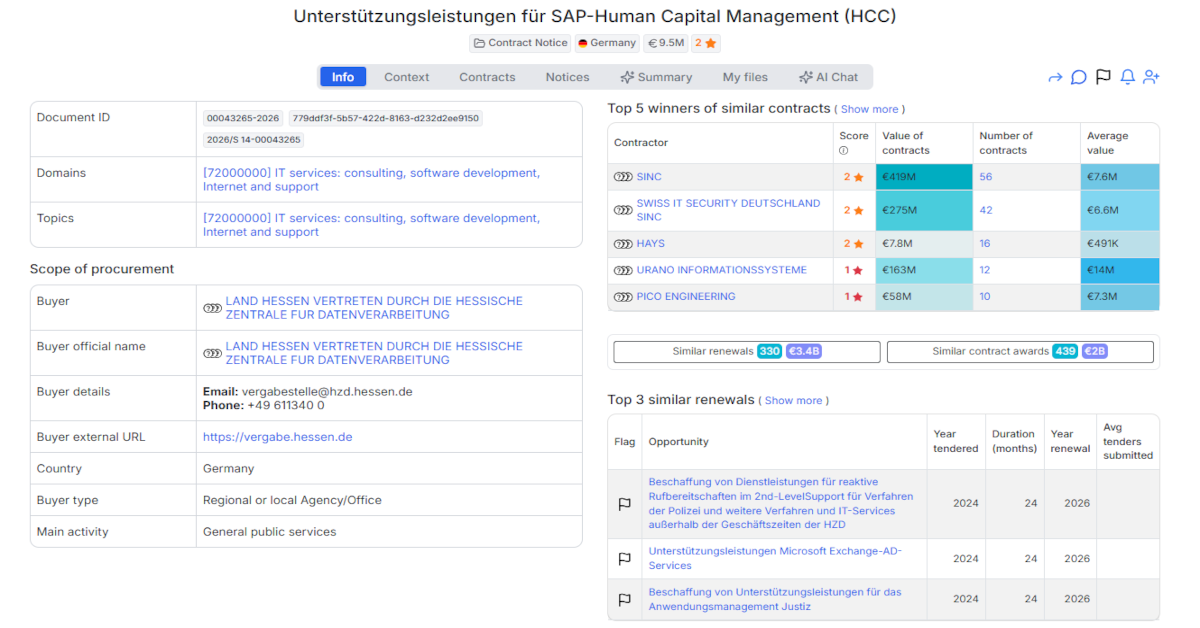
SINC leads decisively with €419 million across 56 contracts (€7.6 million average), representing the strongest position in German public sector SAP services. SINC’s portfolio spans multiple SAP modules with particular strength in complex custom development and HANA migrations.

Swiss IT Security Deutschland SINC follows with €275 million across 42 contracts (€6.6 million average). Despite the Swiss parent company name, operations are Germany-based, specializing in secure SAP implementations for government clients with stringent data protection requirements.

URANO Informationssysteme secured €163 million across just 12 contracts (€14 million average per contract), indicating focus on large-scale, high-value frameworks. URANO specializes in SAP HCM for public administration with particular expertise in payroll and personnel cost planning.

SVA System Vertrieb Alexander won €116 million across 9 contracts (€13 million average), another large-contract specialist focusing on SAP infrastructure and basis services supporting HCM implementations.

CGI Deutschland captured €111 million across 8 contracts (€16 million average), representing the highest average contract value. As part of the global CGI group, they bring enterprise-scale SAP capabilities with strong public sector credentials.

PICO Engineering secured €58 million across 10 contracts (€7.3 million average), specializing in technical SAP development and custom component creation.

ADESSO SE won €34 million across 8 contracts (€11 million average). This German IT consultancy focuses on SAP HCM consulting and business process optimization for public sector clients.

Staffing specialists: HAYS (€7.8M across 16 contracts) and STHREE TEMP Experts (€11M across 7 contracts) provide contract SAP specialists and temporary expertise, often supporting larger prime contractors.

Geographic concentration:
The market shows overwhelming domestic preference with German contractors winning €2.1 billion across 405 contracts (average €5.4M). International presence is minimal: Austria (€2M/2 contracts), Belgium (€9M/1 contract), and Israel (€2.1M/1 contract) together represent less than 1% of market value.

Market insights:
Contract values ranging from €6-16 million average for SAP HCM frameworks align with this tender’s €9.5 million baseline, suggesting HZD has calibrated pricing realistically for the German market. The dominance of specialized SAP service providers over general IT contractors indicates technical depth and SAP certification carry more weight than broad consulting capabilities.

The complete absence of non-German competition in HCM contracts reflects language barriers (German-language requirement), data residency concerns for sensitive personnel data, and preference for contractors with established presence in German public administration.

Commercial and Procedural Requirements

Procurement structure:
Single-lot framework covering all SAP HCM components and services. The 12-month initial term with extension to 4 years maximum provides flexibility for performance-based renewal while securing long-term support continuity.

Award criteria:
Quality and price evaluation, though specific weighting is not disclosed in the contract notice. German public procurement typically weights quality 60-70% for complex IT services, with price carrying 30-40%, though individual authorities set their own ratios.

Language requirement:
German language mandatory for all submissions. This effectively limits competition to German-based contractors or international firms with established German subsidiaries and native-speaking personnel. Technical documentation, consulting deliverables, and all communications must be in German.

Technical requirements:
Contractors must demonstrate expertise across:

  • SAP HCM modules: PA, OM, SPM, PT, VM, PB, PE, PKPL, TM, PY, VADM
  • Development technologies: ABAP, ABAP OO, WebDynpro, Fiori, Business Server Pages, Web UI, Java
  • Modern platforms: HANA, Cloud applications, Business Technology Platform (BTP), artificial intelligence integration
  • Custom component development: Experience creating and maintaining customer-specific SAP solutions
  • Migration expertise: HANA transformation experience, platform migration from legacy systems
  • Public sector knowledge: Understanding of German public administration HR processes, data protection requirements, and regulatory compliance

Service categories:
The framework encompasses three distinct service types requiring different skill sets:

  1. Operational support (Betrieb): Incident management, change management, ongoing system maintenance, user support for standard and custom components
  2. Consulting services (Beratung): Strategic advice on process optimization, business process redesign, technology roadmap development, methodological coaching following professional standards
  3. Development services (Entwicklung): Custom component creation, programming in ABAP/Java/Fiori, customizing, technical implementation of new business processes, HANA transformation work, AI integration

Workload structure:
The estimated 1,750 person-days annually breaks down across multiple work streams: incident resolution, change requests, development projects for new features, HANA transformation activities, and strategic consulting. The detailed lot description emphasizes the need for comprehensive process knowledge and specific module and programming expertise across Hesse’s interconnected SAP system landscape.

Service delivery expectations:
Contractors must support not only individual SAP systems but also interactive processes between system landscapes, requiring holistic understanding of data flows and integration points. Work includes know-how transfer through workshops, creation and presentation of documentation, and structured handover of work results.

Submission details:
Tender submissions must be made through the Hessian procurement portal at https://vergabe.hessen.de, which requires vendor registration and digital submission capabilities. Questions to the contracting authority should be directed to vergabestelle@hzd.hessen.de or phone +49 611340 0.

Strategic Context: German Public Sector Digital Transformation

This procurement sits within Germany’s broader public sector digital transformation, where federal states modernize administrative systems while navigating the transition from legacy SAP ERP to S/4HANA. Hesse’s emphasis on HANA transformation, cloud readiness, and AI integration reflects strategic priorities shared across German Länder.

The custom components (PPB, BeKA, VMQUAK) represent significant investment in bespoke solutions tailored to German public administration requirements that don’t exist in standard SAP. These must be re-platformed for modern SAP architectures without disrupting operations for thousands of users dependent on daily functionality for payroll, personnel administration, and qualification management.

The integration of artificial intelligence and mobile capabilities on BTP signals Hesse’s ambition to modernize user experience beyond traditional SAP interfaces, particularly for employee self-service functions. This requires contractors capable of bridging traditional ABAP development with modern cloud-native approaches.

Takeaways

This opportunity suits contractors who:

  • Hold SAP HCM expertise across multiple modules with proven public sector delivery
  • Maintain German-speaking teams with understanding of German administrative processes
  • Possess HANA transformation experience and cloud migration capabilities
  • Can staff projects with 7-9 FTE availability over multi-year timeframes
  • Demonstrate custom SAP development capabilities in ABAP, Fiori, and BTP technologies
  • Understand German data protection requirements for sensitive personnel data

Key considerations for bidders:

  • German language proficiency is non-negotiable for all team members
  • Experience with Hessian systems or similar German Länder SAP implementations provides significant advantage
  • Quality evaluation likely emphasizes technical approach, team qualifications, and methodology over price
  • Understanding of education sector requirements (particularly teacher administration) strengthens proposals
  • HANA and BTP capabilities are essential, not optional—legacy SAP-only expertise insufficient
  • Wiesbaden location suggests expectation for regular on-site presence, though remote work arrangements may be negotiable

Market positioning analysis:
The €9.5 million value over 4 years positions this as a mid-to-upper tier SAP HCM framework in the German public sector market. Comparable contracts average €6-14 million, suggesting competitive pricing requires rates around €1,200-1,400 per person-day for blended teams of senior architects, developers, and junior consultants.

Prime contractors like SINC, URANO, and CGI typically lead such frameworks with subcontracting arrangements for specialized capabilities. Smaller firms might pursue roles as specialized subcontractors for specific modules (e.g., Payroll, Learning Solution) or technical specialties (e.g., HANA migration, BTP development) rather than competing as prime contractors.

Create your free account and start winning public contracts, easier.

Closing

Hessen’s €9.5 million SAP HCM support framework represents more than routine system maintenance—it’s a multi-year partnership to modernize one of Germany’s largest state HR systems while ensuring uninterrupted service for tens of thousands of public employees. With HANA transformation, cloud migration, and AI integration on the roadmap alongside daily operational support, the successful contractor will help shape how Germany’s fifth-largest state manages its public workforce for years to come.

Start monitoring opportunities in German public sector IT services. Create your free account at https://hermix.com/sign-up/ to track SAP, cloud, and digital transformation tenders across European public administration.

Hessen €9.5M Public Tender - SAP Human Capital Management Support Framework

Luton Council Public Tender: €1.4 Million Food Waste Treatment Contract

A three-year processing agreement for 3,500-5,000 tonnes of food waste annually from residential kerbside collections and commercial trade customers in Bedfordshire.

Create a free account and see the full public tender details here: https://app.hermix.com/opportunities/ukfts_085239-2025

Luton Council has published a €1,443,180 food waste treatment public tender in the UK covering residential and commercial organic waste streams across the town of 225,000 residents. With a January 26, 2026 deadline and 36-month contract duration, this open procedure opportunity provides waste management specialists access to a mid-sized English local authority market where pricing, quality, and social value carry equal weight in award decisions. The per-tonne pricing model and mixed waste source requirements position this contract squarely within the UK’s evolving food waste infrastructure landscape, driven by statutory separate collection obligations and net zero commitments requiring diversion from landfill.

Create your free account and start winning public contracts, easier.

Opportunity Overview

Contracting Authority: Luton Council
Reference Number: DN794752
Tender Title: AT1377 Food Waste Contract

Scope of Services:
Food waste treatment contract handling all organic waste arising from:

Residential Collections:

  • Kerbside food waste collections from households across Luton
  • Separate food waste bins/caddies collected as part of municipal waste service
  • Expected to represent majority of tonnage

Commercial Collections:

  • Food waste from Council’s trade waste customers
  • Businesses, schools, public facilities using Council commercial waste services
  • Variable volumes dependent on trade customer base

Treatment Requirements:

  • Provide complete treatment solution for collected food waste
  • Per-tonne pricing structure for processing costs
  • Facility must handle 3,500-5,000 tonnes per annum
  • Treatment method not specified (likely anaerobic digestion or in-vessel composting)
  • Compliance with UK waste treatment regulations

Volume Profile:
Expected annual tonnage: 3,500-5,000 tonnes (approximately 67-96 tonnes per week)

Location: Luton, Bedfordshire (United Kingdom)
Contract Value: €1,443,180.41 over 36 months (approximately €481K per annum)
Per-Tonne Rate: Approximately €96-137 per tonne based on volume range
Contract Duration: 36 months
Contract Type: Works
Procedure Type: Open

Key Dates:

  • Publication: December 22, 2025
  • Submission Deadline: January 26, 2026 (35 days)
  • Tender Opening: January 26, 2026

Award Criteria:

  • Price: 50% weighting
  • Quality: 30% weighting
  • Social Value: 20% weighting

Contact: Caroline Sturman
Email: caroline.sturman@luton.gov.uk
EU Funding: No

Prior Notices: Two prior information notices published October 20, 2025 (€676K each) indicating procurement planning commenced several months ahead of formal tender.

Track UK food waste and organic treatment opportunities effortlessly. Create your free Hermix account at https://hermix.com/sign-up/ for AI-powered monitoring across local authority waste management tenders and environmental services contracts.

Strategic Context: Luton Council and UK Food Waste Policy

Luton serves as a large town and unitary authority in Bedfordshire, approximately 50 kilometers north of London, with a population of 225,000 residents. As a unitary authority, Luton Council manages all local government functions including waste collection and disposal, making it both collector and contracting authority for treatment services.

UK Food Waste Policy Framework:
This tender reflects statutory obligations under the Environment Act 2021 requiring all English local authorities to provide separate food waste collections for households by March 2026. The legislation aims to divert food waste from landfill and residual waste incineration, supporting UK net zero commitments and circular economy objectives.

Waste Treatment Hierarchy:
UK waste policy prioritizes anaerobic digestion (AD) and in-vessel composting for food waste treatment. AD facilities convert organic waste into biogas (renewable energy) and digestate (soil improver), providing environmental benefits over landfill or energy-from-waste facilities. The per-tonne pricing model in this tender is standard for AD and composting gate fees.

Luton’s Waste Management Context:
Luton’s 3,500-5,000 tonne annual food waste volume suggests approximately 45-65% household participation in separate food waste collections, consistent with national averages for established schemes. The inclusion of commercial trade waste indicates Luton operates business waste services alongside residential collections, common among English unitary authorities.

Buyer Procurement Activity:

  • Total Contract Awards: 955 contracts worth €1 billion
  • Active Pipeline: 1 open tender valued at €11 million
  • Renewal Forecast: 261 upcoming renewals worth €1.4 billion

Waste and Environmental Services:

  • Similar Contract Awards: 116 contracts totaling €404 million (average: €3.7M per contract)
  • Similar Renewals: 73 upcoming renewals worth €583 million

The substantial renewal pipeline (€1.4B across 261 contracts) indicates Luton Council maintains significant ongoing procurement activity across all service areas, though most visible contracts are construction and property maintenance rather than waste-specific services.

Competitive Landscape: Data Limitations and Market Reality

Historical contract data reveals an important limitation in the available dataset. The top contractors visible in Luton Council’s procurement history are predominantly construction, electrical, and mechanical engineering firms, not waste management specialists.

Visible Top Contractors (All Categories):

  1. BOOM CONSTRUCTION – €32M across 4 contracts (€11M average)
  2. CHURCHILL CONTRACT SERVICES – €8M across 2 contracts (€4M average)
  3. GOSHEN MULTISERVICES – €7.9M across 2 contracts (€4M average)
  4. LIFE BUILD SOLUTIONS – €7.2M across 2 contracts (€7.2M average)
  5. J B ELECTRICAL – €3.4M across 7 contracts (€484K average)
  6. WEST COAST MEP – €2.5M across 4 contracts (€636K average)

Critical Observation:
These contractors represent construction, building services, electrical, painting, and general works categories. They are not food waste treatment specialists and will not compete for this opportunity. The data visibility issue stems from category classification where waste treatment contracts may be under-represented in public contract registers compared to construction awards.

Actual Competitive Field:
The real competition for Luton’s food waste contract will come from:

National Waste Management Groups:

  • Veolia UK (major AD network operator)
  • Suez UK (Environnement)
  • Biffa (waste management with AD facilities)
  • Viridor (waste treatment and energy recovery)

Regional AD Facility Operators:

  • Operators of anaerobic digestion plants in Bedfordshire, Hertfordshire, Buckinghamshire
  • In-vessel composting facilities within economic haulage distance
  • Specialist food waste processors serving Home Counties authorities

Key Competitive Factor – Location:
Per-tonne gate fees for food waste treatment are highly sensitive to haulage distance. Facilities within 30-50 kilometers of Luton will have significant cost advantage over distant processors. Bidders will compete primarily on facility proximity, treatment capacity availability, and processing efficiency.100% UK Market:
All 116 visible waste and environmental service contracts were awarded to UK-based entities, confirming domestic market for municipal waste treatment services.

Commercial and Procedural Signals

Per-Tonne Pricing Model:
The tender specifies costs “on a per tonne basis,” standard for waste treatment gate fees. Based on the €1,443,180 contract value and 3,500-5,000 tonne annual volume range, implied per-tonne rates are approximately €96-137 per tonne. This range is commercially reasonable for food waste AD or composting gate fees in Southeast England, though actual rates will vary based on haulage distance, facility type, and market conditions.

Award Criteria Balance:

Price (50%): Dominant but not overwhelming weighting reflects cost sensitivity balanced against quality considerations. Lowest price will not automatically win if quality or social value scores are weak.

Quality (30%): Substantial weighting indicates Luton Council values operational reliability, environmental performance, and service standards beyond pure cost. Quality criteria likely include facility certifications, contingency arrangements, reporting systems, and customer service.

Social Value (20%): Significant weighting reflecting Public Services (Social Value) Act 2012 requirements. Bidders must demonstrate local economic benefits, employment opportunities, environmental sustainability, and community engagement. Social value delivery in waste contracts typically includes workforce training, local supply chain usage, educational initiatives, and carbon reduction commitments.

Open Procedure Approach:
Standard open procedure (not restricted) indicates all qualifying waste treatment operators can submit proposals without pre-qualification stage. Selection based on published award criteria with no negotiation phase.

36-Month Duration:
Three-year term is relatively short for waste treatment contracts, which often run 5-7 years to provide facility operators certainty for capacity planning. The shorter duration may reflect:

  • Luton Council testing market before committing to longer term
  • Transitional contract bridging to future waste strategy
  • Alignment with collection contract end dates
  • Flexibility to respond to changing waste volumes as separate food waste collections mature

Volume Range:
The 3,500-5,000 tonne range (43% variation) creates pricing uncertainty for bidders. Operators must structure per-tonne rates viable across this volume swing, or include minimum tonnage guarantees with price adjustments for lower volumes.

Narrative Insight: UK Food Waste Infrastructure Transition

Luton Council’s €1.4M food waste tender represents one of hundreds of similar English local authority procurements driven by Environment Act 2021 requirements for separate food waste collections. The March 2026 implementation deadline creates concentrated demand for AD and composting treatment capacity across England, potentially tightening market and supporting gate fee prices.

The contract’s per-tonne structure shifts volume risk to the Council (paying for actual tonnage) rather than operators (guaranteed minimum volumes). This arrangement suits established AD facilities with diverse waste feedstock sources who can flexibly accommodate Luton’s volumes within existing capacity. New entrants or dedicated facility developments would prefer longer contracts with minimum tonnage guarantees.

The 3,500-5,000 tonne annual volume positions Luton as mid-sized opportunity for regional AD operators. A facility processing 30,000-50,000 tonnes annually (common AD plant scale) could easily absorb Luton’s volumes as supplementary feedstock. Conversely, very large waste groups with national networks may view this as below minimum efficient contract size given mobilization costs.

Social value weighting (20%) reflects broader trend in English local government procurement toward community benefit outcomes. For waste contracts, social value increasingly focuses on carbon reduction (measuring AD biogas environmental benefits), local workforce development (apprenticeships, training), and circular economy initiatives (promoting digestate usage in local agriculture).

The contract’s timing—with prior notices in October 2025 and formal tender December 2025 for presumed March/April 2026 start—aligns with Environment Act separate collection deadline, suggesting Luton is implementing statutory food waste collections and requires treatment capacity in place for launch.

Practical Takeaways for Bidders

Who This Tender Suits:

  • Anaerobic digestion facility operators in Bedfordshire, Hertfordshire, Buckinghamshire
  • In-vessel composting plants within 50km of Luton
  • Regional waste management companies with food waste treatment capacity
  • National waste groups with Southeast England infrastructure
  • Operators with spare capacity seeking supplementary feedstock volumes

Critical Success Factors:

Facility Location: Proximity to Luton is paramount. Haulage costs dominate food waste treatment economics. Facilities within 30km radius have significant competitive advantage. Bidders should clearly state facility location and distance from Luton.

Treatment Capacity Availability: Demonstrate sufficient capacity to reliably process 5,000 tonnes annually without compromising existing contracts or facility performance. Include contingency capacity for seasonal peaks.

Quality Delivery: Develop robust quality submission addressing facility certifications (PAS 110 for AD digestate, PAS 100 for compost), environmental permits, operational track records, and contingency arrangements for facility downtime.

Social Value Strategy: Articulate tangible local benefits including workforce opportunities, supply chain engagement, educational partnerships with Luton schools, carbon reduction quantification, and digestate usage promoting circular economy.

Pricing Flexibility: Structure per-tonne rates viable across 3,500-5,000 tonne range. Consider volume-based discounts or minimum tonnage thresholds to manage commercial risk.

Volume Risk Management: Understand that per-tonne pricing without minimum guarantees transfers volume risk to contractor. Price accordingly or propose contractual protections.

Contract Mobilization: Plan for rapid mobilization to support Luton’s anticipated spring 2026 separate food waste collection launch. Demonstrate readiness for immediate service commencement.

Trade Waste Considerations: Address commercial waste handling including potential contamination risks, different collection schedules, and quality assurance for mixed-source feedstock.

Create your free account and start winning public contracts, easier.

Conclusion

Luton Council’s €1,443,180 food waste treatment tender represents straightforward opportunity for Southeast England AD and composting operators to secure mid-volume municipal contract supporting UK statutory separate collection requirements. The balanced award criteria (50% price, 30% quality, 20% social value) reward cost-competitive bids demonstrating operational excellence and local community benefits, rather than pure lowest-price competition.

While the visible historical contractor data shows construction firms rather than waste specialists, the actual competitive field will comprise regional AD facility operators and national waste groups with treatment infrastructure within economic haulage distance of Luton. For appropriately positioned waste treatment businesses, this contract offers three-year revenue stream, municipal sector credentials, and potential foundation for longer-term partnership as Luton’s food waste collections mature.

Hermix automates tracking of UK local authority waste and environmental services opportunities. Access real-time monitoring, competitive intelligence, and renewal forecasts. Create your free account at https://hermix.com/sign-up/and win more waste management contracts across European and UK public procurement markets.

AT1377 Food Waste Contract

Loire Forez Agglomération Launches €2 Million Wastewater Maintenance

A 48-month contract for electromechanical maintenance across two geographic sectors in France’s Loire department signals steady procurement activity from an authority with €222 million in historical contract awards.

Loire Forez Agglomération is returning to the market with a substantial wastewater infrastructure maintenance opportunity. The French public authority has published a €2 million open procedure tender covering comprehensive maintenance services for pumping stations, storm overflows, and treatment plants across its territory. With a deadline of January 6, 2026, and a four-year contract term, this procurement represents a significant commitment to maintaining operational reliability in critical environmental infrastructure.

The tender’s split into northern and southern geographic sectors, combined with the authority’s track record of 343 total contract awards valued at €222 million, positions this as both a strategic opportunity for established regional operators and a revealing window into how French inter-municipal authorities structure essential services procurement.

Create your free account and start winning public contracts, easier.

Opportunity Overview

Contracting Authority: Loire Forez Agglomération
Reference Number: 25LFAS095
Tender Title: Prestations de maintenance en assainissement (Wastewater Maintenance Services)

Scope of Work:
The contract encompasses electromechanical maintenance, piping, boilermaking, automation systems, and all operational maintenance work required to keep wastewater infrastructure functioning. Specific facilities include:

  • Pumping stations (postes de relèvement)
  • Storm overflow structures (déversoirs d’orage)
  • Wastewater treatment plants (stations d’épuration)

Location: Loire department, France
Contract Structure: Two lots

  • Lot 1: Secteur Nord (Northern Sector)
  • Lot 2: Secteur Sud (Southern Sector)

Estimated Total Value: €2,000,000.00
Contract Duration: 48 months (4 years)
Procedure Type: Open procedure
Award Criteria: Quality and Price

Key Dates:

  • Publication: December 8, 2025
  • Submission Deadline: January 6, 2026
  • Tender Opening: January 6, 2026

Language Requirements: French only

Contact Details for Loire Forez Agglomération’s Tender:

  • Contact Person: Bazile Christophe
  • Email: commandepublique@loireforez.fr
  • Phone: 04 26 54 70 00

Ready to qualify tenders like this in minutes instead of hours?

Create your free Hermix account at https://hermix.com/sign-up/ and access AI-powered tender analysis, competitive intelligence, and automated monitoring across Europe’s €2 trillion public procurement market.

Authority Profile: Loire Forez Agglomération

Loire Forez Agglomération is an inter-municipal cooperation structure (établissement public de coopération intercommunale) in the Loire department of France’s Auvergne-Rhône-Alpes region. As a body governed by public law focused on general public services, the authority coordinates essential infrastructure and services across multiple communes in the Forez area.

The authority demonstrates consistent procurement activity across environmental infrastructure and municipal services:

Overall Procurement Activity:

  • Total Contract Awards: 343 contracts worth €222 million
  • Active Tender Pipeline: 1 open tender valued at €7.6M
  • Renewal Forecast: 168 potential contract renewals worth €174 million

Wastewater and Similar Services:

  • Similar Contract Awards: 40 contracts totaling €24 million (average value: €600K)
  • Similar Renewals: 26 upcoming renewals worth €21 million (average: €808K)
  • No Similar Open Tenders: This is currently the only active procurement in this category

The authority’s procurement pattern reveals steady, recurring investment in wastewater infrastructure maintenance. The fact that 26 similar contracts are approaching renewal over the coming period suggests systematic contract cycling, likely aligned with standard French public service delegation timeframes.

Loire Forez Agglomération operates within a broader market context where 22,000 other French authorities have similar wastewater maintenance needs, collectively representing €69 billion in related procurement activity. This positions any successful bidder not just for this specific contract, but potentially for relationship-building that could extend to neighboring authorities or future contract renewals.

Competitive Landscape: Major National Players Dominate

Historical contract awards for similar wastewater maintenance services in Loire Forez Agglomération’s procurement sphere reveal a market dominated by France’s major environmental services providers, with a clear concentration among the top two contractors.

Top Contract Winners (Similar Services):

  1. SAUR – €4.4M across 5 contracts (€875K average)
  2. VEOLIA – €4.4M across 3 contracts (€1.5M average)
  3. WINBIN – €1.6M across 2 contracts (€800K average)
  4. SADE CGTH – €1M across 2 contracts (€500K average)
  5. DALKIA – €870K across 2 contracts (€435K average)
  6. DALKIA 54 – €756K across 2 contracts (€378K average)
  7. AGEC SASU – €26K across 2 contracts (€13K average)
  8. ESE FRANCE – €2.3M for 1 contract
  9. TDS ENVIRONNEMENT – €2M for 1 contract
  10. ASTECH – €1M for 1 contract

Key Competitive Observations:

Market Concentration: SAUR and VEOLIA together account for €8.8 million of the €24 million in similar contract awards, representing 37% market share between just two contractors. Both companies secured contracts with substantial average values (€875K for SAUR, €1.5M for VEOLIA), indicating their capability to handle larger, more complex maintenance operations.

Geographic Pattern: All 36 historical contract winners are French companies. There is no evidence of cross-border competition in this data set, suggesting either strong local market knowledge requirements, language barriers, or established relationships between French authorities and domestic environmental services providers.

Contract Size Distribution: The market shows a clear divide between major multi-contract winners (SAUR, VEOLIA, WINBIN) who demonstrate repeat business capability, and single-contract specialists (ESE FRANCE, TDS ENVIRONNEMENT, ASTECH) who may have won based on specific technical capabilities or competitive pricing for particular project types.

Dalkia’s Dual Presence: The appearance of both DALKIA and DALKIA 54 (a regional entity) with different contract histories suggests that even within large national groups, regional subsidiaries compete independently, potentially offering more tailored local service approaches.

Emerging Players: AGEC SASU’s presence with two small-value contracts (€13K average) indicates that opportunities exist for smaller, specialized maintenance providers, though likely for specific technical tasks rather than comprehensive facility management.

Commercial and Procedural Signals

Award Criteria Structure:
The tender evaluates bids on both Quality and Price, though specific weightings are not disclosed in the available documentation. This dual-criteria approach is standard for French wastewater maintenance contracts, where technical reliability, response times, and regulatory compliance matter as much as cost efficiency.

Language Constraint:
Offers must be submitted in French only. This represents a significant procedural barrier for non-Francophone contractors and effectively limits competition to French companies or those with established French operations and French-speaking technical staff capable of managing day-to-day maintenance operations and documentation.

Lot Structure Strategy:
The division into Secteur Nord and Secteur Sud allows the authority to potentially diversify risk across two contractors or enable a single bidder to demonstrate operational capacity across both geographic areas. Bidders can likely submit for one or both lots, though this is not explicitly confirmed in the available documentation.

Contract Duration:
The 48-month (4-year) term aligns with typical French service delegation cycles for wastewater infrastructure maintenance. This provides stability for contractors to invest in local resources, equipment positioning, and staff training while ensuring the authority can re-evaluate market conditions and performance within a reasonable timeframe.

Submission and Opening:
Both the deadline and tender opening occur on January 6, 2026, indicating a rapid evaluation timeline likely to follow. The nearly one-month window from publication (December 8) to deadline provides adequate time for site visits and technical proposal preparation, but demands efficient bid team mobilization.

No EU Funding:
The absence of European Union co-financing means standard French procurement rules apply without additional EU-specific reporting, compliance, or eligibility requirements, simplifying the administrative framework but also removing any EU policy preferences that might favor smaller businesses or cross-border participation.

Strategic Context: What the Numbers Tell Us About This Opportunity

The procurement data surrounding Loire Forez Agglomération’s wastewater maintenance tender reveals several strategic patterns that extend beyond the immediate €2 million contract value.

Authority’s Procurement Maturity:
With 343 historical contracts totaling €222 million and 168 renewal opportunities worth €174 million on the horizon, Loire Forez Agglomération demonstrates sophisticated, ongoing procurement management. The authority isn’t experimenting with wastewater maintenance procurement, it’s executing a systematic, well-established process. For bidders, this means clear evaluation standards, documented expectations, and likely detailed technical specifications.

The Renewal Pipeline Signal:
The 26 similar contracts approaching renewal (€21M total value) within the authority’s portfolio suggest this tender may be part of a broader infrastructure maintenance refresh cycle. Successful performance on this contract could position a bidder favorably for upcoming renewals, particularly if they can demonstrate improved service delivery or cost efficiency compared to incumbents.

Market Consolidation Pattern:
The dominance of SAUR and VEOLIA, both securing multiple contracts with high average values, indicates the authority’s historical comfort with national-scale environmental services providers. However, the presence of mid-sized regional players like WINBIN (€1.6M) and specialized firms like TDS ENVIRONNEMENT (€2M single contract) shows pathways exist for contractors who can differentiate on technical capability, local presence, or specialized expertise in electromechanical systems or automation.

Hermix users analyzing this tender can instantly access this competitive intelligence, including detailed contractor profiles, partnership analysis, and authority spending patterns, in minutes rather than hours. The platform’s AI-powered analysis identifies not just who won past contracts, but patterns in award criteria, typical contract durations, and authority preferences that help you qualify opportunities faster and bid smarter. By connecting this tender to 168 renewal opportunities and 343 historical awards, Hermix transforms isolated procurement notices into strategic market intelligence.

The Geographic Factor:
The 100% French contractor base in historical awards suggests either explicit local presence requirements embedded in past specifications, or practical necessities around response times, local parts supply, and French-language operational documentation that create natural barriers to entry. Bidders without established Loire operations should carefully evaluate whether partnership with a local technical services firm might strengthen their position.

Technical Complexity Indicator:
The scope covering electromechanical systems, automation, piping, and boilermaking across three different infrastructure types (pumping stations, storm overflows, treatment plants) points to a contract requiring multi-disciplinary technical teams. This isn’t basic facilities maintenance, it’s specialized environmental engineering services. The €2 million value over four years (€500K annually) suggests a substantial workload requiring dedicated staff, not occasional call-out services.

Practical Takeaways for Bidders

Who This Tender Suits:

  • French environmental services companies with established Loire or Auvergne-Rhône-Alpes regional operations
  • Wastewater infrastructure maintenance specialists with expertise across electromechanical systems, automation, and civil works
  • Mid-to-large contractors capable of mobilizing multi-disciplinary teams across two geographic sectors
  • Companies with French-speaking technical staff and operational documentation capacity
  • Firms seeking multi-year stability (48 months) in environmental infrastructure services

Critical Attention Points:

Technical Proposal Development:
Your bid must demonstrate competence across four distinct technical domains, electromechanical maintenance, piping, boilermaking (chaudronnerie), and automation systems. Generic maintenance capability statements won’t suffice. Expect detailed technical questions about specific equipment types, preventive maintenance protocols, emergency response capabilities, and regulatory compliance approaches for each infrastructure type.

Quality-Price Balance:
While specific weighting isn’t disclosed, the inclusion of quality criteria alongside price means technical proposal strength matters significantly. Past awards to VEOLIA at €1.5M average versus SAUR at €875K average suggest the authority values comprehensive service quality and may accept premium pricing for demonstrated reliability and technical sophistication.

Geographic Lot Strategy:
Evaluate carefully whether to bid on one lot or both. Bidding both demonstrates greater resource capacity and may offer cost efficiencies (shared management, equipment, emergency response resources), but also increases delivery risk if awarded both. Consider whether partnership strategies might strengthen a two-lot bid.

Language and Documentation:
All proposal materials, technical specifications, safety documentation, and ongoing operational reporting will be in French. Ensure your bid team includes native French speakers who understand French wastewater regulatory terminology and technical standards (likely references to AQSE, CEREMA, and French Ministry of Ecological Transition guidelines).

Site Visit Imperative:
With only 29 days between publication and deadline, prioritize site visits for the specific pumping stations, storm overflows, and treatment plants covered. Understanding current equipment conditions, access logistics, and existing operational challenges will be essential to accurate pricing and credible technical proposals.

Incumbent Research:
While the current contract holder(s) aren’t disclosed in this notice, the historical winner data provides likely candidates. If SAUR or VEOLIA currently hold these contracts, study their publicly available service delivery models. If neither is incumbent, investigate why, it might reveal authority dissatisfaction or opportunity for new approaches.

Compliance Documentation:
Prepare standard French procurement compliance documents: insurance certificates, professional qualifications (relevant diplomas for key personnel), company financial statements, quality management certifications (ISO 9001, ISO 14001 if held), and any specialized certifications for wastewater facility operations or electrical work.

Create your free account and start winning public contracts, easier.

Positioning for Success in French Wastewater Procurement

Loire Forez Agglomération’s €2 million wastewater maintenance tender exemplifies the steady, substantial procurement opportunities that characterize French inter-municipal environmental infrastructure management. The authority’s 343 historical contracts (€222M), combined with 168 upcoming renewals (€174M), signal consistent, professional procurement operations where past performance and technical credibility drive award decisions as much as competitive pricing.

The competitive landscape, dominated by SAUR and VEOLIA but with demonstrated openings for specialized mid-tier firms, rewards bidders who combine technical excellence across multiple disciplines with proven local operational capability. For companies already established in France’s Auvergne-Rhône-Alpes region or seeking entry into systematic, multi-year environmental services contracts, this tender offers both immediate opportunity and potential positioning for the broader renewal pipeline ahead.

Understanding authority procurement patterns, competitor positioning, and the technical requirements embedded in France’s wastewater regulatory framework transforms bid decisions from opportunistic reactions into strategic market entry or expansion moves.

Hermix makes this analysis possible in minutes. Instead of manually searching tender portals, researching contractor histories, and compiling authority spending data, Hermix’s AI-powered platform delivers instant competitive intelligence, automated tender monitoring, and strategic procurement insights across Europe’s entire public sector market.

Create your free account today at https://hermix.com/sign-up/ and win more public contracts with the data-driven approach that helps companies like Capgemini, Publicis-Sapient, and Indra consistently succeed in B2G sales.

PS: This analysis is based on publicly available tender documentation and data provided by the contracting authority. While we strive to provide accurate information, users are responsible for verifying all details against official tender documents before making any procurement decisions.

Loire Forez Agglomération Launches-€2 Million Wastewater Maintenance-Public Tender Analysis

KU Leuven Association Launches €800,000 Tenable Vulnerability Scanning Framework Agreement

A 48-month cybersecurity software procurement serving Belgium’s leading academic research consortium signals strategic investment in vulnerability management infrastructure across multiple educational and research institutions.

Associatie KU Leuven, the coordinating body for Belgium’s largest university association, has published an €800,000 framework agreement for Tenable vulnerability scanning software covering delivery, installation, maintenance, and consultancy services. With a deadline of December 15, 2025, and a four-year contract term using a negotiated procedure with prior publication, this procurement represents a significant commitment to enterprise-grade cybersecurity infrastructure protecting research networks, student data, and academic IT systems across member institutions.

The tender’s scope encompasses the entire Tenable vulnerability management lifecycle—from initial software licensing through ongoing technical support—for both Associatie KU Leuven members and Flanders Make vzw, Belgium’s strategic research center for manufacturing innovation. The authority’s track record of 134 contracts worth €250 million, combined with 66 upcoming renewals valued at €274 million, positions this as both a strategic cybersecurity investment and a revealing window into how Belgian academic institutions structure IT security procurement.

Create your free account and start winning public contracts, easier.

Opportunity Overview

Contracting Authority: Associatie KU Leuven
Reference Number: QMMO25-3863
Tender Title: Framework agreement for delivery, installation, maintenance and consultancy of Tenable vulnerability scanning software for members of Associatie KU Leuven and Flanders Make vzw

Scope of Work:
The framework agreement covers comprehensive Tenable vulnerability scanning software services including:

  • Software licensing and delivery for multiple institutions
  • Installation and deployment across academic and research networks
  • Ongoing maintenance and technical support
  • Consultancy services for vulnerability management strategy and implementation

Beneficiary Institutions:

  • Members of Associatie KU Leuven (multiple academic institutions)
  • Flanders Make vzw (strategic research center)

Location: Arr. Leuven, Belgium
Contract Value: €800,000.00
Contract Duration: 48 months (4 years)
Contract Type: Supplies
Procedure Type: Negotiated with prior publication of a call for competition / competitive with negotiation
Award Criteria: Price and Quality (specific weightings not disclosed)

Key Dates:

  • Publication: November 27, 2025
  • Submission Deadline: December 15, 2025 (18 days from publication)

Language Requirements: Flemish or English accepted
EU Funding: No

Contact Details:

  • Email: leveranciers.aankoop@kuleuven.be
  • Phone: +32 16 32 84 00

Ready to track Belgian academic IT security tenders?

Create your free Hermix account at https://hermix.com/sign-up/ and access AI-powered tender monitoring, competitive intelligence across Belgium’s education sector, and automated alerts for cybersecurity procurement opportunities.

Authority Profile: Associatie KU Leuven and Belgium’s Academic Network

Associatie KU Leuven is the coordinating association for KU Leuven (Katholieke Universiteit Leuven) and its partner institutions, forming Belgium’s largest university association. As a body governed by public law focused on education, the association coordinates procurement, research infrastructure, and shared services across multiple academic institutions in Flanders.

KU Leuven itself is Belgium’s highest-ranked university and one of Europe’s leading research institutions, with approximately 60,000 students and 15,000 staff members. The association structure allows member institutions to leverage collective purchasing power for major IT infrastructure, software licensing, and specialized services.

Overall Procurement Activity:

  • Total Contract Awards: 134 contracts worth €250 million
  • Active Tender Pipeline: 3 open tenders valued at €3.8 million
  • Renewal Forecast: 66 potential contract renewals worth €274 million

Software and IT Security Services:

  • Similar Contract Awards: 2 contracts totaling €2.5 million
  • Similar Open Tenders: None currently (this is the only active procurement in this category)
  • Similar Renewals: 3 upcoming renewals worth €4.0 million (average: €1.3M per contract)

Market Context:
Associatie KU Leuven operates within a broader European academic cybersecurity market where 530 other educational and research institutions have similar vulnerability scanning and security software needs, collectively representing €1.2 billion in related procurement activity. This positions successful bidders not just for this specific Tenable contract, but potentially for relationships across Belgium’s academic network and European university consortia.

The substantial renewal pipeline (€274M across 66 contracts) indicates systematic procurement cycling, with this cybersecurity investment representing approximately 1.5% of the authority’s upcoming contract renewal activity—a significant allocation for specialized security software in the education sector.

Competitive Landscape: Limited Historical Data Reveals Vendor Concentration

Historical contract awards for similar software and information systems reveal a surprisingly concentrated market, with only one visible contractor in the available dataset.

Winner of Similar Contracts:

  1. PIROS – €2.5M for 1 contract

Key Competitive Observations:

Single Visible Competitor: The historical data shows only PIROS securing a €2.5M contract for similar software and information systems work. This extreme concentration could indicate either:

  • Very limited dataset visibility (only showing top result)
  • Highly specialized market where few vendors meet technical requirements
  • Vendor lock-in situations common in enterprise software licensing
  • Recent category where historical procurement is limited

Geographic Pattern: The single visible contractor (PIROS) is Belgian, suggesting either local market preferences, language requirements favoring Flemish/Dutch-speaking vendors, or practical necessities around on-site support for academic institutions.

Tenable-Specific Market Dynamics: This procurement explicitly names Tenable vulnerability scanning software, creating a vendor-specific requirement. Tenable (Nasdaq: TENB) is a U.S.-based cybersecurity company with limited authorized resellers and implementation partners per region. This means competition will likely focus among:

  • Tenable’s authorized Belgian/Benelux distributors
  • IT security consultancies with Tenable partnership agreements
  • Managed security service providers (MSSPs) with Tenable expertise

Value Comparison: The historical €2.5M contract significantly exceeds this tender’s €800K value, suggesting either broader scope (more institutions, longer term) or that this represents a scaled-down or pilot procurement before potential expansion.

Academic Sector Specialization: Universities have unique cybersecurity requirements including research network segmentation, student data protection under GDPR, academic freedom considerations, and complex multi-tenant environments. Vendors with higher education sector experience will likely have competitive advantages.

Commercial and Procedural Signals

Negotiated Procedure Implications:
Unlike standard open procedures, this tender uses a “negotiated with prior publication” approach, meaning Associatie KU Leuven reserves the right to negotiate terms with qualifying bidders. This suggests:

  • Technical complexity requiring dialogue about implementation approaches
  • Desire for flexibility in configuring licensing models across multiple institutions
  • Potential for customized pricing structures based on user counts, network sizes, or deployment models

Award Criteria Structure:
Evaluation on both Price and Quality without disclosed weightings indicates balanced consideration of:

  • Total cost of ownership (licensing, maintenance, support)
  • Technical capability and deployment expertise
  • Quality of consultancy services and knowledge transfer
  • Implementation timeline and risk management approach
  • Ongoing support responsiveness and SLA commitments

Language Flexibility:
Acceptance of both Flemish and English submissions opens competition to international cybersecurity vendors with English-language capabilities, though operational delivery (installation, support, consultancy) will require Flemish/Dutch language capacity for end-user interactions with academic staff.

Tenable Product Specificity:
The tender explicitly names Tenable vulnerability scanning software, which could indicate:

  • Existing Tenable deployment being expanded or renewed
  • Technical evaluation concluding Tenable meets specific academic sector requirements
  • Integration requirements with existing security operations center (SOC) infrastructure
  • Compliance with Belgian/EU academic cybersecurity frameworks favoring specific tools

Bidders should clarify whether alternative vulnerability scanning platforms (Qualys, Rapid7, Nessus Professional, OpenVAS) would be considered or if Tenable is a mandatory requirement.

Multi-Institution Complexity:
Serving both Associatie KU Leuven members and Flanders Make vzw requires:

  • Flexible licensing models accommodating different institution sizes
  • Scalable deployment architecture across multiple networks
  • Centralized management with institution-specific reporting
  • Coordinated implementation schedules respecting academic calendars

48-Month Term:
The four-year duration aligns with typical enterprise software licensing cycles and provides stability for:

  • Long-term cybersecurity strategy planning
  • Staff training and expertise development
  • Predictable budgeting for academic institutions
  • Vendor relationship continuity through potential infrastructure changes

Strategic Context: Academic Cybersecurity Investment Patterns

The procurement data surrounding Associatie KU Leuven’s Tenable tender reveals strategic patterns extending beyond immediate vulnerability scanning needs.

Authority’s IT Procurement Maturity:
With 134 historical contracts (€250M) and 66 renewals (€274M) approaching, Associatie KU Leuven demonstrates sophisticated procurement operations befitting Belgium’s leading academic institution. This isn’t exploratory procurement—it’s systematic infrastructure investment with clear technical requirements.

Cybersecurity Budget Allocation:
The €800K investment over four years (€200K annually) represents significant commitment to proactive vulnerability management. For academic institutions facing increasing cyber threats—including ransomware targeting research data, credential theft, and state-sponsored espionage—this signals strategic prioritization of security infrastructure.

The Flanders Make Connection:
Including Flanders Make vzw (Belgium’s strategic manufacturing research center) in this procurement suggests either shared IT infrastructure or coordinated security operations across academic and industry research environments. Flanders Make focuses on advanced manufacturing, robotics, and Industry 4.0 research—high-value intellectual property requiring enterprise-grade vulnerability management.

Hermix users analyzing this tender gain immediate advantages. Instead of manually monitoring Belgian procurement portals, translating Dutch/Flemish notices, and researching authority spending patterns, Hermix delivers instant competitive intelligence on Associatie KU Leuven’s 134 historical contracts, automated monitoring of similar cybersecurity opportunities across 530 academic institutions, and AI-powered analysis connecting this tender to the broader €1.2B education sector security market.

Academic Renewal Pipeline:
The 3 similar renewals (€4.0M) approaching suggest systematic refresh cycles for security software across Belgian academic institutions. Excellence in this Tenable deployment could position vendors for upcoming renewals potentially exceeding this contract’s value.

Practical Takeaways for Bidders

Who This Tender Suits:

  • Tenable authorized resellers and implementation partners in Belgium/Benelux
  • Cybersecurity consultancies with higher education sector experience
  • Managed security service providers (MSSPs) offering vulnerability management
  • IT service integrators with Flemish/Dutch language capacity and academic sector references

Critical Attention Points:

Tenable Authorization Requirements:
Verify your organization’s status as a Tenable authorized partner. Tenable typically requires:

  • Active partnership agreement with distribution rights in Belgium
  • Certified technical staff (Tenable Certified Sales Engineer, Tenable Certified Implementation Engineer)
  • Demonstrated capability to provide Tier 2/3 technical support
  • Access to Tenable licensing portals and support resources

Multi-Institution Deployment Planning:
Your proposal must address:

  • Scalable licensing model accommodating varying institution sizes (major universities vs. smaller colleges)
  • Centralized vs. distributed deployment architecture
  • Role-based access control for different institution administrators
  • Institution-specific vulnerability reporting and dashboards
  • Data sovereignty and isolation between institutions

Academic Sector Expertise:
Demonstrate understanding of unique university cybersecurity requirements:

  • Research network segmentation (protecting sensitive research while enabling collaboration)
  • Student device management (BYOD, multi-tenant networks)
  • Academic calendar considerations (deployment during summer breaks, avoiding exam periods)
  • Open access requirements balanced with security controls
  • GDPR compliance for student and staff personal data

Consultancy Services Definition:
The scope includes consultancy beyond technical implementation. Clarify and propose:

  • Vulnerability management strategy development
  • Security operations center (SOC) integration planning
  • Staff training programs (technical teams and security analysts)
  • Reporting frameworks aligned with academic governance structures
  • Continuous improvement and optimization services

Language and Support Delivery:
While proposals can be submitted in English, operational delivery requires:

  • Flemish/Dutch-speaking support staff for end-user interactions
  • Documentation and training materials in Flemish
  • On-site presence capability in Leuven area
  • Understanding of Belgian academic institutional culture and decision-making processes

Quality-Price Balance:
With both criteria weighted but not disclosed, avoid pure low-price strategies. Academic institutions value:

  • Long-term partnership stability over short-term cost savings
  • Knowledge transfer and capability building
  • Responsive, high-quality technical support
  • Proven track record in education sector deployments

Create your free account and start winning public contracts, easier.

Positioning for Success in Belgian Academic Cybersecurity

Associatie KU Leuven’s €800,000 Tenable vulnerability scanning framework exemplifies the specialized, strategically important procurement opportunities characterizing European academic cybersecurity investment. The authority’s 134 historical contracts (€250M), combined with 66 upcoming renewals (€274M), signal mature, professional procurement operations where technical expertise, sector experience, and service quality drive decisions as much as pricing.

The negotiated procedure rewards bidders who combine deep Tenable product expertise with proven academic sector implementation experience and strong local presence in Belgium’s Flemish region. For cybersecurity vendors seeking entry into European education markets or expanding within Belgium’s academic network, this tender offers both immediate opportunity and potential positioning for the broader €1.2B academic security market across 530 similar institutions.

Hermix makes qualifying opportunities like this effortless. Instead of manually searching Belgian procurement portals, translating Flemish notices, and researching contractor histories, Hermix’s AI-powered platform delivers instant competitive intelligence, automated monitoring across all Belgian public buyers, and strategic insights.

Create your free account today at https://hermix.com/sign-up/ and win more public contracts with the data-driven approach helping companies succeed in Europe’s complex, multilingual B2G landscape.

PS: This analysis is based on publicly available tender documentation and data provided by the contracting authority. While we strive to provide accurate information, users are responsible for verifying all details against official tender documents before making any procurement decisions.

KU Leuven Association Launches - €800,000 Tenable Vulnerability Scanning Framework - Agreement

Heidelberg University Launches €2.1 Million Identity and Access Management Framework

Germany’s oldest university seeks comprehensive IAM implementation based on open-source MidPoint software, with a 48-month framework covering initial deployment, ongoing development, and maintenance services.

Universität Heidelberg, one of Europe’s most prestigious research institutions, has published a €2.1 million framework agreement for Identity and Access Management (IAM) services. With a deadline of January 27, 2026, this procurement mandates implementation of the open-source MidPoint platform from Evolveum s.r.o., covering everything from initial system configuration through long-term maintenance and enhancement. The framework’s three-part structure—initial implementation, development services, and ongoing maintenance—signals strategic commitment to modernizing identity governance across the university’s complex, multi-campus IT infrastructure.

The tender explicitly requires on-premises deployment on university-owned infrastructure, prohibiting cloud-based solutions—a significant constraint reflecting German academic sector data sovereignty requirements. With 187 historical contracts worth €18 million and 193 renewals valued at €162 million approaching, this represents both immediate opportunity and potential positioning within Germany’s university IT services market.

Create your free account and start winning public contracts, easier.

Opportunity Overview

Contracting Authority: Universität Heidelberg (Heidelberg University)
Reference Number: Uni-HD.2025.1591_RV_Dienstleistungen_Identity_und_Access_Management_URZ
Tender Title: Framework agreement for services in the area of Identity and Access Management

Scope of Work:
The framework encompasses comprehensive IAM implementation structured in three distinct parts:

Part A: Open-Source Software Adaptation (Initial Implementation)

  • MidPoint software installation and configuration
  • System environment setup (minimum three environments: development, test, production)
  • Integration of source and target systems
  • Basic module and interface customization
  • Technical and operational documentation
  • Delivery of functional IAM base platform

Part B: Development Services (Ongoing Enhancement) Available after first six months on call-off basis:

  • Process consulting and new use case implementation
  • Migration concepts for LDAP systems
  • Data and role concept development
  • Joiner-Mover-Leaver process consulting
  • User interface extensions with additional functions
  • Operational support and optimization

Part C: Maintenance Services (Ongoing Support)

  • Continuous maintenance and support
  • Updates and security patches
  • Error corrections and bug fixes
  • Stability and functionality assurance

Technical Requirements:

  • Must use MidPoint open-source software (Evolveum s.r.o.)
  • Deployment on university’s virtualized servers (NOT cloud-based)
  • Minimum three environments required (dev, test, production)
  • Automated management of user accounts, groups, roles, and permissions
  • Self-service portal for decentralized IT administrators
  • Integration with existing university IT systems

Location: Mannheim and Heidelberg, Germany
Estimated Value: €1,400,000 baseline, with optional increase up to €2,100,000 (50% increase)
Contract Duration: 48 months OR until maximum contract value reached, whichever occurs first
Contract Type: Services
Procedure Type: Open
Award Criteria: Price only

Key Dates:

  • Publication: December 5, 2025
  • Submission Deadline: January 27, 2026 (53 days)
  • Tender Opening: January 27, 2026

Language Requirements: German (implicit from tender language)
EU Funding: No

Contact Details:

  • Department: Vergabestelle (Procurement Office)
  • Email: vergabe@zuv.uni-heidelberg.de
  • Phone: +49 6221-5412452

Track German university IT tenders effortlessly.

Create your free Hermix account at https://hermix.com/sign-up/ for AI-powered monitoring of German academic procurement, automated translations, and competitive intelligence across Europe’s €11 billion university IT services market.

Authority Profile: Universität Heidelberg

Founded in 1386, Universität Heidelberg (Heidelberg University) is Germany’s oldest university and consistently ranks among Europe’s top research institutions. As a body governed by public law focused on education, the university operates multiple campuses across Heidelberg and Mannheim, serving approximately 30,000 students and employing over 15,000 staff members including world-leading researchers across sciences, medicine, humanities, and law.

Overall Procurement Activity:

  • Total Contract Awards: 187 contracts worth €18 million (average: €96K per contract)
  • Active Tender Pipeline: 1 open tender valued at €10 million
  • Renewal Forecast: 193 potential renewals worth €162 million

IT Services and Software:

  • Similar Contract Awards: 21 contracts totaling €4.2 million (average: €200K per contract)
  • Similar Open Tenders: None currently (this is the only active IAM procurement)
  • Similar Renewals: 23 upcoming renewals worth €18 million (average: €783K per contract)

Market Context:
Heidelberg University operates within Germany’s higher education IT landscape where 5,600 similar institutions collectively represent €11 billion in IT services procurement. The university’s substantial renewal pipeline (€162M across 193 contracts) indicates systematic procurement cycling, with this IAM investment representing approximately 1.3% of upcoming renewal activity—a significant allocation for specialized identity management infrastructure.

The jump from historical similar contract average (€200K) to this framework’s potential value (€2.1M) signals strategic consolidation toward comprehensive, long-term service relationships rather than fragmented project-based engagements.

Competitive Landscape: Specialized Security Providers Lead

Historical contract awards reveal a market dominated by German IT security and services providers, with notable concentration in cybersecurity and infrastructure management.

Top Contract Winners (Similar Services):

  1. GREENBONE NETWORKS – €4M for 1 contract
  2. OCLC BETRIEBSSTATTE BOHL IGGELHEIM – €152K across 2 contracts (€76K average)
  3. HEIDELBERG IT MANAGEMENT KG – €2 across 2 contracts (€1 average)
  4. TRIO GROUP IAM COMMUNICATION MARKETING – €1 across 2 contracts
  5. XSUITE GROUP – 1 contract (value not disclosed)

Additional single-contract winners: ASKNET SOLUTIONS, NEWPORT SPECTRA PHYSICS, PCO KG, SVA SYSTEM VERTRIEB ALEXANDER, ALARM UND SICHERHEITSTECHNIK LOHRER

Key Competitive Observations:

Greenbone Networks Dominance: The single €4M contract secured by Greenbone Networks dwarfs all other similar awards, representing 95% of the visible €4.2M market. Greenbone specializes in vulnerability management and security solutions, suggesting this may have been a comprehensive security infrastructure contract rather than pure IAM services.

IAM-Specific Provider Presence: TRIO GROUP IAM COMMUNICATION MARKETING’s name explicitly references IAM, indicating specialized identity and access management expertise. Despite modest contract values shown (€1), their presence signals relevant sector experience.

100% German Market: All 18 visible contracts (€4.2M total, average €415K) were awarded exclusively to German companies. This indicates either explicit requirements for German language/presence, data sovereignty considerations for academic institutions, or practical necessities around on-site support and compliance with German data protection frameworks.

MidPoint Expertise Scarcity: This tender mandates Evolveum MidPoint—a specialized open-source IAM platform with limited deployment base compared to commercial alternatives like SailPoint, Okta, or Microsoft Identity Manager. The competitive field will likely narrow to:

  • Evolveum certified partners in Germany
  • Open-source IAM specialists with MidPoint expertise
  • IT consultancies with proven academic sector MidPoint implementations

Value Comparison: The €2.1M framework significantly exceeds the historical average (€200K), suggesting either broader scope, longer term, or that previous contracts were smaller project-based engagements rather than comprehensive IAM transformations.

Commercial and Procedural Signals

Price-Only Evaluation:
Unlike most complex IT services tenders that weigh quality and price, this procurement evaluates on price alone. This unusual approach for a sophisticated IAM implementation suggests either:

  • Extremely detailed technical specifications eliminating quality variation
  • Pre-qualification stage ensuring only capable bidders proceed
  • University’s confidence that MidPoint platform standardization ensures baseline quality
  • Potential cost-optimization pressure within university budget constraints

Bidders must balance competitive pricing against realistic effort estimates for complex IAM transformation—underpricing risks project failure and relationship damage.

MidPoint Platform Mandate:
Requiring Evolveum MidPoint open-source software creates vendor-specific constraint limiting competition to firms with:

  • Proven MidPoint implementation experience
  • Certified MidPoint technical staff
  • Evolveum partnership or direct relationship for support escalation
  • Understanding of MidPoint’s specific capabilities and limitations versus commercial IAM platforms

This effectively narrows the competitive field but ensures specialized expertise.

On-Premises Deployment Requirement:
The explicit prohibition of cloud-based delivery (“Es ist nicht zulässig die Software auf einer Cloud Umgebung des Auftragnehmers dem Auftraggeber zur Verfügung zu stellen”) reflects:

  • German data protection regulations (BDSG/DSGVO) and academic sector sensitivity
  • University’s existing infrastructure investment in virtualized server environment
  • Control requirements over student and research staff personal data
  • Potential resistance to dependency on external cloud providers for identity infrastructure

Three-Part Framework Structure:
The division into initial implementation (Part A), ongoing development (Part B), and maintenance (Part C) provides:

  • Flexibility to scale services based on actual needs
  • Reduced financial commitment risk (no guaranteed minimum spend)
  • Ability to adjust scope after initial six months based on Part A outcomes
  • Predictable budgeting for university finance planning

Contract Duration Flexibility:
The framework ends at 48 months OR €2.1M total spend, whichever comes first. At baseline estimate (€1.4M over 48 months = €29K monthly), the framework would run full term. The 50% optional increase provides headroom for expanded scope without re-tendering.

Strategic Context and Practical Takeaways

University IAM Modernization Driver:
Heidelberg University’s investment signals broader German academic sector trend toward professional identity governance meeting IT security, GDPR compliance, and operational efficiency requirements. Universities face unique IAM complexity: student lifecycle management, guest researcher access, multi-tenant research groups, and federated identity requirements for inter-university collaboration.

Open-Source Strategic Choice:
Selecting MidPoint over commercial IAM platforms reflects:

  • Cost optimization (no per-user licensing fees)
  • Customization flexibility for academic-specific requirements
  • Vendor independence and community-driven development
  • Alignment with open-source academic values

However, it requires specialized implementation expertise—hence this substantial services framework.

Hermix Advantage for German Academic Tenders:

Hermix users gain immediate competitive intelligence on Heidelberg’s 187 historical contracts, automated monitoring of 193 upcoming renewals (€162M), and AI-powered German-to-English translation eliminating language barriers. The platform connects this tender to broader patterns across 5,600 similar institutions (€11B market), transforming isolated opportunities into strategic market positioning.

Who This Tender Suits:

  • German IT consultancies with MidPoint implementation expertise
  • Identity and access management specialists serving academic sector
  • Evolveum certified partners with German language capability
  • Firms with proven track record in German university IT projects
  • Open-source IAM practitioners with LDAP migration experience

Critical Success Factors:

MidPoint Certification and References: Demonstrate proven MidPoint deployments, ideally within German academic institutions. Include specific examples of LDAP integration, role modeling, and joiner-mover-leaver process automation using MidPoint.

German Academic Sector Knowledge: Understanding university-specific IAM requirements: student account lifecycle management, research group isolation, guest researcher workflows, federated identity (DFN-AAI), and compliance with state-level data protection officers.

Competitive Pricing Strategy: With price-only evaluation, your bid must be financially competitive while realistic about effort. Under-pricing a complex 48-month IAM transformation risks project failure. Ensure adequate contingency for university’s complex, legacy IT landscape.

On-Site Delivery Capability: Heidelberg and Mannheim presence or willingness to establish local project teams. Remote-only delivery is unlikely to succeed for transformation requiring deep stakeholder engagement across multiple university departments.

Create your free account and start winning public contracts, easier.

Conclusion

Universität Heidelberg’s €2.1 million IAM framework exemplifies specialized, strategically important procurement characterizing German academic IT modernization. The authority’s 187 historical contracts (€18M) and 193 approaching renewals (€162M) signal mature procurement operations where specialized technical expertise and competitive pricing drive selection.

The MidPoint platform mandate and on-premises requirement favor German IT consultancies with deep open-source IAM expertise and proven academic sector experience. For firms seeking entry into Germany’s university IT market or expanding within the €11B education technology landscape, this framework offers substantial opportunity and positioning for future engagements.

Hermix transforms German procurement complexity into opportunity. Access instant AI-powered translations, automated monitoring, and competitive intelligence.

Create your free account at https://hermix.com/sign-up/ and win more public contracts across Europe’s multilingual B2G landscape.

PS: This analysis is based on publicly available tender documentation and data provided by the contracting authority. While we strive to provide accurate information, users are responsible for verifying all details against official tender documents before making any procurement decisions.

Heidelberg University Launches - €2.1 Million Identity and Access Management Framework