Tender Analysis

Follow us and subscribe to our newsletter to keep in touch

Gemeinde Hettstadt Launches Architectural and Engineering Services Tender for Herzog-Hedan-Halle Multipurpose Hall Renovation

A competitive negotiation procedure for full-scope architectural and engineering services across all HOAI service phases signals a publicly subsidised comprehensive renovation of a community multipurpose hall serving both local events and primary school sports in the Würzburg district of Bavaria.

Create a free account and see the full public tender details here: https://app.hermix.com/opportunities/00111725-2026

Gemeinde Hettstadt, the municipal authority for the community of Hettstadt in the Landkreis Würzburg in Bavaria, is seeking an architectural and engineering services provider for the comprehensive renovation of the Herzog-Hedan-Halle, the community’s existing multipurpose hall. The procurement covers all service phases under German HOAI fee regulations from the preliminary objective-finding phase through to phases 1 to 9, delivered in staged commissioning.

The renovation is supported by the Städtebauförderung, Germany’s urban development grant programme, which provides financial assistance for municipal building investments in eligible communities. Published on 17 February 2026 with a deadline of 13 March 2026, this is a competitive negotiation procedure evaluated on price and quality, with German as the only permitted language. Place of performance is Landkreis Würzburg.

For German architectural and engineering firms with experience in public building renovation, HOAI-compliant service delivery, and publicly funded municipal projects in Bavaria, this is a locally focused opportunity requiring immediate attention given the 24-day submission window.

Create your free account and start winning public contracts, easier.

Opportunity Overview

Contracting Authority: Gemeinde Hettstadt
Document ID: 00111725-2026
Tender Title: Renovation of the Multipurpose Hall (Herzog-Hedan-Halle) in Hettstadt (Sanierung Mehrzweckhalle (Herzog-Hedan-Halle) in Hettstadt)

Scope of Work: Architectural and engineering services for the comprehensive renovation of the Herzog-Hedan-Halle multipurpose hall in Hettstadt, delivered with financial support from the Städtebauförderung urban development grant programme. The building functions as a community multipurpose hall and also serves as the sports facility for the local primary school. The service scope covers:

  • Preliminary objective-finding phase (Zielfindungsphase)
  • HOAI service phases 1 through 9, covering basic assessment, preliminary planning, design development, approval planning, tender preparation, contractor participation, object supervision and documentation
  • Phased commissioning structure (stufenweise Beauftragung) across the full phase sequence

Lot Structure:

  • Lot 1: Renovation of the Herzog-Hedan-Halle Multipurpose Hall Hettstadt – no lot value stated in the PDF

Location / Place of Performance: Hettstadt, Landkreis Würzburg, Bavaria, Germany
Procedure Type: Negotiated with prior publication of a call for competition / competitive with negotiation
Award Criteria: Price and Quality (specific weightings not disclosed in the PDF)
Publication Date: 17/02/2026
Deadline: 13/03/2026
Language Requirements: German only
EU Funding: No
Contact: alexander.luft@vgem-hettstadt.de / +49931468610
Submission Portal: https://plattform.aumass.de/Veroeffentlichung/av273657-eu

Ready to qualify tenders like this faster? Create your free Hermix account at https://hermix.com/sign-up/

Authority and History

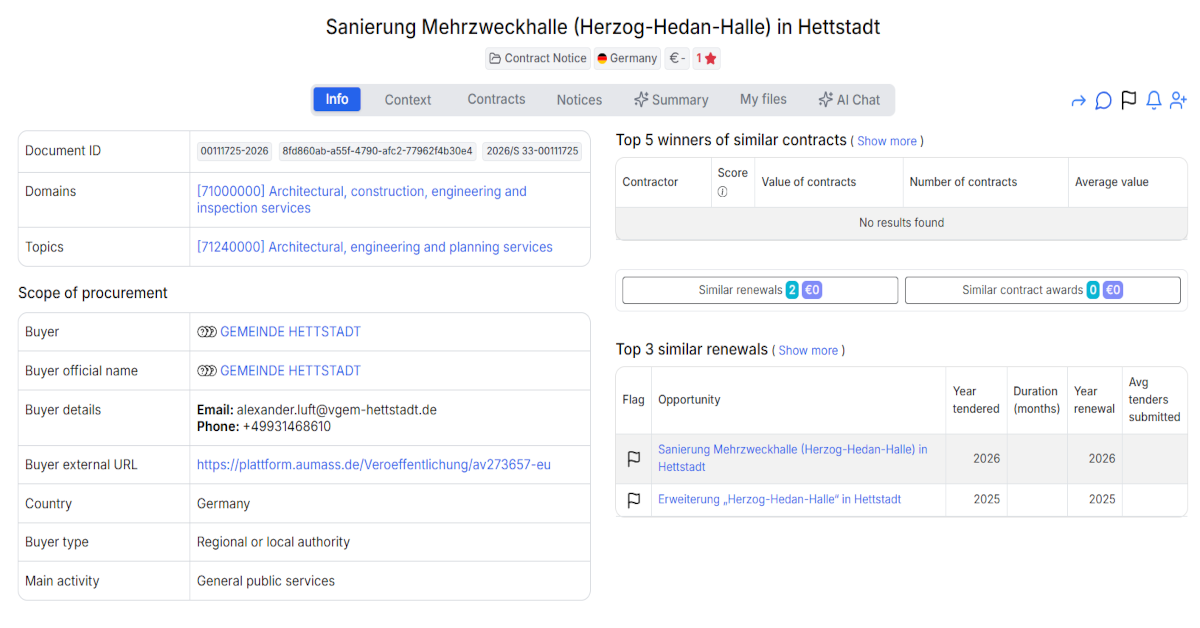
Gemeinde Hettstadt is a regional or local authority operating under general public services, located in the Landkreis Würzburg in the administrative region of Lower Franconia in Bavaria. As a small municipality, Hettstadt does not maintain a large procurement track record. The Hermix platform shows zero similar contract awards, zero all contract awards, zero prior notices, and zero financially valued renewals for this buyer. This is consistent with a small German municipality procuring architectural and engineering services on an infrequent, project-specific basis rather than through ongoing procurement cycles.

The current tender is a one-off commission for a defined community building project, backed by Städtebauförderung funding, Germany’s federal-state urban development subsidy programme. Access to this programme indicates Hettstadt has secured external grant funding to support the renovation, making this a publicly backed project rather than a purely municipal budget commitment. The grant context also implies specific documentation, reporting, and compliance requirements that a successful firm will need to meet throughout the engagement.

The broader market context confirms this is a large category nationally and across Europe. Some 38,000 other buyers have similar projects totaling €42 billion. The German architectural and engineering services market for public building renovation is deep and active, driven by ageing municipal infrastructure across thousands of local authorities, ongoing Städtebauförderung programmes, and energy efficiency retrofit obligations. Hettstadt is one node in a very large national procurement landscape.

Competitive Landscape

The Hermix platform records no similar contract awards and no all contract awards for this buyer. No Winners of Similar Contracts table is available for this tender. Gemeinde Hettstadt has no documented procurement history for architectural and engineering services in the Hermix dataset, which is typical for a small municipality commissioning this type of engagement infrequently. There is no identifiable incumbent, and no historical contractor data is available from the PDF to inform competitive positioning.

The absence of recorded contract history does not indicate a less competitive market. German public building renovation tenders at the municipal level typically attract local and regional architectural firms, engineering consultancies, and planning offices with Bavarian or Franconian project portfolios. The competitive field for this type of work is defined by geographic proximity, familiarity with Bavarian building regulations, HOAI expertise, and experience navigating Städtebauförderung grant requirements, rather than by documented procurement data from the specific buyer.

The negotiated procedure with prior publication (competitive with negotiation) structure means that following initial expressions of interest or first-stage submissions, Gemeinde Hettstadt will conduct negotiation rounds with selected firms before final award. This procedure allows the authority to refine scope, clarify requirements, and assess both technical methodology and fee structures in dialogue with candidates, giving firms that perform well in early rounds an opportunity to strengthen their positions before final submission.

Commercial and Procedural Signals

Estimated Value and Duration: Both are listed as unknown in the PDF. This is not unusual for a competitive negotiation procedure where fee calculation follows HOAI scales and the final scope may be refined through negotiation. Under HOAI, architectural and engineering fees for renovation projects are calculated as a percentage of eligible construction costs, which in turn depend on the final scope of works defined during the objective-finding and planning phases. The fee structure will emerge through the service process rather than being fixed in advance.

Procedure Type: The competitive negotiation procedure with prior publication differs significantly from a standard open procedure. It is a multi-stage process. Following publication, interested firms typically submit expressions of interest or initial proposals. The authority then selects a shortlist for negotiation. Final proposals are submitted after one or more negotiation rounds. This procedure is frequently used for complex planning and design services where the scope cannot be fully specified in advance.

Phased Commissioning: The stufenweise Beauftragung structure means that Gemeinde Hettstadt will commission service phases progressively rather than awarding all nine HOAI phases at once. Initial commissioning likely covers the objective-finding phase and early HOAI phases, with subsequent phases commissioned as the project develops. This structure limits the authority’s commitment at each stage and allows scope adjustment, but also creates planning uncertainty for the provider on total revenue over the engagement.

Award Criteria: Price and Quality are both evaluation dimensions.. For an HOAI architectural and engineering services commission of this type, quality criteria typically assess methodology, relevant project references, team qualifications, and approach to the specific renovation challenges. Price under HOAI is structured as a fee percentage rather than a fixed lump sum. Bidders should prepare to demonstrate relevant Bavarian or comparable regional renovation experience alongside a HOAI-compliant fee proposal.

Städtebauförderung Context: The grant programme funding brings specific requirements. Projects supported by Städtebauförderung must comply with programme guidelines covering eligibility of costs, documentation standards, interim reporting, and final accounting. A successful firm must be familiar with these administrative requirements. Failure to manage grant compliance documentation correctly can create liability and delay final payment. This is a practical competency that bidders should address explicitly in their methodology.

Language: German is the only permitted language. All submissions, negotiations, and project communications will be conducted in German.

Submission Timeline: From publication on 17 February 2026 to the deadline on 13 March 2026 is 24 days. This is the shortest submission window in the current batch of tenders. It requires immediate action for any firm not already monitoring this category.

Narrative Insight

This procurement is structurally different from high-value framework tenders with rich competitive datasets. It is a small municipality commissioning a full-scope architectural and engineering engagement for a single community building project, backed by a specific grant programme. The contract value is unknown, the duration is undetermined, and no prior winners exist in the dataset.

What matters for qualification is local relevance and procedural experience. Firms that have previously delivered Städtebauförderung-funded building projects in Bavaria, and specifically in the Würzburg district, carry material advantages. They understand the grant compliance layer, the regional building authority expectations, and the practical dynamics of working with small municipal clients who have limited in-house project management capacity.

The phased commissioning structure is a signal worth reading carefully. Gemeinde Hettstadt is not committing to a single large contract. It is procuring an advisory and planning relationship that will evolve with the project. The firm that wins the early objective-finding and planning phases and performs well will be well positioned to retain the remaining phases through to construction supervision and final documentation. The value of the engagement, while unstated in the PDF, compounds across all nine HOAI phases over the full renovation timeline.

The competitive negotiation procedure creates space for relationship-building during the selection process. Firms that present clearly, ask the right questions during negotiation, and demonstrate genuine familiarity with the specific challenges of renovating a community sports and events facility in a Städtebauförderung context will differentiate more effectively than those relying on generic credentials.

Hermix users tracking German municipal architectural and engineering procurement can monitor the full pipeline of similar tenders across 38,000 buyers totaling €42 billion, filter by region to identify Bavarian and Franconian opportunities, and access authority profiles and renewal data to build a systematic approach to this high-volume segment.

Create your free account and start winning public contracts, easier.

Practical Takeaways for Bidders

Who this tender suits:

  • German architectural firms and engineering consultancies based in Bavaria or with established project delivery experience in the Landkreis Würzburg or wider Franconia region, capable of providing full HOAI phase 1 to 9 services for public building renovation
  • Firms with documented experience delivering renovation projects supported by Städtebauförderung or comparable German urban development grant programmes, with practical familiarity with grant compliance, documentation, and reporting requirements
  • Architectural and engineering practices with relevant references in the renovation of multipurpose community buildings, sports halls, or comparable public facilities for German municipal clients
  • Smaller to mid-sized regional offices capable of forming a direct, accessible working relationship with a small Bavarian municipality that has limited in-house technical and project management capacity

Critical attention points:

  • The submission deadline is 13 March 2026, just 24 days after publication on 17 February 2026. This is the tightest window in the current tender batch. Immediate registration and response via the aumass.de platform is required
  • Fee proposals must be structured under HOAI regulations. Request the full tender documents immediately through the submission portal to understand the project scale, construction cost estimate, and eligible cost base for fee calculation
  • The phased commissioning structure means the full contract value is not committed upfront. Clarify during the negotiation process which phases are included in the initial commissioning and what triggers subsequent phase awards
  • Städtebauförderung funding brings grant compliance obligations beyond standard architectural service delivery. Ensure your methodology addresses documentation, cost eligibility, reporting timelines, and approval processes under the applicable programme guidelines
  • The competitive negotiation procedure involves multi-stage engagement with the authority. Prepare a strong first-stage submission addressing methodology, relevant references, and team qualifications, as the negotiation process rewards firms that demonstrate early understanding of the project context
  • German is the only permitted language. All documentation, proposals, and negotiation communications must be in German throughout

Gemeinde Hettstadt is procuring a long-term architectural and engineering partner for a community building project that will span multiple years across all HOAI service phases. While the contract value is not disclosed and the buyer has no recorded prior procurement history in this category, the Städtebauförderung backing and the full nine-phase scope make this a substantive engagement for the right regional firm.

With 38,000 similar buyers and €42 billion in comparable projects across Europe, architectural and engineering services for publicly subsidised municipal renovation represent one of the most consistent and accessible public procurement categories in Germany. For a Bavarian firm with the right credentials and the ability to respond within 24 days, this is a straightforward opportunity to qualify.

Create your free account today at https://hermix.com/sign-up/ and win more public contracts with the data-driven approach that helps companies consistently succeed in B2G sales across Europe.
Gemeinde Hettstadt Launches Architectural and Engineering Services Tender for Herzog-Hedan-Halle Multipurpose Hall Renovation

Fortifikationsverket Launches €437K Assistant Project Manager Tender in Stockholm

A 66-month services contract for construction project management support at Sweden’s national fortifications authority signals a long-term infrastructure commitment backed by a procurement history of €919 million in total contract awards.

Create a free account and see the full public tender details here: https://app.hermix.com/opportunities/00111800-2026

Fortifikationsverket is Sweden’s national authority responsible for providing premises, facilities, and construction services to the Swedish Armed Forces and other defence-related organizations. The authority is now seeking an assistant project manager based in Stockholm to support its own project managers across pre-studies, design phases, and construction. The contract is valued at €437,349.66 and runs for 66 months, making it one of the longer-term construction management engagements in the current Swedish public tender market.

Published on 17 February 2026 with a deadline of 16 March 2026, this is a competitive negotiation procedure. For Swedish engineering and construction consultancy firms with project management capability in the Stockholm region, the window is short, and the procedure requires active engagement from first contact.

Create your free account and start winning public contracts, easier.

Opportunity Overview

Contracting Authority: Fortifikationsverket Reference Number: 807/2026 Document ID: 00111800-2026 Tender Title: Assistant Project Manager Stockholm (Biträdande projektledare Stockholm)

Scope of Work: The assignment covers the role of assistant project manager supporting Fortifikationsverket’s project managers, with involvement across pre-studies, design, and construction phases of infrastructure projects in the Stockholm region.

Lot Structure:

  • Lot 0: Assistant Project Manager Stockholm – lot value €437,349.66

Location / Place of Performance: Stockholms lan, Sweden Estimated Total Value: €437,349.66 Contract Duration:66 months Procedure Type: Negotiated with prior publication of a call for competition / competitive with negotiationAward Criteria: Unknown (not stated in the PDF) Publication Date: 17/02/2026 Deadline: 16/03/2026 Language Requirements: Swedish only EU Funding: No Contact: Victoria Jonsson, victoria.jonsson@fortifikationsverket.se / +46 010-44 44 000 Submission Portal: https://tendsign.com/doc.aspx?MeFormsNoticeId=83702&GoTo=Tender

Ready to qualify tenders like this faster? Create your free Hermix account at https://hermix.com/sign-up/ and access AI-powered tender analysis, competitive intelligence, and automated monitoring across Europe’s €2 trillion public procurement market.

Authority and History

Fortifikationsverket is classified as a ministry or national federal authority with general public services as its main activity. It operates as Sweden’s dedicated defence infrastructure agency, procuring construction management, engineering, and inspection services on an ongoing basis to support its facilities obligations to the Swedish Armed Forces.

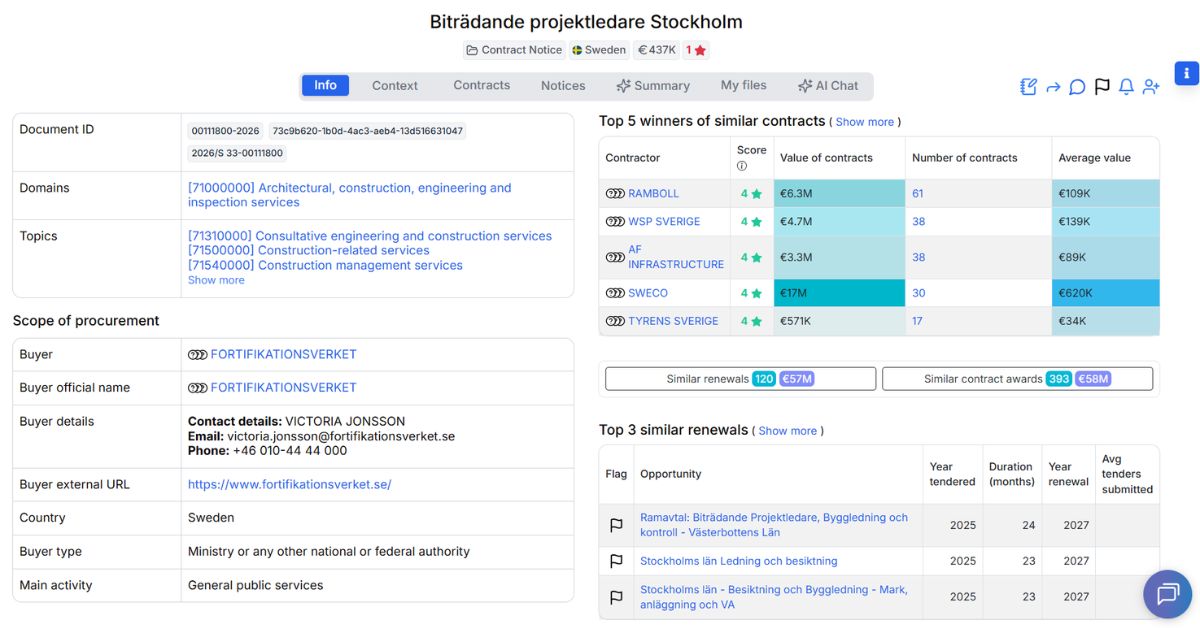
The authority’s procurement footprint is substantial. The Hermix platform shows 688 all contract awards totaling €919 million, of which 393 similar contract awards account for €58 million. The renewal pipeline is equally active: 341 all renewals valued at €1.9 billion, with 120 similar renewals totaling €57 million. There is currently 1 similar open tender valued at €3.9 million and 5 all open tenders at €29 million. Four similar prior notices are recorded at €986K, with 8 all prior notices totaling €6 million.

The scale of the renewal pipeline is the most telling data point. With €1.9 billion in all renewals across 341 contracts, Fortifikationsverket is a buyer that continuously re-procures construction and engineering services. A supplier establishing a relationship here is entering a long-duration commercial engagement, not a standalone project. The 66-month contract term reinforces this: Fortifikationsverket structures its procurement for extended delivery, not short cycles. Beyond this authority, 3,300 other buyers across Europe hold similar projects totaling €6.9 billion, confirming the depth of demand for construction project management services in the public sector.

Competitive Landscape

The Winners of Similar Contracts table (data limited to 10 results) reveals a field dominated by large Swedish engineering consultancies with high contract frequency. The full breakdown is as follows:

  • Ramboll: €6.3M across 61 contracts, averaging €109K per contract
  • WSP Sverige: €4.7M across 38 contracts, averaging €139K per contract
  • AF Infrastructure: €3.3M across 38 contracts, averaging €89K per contract
  • Tyrens Sverige: €571K across 17 contracts, averaging €34K per contract
  • Sweco Structures: €4.7M across 14 contracts, averaging €362K per contract
  • Airfield Group Sweden: €941K across 11 contracts, averaging €86K per contract
  • Sweco Sverige: €11M across 10 contracts, averaging €2.3M per contract
  • Bengt Dahlgren Skovde: €1.8M across 8 contracts, averaging €231K per contract
  • PE Teknik Arkitektur: €2.5M across 7 contracts, averaging €358K per contract
  • Pontarius: €941K across 6 contracts, averaging €157K per contract

Sweco Sverige stands out with the highest total value at €11M across 10 contracts, averaging €2.3M per contract. This suggests Sweco Sverige wins large, consolidated assignments rather than frequent smaller ones. Ramboll leads on contract frequency at 61 contracts, reflecting a sustained pattern of winning smaller-scale project management and consultancy assignments. WSP Sverige and AF Infrastructure both hold 38 contracts each, confirming their position as systematic repeat winners in this category.

The Contractors’ Countries table shows Sweden as the sole listed country: 374 contracts totaling €58M, with an average value of €172K. This is an entirely domestic market. Language requirements, security considerations given Fortifikationsverket’s defence mandate, and established procurement relationships effectively make this a Sweden-only competitive environment.

Commercial and Procedural Signals

Award Criteria: The PDF lists evaluation criteria as unknown. No weighting or scoring methodology is available. Given the defence infrastructure context and the negotiated procedure, bidders should expect evaluation to cover technical competence, relevant project management experience, and team qualifications, alongside commercial terms.

Procedure Type: The negotiated procedure with prior publication is significant. This is not a straightforward open tender where bids are submitted and evaluated in one round. The competitive negotiation format means the authority will engage with shortlisted candidates before final award. Bidders must be prepared for dialogue, clarification, and potential revision of their proposals across multiple stages. This favors firms with structured bid teams and prior experience navigating negotiated procedures in Swedish public procurement.

Language: Swedish is the only permitted language for submissions. All proposals, CVs, technical documentation, and correspondence must be in Swedish. This is a firm compliance requirement, not a preference, and effectively excludes non-Swedish-speaking firms without established local operations.

Contract Duration: 66 months is an unusually long contract term for a services assignment. It signals that Fortifikationsverket is looking for a stable, embedded resource rather than a consultant brought in for a discrete project phase. The implication for bidders is that the authority will prioritize reliability, continuity, and the ability to support evolving project scopes over a multi-year horizon.

Submission Timeline: From publication on 17 February 2026 to the deadline on 16 March 2026 is 27 days. For a negotiated procedure requiring structured capability statements and potentially CVs for proposed personnel, this is a tight window. Firms not already tracking Fortifikationsverket procurement will struggle to prepare a competitive first-stage submission in time.

EU Funding: Not applicable. Standard Swedish public procurement rules govern this procedure.

Narrative Insight

The combination of a 66-month duration, a negotiated procedure, and a defence infrastructure authority creates a distinct procurement profile. Fortifikationsverket is not buying a standardized consultancy service. It is procuring a person or a small team to sit alongside its own project managers for over five years, navigating pre-studies through to construction completion on what are likely sensitive and operationally critical facilities.

The competitive data tells a clear story about who wins in this space. Ramboll, WSP Sverige, and AF Infrastructure together account for 137 contracts in the similar awards dataset. These are firms with deep, systematic relationships across Swedish public construction clients, proven delivery track records, and the infrastructure to support long-term assignments without disruption. New entrants or smaller consultancies will face a high bar.

Sweco Sverige’s average contract value of €2.3M per contract, significantly above the current tender value of €437K, suggests that Sweco tends to win larger consolidated scopes. The current tender’s relatively modest value means the competitive dynamic may favor mid-tier specialists who can offer dedicated senior resources at a competitive day rate rather than large firms deploying generalist teams.

Hermix users analyzing this tender can access the full competitive picture instantly, including Fortifikationsverket’s complete contract award history, contractor profiles for all key players in the Swedish construction management market, and the 120-contract renewal pipeline, in minutes rather than hours.

The 120 similar renewals valued at €57 million in the pipeline make this category a sustained revenue opportunity for firms positioned correctly with Swedish defence and public infrastructure clients. A win at Fortifikationsverket opens the door to a buyer that procures continuously and at significant scale.

Create your free account and start winning public contracts, easier.

Practical Takeaways for Bidders

Who this tender suits:

  • Swedish engineering and construction consultancy firms with dedicated project management capability in the Stockholm region and prior experience on public sector infrastructure assignments
  • Firms with demonstrable experience supporting defence or government facility projects, given Fortifikationsverket’s operational mandate
  • Mid-size consultancies able to commit a senior project management resource for 66 months, including continuity planning for a multi-year assignment
  • Companies already active in the Swedish public construction management market with Swedish-speaking staff and familiarity with Swedish procurement procedures

Critical attention points:

  • The 27-day submission window from 17 February to 16 March 2026 demands immediate action. A negotiated procedure requires a structured first-stage response, not just a standard bid form
  • Swedish is the only permitted language. All documentation, including CVs, methodology descriptions, and company references, must be in Swedish
  • Award criteria are not disclosed in the PDF. Prepare a comprehensive capability statement covering project management methodology, relevant reference projects, proposed personnel qualifications, and commercial terms
  • The negotiated procedure format means shortlisting will occur before final award. Prepare for a multi-stage process requiring availability for dialogue and clarification rounds with the authority
  • A 66-month commitment requires demonstrating organizational stability and the ability to maintain resource continuity. The authority will expect evidence that the proposed individual or team can sustain delivery across the full contract term
  • Submissions are managed through the Tendsign platform. Registration and submission must be completed via tendsign.com before the 16 March 2026 deadline

Fortifikationsverket sits at the top of Sweden’s public construction procurement hierarchy, with €919 million in total contract awards and a renewal pipeline of €1.9 billion confirming it as one of the most active infrastructure buyers in the Nordic region. This assistant project manager assignment is modest in value but significant in duration and strategic positioning. For a Swedish engineering consultancy looking to establish a long-term relationship with a high-value, consistently procuring defence infrastructure client, the 66-month term makes this far more than a routine contract.

Create your free account today at https://hermix.com/sign-up/ and win more public contracts with the data-driven approach that helps companies consistently succeed in B2G sales across Europe.
Biträdande projektledare Stockholm


East Sussex Schools Public Tender: £640,000 Collaborative Catering Tender

A 36-month school meals contract across six primary schools signals innovative collaborative procurement in East Sussex, prioritizing meal quality and pupil voice over lowest-price competition.

Create a free account and see the full public tender details here: https://app.hermix.com/opportunities/ukfts_003249-2026

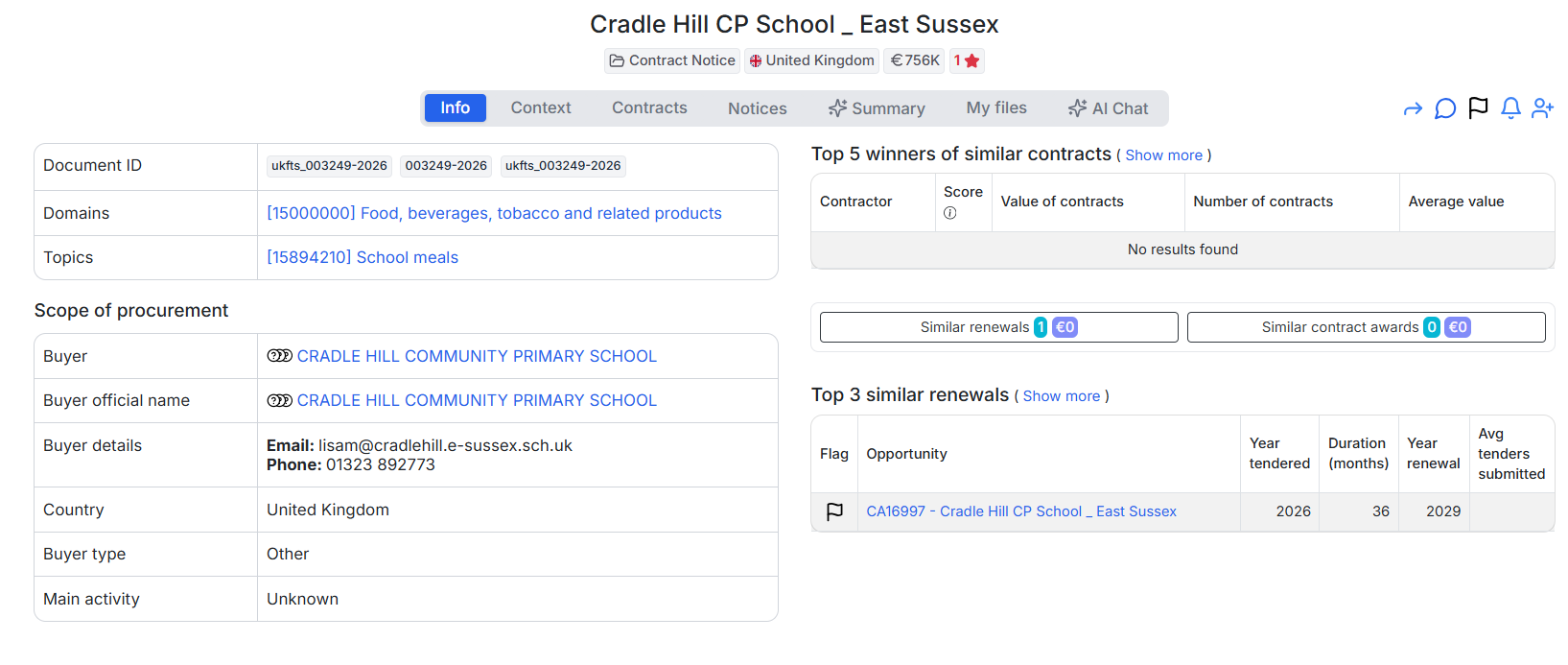
Cradle Hill Community Primary School, leading a six-school collaboration in East Sussex, has published a £640,000 (€755,605.82) tender for high-quality catering services serving primary school communities across the Seaford and Eastbourne area. With a March 19, 2026 deadline and a three-year contract term, this procurement represents a strategic shift toward collaborative school catering procurement that balances economies of scale with individual school autonomy.

The tender’s unique structure allows participating schools—Cradle Hill, Seaford Primary, Meridian Community Primary, Willingdon Primary, Motcombe, and Denton Community Primary—to conduct joint evaluation while each retains independent decision-making authority to select the catering partner best aligned with its community values. The collaboration operates within a broader UK school meals market where 101 similar institutions collectively represent £306 million (€362M) in catering procurement activity.

Create your free account and start winning public contracts, easier.

Opportunity Overview

Contracting Authority: Cradle Hill Community Primary School (lead procurement authority)
Reference Number: CA16997
Tender Title: Cradle Hill CP School _ East Sussex
Collaborative Procurement Structure:
This tender involves six East Sussex primary schools conducting shared procurement while maintaining individual contracting autonomy:

Participating Schools:

  1. Cradle Hill Community Primary School (lead)
  2. Seaford Primary School
  3. Meridian Community Primary School
  4. Willingdon Primary School
  5. Motcombe School
  6. Denton Community Primary School

Service Scope:
The collaboration seeks catering partners to deliver comprehensive school meals services including:

  • Daily meal preparation and service for primary school pupils
  • Fresh, nutritious, and seasonal food prepared with care
  • Menu planning responding to pupil feedback and preferences
  • Allergen management and dietary requirement accommodation
  • Kitchen operations management within school facilities

Shared Service Aspirations:

  • Increased meal uptake through quality, appeal, and value
  • Fresh, nutritious, and seasonal food prepared with care
  • Trusted, transparent, and collaborative partnership
  • Strong pupil advocacy, ensuring children’s voices shape dining experience

Contract Value: €755,605.82 (approximately £640,000) for Cradle Hill’s lot
Contract Duration: 36 months (3 years)
Procedure Type: Open procedure
Award Criteria: Quality, Integrity, Management (60%) and Finances/Cost (40%)

Key Dates:

  • Publication: January 14, 2026
  • Submission Deadline: March 19, 2026 (64 days from publication)
  • Tender Opening: March 19, 2026

Location: East Sussex, United Kingdom
EU Funding: No

Contact Details:

  • Email: lisam@cradlehill.e-sussex.sch.uk
  • Phone: 01323 892773

Submission: Via UK Find a Tender Service

Looking to win UK school catering contracts?

Create your free Hermix account at https://hermix.com/sign-up/ and access AI-powered tender analysis, competitive intelligence, and automated monitoring across the UK’s public sector education catering market.

Authority Profile: Collaborative Primary School Procurement

Cradle Hill Community Primary School serves as the lead procurement authority for this six-school collaboration, representing a growing trend in UK primary education where smaller institutions pool procurement resources to achieve better value while maintaining service quality and local responsiveness.

The collaboration spans schools across East Sussex’s coastal communities around Seaford and Eastbourne, serving diverse pupil populations with varying dietary, cultural, and socioeconomic backgrounds. This geographic clustering enables potential operational efficiencies through shared supplier relationships, centralized menu planning, and coordinated delivery logistics.

Procurement Context:

  • Similar Open Tenders: 1 current opportunity (this tender)
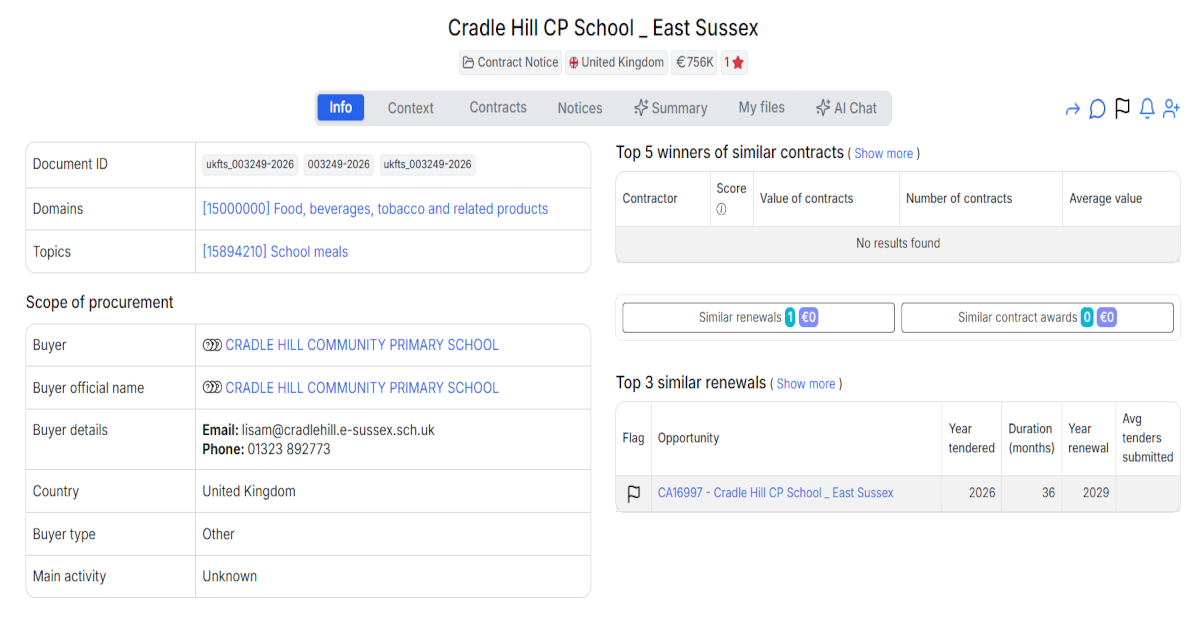
  • Similar Renewals: 1 upcoming renewal
  • Historical Contract Awards: No visible historical data (likely first major collaborative procurement)
  • Broader Market: 101 UK primary schools with similar catering needs representing €362 million in collective procurement

The absence of historical contract award data suggests either this represents the schools’ first major collaborative catering procurement, or previous contracts were managed independently by each school at smaller values below reporting thresholds. This collaborative approach likely aims to leverage collective purchasing power while maintaining individual school identity and community preferences.

Competitive Landscape: Open Market with No Incumbent Visible

The procurement data reveals no historical contract awards for similar school meals services at Cradle Hill Community Primary School or visible incumbent providers, indicating either first-time collaborative procurement or transition from previous individual school arrangements.

Market Context:

With no historical contractor data available but 101 other UK buyers operating in the school meals sector (€362M total value), the competitive landscape likely includes:

  • National School Catering Providers: Large operators like Chartwells, Caterlink, or Dolce serving multiple schools across regions
  • Regional Catering Specialists: Mid-sized providers focused on specific geographic areas with local supplier relationships
  • Local Independent Caterers: Smaller operations with deep community ties and flexible service models
  • In-House Provision: Some schools may be transitioning from direct employment models

Key Competitive Observations:

Open Market Competition: The absence of visible incumbent contractor creates genuine open competition rather than renewal-focused procurement favoring existing providers. This levels the playing field for new entrants and regional specialists.

Multi-School Capability Requirement: The tender explicitly requires demonstrating “capacity, capability, and operational resilience to cater for all six schools,” creating a barrier to entry for very small local caterers while favoring providers with multi-site operations experience.

Individual School Selection: Each school’s autonomy to select independently means competitive positioning must address both collective efficiency and individual school culture fit. A provider might win one, several, or all six schools based on their tailored approach to each community.

Commercial and Procedural Signals

Quality-Weighted Award Criteria:
The 60% weighting on Quality, Integrity, and Management versus 40% on Cost signals the collaboration’s genuine commitment to meal quality and partnership values over purely price-driven selection. This procurement prioritizes educational and nutritional outcomes alongside financial efficiency.

Multi-School Qualification Requirement:
Bidders must demonstrate capacity to serve all six schools even though individual schools may select different providers. This ensures only operationally robust caterers compete, reducing risk of service failure while enabling schools to choose from pre-qualified providers.

School Autonomy Preservation:
The unique procurement structure—shared evaluation timeline but independent selection authority—balances collaborative efficiency with local responsiveness. Bidders should prepare both a unified service model demonstrating cross-school capability and tailored approaches addressing each school’s specific community character.

Pupil Voice Emphasis:
The tender explicitly requires “strong pupil advocacy, ensuring children’s voices shape the dining experience.” Successful bids must demonstrate genuine mechanisms for gathering, responding to, and incorporating pupil feedback into menu planning and service delivery.

Fresh and Seasonal Food Commitment:
The emphasis on “fresh, nutritious, and seasonal food prepared with care” indicates preference for scratch cooking over pre-prepared meals, local sourcing where practical, and culinary skill rather than reheating operations.

64-Day Procurement Window:
The extended deadline (64 days from publication) provides adequate time for comprehensive bid development including school visits, pupil engagement, menu development, and detailed operational planning across all six sites.

Strategic Context: Collaborative School Procurement Innovation

This tender exemplifies emerging trends in UK primary school procurement where smaller institutions collaborate to achieve value while maintaining individual identity and community responsiveness.

The Collaboration Model:
By pooling procurement resources while preserving selection autonomy, the six schools achieve:

  • Professional procurement process with robust specifications
  • Economies of scale through collective negotiation
  • Reduced individual school administrative burden
  • Maintained flexibility to select providers matching local community values

Educational Outcomes Focus:
School meals directly impact pupil concentration, behavior, and educational attainment. By prioritizing quality (60%) over cost (40%), the collaboration signals understanding that nutritious, appealing meals represent educational investment rather than purely operational expense.

Hermix users analyzing school catering tenders gain competitive advantages through instant market intelligence. Rather than manually searching fragmented school procurement portals and researching local education authority catering frameworks, Hermix delivers AI-powered analysis of procurement patterns, competitive landscapes, and renewal pipelines across the UK’s education sector. The platform helps catering providers consistently qualify the right opportunities and win more school meal contracts.

Create your free account and start winning public contracts, easier.

Practical Takeaways for Bidders

Who This Tender Suits:

  • Regional school catering specialists with East Sussex operational presence
  • National providers with flexible multi-site models accommodating individual school cultures
  • Catering companies emphasizing fresh food preparation and scratch cooking
  • Providers with proven pupil engagement and menu co-design experience
  • Organizations with primary school safeguarding and food safety expertise

Critical Attention Points:

Multi-School Capability Demonstration: Your bid must convincingly demonstrate capacity to serve all six schools simultaneously, including kitchen staffing plans, supply chain resilience, management structures, and operational contingency arrangements. Generic capability statements will be insufficient.

Individual School Tailoring: While demonstrating collective capability, prepare tailored approaches for each school addressing their unique communities, facilities, and cultures. Research each school’s demographic, Ofsted reports, and community context to demonstrate genuine understanding.

Quality Over Price Strategy: With 60% weighting on quality factors, invest bid resources in demonstrating nutritional excellence, culinary skill, pupil engagement methodologies, and partnership approaches rather than aggressive cost reduction. Lowest price will not automatically win.

Pupil Voice Mechanisms: Detail specific, practical methods for involving pupils in menu planning, service evaluation, and dining experience improvement. Examples from previous contracts showing measurable impact of pupil feedback will strengthen quality scoring.

Fresh Food Sourcing: Provide concrete evidence of local supplier relationships, seasonal menu planning, scratch cooking capabilities, and food provenance transparency. Generic commitments to “quality ingredients” won’t differentiate your bid.

School Visits Essential: Use the 64-day window to visit all six schools, meet catering facilities, understand meal service logistics, and engage with headteachers and school business managers. Demonstrate your bid reflects genuine understanding of each site’s operational realities.

Allergen and Dietary Management: Primary schools manage increasingly complex dietary requirements including allergies, intolerances, religious restrictions, and medical diets. Detail your allergen management systems, staff training, and communication protocols with parents and school staff.

Create your free Hermix account today at https://hermix.com/sign-up/ and access AI-powered intelligence that transforms UK school tender analysis from hours of research into minutes of actionable competitive insight.

East Sussex Schools Public Tender - £640,000 Collaborative Catering Tender

Foment de Ciutat Launches €394,800 Technical Assistance Tender for Private Housing Rehabilitation Under Barcelona’s Plan de Barrios

A three-lot, four-month open procedure contract for technical advisory and social efficiency support services signals Barcelona’s ongoing commitment to neighbourhood-level housing rehabilitation and community development through its Plan de Barrios programme.

Create a free account and see the full public tender details here: https://app.hermix.com/opportunities/00113866-2026

Foment de Ciutat, the Barcelona City Council agency responsible for urban regeneration and neighbourhood development, is tendering for technical assistance services to support the rehabilitation of private residential buildings across two neighbourhood areas under the Plan de Barrios framework. The procurement covers both architectural and social advisory functions, spanning structural rehabilitation guidance, social efficiency promotion, and community engagement. The estimated total value is €394,799.70 across three lots, with a contract duration of just four months.

Published on 17 February 2026 with a deadline of 16 March 2026, this is an open procedure evaluated on price and quality. Bids must be submitted in Catalan or Spanish. For Spanish urban regeneration consultancies, social work organisations, and architectural advisory firms with Barcelona neighbourhood experience, this is a compact but distinctive opportunity tied to one of Spain’s most active municipal housing rehabilitation programmes.

Create your free account and start winning public contracts, easier.

Opportunity Overview

Contracting Authority: Foment de Ciutat

Reference Numbers: F260000092 y F260000093

Document ID: 00113866-2026

Tender Title: Technical Assistance Services for Promoting and Supporting the Rehabilitation of Private Residential Buildings under the Plan de Barrios, Lots 1 and 2, as well as for Promoting Social Efficiency

Scope of Work: Technical assistance services supporting the rehabilitation of private residential buildings under the Plan de Barrios programme, covering architectural advisory, rehabilitation promotion, community engagement, and social efficiency functions across two neighbourhood lots.

Lot Structure:

  • Lot 1: Technical assistance services for both Plan de Barrios Lots 1 and 2, as well as for promoting social efficiency – lot value €394,799.70
  • Lot 3: Technical assistance services for Plan de Barrios Lot 1, as well as for promoting social efficiency – lot value €204,122.81
  • Lot 4: Technical assistance services for Plan de Barrios Lot 2, as well as for promoting social efficiency – lot value €190,676.26

Note: Lot numbering follows the PDF as published. Lots 3 and 4 correspond to the individual geographic areas covered jointly by Lot 1.

Location / Place of Performance: Barcelona, Spain

Estimated Total Value: €394,799.70 (as stated in the PDF)

Contract Duration: 4 months

Procedure Type: Open

Award Criteria: Price and Quality (Lot 1 confirmed; specific weightings not disclosed in the PDF)

Publication Date: 17/02/2026

Deadline: 16/03/2026

Tender Opening Date: 20/03/2026

Language Requirements: Catalan and Spanish

EU Funding: No

Contact: jramos@bcn.cat / 932566600

Submission Portal: https://licitacions.bcn.cat/

Ready to qualify tenders like this faster? Create your free Hermix account at https://hermix.com/sign-up/

Authority and History

Foment de Ciutat is a body governed by public law under the Barcelona City Council, with housing and community amenities as its main activity. The organisation operates as Barcelona’s urban regeneration agency, responsible for coordinating neighbourhood improvement programmes, social housing policy, and community development initiatives across the city’s districts.

The Plan de Barrios is Foment de Ciutat’s flagship neighbourhood investment framework, directing resources toward Barcelona’s most vulnerable urban areas through a combination of infrastructure, housing, and social services interventions. Technical assistance contracts of this type are a recurring instrument within the programme, supporting private building owners in accessing and navigating rehabilitation processes.

The Hermix procurement context shows a focused but active buying pattern in this category. Similar contract awards number 7, totaling €2 million. All contract awards reach 12, totaling €5 million. The renewal pipeline is notable: 16 similar renewals valued at €20 million and 23 all renewals at €27 million. There are currently no similar or all open tenders active, and no prior notices recorded.

The renewal data is the strongest signal of procurement continuity. With 16 similar renewals valued at €20 million in the pipeline, this category of technical assistance for residential rehabilitation is clearly a recurring programme element rather than a one-off procurement. Beyond Foment de Ciutat, 6,400 other buyers across Europe hold similar projects totaling €25 billion, confirming the breadth of the market for social and architectural advisory services tied to urban regeneration.

Competitive Landscape

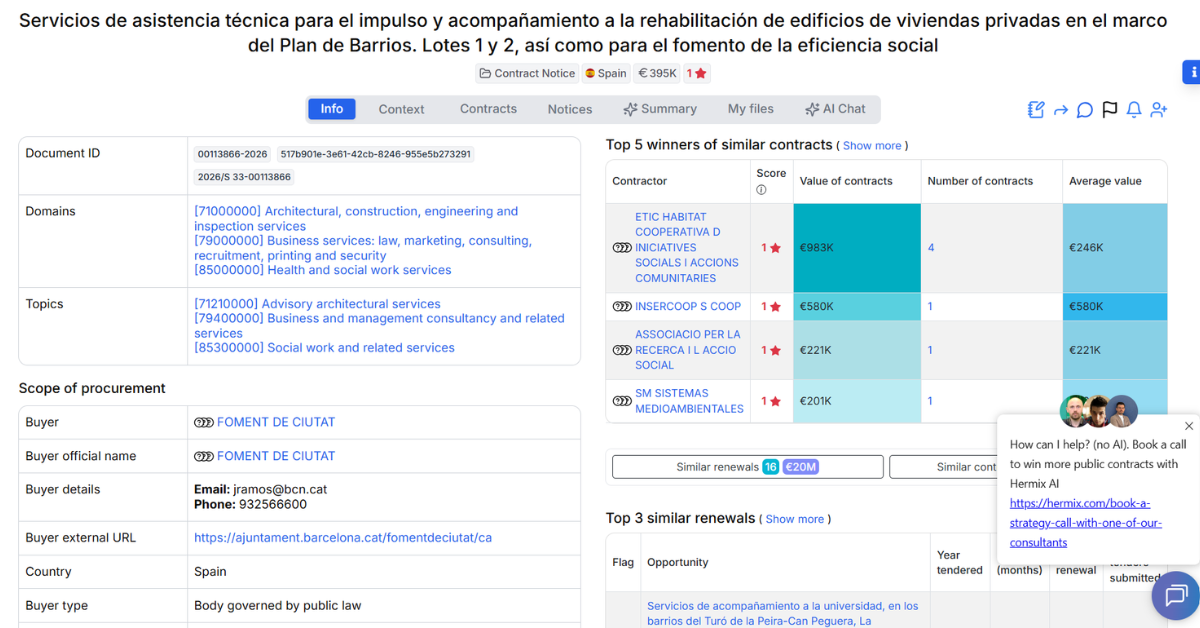
The Winners of Similar Contracts table (data limited to 10 results) shows a compact field of four Spanish contractors, with one organisation holding a clear lead on both contract frequency and cumulative value. The full breakdown is as follows:

  • Etic Habitat Cooperativa d’Iniciatives Socials i Accions Comunitaries: €983K across 4 contracts, averaging €246K per contract
  • Insercoop S Coop: €580K across 1 contract, averaging €580K per contract
  • Associacio per la Recerca i l’Accio Social: €221K across 1 contract, averaging €221K per contract
  • SM Sistemas Medioambientales: €201K across 1 contract, averaging €201K per contract

Etic Habitat Cooperativa d’Iniciatives Socials i Accions Comunitaries is the clear incumbent in this dataset. With four contracts totaling €983K and an average of €246K per contract, it has won more similar contracts than the other three competitors combined. Its contract profile, spanning multiple awards at consistent values, strongly suggests a sustained working relationship with Foment de Ciutat across successive Plan de Barrios procurement cycles.

Insercoop S Coop stands out for a different reason: its single contract at €580K is the highest individual award value in the dataset. This suggests a capacity for larger, more comprehensive service packages rather than repeated smaller engagements. Associacio per la Recerca i l’Accio Social and SM Sistemas Medioambientales each hold one contract at €221K and €201K respectively, positioning them as smaller players in this specific market.

The Contractors’ Countries table confirms Spain as the sole listed country: 7 contracts totaling €2 million with an average of €283K per contract. This is an entirely domestic and locally concentrated market. Language requirements in Catalan and Spanish, combined with the neighbourhood-specific delivery context of the Plan de Barrios, effectively limit viable competition to organisations with direct Barcelona or Catalan urban context expertise.

Commercial and Procedural Signals

Award Criteria: Price and Quality are both evaluation criteria, confirmed for Lot 1 in the lots summary. Specific weightings are not disclosed in the PDF. Given the social and community-oriented nature of the service scope, quality criteria will likely reflect methodological approach, relevant experience in similar neighbourhood programmes, and team qualifications alongside competitive pricing.

Procedure Type: The open procedure means any eligible organisation may submit without prior qualification. The combination of architectural advisory and social work service domains (CPV codes spanning advisory architectural services, business and management consultancy, and social work services) creates a cross-disciplinary scope that suits specialist urban regeneration agencies, social cooperatives, and multi-disciplinary consultancies.

Lot Structure: The procurement presents an unusual numbering structure with Lots 1, 3, and 4 (no Lot 2). Lot 1 covers both geographic neighbourhood areas jointly, while Lots 3 and 4 correspond to the individual areas separately. A bidder could in principle compete for Lot 1 (covering both areas) or for either of the individual area lots. This structure allows the authority flexibility in how it awards, potentially splitting the work geographically or awarding a single provider for the full scope.

Contract Duration: Four months is a very short contract term for this type of technical assistance engagement. It signals a time-bounded programme intervention rather than an ongoing advisory relationship. Mobilisation must be immediate upon award, and deliverables will need to be scoped and delivered within a compressed timeframe. Providers must demonstrate capacity to deploy qualified teams without delay.

Language: Both Catalan and Spanish are accepted. This is the standard requirement for Barcelona municipal procurement and reflects the bilingual institutional environment. Submissions and all service delivery communications may be conducted in either language.

Submission Timeline: From publication on 17 February 2026 to the deadline on 16 March 2026 is 27 days. Note that the tender opening date is 20 March 2026, four days after the submission deadline. For organisations already active in this market, 27 days is workable. For new entrants without an established profile in Barcelona neighbourhood rehabilitation, it is tight.

EU Funding: Not applicable. This is a Barcelona City Council programme funded through municipal resources.

Narrative Insight

The competitive picture here is compact and telling. Four contractors across all similar awards, one of them with a clear repeat-winner profile, and an entirely Spanish contractor country distribution. Etic Habitat Cooperativa d’Iniciatives Socials i Accions Comunitaries has established itself as the reference provider for this type of work with Foment de Ciutat. Its four contracts at consistent values indicate systematic engagement rather than opportunistic wins.

That said, the price and quality evaluation methodology gives new entrants a genuine pathway. Unlike price-only competitions, quality-weighted criteria allow organisations to differentiate on methodology, team experience, and programme fit. A bidder with strong credentials in social work, community engagement, or architectural advisory services for vulnerable urban populations can compete on the quality dimension even without the incumbent’s contract history.

The four-month duration is the defining operational signal. This is not a relationship contract. It is a defined-scope delivery engagement. Providers must approach it as a project, not a retainer, with clear deliverables, staffing plans, and mobilisation protocols already in place before bid submission. Teams without direct experience in Barcelona’s neighbourhood programme context will struggle to demonstrate credible delivery capacity within that timeframe.

The renewal pipeline of 16 similar contracts worth €20 million is worth noting in strategic context. A provider winning this four-month contract positions itself for the next cycle. Foment de Ciutat’s procurement history shows consistent demand for these services. Winning a short initial contract is a market entry mechanism, not a one-time transaction.

Hermix users analyzing this tender can access Foment de Ciutat’s full contract award history, detailed profiles of all four competing contractors, and the renewal pipeline across 6,400 similar buyers totaling €25 billion, providing the competitive intelligence needed to qualify and price this opportunity accurately in minutes.

Create your free account and start winning public contracts, easier.

Practical Takeaways for Bidders

Who this tender suits:

  • Spanish urban regeneration consultancies and social cooperatives with demonstrated experience delivering technical assistance programmes in Barcelona or Catalan neighbourhood rehabilitation contexts
  • Multi-disciplinary organisations capable of covering both the architectural advisory dimension (building rehabilitation guidance, technical support for private owners) and the social efficiency dimension (community engagement, social work coordination) required across all lots
  • Organisations fluent in Catalan and Spanish capable of immediate deployment within a four-month delivery window with no ramp-up time available
  • Smaller specialist firms or cooperatives similar in profile to the existing contract winners: social cooperatives, research and social action associations, and environmental management consultancies active in Barcelona’s public sector

Critical attention points:

  • The four-month contract duration means immediate mobilisation is essential. Teams, methodologies, and delivery structures must be fully defined in the bid, not developed after award
  • Price and Quality are both evaluation criteria. Invest in the quality narrative, including team profiles, methodological approach, and relevant programme references. Price alone will not win this
  • The lot structure (Lots 1, 3, and 4) allows bidding for the combined scope or individual geographic areas. Consider which lot best matches your delivery capacity and geographic knowledge
  • The 27-day submission window from 17 February to 16 March 2026 is tight. Submission through licitacions.bcn.cat must be completed before the deadline. The tender opens on 20 March 2026
  • Both Catalan and Spanish are accepted. All submission documents may be prepared in either language
  • Etic Habitat Cooperativa d’Iniciatives Socials i Accions Comunitaries is the clear incumbent with four prior similar contracts. A competitive bid must address and demonstrate credible differentiation from their established programme familiarity

Foment de Ciutat is one of Barcelona’s most consistent buyers in urban regeneration technical assistance, with a renewal pipeline of 16 similar contracts worth €20 million confirming sustained programme demand. This four-month engagement is a compact but strategically significant entry point into a procurement relationship with an active authority whose neighbourhood rehabilitation ambitions generate repeated contracting cycles. For organisations with the right Barcelona urban context expertise and the operational readiness to deliver immediately, this is a well-positioned opportunity.

Create your free account today at https://hermix.com/sign-up/ and win more public contracts with the data-driven approach that helps companies consistently succeed in B2G sales across Europe.
Servicios de asistencia técnica para el impulso y acompañamiento a la rehabilitación de edificios de viviendas privadas en el marco del Plan de Barrios. Lotes 1 y 2, así como para el fomento de la eficiencia social

Departement du Tarn Launches €2.6 Million Fuel and Electric Vehicle Charging Card Tender

A single-lot, 12-month supply contract for credit cards covering fuel, electric recharging, and associated services across France’s Tarn department reflects a high-volume, recurring procurement category with a well-established competitive field.

Create a free account and see the full public tender details here: https://app.hermix.com/opportunities/00111127-2026

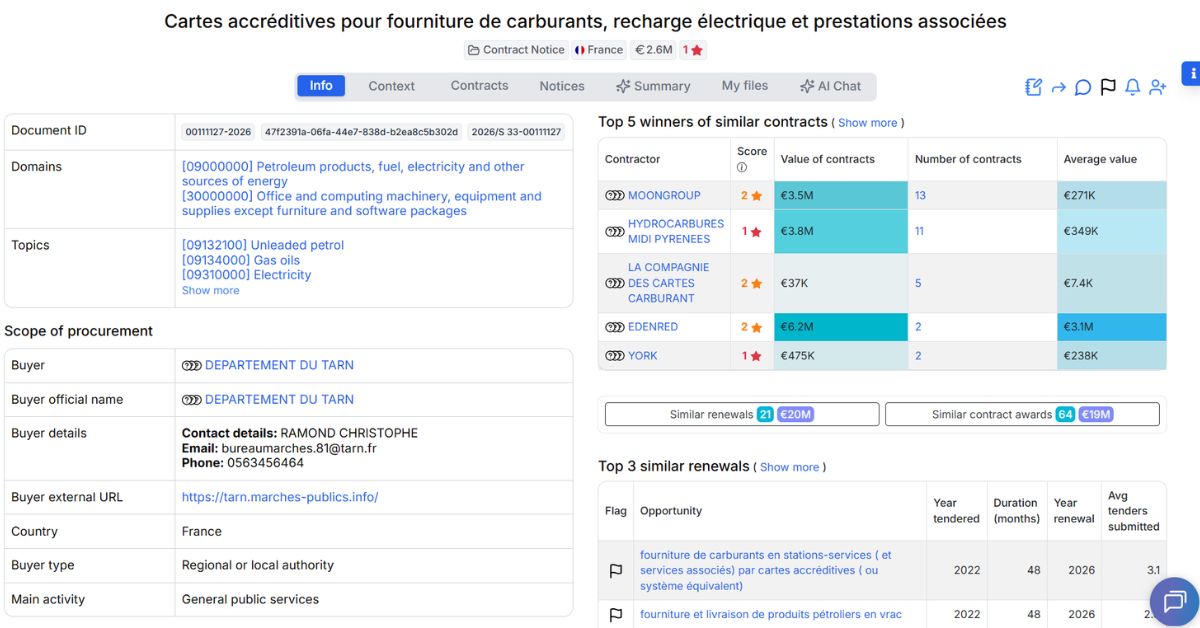
The Departement du Tarn is a regional public authority in southwestern France responsible for general public services across the Tarn department. It is now tendering for a card-based fuel and electric vehicle charging solution covering all staff who need to refuel or recharge across the department and the national territory. The estimated value stands at €2,600,000 for a 12-month contract, published on 17 February 2026 with a submission deadline of 16 March 2026.

This is a straightforward but commercially significant supply procurement. The card-based model bundles fuel access, electric recharging, vehicle washing, parking, and toll services into a single managed solution. For companies in the fleet card and energy distribution space operating in France, the window is short and the competitive field is active.

Create your free account and start winning public contracts, easier.

Opportunity Overview

Contracting Authority: Departement du Tarn Reference Number: 20250081 Document ID: 00111127-2026 Tender Title: Credit Cards for Fuel Supply, Electric Recharging and Associated Services (Cartes accréditives pour fourniture de carburants, recharge électrique et prestations associées)

Scope of Work: Supply of credit cards enabling department staff to purchase fuel (unleaded petrol and gas oils) and recharge electric vehicles at stations located near their workplace throughout the Tarn department and across the national territory. Associated services include vehicle washing, parking, and toll payments.

Lot Structure:

  • Lot 0: Credit Cards for Fuel Supply, Electric Recharging and Associated Services – lot value €2,600,000

Location / Place of Performance: Tarn department and national territory, France Estimated Total Value: €2,600,000Contract Duration: 12 months Procedure Type: Open Award Criteria: Unknown (not stated in the PDF) Publication Date: 17/02/2026 Deadline: 16/03/2026 Tender Opening Date: 16/03/2026 Language Requirements: French only EU Funding: No Contact: Ramond Christophe, bureaumarches.81@tarn.fr / 0563456464 Submission Portal:https://www.marches-publics.info/mpiaws/index.cfm?fuseaction=demat.termes&IDM=1780274

Ready to qualify tenders like this faster? Create your free Hermix account at https://hermix.com/sign-up/ and access AI-powered tender analysis, competitive intelligence, and automated monitoring across Europe’s €2 trillion public procurement market.

Authority and History

The Departement du Tarn is a regional or local authority classified under general public services. It procures centrally through its public markets bureau, with Ramond Christophe listed as the procurement contact. The authority’s external procurement portal is tarn.marches-publics.info, and submissions are managed via the national marches-publics.info platform.

The broader procurement context for this category is substantial. The Hermix platform shows 64 similar contract awards totaling €19 million, against 646 all contract awards totaling €413 million for this authority’s overall procurement activity. On the renewal side, 21 similar renewals are valued at €20 million, while 223 all renewals total €240 million. There are currently no similar open tenders active, and no prior notices for this category.

The alignment between similar contract awards (€19M across 64 contracts) and similar renewals (€20M across 21) tells a clear story. Fuel and fleet card contracts cycle regularly in French local government. The Tarn department is operating within a well-established pattern. For a supplier entering this relationship, the probability of renewal engagement at contract end is real, not speculative. Beyond the Tarn department itself, 9,500 other buyers across Europe hold similar projects totaling €45 billion, confirming this is one of the most widely procured categories in European public sector fleet management.

Competitive Landscape

The Winners of Similar Contracts table (data limited to 10 results) shows a diverse field spanning large national fleet card operators, regional fuel distributors, and smaller specialist entities. The full ranked breakdown is as follows:

  • Moongroup: €3.5M across 13 contracts, averaging €271K per contract
  • Hydrocarbures Midi Pyrenees: €3.8M across 11 contracts, averaging €349K per contract
  • La Compagnie des Cartes Carburant: €37K across 5 contracts, averaging €7.4K per contract
  • Edenred: €6.2M across 2 contracts, averaging €3.1M per contract
  • York: €475K across 2 contracts, averaging €238K per contract
  • Total Marketing France Cartes Petrolieres: €360K across 2 contracts, averaging €180K per contract
  • Inapa France: €200K across 2 contracts, averaging €100K per contract
  • Eurl Garage Vialettes: €151K across 2 contracts, averaging €76K per contract
  • Siplec: €17K across 2 contracts, averaging €8.5K per contract
  • Deldossi: €14K across 2 contracts, averaging €7K per contract

Edenred commands the highest total value among contractors with two contracts at an average of €3.1M each, reflecting its position as a large national fleet card and payment solutions provider. Hydrocarbures Midi Pyrenees and Moongroup lead on contract frequency, with 11 and 13 contracts respectively, suggesting deep-rooted activity with regional French public authorities. Combined, these three contractors account for the dominant share of similar contract value in this dataset.

The Contractors’ Countries table shows France as the sole listed country: 64 contracts totaling €19M, with an average value of €289K. This is an entirely domestic market in terms of contract awards, which is expected given the nature of the procurement. Fuel network coverage, local station proximity requirements, and French administrative procedures effectively limit realistic competition to France-based operators.

Commercial and Procedural Signals

Award Criteria: The PDF lists evaluation criteria as unknown. No weighting or criteria breakdown is available. Bidders should prepare comprehensive technical and commercial proposals covering both the breadth of the card acceptance network and the quality of the associated digital management platform, alongside competitive pricing.

Procedure Type: The open procedure means any eligible supplier may submit without prior qualification. Competition is likely to be active given the number of established players in this category across France.

Language: French is the only permitted language. This is a hard requirement. All submission documents, technical specifications, and service descriptions must be in French. This effectively closes the tender to non-French-speaking organizations without established French operations.

Lot Structure: A single lot covering the complete scope. There is no option to bid on partial services. A winning supplier must be capable of providing fuel card access, electric vehicle recharging, vehicle washing, parking, and toll services across the full Tarn territory and nationally.

Contract Duration: 12 months is a short contract cycle. This signals an annual renewal pattern, consistent with the renewal data showing 21 similar renewals at €20M. Incumbent suppliers in this category tend to cycle back through competition annually. Pricing strategy should reflect the short horizon while positioning for renewal.

Submission Timeline: From publication on 17 February 2026 to the deadline on 16 March 2026 is 27 days. This is tight. Organizations not already active in this procurement category will struggle to prepare a compliant French-language submission covering the full scope of card services within this window.

EU Funding: Not applicable. Standard French public procurement rules govern this procedure.

Narrative Insight

The Tarn department tender sits in one of the most commoditized yet operationally critical categories in French local government procurement. Fleet fuel management is not optional. Every department with a vehicle fleet needs a reliable, cost-controlled solution, and the card-based model has become the standard delivery mechanism across France.

What makes this tender commercially interesting is the bundled scope. The requirement extends well beyond simple fuel cards. Washing, parking, and toll services integrated into a single card contract points to a buyer looking for administrative simplicity. A supplier who can demonstrate a broad acceptance network across southern France, a strong digital management dashboard for tracking spend per vehicle or employee, and competitive margin rates on fuel will have a structural advantage over narrower specialists.

The contrast between Edenred’s high average contract value (€3.1M per contract across just two awards) and the frequency leaders Moongroup and Hydrocarbures Midi Pyrenees (13 and 11 contracts respectively at lower average values) reveals two distinct winning profiles in this market. Edenred wins large consolidated contracts. Moongroup and Hydrocarbures Midi Pyrenees win frequently at smaller scale. The Tarn contract at €2.6M sits closer to Edenred’s typical contract size, which may indicate the competitive dynamic favors national-scale operators for tenders of this value.

Hermix users analyzing this tender can access the full competitive intelligence for this category instantly, including contractor profiles, the complete renewal pipeline across French local authorities, and similar open tenders across 9,500 buyers, in minutes rather than hours.

The 12-month contract duration combined with 21 similar renewals in the pipeline makes this category a repeating commercial opportunity, not a one-off event. A supplier winning the Tarn contract is establishing a relationship with a regional authority that procures in this space regularly.

Create your free account and start winning public contracts, easier.

Practical Takeaways for Bidders

Who this tender suits:

  • French fleet card and fuel distribution companies with established card acceptance networks covering the Tarn department and national territory
  • National payment solutions providers such as large fleet card operators with electric vehicle recharging capability already integrated into their card infrastructure
  • Regional fuel distributors with strong southwestern France coverage who can extend their offer to include associated services such as washing, parking, and tolls
  • Companies already active in similar French local authority fuel card contracts, given the French-only language requirement and the domestic-only contractor history

Critical attention points:

  • The 27-day submission window from 17 February to 16 March 2026 requires immediate mobilization. French-language documentation covering the full scope must be prepared without delay
  • French is the only permitted language for offers. Non-compliant submissions will be disqualified
  • Award criteria are not disclosed in the PDF. Prepare a comprehensive proposal covering network breadth, digital management tools, electric vehicle recharging access, and pricing, rather than leading with price alone
  • The single-lot structure means the winning supplier must cover all services: fuel, electric recharging, washing, parking, and toll payments. Partial capability is not sufficient
  • Geographic coverage is a likely evaluation factor. The tender explicitly requires staff to refuel near their workplace across the entire Tarn department, so network density matters
  • Electric vehicle recharging is explicitly listed as a required service. Suppliers without an established EV charging network integration will face a qualification gap

The Departement du Tarn is a consistent buyer in the fleet card and fuel management category, operating within a national procurement pattern where this type of contract recycles annually. The €2.6 million value for 12 months, set against a renewal pipeline of 21 similar contracts worth €20 million, confirms that the broader market for this service in France is active and continuous. Structured intelligence on the competitive field and buyer history is what separates a well-qualified bid from a speculative one.

Create your free account today at https://hermix.com/sign-up/ and win more public contracts with the data-driven approach that helps companies consistently succeed in B2G sales across Europe.
Cartes accréditives pour fourniture de carburants, recharge électrique et prestations associées


Bergen Municipality Public Tender for Cloud Procurement System Replacement

A 60-month contract for comprehensive eProcurement platform replacement signals Norway’s second-largest city’s commitment to modern, cloud-based purchasing infrastructure serving municipal operations.

Create a free account and see the full public tender details here: https://app.hermix.com/opportunities/00025283-2026

Bergen Municipality Launches Cloud Procurement System Replacement Tender

A 60-month contract for comprehensive eProcurement platform replacement signals Norway’s second-largest city’s commitment to modern, cloud-based purchasing infrastructure serving municipal operations.

Bergen Kommune, Norway’s second-largest municipality, has published a qualification-phase tender for a new cloud-based procurement system to replace its current UNIT4 ERP ordering platform. With a February 16, 2026 deadline and a five-year contract term, this procurement represents a strategic shift toward independent, integrated eProcurement infrastructure serving Bergen’s extensive municipal operations across Vestland county.

The tender seeks a complete procurement-to-pay solution covering requisitioning, ordering, goods receipt, and reporting—delivered as a cloud service with comprehensive implementation, training, ongoing support, and integration services.

Bergen Kommune’s procurement history of 837 contracts worth €2 billion, combined with 1,100 upcoming renewals valued at €3.3 billion, positions this within a sophisticated municipal IT procurement operation where vendor relationships and proven cloud platform expertise drive long-term partnerships.

Create your free account and start winning public contracts, easier.

Opportunity Overview

Contracting Authority: Bergen Kommune (City of Bergen)
Reference Number: 2025/271119
Tender Title: Qualification phase – IK-EEA 2026-010 Procurement of a new Procurement System

Service Scope:
Bergen Kommune requires a comprehensive cloud-based procurement system (eCommerce/ordering platform) replacing the current UNIT4 ERP UBW Economy/e-Procurement system implemented in 2022.

Current System Context:
The existing UNIT4 ERP ordering module is integrated within Bergen’s financial system. The new procurement seeks an independent procurement platform with data exchange managed through integrations, allowing greater flexibility and specialized functionality beyond embedded ERP ordering modules.

Core System Requirements:
Requisitioning and Procurement Lists:

  • Registration of procurement needs
  • Use of procurement lists and catalogs
  • Requirement approval workflows

Order Management:

  • Order creation, modification, follow-up, and approval
  • Automatic order generation from approved requisitions
  • Order tracking and status management

Goods Receipt:

  • Registration of received goods and services
  • Matching goods receipts against purchase orders
  • Returns management and processing

Reporting and Analysis:

  • Procurement analytics and dashboards
  • Spending analysis by category, supplier, department
  • Compliance and exception reporting

EHF Format Support (Norwegian Electronic Invoicing Standard):

  • EHF Catalogue integration
  • EHF Orders transmission
  • EHF Invoice reception
  • EHF Punchout for supplier catalogs
  • EHF Order Confirmation
  • EHF Pakkseddel (delivery notes)

Technical Requirements:

  • Mobile device support (smartphones, tablets)
  • Role-based user interfaces tailored to different user groups
  • Integration capabilities with Bergen’s financial system and other municipal systems
  • Data exchange and information synchronization across platforms

Scope Boundaries:
The procurement system covers need-to-receipt processes. Invoice processing, invoice matching, and payment execution remain within Bergen Kommune’s existing financial system.

Contract Inclusions:

  • Implementation and system setup
  • Training for municipal staff across departments
  • Integration development and maintenance
  • Ongoing operation and management
  • Continuous development and enhancement
  • User support services
  • Optional: Additional consultancy services and expanded support

Estimated Contract Value: Not disclosed
Contract Duration: 60 months (5 years)
Procedure Type: Negotiated with prior publication of call for competition
Award Criteria: Quality and Price (weightings not disclosed)

Key Dates:

  • Publication: January 14, 2026
  • Submission Deadline: February 16, 2026 (33 days from publication)

Location: Vestland, Norway (Bergen municipality)
Language Requirements: Norwegian only
EU Funding: No

Contact Details:

  • Contact Person: Kevin Tobin
  • Email: kevin.tobin@bergen.kommune.no
  • Phone: +47 05556

Submission Portal: https://permalink.mercell.com/261120912.aspx

Ready to win Norwegian public sector IT contracts?

Create your free Hermix account at https://hermix.com/sign-up/ and access AI-powered tender analysis, automated monitoring of Norwegian procurement portals, and competitive intelligence across Scandinavia’s public procurement market.

Authority Profile: Bergen Kommune’s Digital Transformation

Bergen Kommune serves Norway’s second-largest city with approximately 285,000 residents across Vestland county. As a body governed by public law responsible for extensive general public services, the municipality operates complex procurement infrastructure supporting education, healthcare, social services, infrastructure, and administrative operations.

The decision to replace a recently implemented UNIT4 ERP ordering system (deployed in 2022) signals Bergen’s recognition that embedded ERP procurement modules, while functional, lack the specialized capabilities required for modern, efficient municipal purchasing operations. This strategic move toward best-of-breed procurement platforms reflects broader Scandinavian public sector trends prioritizing user experience, mobile accessibility, and advanced analytics.

Overall Procurement Activity:

  • Total Contract Awards: 837 contracts worth €2 billion
  • Active Tender Pipeline: 31 open tenders valued at €104 million
  • Renewal Forecast: 1,100 potential renewals worth €3.3 billion

IT Services and Software Procurement:

  • Similar Contract Awards: 131 contracts totaling €247 million (average: €2.2M per contract)
  • Similar Open Tenders: 8 current opportunities worth €9.8 million
  • Similar Renewals: 132 upcoming renewals worth €340 million

Bergen Kommune operates within Norway’s sophisticated municipal IT procurement ecosystem where 2,300 similar authorities collectively represent €10 billion in software and IT services procurement. Success with Bergen positions vendors for relationships across Norwegian kommuner (municipalities) and potentially broader Nordic public sector opportunities.

Competitive Landscape: IT Services Giants and Nordic Specialists

Historical contract awards for similar software and IT services reveal a competitive market dominated by established IT services providers with strong Norwegian public sector presence.

Top Contract Winners (Similar Services):

  1. ATEA – €42M across 12 contracts (€3.5M average)
  2. SOPRA – €25M across 6 contracts (€4.2M average)
  3. CAPGEMINI – €18M across 4 contracts (€5.9M average)
  4. KPMG – €18M across 3 contracts (€5.9M average)
  5. CRAYON – €8M across 3 contracts (€2.7M average)
  6. TELIA – €6.5M across 3 contracts (€2.2M average)
  7. MULTICONSULT – €4.7M across 5 contracts (€1.2M average)
  8. BDO HOVEDENHET – €3.3M across 4 contracts (€821K average)
  9. NORCONSULT HOVEDENHET – €904K across 7 contracts (€151K average)
  10. SWECO NORGE HOVEDENHET – €685K across 4 contracts (€228K average)

Key Competitive Observations:

Norwegian Market Dominance: Of 119 similar contracts totaling €247M, all but one (€157K to an Italian contractor) went to Norwegian companies. This overwhelming domestic preference suggests either explicit language and local presence requirements, practical necessities around on-site implementation support in Norwegian, or deep relationships between Norwegian IT providers and municipal procurement teams.

ATEA’s Repeat Business Leadership: With 12 contracts worth €42M (€3.5M average), ATEA demonstrates sustained relationships with Bergen Kommune across multiple IT procurement cycles. This repeat business indicates proven municipal IT capability and likely positions them as a strong contender for this procurement platform replacement.

Software Implementation Specialists: SOPRA’s €25M across 6 contracts (€4.2M average) suggests substantial software implementation projects, potentially including ERP, procurement, or other enterprise systems—directly relevant experience for this tender.

Consultancy Firm Presence: KPMG (€18M), BDO (€3.3M), and multiple Norwegian consultancies indicate Bergen’s willingness to engage advisory firms for IT strategy, implementation oversight, and change management—relevant for bidders considering partnership approaches.

Average Contract Scale: The €2.2M average for similar contracts provides context for likely contract value expectations, though this specific tender’s value remains undisclosed during the qualification phase.

Commercial and Procedural Signals

Qualification Phase Structure:
This tender uses a two-stage procedure beginning with qualification, allowing Bergen Kommune to pre-qualify capable bidders before inviting detailed proposals. Only qualified suppliers will proceed to the negotiated dialogue phase, reducing evaluation workload while ensuring only serious, capable providers compete.

Negotiated Procedure:
The competitive negotiation approach enables Bergen to engage in dialogue with qualified bidders to refine technical solutions, integration approaches, implementation methodologies, and commercial terms—particularly important for complex cloud platform procurement requiring tailored approaches.

SSA-Cloud Agreement Compliance:
Tenders must comply with Norway’s standard SSA-Cloud agreement for cloud services, establishing baseline terms, security requirements, data protection obligations, and service level expectations for Norwegian public sector cloud procurement.

Norwegian Language Requirement:
Submissions must be in Norwegian, creating significant barriers for non-Nordic providers. This extends beyond proposal language to encompass product user interfaces, documentation, training materials, and ongoing support—all requiring Norwegian language capability.

Undisclosed Contract Value:
Bergen has not published estimated contract value during qualification phase, likely to avoid anchoring bids and enable flexible negotiation during dialogue stage. Based on similar contracts averaging €2.2M, realistic expectations likely range from €3-8M over five years depending on scope and user count.

Quality and Price Evaluation:
Without disclosed weightings, bidders should balance competitive pricing with strong quality demonstration across functionality, user experience, implementation methodology, integration capability, and ongoing support models.

Strategic Context: Municipal Procurement Modernization

This tender reflects Bergen Kommune’s recognition that efficient procurement processes directly impact municipal operational effectiveness and budget optimization across all departments.

The Replacement Decision:
Bergen’s choice to replace a system implemented just four years ago (2022) signals either significant functional gaps in the UNIT4 ERP embedded procurement module, user adoption challenges, or strategic vision for best-of-breed procurement capabilities unavailable in integrated ERP platforms.

Cloud-First Approach:
Mandating cloud service delivery aligns with Norwegian public sector digital strategies prioritizing operational flexibility, automatic updates, reduced IT infrastructure burden, and disaster recovery resilience through geographically distributed cloud architectures.

Integration Over Integration:
By seeking an independent procurement system integrated with the financial system rather than embedded functionality, Bergen gains specialized procurement capabilities while maintaining financial system investment—a pragmatic approach increasingly common in European municipalities.

Hermix users analyzing Norwegian public tenders gain decisive advantages. The platform delivers instant competitive intelligence on all 10 historical contractors, automated Norwegian-language tender monitoring, and procurement pattern analysis across Bergen’s €2B contract history. Rather than manually navigating Norwegian procurement portals and translating technical specifications, Hermix provides AI-powered insights that help international providers consistently qualify opportunities and win Nordic public sector contracts.

Create your free account and start winning public contracts, easier.

Practical Takeaways for Bidders

Who This Tender Suits:

Procurement software vendors with cloud-native eProcurement platforms
Norwegian IT service providers with municipal sector experience
European providers with Norwegian language capabilities and Nordic presence
Companies with proven EHF format integration expertise
Vendors offering comprehensive implementation and change management services

Critical Attention Points:

Norwegian Language Imperative: Beyond proposal translation, success requires Norwegian-language user interfaces, documentation, training materials, help desk support, and implementation consultants. Partner with Norwegian firms if lacking native capabilities.

EHF Format Integration: Norway’s electronic invoicing standards (EHF) are non-negotiable requirements. Demonstrate proven EHF catalogue, order, invoice, punchout, confirmation, and delivery note integrations with Norwegian suppliers and systems.

UNIT4 ERP Migration Experience: Understanding why Bergen is replacing UNIT4 and demonstrating smooth migration from embedded ERP procurement to independent platforms will strengthen your position. Emphasize data migration, user transition, and change management capabilities.

Financial System Integration: Bergen’s financial system handles invoice processing and payment. Detail your integration architecture, data synchronization approaches, and proven connectors to common Norwegian municipal financial platforms.

Municipal Sector References: Norwegian public sector buyers value domestic references. Prioritize showcasing successful implementations for Norwegian kommuner, particularly those of comparable size or complexity to Bergen.

SSA-Cloud Compliance: Familiarize yourself with Norway’s standard cloud services agreement terms, security requirements, and data residency expectations. Demonstrate compliance and willingness to operate under these frameworks.

Mobile-First Design: Norwegian municipal workforces increasingly work remotely or on mobile devices. Emphasize responsive design, native mobile apps, offline capabilities, and user experiences optimized for smartphones and tablets.

Create your free Hermix account today at https://hermix.com/sign-up/ and transform Norwegian public sector tender analysis from days of manual work into minutes of AI-powered competitive intelligence that wins more Nordic contracts.

Bergen Municipality Public Tender - for - Cloud Procurement System Replacement

AIRC Associação de Informática da Região Centro Launches €299,180 Microsoft Enterprise Agreement Licence Tender

A single-lot, 36-month open procedure supply contract for Microsoft Enterprise Agreement software licences from a Portuguese regional IT shared services authority confirms recurring demand for Microsoft volume licensing in the country’s central regional public administration.

Create a free account and see the full public tender details here: https://app.hermix.com/opportunities/00111377-2026

AIRC Associacao de Informatica da Regiao Centro, the regional IT shared services association for central Portugal, has published a €299,180.28 open procedure tender for the acquisition of Microsoft Enterprise Agreement software licences. The contract covers a 36-month supply period, evaluated solely on price, with Portuguese as the only permitted language. Place of performance is the Regiao de Coimbra.

Published on 17 February 2026 with a deadline of 15 March 2026, this procurement is a standard volume software licensing renewal of the type that recurs systematically across Portuguese regional authorities. For Microsoft licensing resellers and volume agreement partners authorised to operate in Portugal, this is a focused, price-competitive opportunity with a clear incumbent in the historical data.

Create your free account and start winning public contracts, easier.

Opportunity Overview

Contracting Authority: AIRC Associacao de Informatica da Regiao Centro
Reference Number: 14/AIRC/2026
Document ID: 00111377-2026
Tender Title: Acquisition of Microsoft Enterprise Agreement Software Licences (Aquisição de licenças do software Microsoft Enterprise Agreement)
Scope of Work: Acquisition of software licences under the Microsoft Enterprise Agreement programme for AIRC Associacao de Informatica da Regiao Centro.

Lot Structure:

  • Lot 0: Acquisition of Microsoft Enterprise Agreement Software Licences – lot value €299,180.28

Location / Place of Performance: Regiao de Coimbra, Portugal
Estimated Total Value: €299,180.28
Contract Duration: 36 months
Procedure Type: Open
Award Criteria: Price
Publication Date: 17/02/2026
Deadline: 15/03/2026
Language Requirements: Portuguese only
EU Funding: No
Contact: geral@airc.pt / 239850500
Submission Portal: https://community.vortal.biz/public/

Ready to qualify tenders like this faster? Create your free Hermix account at https://hermix.com/sign-up/

Authority and History

AIRC Associacao de Informatica da Regiao Centro is a regional or local authority operating under general public services, based in central Portugal in the Coimbra region. AIRC functions as a shared IT services organisation serving municipalities and public entities in central Portugal, providing centralised digital infrastructure, software platforms, and technology services to local government. The acquisition of Microsoft Enterprise Agreement licences is a routine but essential procurement for an organisation of this type, covering the productivity, operating system, and enterprise software needs of AIRC and the public entities it serves.

The procurement context in the Hermix platform is minimal, reflecting the specialised and narrow profile of this buyer’s recorded procurement history. Similar contract awards number 1, totaling €1.5 million. All contract awards also number 1, at the same €1.5 million. The renewal pipeline shows 2 similar renewals totaling €1 million and 3 all renewals also totaling €1 million. There are no similar or all open tenders currently active, and no prior notices recorded.

The thin procurement history is consistent with a small, focused shared services organisation that procures selectively and on a cyclical basis. The current €299K tender is the next procurement cycle following the single prior similar award at €1.5 million, suggesting a shift to a lower-value contract scope or a different licensing tier for this cycle. Beyond AIRC, 143 other buyers across Europe hold similar projects totaling €676 million, confirming that Microsoft Enterprise Agreement procurement is a high-volume category across the continent’s public sector.

Competitive Landscape

The Winners of Similar Contracts table contains a single entry (data limited to 10 results). The full breakdown is as follows:

  • Arrowecs Portugal Sociedade Unipessoal Lda: €1.5M across 1 contract, averaging €1.5M per contract

Arrowecs Portugal is the sole recorded winner of a similar contract in this dataset. Its single award at €1.5 million is five times the value of the current €299K tender. This discrepancy may reflect a previous broader licensing scope, a different contract structure, or a multi-entity procurement that has since been disaggregated. Regardless of the value difference, Arrowecs Portugal holds the only documented track record with AIRC in this category.

Arrowecs is a Microsoft volume licensing specialist and distributor operating in Portugal. As a Microsoft partner with expertise in Enterprise Agreement procurement, it is precisely the type of intermediary organisation through which public entities in Portugal acquire large Microsoft licence volumes. Its position as the sole similar contract winner makes it the de facto incumbent for this renewal.

The Contractors’ Countries table confirms Portugal as the sole listed country: 1 contract totaling €1.5 million at an average of €1.5 million. This is a domestically served market, consistent with the Portuguese-only language requirement and the local regulatory and commercial context of Microsoft volume licensing procurement in Portugal.

Commercial and Procedural Signals

Award Criteria: Price is the sole evaluation criterion. This is a lowest-price competition with no quality weighting. For a standardised Microsoft Enterprise Agreement, the product is fixed by Microsoft’s licensing framework. The only variable is the reseller’s pricing, which reflects their Microsoft partner discount tier, operational costs, and margin. Lowest-price evaluation in this context rewards Microsoft partners with the highest discount tier from Microsoft and the most competitive cost structure.

Procedure Type: The open procedure means any eligible supplier may submit. In practice, Microsoft Enterprise Agreement resellers must be authorised Microsoft partners to supply these licences legitimately. This commercial prerequisite narrows the effective field to authorised Microsoft volume licensing specialists operating in Portugal.

Contract Duration: 36 months aligns with the standard Microsoft Enterprise Agreement three-year cycle. This is not a coincidence. Enterprise Agreements are structured as three-year commitments, and this procurement period mirrors that framework. The €299K total over 36 months implies approximately €100K in annual Microsoft licence spend, covering the organisation’s software estate under EA terms.

Language: Portuguese is the only permitted language. All documentation and submissions must be in Portuguese.

Submission Timeline: From publication on 17 February 2026 to the deadline of 15 March 2026 is 26 days. The PDF does not state a tender opening date. For a specialist Microsoft volume licensing reseller already active in the Portuguese public sector market, 26 days is workable. Submissions must be made through the vortal.biz platform.

EU Funding: Not applicable. Standard Portuguese public procurement rules govern this procedure.

Narrative Insight

This tender is structurally simple. Price wins. The product is fixed. The only meaningful variable is the reseller’s Microsoft partner pricing tier and their ability to submit a compliant Portuguese-language bid through the vortal.biz platform before 15 March 2026

Arrowecs Portugal’s position as the sole documented similar contract winner gives it incumbent status, but that advantage is limited in a price-only competition for a standardised product. Any authorised Microsoft volume licensing partner with a competitive discount tier from Microsoft can challenge on price regardless of prior relationship. The absence of quality criteria eliminates the soft advantages that incumbents typically enjoy.

The value drop from the previous €1.5 million similar contract to the current €299K scope is notable. It may reflect a reduction in the number of licences, a change in licensing product mix, a shorter subscription term within the EA framework, or a decision to procure a subset of the previous agreement’s scope in this cycle. None of these explanations can be confirmed from the PDF alone, but the disparity should prompt bidders to review the full tender specification carefully before pricing.

The broader market context is significant even if this individual contract is modest. With 143 other buyers in Europe procuring similar software licences totaling €676 million, Microsoft Enterprise Agreement procurement is one of the most consistently recurring software categories across European public sector procurement. A reseller building a portfolio of these contracts across multiple Portuguese public entities creates a compounding position in a predictable, renewal-driven market

Hermix users tracking this category can monitor the full pipeline of Microsoft licensing renewals across 143 similar buyers, access AIRC’s authority profile, and qualify comparable opportunities across Portugal and the wider European market in a fraction of the time required by manual research.

Create your free account and start winning public contracts, easier.

Practical Takeaways for Bidders

Who this tender suits:

  • Authorised Microsoft volume licensing partners and Enterprise Agreement resellers operating in Portugal, with the commercial standing to supply EA licences to Portuguese public entities
  • Microsoft partners with high discount tiers enabling competitive pricing in a price-only evaluation where the winning margin may be narrow
  • IT distributors and software resellers already registered on the vortal.biz procurement platform with established Portuguese public sector supply references
  • Organisations with Portuguese-language commercial and legal documentation capability, as all submission materials must be in Portuguese

Critical attention points:

  • Price is the only evaluation criterion. Pricing accuracy and competitiveness relative to other Microsoft partners are the sole determinants of outcome. Margin assumptions must be stress-tested before submission
  • The 26-day window from 17 February to 15 March 2026 is tight. Suppliers not yet registered on community.vortal.biz must register immediately. All documentation must be submitted through this platform
  • Arrowecs Portugal Sociedade Unipessoal Lda is the sole documented similar contract winner at €1.5M. Review the full tender specification to understand the scope reduction from the prior award before pricing
  • The 36-month contract duration mirrors the standard Microsoft Enterprise Agreement cycle. Pricing must be structured to sustain delivery across the full three-year term without mid-contract adjustments
  • Portuguese is the only accepted language for all submission documents. Non-Portuguese suppliers must ensure full translation and legal compliance of all bid materials
  • Place of performance is the Regiao de Coimbra. Confirm that your Microsoft partner authorisation and commercial terms permit supply to Portuguese regional authority entities

AIRC Associacao de Informatica da Regiao Centro is a focused shared IT services buyer whose Microsoft Enterprise Agreement procurement follows the standard three-year licensing cycle. With 2 similar renewals worth €1 million already in the pipeline and 143 comparable buyers across Europe totaling €676 million, this category generates reliable, predictable procurement activity for authorised Microsoft partners who track it systematically. For resellers with the right partner tier and Portuguese market presence, the 26-day window to 15 March 2026 is sufficient to submit a competitive price and take this contract from the incumbent.

Create your free account today at https://hermix.com/sign-up/ and win more public contracts with the data-driven approach that helps companies consistently succeed in B2G sales across Europe.
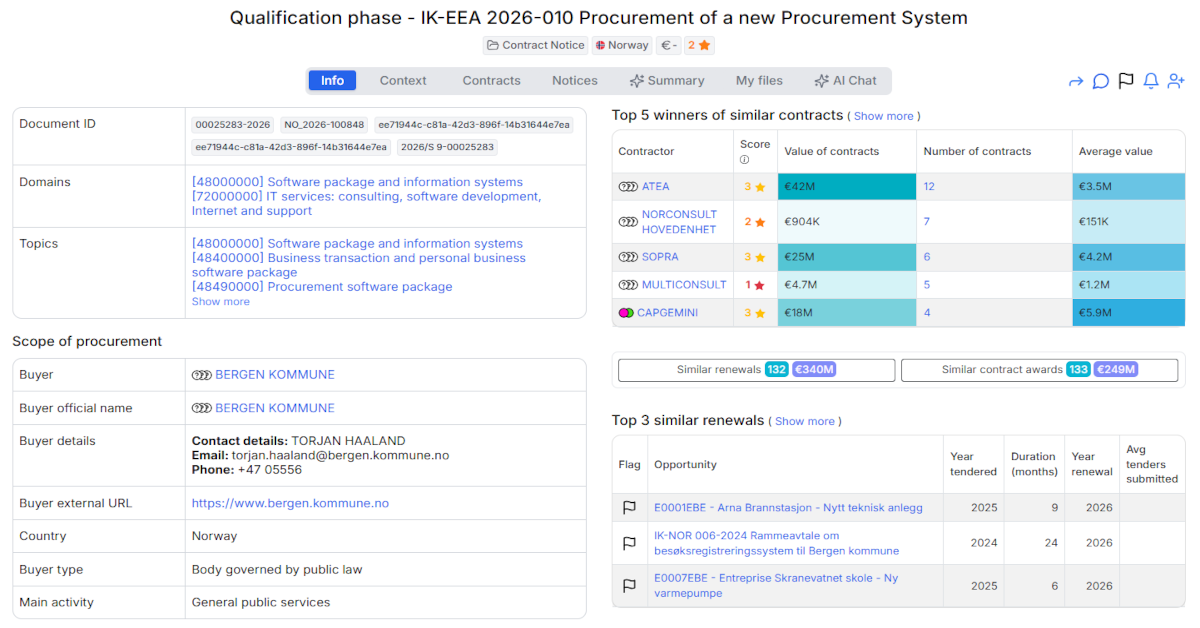
AIRC Associação de Informática da Região Centro Launches - €299,180 Microsoft Enterprise Agreement Licence Tender

Innlandet County IT Public Tender: €4.3 Million Cloud-Based Procurement Software Framework

A 48-month framework agreement for modern competition implementation software signals Norwegian counties’ strategic shift toward digital procurement transformation and inter-municipal collaboration.

Create a free account and see the full public tender details here: https://app.hermix.com/opportunities/00048160-2026

Innlandet County Launches €4.3 Million Cloud-Based Procurement Software Framework

A 48-month framework agreement for modern competition implementation software signals Norwegian counties’ strategic shift toward digital procurement transformation and inter-municipal collaboration.

Innlandet Fylkeskommune, one of Norway’s largest counties, has published a €4.3 million framework agreement for a cloud-based competition implementation tool (KGV) with accompanying modules. The procurement, published January 22, 2026 with a February 27 deadline, represents a strategic investment in digitalizing procurement operations not just for Innlandet County but for multiple Norwegian counties and associated entities seeking to modernize tender management processes.

The framework’s scope, encompassing competition management software with KAV (supplier qualification) modules and additional options, positions this as a comprehensive digital procurement transformation initiative. Innlandet County’s procurement history of 267 contracts worth €1.5 billion, combined with 376 upcoming renewals valued at €1.1 billion, demonstrates sophisticated procurement operations where proven software capabilities and multi-entity implementation experience drive vendor selection.

Create your free account and start winning public contracts, easier.

Opportunity Overview

Contracting Authority: Innlandet Fylkeskommune
Reference Number: 2025/14030
Tender Title: Competition implementation tool (KGV) with the accompanying options

Project Scope:
Framework agreement for modern, cloud-based competition tool encompassing:

Core Software Platform:

  • Competition implementation tool (KGV – Konkurranse Gjennomførings Verktøy)
  • KAV (supplier qualification) module integration
  • Cloud-based architecture supporting multiple entities
  • Digital procurement process automation

Implementation Scope:

  • Deployment across multiple Norwegian counties
  • Configuration for associated entities and municipalities
  • Streamlining and digitalization of procurement workflows
  • Multi-organization framework structure

Location: Innlandet, Norway
Framework Value: €4,299,595.84
Contract Duration: 48 months (4 years)
Procedure Type: Negotiated with prior publication of call for competition / competitive with negotiation
Award Criteria: Not disclosed in available documentation

Key Dates:

  • Publication: January 22, 2026
  • Submission Deadline: February 27, 2026 (36 days from publication)

Language Requirements: Norwegian only
EU Funding: No
Contact Details:

  • Contact Person: Samuel Andersen
  • Email: samand@innlandetfylke.no
  • Phone: 62000880
  • Website: www.innlandetfylke.no

Submission Portal: https://permalink.mercell.com/274670750.aspx

Looking to win Norwegian public sector software contracts?

Create your free Hermix account at https://hermix.com/sign-up/ and access AI-powered tender analysis, automated Norwegian tender monitoring with instant translation, and competitive intelligence across Europe’s procurement markets.

Authority Profile: Innlandet County’s Digital Transformation

Innlandet Fylkeskommune, formed in 2020 through the merger of Hedmark and Oppland counties, is one of Norway’s largest counties by geographic area, covering vast inland territories of eastern Norway. As a regional government body responsible for education, public transport, regional development, and cultural affairs, Innlandet manages substantial procurement operations requiring sophisticated digital tools.

Overall Procurement Activity:

  • Total Contract Awards: 267 contracts worth €1.5 billion
  • Active Tender Pipeline: 18 open tenders valued at €44 million
  • Renewal Forecast: 376 potential contract renewals worth €1.1 billion

Software and IT Systems Procurement:

  • Similar Contract Awards: 37 contracts totaling €28 million (average: €757K)
  • Similar Open Tenders: 2 current opportunities worth €4.3 million (including this tender)
  • Similar Renewals: 52 upcoming renewals worth €56 million (average: €1.1M)
  • Prior Notices: 22 published notices worth €13 million

The substantial renewal pipeline (€56M across 52 similar contracts) indicates systematic software contract cycling where proven digital transformation capabilities and successful multi-entity implementations drive vendor relationships. The average renewal value of €1.1 million, significantly lower than this framework’s €4.3 million, suggests this represents a strategic consolidation of procurement software needs across multiple counties rather than a single-entity system.

Innlandet operates within a broader Norwegian and Nordic public sector software market where 884 similar authorities have procurement digitalization needs, collectively representing €1.4 billion in related procurement. Success here positions vendors not only for Innlandet but potentially for relationships across Norway’s 11 counties and numerous municipalities seeking collaborative procurement software frameworks.

Competitive Landscape: Norwegian IT Leaders with Specialized Software Providers

Historical contract awards for similar software and IT services reveal a competitive market combining major Norwegian IT integrators with specialized public sector software providers.

Top Contract Winners (Similar Services):

  1. SIKRI – €190K across 4 contracts (€48K average)
  2. CRAYON – €9.6M across 3 contracts (€3.2M average)
  3. ATEA – €6.2M across 2 contracts (€3.1M average)
  4. CANON – €3.5M across 2 contracts (€1.8M average)
  5. MNEMONIC – €1.9M across 2 contracts (€951K average)
  6. FRAMSIKT – €1.1M across 2 contracts (€564K average)
  7. BIBLIOTEKSENTRALEN – €738K across 2 contracts (€369K average)
  8. DIGITAL WORKFORCE – €656K across 2 contracts (€328K average)
  9. BDO HOVEDENHET – €152K across 2 contracts (€76K average)
  10. MOLLER BIL – €109K across 2 contracts (€55K average)

Key Competitive Observations:

SIKRI’s Procurement Software Heritage: SIKRI, despite smaller contract values, secured 4 contracts, the highest frequency among competitors. SIKRI is a well-established Norwegian provider of public sector administrative software, including procurement and case management systems, suggesting strong domain expertise in Norwegian municipal procurement digitalization.

Major IT Integrators Dominate Value: CRAYON and ATEA, both major Norwegian IT service providers, collectively secured €15.8 million across 5 contracts with high average values (€3.2M and €3.1M respectively). Their presence indicates Innlandet’s comfort with large-scale IT implementations requiring integration capabilities beyond pure software licensing.

Nearly Complete Norwegian Market: Of €28 million in similar contracts, all but €294K (one Swedish contract) went to Norwegian companies. This 99% domestic award pattern reflects Norwegian language requirements, understanding of Norwegian public procurement law (FOA/LOA), local presence for implementation support, and established relationships within Norway’s close-knit public sector software ecosystem.

Specialized vs. Generalist Split: The market segments between procurement-specific software specialists (SIKRI, FRAMSIKT) and broader IT service integrators (ATEA, CRAYON). This €4.3M framework’s size suggests it may favor integrators capable of comprehensive implementation across multiple counties over point-solution vendors.

Strategic Context: Nordic Procurement Digitalization

This tender reflects broader Nordic trends toward procurement digitalization, where counties and municipalities collaborate on shared software frameworks to achieve cost efficiency, standardization, and improved compliance with increasingly complex public procurement regulations.

Multi-County Framework Structure: The tender explicitly states the system will serve “several counties and associated entities,” indicating a collaborative procurement model common in Norwegian public sector where smaller entities leverage larger counties’ purchasing power and implementation expertise. This multi-tenant architecture requirement significantly impacts vendor selection, favoring platforms with proven multi-organization capabilities.

KGV and KAV Integration: The Norwegian procurement software market uses specific terminology, KGV (competition implementation tool) focuses on tender execution and evaluation, while KAV (supplier qualification systems) manages contractor prequalification databases. The integration requirement signals Innlandet’s desire for end-to-end procurement digitalization beyond basic tender publishing.

Hermix users analyzing Norwegian tenders gain decisive advantages. Rather than manually searching Norwegian procurement portals, translating technical specifications from Norwegian, and researching contractor histories across fragmented databases, Hermix delivers instant competitive intelligence with automated translation, detailed analysis of all historical winners, and strategic insights connecting this tender to 52 renewal opportunities worth €56 million. The platform helps companies consistently qualify the right Nordic procurement software opportunities.

Create your free account and start winning public contracts, easier.

Practical Takeaways for Bidders

Who This Tender Suits:

  • Norwegian procurement software vendors with multi-county implementation experience
  • Nordic IT integrators (ATEA, CRAYON) with proven public sector credentials
  • Specialized competition management software providers serving Scandinavian markets
  • Companies with Norwegian-speaking implementation teams and Norway-based support
  • Firms with cloud-based multi-tenant platforms supporting collaborative frameworks

Critical Attention Points:

Multi-Entity Architecture Requirements: Your technical proposal must demonstrate capability to serve multiple counties and municipalities through a single cloud platform while maintaining data segregation, customizable workflows per entity, and centralized administration. Reference implementations serving Norwegian county collaborations will be essential.

Norwegian Public Procurement Law Compliance: The software must align with Norwegian FOA/LOA procurement regulations, support EU directive compliance (2014/24/EU as implemented in Norway), and accommodate Norwegian-specific procurement processes including negotiated procedures, framework agreements, and dynamic purchasing systems.

Norwegian Language and Localization: Beyond interface translation, the system must support Norwegian procurement terminology, document templates complying with Norwegian standards, and integration with Norwegian national procurement systems (DOFFIN tender portal, Altinn business registry).

KAV Module Integration: Demonstrate how your KGV platform integrates with supplier qualification systems, maintains contractor databases complying with Norwegian data protection rules, and supports pre-qualification processes common in Norwegian public procurement.

36-Day Submission Timeline: The window from January 22 to February 27 demands rapid mobilization. If you’re an international vendor, immediately engage Norwegian partners with public sector implementation experience and begin translation of reference materials into Norwegian.

Negotiated Procedure Strategy: The competitive negotiation procedure allows dialogue to refine proposals. Prepare for multiple rounds where technical capabilities, implementation methodology, pricing models, and support structures will be discussed and potentially adjusted based on authority feedback.

Create your free Hermix account today at https://hermix.com/sign-up/ and transform Nordic public sector tender analysis from days of manual work into minutes of AI-powered intelligence that helps you win more contracts across Norway, Sweden, Denmark, and Finland.

Innlandet County IT Public Tender-€4.3 Million Cloud-Based Procurement Software Framework

Metro de Madrid Public Tender: €1.27 Million Rolling Stock Door Maintenance Tender

A 48-month preventive maintenance contract for passenger door systems on Series 3000-1st trains signals Madrid’s commitment to operational reliability across one of Europe’s largest metro networks.

Create a free account and see the full public tender details here: https://app.hermix.com/opportunities/00048146-2026

Metro de Madrid has published a €1.27 million tender for long-cycle preventive maintenance services on passenger access doors across its Series 3000-1st rolling stock fleet. Split into two lots covering different train configurations (MRSM and MRSSRM variants), with a February 20, 2026 deadline and a four-year contract term, this procurement represents systematic investment in maintaining service reliability and passenger safety across Madrid’s extensive urban rail network.

The tender reflects Metro de Madrid’s mature rolling stock maintenance strategy, evidenced by 832 historical contracts worth €3 billion and 255 upcoming renewals valued at €1.3 billion. With 196 similar maintenance contracts totaling €365 million already awarded, the authority demonstrates consistent, professional procurement operations where specialized technical capability and proven metro experience drive long-term vendor relationships.

Create your free account and start winning public contracts, easier.

Opportunity Overview

Contracting Authority: Metro de Madrid
Reference Number: 6012600009
Tender Title: Servicio de Mantenimiento Preventivo de Ciclo Largo de las Puertas de Acceso de Viajeros en el Material Móvil de la Serie 3000-1ª

Scope of Work:
Long-cycle preventive maintenance services for passenger access door equipment on Series 3000-1st rolling stock, encompassing:

Lot 1 – Series 3000-1st MRSM Trains:

  • Preventive maintenance on passenger door systems
  • Long-cycle maintenance protocols
  • Contract value: €664,200.00

Lot 2 – Series 3000-1st MRSSRM Trains:

  • Preventive maintenance on passenger door systems
  • Long-cycle maintenance protocols
  • Contract value: €610,200.00

Location: Madrid, Spain
Total Contract Value: €1,274,400.00
Contract Duration: 48 months (4 years)
Procedure Type: Open procedure
Award Criteria: Quality and Price (specific weightings not disclosed)

Key Dates:

  • Publication: January 22, 2026
  • Submission Deadline: February 20, 2026 (29 days from publication)
  • Tender Opening: February 21, 2026

Language Requirements: Spanish only
EU Funding: No

Financial Guarantees Required:

  • Provisional: None
  • Definitive: 5% of base budget (VAT excluded)
  • Complementary: 5% of base budget (VAT excluded) if required

Contact Details:

Submission Portal:https://www.metromadrid.es/es/perfil-del-contratante/

Ready to win Spanish public transport maintenance contracts? Create your free Hermix account at https://hermix.com/sign-up/ and access AI-powered tender analysis, automated Spanish tender monitoring, and competitive intelligence across Europe’s €2 trillion public procurement market.

Authority Profile: Metro de Madrid’s Procurement Excellence

Metro de Madrid operates one of Europe’s largest and most complex urban rail networks, serving Spain’s capital with 302 kilometers of track, 302 stations, and approximately 2 million daily passengers. As the backbone of Madrid’s public transport system, the metro requires continuous, systematic maintenance to ensure operational reliability, passenger safety, and service quality.

The authority’s procurement operations reflect the scale and sophistication required to maintain such extensive infrastructure. Metro de Madrid doesn’t experiment with maintenance procurement—it executes systematic, professional operations built on decades of experience managing complex rolling stock fleets.

Overall Procurement Activity:

  • Total Contract Awards: 832 contracts worth €3.0 billion
  • Active Tender Pipeline: 10 open tenders valued at €14 million
  • Renewal Forecast: 255 potential contract renewals worth €1.3 billion

Rolling Stock Maintenance Services:

  • Similar Contract Awards: 196 contracts totaling €365 million (average: €2.6M per contract)
  • Similar Open Tenders: 3 current opportunities worth €4.4 million
  • Similar Renewals: 91 upcoming renewals worth €470 million (average: €5.2M per contract)
  • Prior Notices: 75 published notices worth €722 million

The substantial renewal pipeline (€470M across 91 contracts) signals consistent, cyclical contract management where proven maintenance providers secure recurring relationships. The average renewal value of €5.2 million—significantly higher than this tender’s €1.27 million—suggests opportunities for contract growth and expanded scope for successful performers.

Metro de Madrid operates within a broader Spanish and European urban rail maintenance market where 603 similar authorities have rolling stock maintenance needs, collectively representing €1.2 billion in related procurement. Success here positions contractors not only for Madrid metro work but potentially for relationships across Spain’s urban transport operators and broader European metro networks.

Competitive Landscape: Specialized Rail and Industrial Equipment Leaders

Historical contract awards for similar rolling stock maintenance services reveal a competitive market dominated by multinational industrial equipment manufacturers and specialized Spanish rail maintenance providers.

Top Contract Winners (Similar Services):

  1. THYSSENKRUPP – €17M across 10 contracts (€2.8M average)
  2. KONE – €6.8M across 9 contracts (€1.4M average)
  3. INETUM – €15M across 8 contracts (€1.9M average)
  4. SIEMENS – €10M across 7 contracts (€1.7M average)
  5. SISTEMAS AVANZADOS DE TECNOLOGIA – €4M across 6 contracts (€808K average)
  6. INDUREMON – €6.9M across 5 contracts (€1.7M average)
  7. TROYA CONSTRUCCIONES FERROVIARIAS – €4M across 5 contracts (€804K average)
  8. DARDI INSTALACIONES Y SERVICIOS – €3M across 5 contracts (€760K average)
  9. ORONA S COOP – €227K across 5 contracts (€227K average)
  10. PROSEGUR SOLUCIONES INTEGRALES – €5M across 4 contracts (€2.5M average)

Key Competitive Observations:

Industrial Equipment Giants Lead: ThyssenKrupp, KONE, and Siemens—global leaders in elevator, escalator, and rail systems—collectively secured 26 contracts worth €34 million. Their presence indicates Metro de Madrid’s preference for established industrial equipment manufacturers with proven track records in safety-critical mechanical systems maintenance.

High Contract Frequency Winners: ThyssenKrupp’s 10 contracts and KONE’s 9 contracts demonstrate sustained relationships with Metro de Madrid, suggesting satisfaction with service delivery and technical capability. Repeat business dominates this market—success on initial contracts opens doors to ongoing opportunities.

100% Spanish Market: All 167 historical contracts worth €365 million went exclusively to Spanish companies or Spanish subsidiaries of international firms. This complete domestic award pattern reflects Spanish procurement regulations, practical requirements for Madrid-based maintenance teams with rapid response capabilities, and Spanish-language technical documentation and operational coordination.

IT and Technology Integration: INETUM’s presence (€15M across 8 contracts) alongside traditional mechanical maintenance providers suggests increasing integration of digital systems, predictive maintenance technologies, and automated monitoring in modern metro rolling stock maintenance.

Average Contract Values Signal Market Tiers: The range from ORONA’s €227K average to ThyssenKrupp’s €2.8M average indicates market segmentation—larger comprehensive maintenance contracts versus smaller specialized interventions or specific equipment maintenance.

Commercial and Procedural Signals

Two-Lot Structure:
The split between MRSM and MRSSRM train configurations allows specialized bidding. Contractors can pursue one lot matching their specific technical expertise or bid both to demonstrate comprehensive fleet maintenance capability. The similar values (€664K vs. €610K) suggest comparable maintenance workloads across both train variants.

Award Criteria Balance:
Evaluation on both Quality and Price, without disclosed weightings, indicates Metro de Madrid’s balanced approach. Given the safety-critical nature of passenger door systems—failures directly impact service reliability and passenger safety—quality factors likely carry substantial weight and may include:

  • Technical maintenance protocols and preventive maintenance schedules
  • Response time commitments for emergency repairs
  • Spare parts availability and supply chain management
  • Technician qualifications and certifications
  • Historical performance on similar metro maintenance contracts
  • Quality management systems and safety protocols

Long-Cycle Preventive Maintenance Focus:
The tender specifically requires “long-cycle” (ciclo largo) preventive maintenance, distinguishing this from routine short-interval maintenance. This typically involves comprehensive overhauls, component replacements, and detailed inspections at extended mileage or time intervals, requiring specialized tools, deep technical knowledge of door mechanisms, and potentially workshop facilities for component refurbishment.

Financial Guarantee Requirements:
The 5% definitive guarantee and potential 5% complementary guarantee (10% total) represent significant financial commitment (€127,440 combined). These guarantees must be maintained throughout the 48-month contract term, favoring financially stable contractors with established banking relationships for performance bonds.

Spanish Language Mandate:
Offers must be submitted in Spanish only, with ongoing contract management, technical documentation, and coordination with Metro de Madrid operations staff conducted entirely in Spanish. This creates natural barriers for non-Spanish contractors and effectively requires either Spanish company status or Spanish-speaking technical teams based in Madrid.

29-Day Submission Window:
The period from January 22 to February 20 provides reasonable time for technical proposal development but demands efficient mobilization, particularly for contractors needing to understand Series 3000-1st train door system specifications, assess maintenance facility requirements, and structure pricing for long-cycle interventions.

Strategic Context: Urban Rail Reliability Through Preventive Maintenance

This tender reflects broader trends in European metro operations, where aging rolling stock fleets require increasingly sophisticated preventive maintenance to maintain service reliability while maximizing asset life before major fleet renewals.

Series 3000 Fleet Context:
Metro de Madrid’s Series 3000 trains entered service in the 1990s, making them approximately 30 years old. At this lifecycle stage, passenger door systems—subject to millions of open/close cycles annually—require comprehensive preventive maintenance programs to prevent service-affecting failures and ensure passenger safety during boarding and alighting.

The Door Systems Challenge:
Passenger doors represent one of the most failure-prone systems on metro rolling stock due to constant mechanical stress, exposure to passenger interference, and critical safety functions. Reliable door operation directly impacts service punctuality (door faults cause significant delays), passenger safety (preventing accidents during closure), and operational efficiency (avoiding train withdrawals for repairs).

Hermix users gain strategic advantages analyzing Spanish transport tenders. Rather than manually searching Spanish procurement portals, translating technical specifications, and researching contractor histories, Hermix delivers instant competitive intelligence with automated Spanish-to-English translation, detailed analysis of all 10 top contractors, and insights connecting this tender to 91 renewal opportunities worth €470 million. The platform helps companies consistently qualify the right metro maintenance opportunities and win more Spanish public transport contracts.

The Renewal Pipeline Opportunity:
Metro de Madrid’s 91 similar contracts approaching renewal (€470M total) suggest systematic contract cycling. Successful performance on this €1.27M door maintenance contract positions bidders favorably for larger comprehensive maintenance frameworks, expanded fleet coverage, or additional subsystem maintenance as relationships develop.

Create your free account and start winning public contracts, easier.

Practical Takeaways for Bidders

Who This Tender Suits:

  • Spanish rail maintenance specialists with Madrid metro experience
  • Industrial equipment manufacturers (ThyssenKrupp, KONE, Siemens) with Spanish subsidiaries
  • Mechanical maintenance providers specializing in passenger door systems and safety-critical rail components
  • Companies with Spanish-speaking technical teams and Madrid-area maintenance facilities
  • Firms seeking long-term stability (48 months) in urban rail maintenance services

Critical Attention Points:

Series 3000 Door System Expertise: Your proposal must demonstrate specific knowledge of Series 3000-1st train passenger door systems, including mechanical components, control systems, safety interlocks, and common failure modes. Generic rolling stock maintenance capability won’t suffice—Metro de Madrid expects specialized technical competence.

Long-Cycle Maintenance Methodology: Define comprehensive preventive maintenance protocols including inspection schedules, component replacement intervals, testing procedures, and quality control measures. Demonstrate understanding of when doors require workshop-level intervention versus on-site maintenance.

Response Time and Availability: While not explicitly stated, metro operations demand rapid response to door system failures affecting service. Your technical proposal should include emergency response capabilities, spare parts inventory management, and 24/7 availability commitments.

Madrid Presence Requirements: Successful bidders will need Madrid-based technical staff, spare parts storage, and potentially workshop facilities for component refurbishment. Detail your local infrastructure and team structure.

Quality-Price Balance: Historical contract values averaging €2.6M suggest Metro de Madrid values comprehensive technical capability. Don’t underprice at the risk of failing quality thresholds—focus on demonstrating superior preventive maintenance expertise and proven metro reliability improvements.

Financial Guarantee Preparation: Arrange definitive (5%) and complementary (5%) guarantees totaling €127,440 before contract award. Electronic format preferred, with physical delivery to Madrid if necessary.

Reference Projects Essential: Prepare compelling case studies demonstrating successful metro door system maintenance, particularly on aging rolling stock fleets. Include service reliability metrics, mean time between failures (MTBF) improvements, and safety performance data.

Create your free Hermix account today at https://hermix.com/sign-up/ and transform Spanish public transport tender analysis from hours of manual translation and research into minutes of AI-powered intelligence that helps you win more contracts.

SERVICIO DE MANTENIMIENTO PREVENTIVO DE CICLO LARGO DE LAS PUERTAS DE ACCESO DE VIAJEROS EN EL MATERIAL MÓVIL DE LA SERIE 3000-1ª

East Sussex Schools Public Tender: £640,000 Collaborative Catering Tender

A 36-month school meals contract across six primary schools signals innovative collaborative procurement in East Sussex, prioritizing meal quality and pupil voice over lowest-price competition.

Create a free account and see the full public tender details here: https://app.hermix.com/opportunities/ukfts_003249-2026

Cradle Hill Community Primary School, leading a six-school collaboration in East Sussex, has published a £640,000 (€755,605.82) tender for high-quality catering services serving primary school communities across the Seaford and Eastbourne area. With a March 19, 2026 deadline and a three-year contract term, this procurement represents a strategic shift toward collaborative school catering procurement that balances economies of scale with individual school autonomy.

The tender’s unique structure allows participating schools—Cradle Hill, Seaford Primary, Meridian Community Primary, Willingdon Primary, Motcombe, and Denton Community Primary—to conduct joint evaluation while each retains independent decision-making authority to select the catering partner best aligned with its community values. The collaboration operates within a broader UK school meals market where 101 similar institutions collectively represent £306 million (€362M) in catering procurement activity.

Create your free account and start winning public contracts, easier.

Opportunity Overview

Contracting Authority: Cradle Hill Community Primary School (lead procurement authority)
Reference Number: CA16997
Tender Title: Cradle Hill CP School _ East Sussex

Collaborative Procurement Structure:
This tender involves six East Sussex primary schools conducting shared procurement while maintaining individual contracting autonomy:

Participating Schools:

  1. Cradle Hill Community Primary School (lead)
  2. Seaford Primary School
  3. Meridian Community Primary School
  4. Willingdon Primary School
  5. Motcombe School
  6. Denton Community Primary School

Service Scope:
The collaboration seeks catering partners to deliver comprehensive school meals services including:

  • Daily meal preparation and service for primary school pupils
  • Fresh, nutritious, and seasonal food prepared with care
  • Menu planning responding to pupil feedback and preferences
  • Allergen management and dietary requirement accommodation
  • Kitchen operations management within school facilities

Shared Service Aspirations:

  • Increased meal uptake through quality, appeal, and value
  • Fresh, nutritious, and seasonal food prepared with care
  • Trusted, transparent, and collaborative partnership
  • Strong pupil advocacy, ensuring children’s voices shape dining experience

Contract Value: €755,605.82 (approximately £640,000) for Cradle Hill’s lot
Contract Duration: 36 months (3 years)
Procedure Type: Open procedure
Award Criteria: Quality, Integrity, Management (60%) and Finances/Cost (40%)

Key Dates:
Publication: January 14, 2026
Submission Deadline: March 19, 2026 (64 days from publication)
Tender Opening: March 19, 2026

Location: East Sussex, United Kingdom
EU Funding: No

Contact Details:
Email:
lisam@cradlehill.e-sussex.sch.uk
Phone: 01323 892773

Submission: Via UK Find a Tender Service

Looking to win UK school catering contracts?

Create your free Hermix account at https://hermix.com/sign-up/ and access AI-powered tender analysis, competitive intelligence, and automated monitoring across the UK’s public sector education catering market.

Authority Profile: Collaborative Primary School Procurement

Cradle Hill Community Primary School serves as the lead procurement authority for this six-school collaboration, representing a growing trend in UK primary education where smaller institutions pool procurement resources to achieve better value while maintaining service quality and local responsiveness.

The collaboration spans schools across East Sussex’s coastal communities around Seaford and Eastbourne, serving diverse pupil populations with varying dietary, cultural, and socioeconomic backgrounds. This geographic clustering enables potential operational efficiencies through shared supplier relationships, centralized menu planning, and coordinated delivery logistics.

Procurement Context:

  • Similar Open Tenders: 1 current opportunity (this tender)
  • Similar Renewals: 1 upcoming renewal
  • Historical Contract Awards: No visible historical data (likely first major collaborative procurement)
  • Broader Market: 101 UK primary schools with similar catering needs representing €362 million in collective procurement

The absence of historical contract award data suggests either this represents the schools’ first major collaborative catering procurement, or previous contracts were managed independently by each school at smaller values below reporting thresholds. This collaborative approach likely aims to leverage collective purchasing power while maintaining individual school identity and community preferences.

Competitive Landscape: Open Market with No Incumbent Visible

The procurement data reveals no historical contract awards for similar school meals services at Cradle Hill Community Primary School or visible incumbent providers, indicating either first-time collaborative procurement or transition from previous individual school arrangements.

Market Context:

With no historical contractor data available but 101 other UK buyers operating in the school meals sector (€362M total value), the competitive landscape likely includes:

  • National School Catering Providers: Large operators like Chartwells, Caterlink, or Dolce serving multiple schools across regions
  • Regional Catering Specialists: Mid-sized providers focused on specific geographic areas with local supplier relationships
  • Local Independent Caterers: Smaller operations with deep community ties and flexible service models
  • In-House Provision: Some schools may be transitioning from direct employment models

Key Competitive Observations:

Open Market Competition: The absence of visible incumbent contractor creates genuine open competition rather than renewal-focused procurement favoring existing providers. This levels the playing field for new entrants and regional specialists.

Multi-School Capability Requirement: The tender explicitly requires demonstrating “capacity, capability, and operational resilience to cater for all six schools,” creating a barrier to entry for very small local caterers while favoring providers with multi-site operations experience.

Individual School Selection: Each school’s autonomy to select independently means competitive positioning must address both collective efficiency and individual school culture fit. A provider might win one, several, or all six schools based on their tailored approach to each community.

Commercial and Procedural Signals

Quality-Weighted Award Criteria:
The 60% weighting on Quality, Integrity, and Management versus 40% on Cost signals the collaboration’s genuine commitment to meal quality and partnership values over purely price-driven selection. This procurement prioritizes educational and nutritional outcomes alongside financial efficiency.

Multi-School Qualification Requirement:
Bidders must demonstrate capacity to serve all six schools even though individual schools may select different providers. This ensures only operationally robust caterers compete, reducing risk of service failure while enabling schools to choose from pre-qualified providers.

School Autonomy Preservation:
The unique procurement structure—shared evaluation timeline but independent selection authority—balances collaborative efficiency with local responsiveness. Bidders should prepare both a unified service model demonstrating cross-school capability and tailored approaches addressing each school’s specific community character.

Pupil Voice Emphasis:
The tender explicitly requires “strong pupil advocacy, ensuring children’s voices shape the dining experience.” Successful bids must demonstrate genuine mechanisms for gathering, responding to, and incorporating pupil feedback into menu planning and service delivery.

Fresh and Seasonal Food Commitment:
The emphasis on “fresh, nutritious, and seasonal food prepared with care” indicates preference for scratch cooking over pre-prepared meals, local sourcing where practical, and culinary skill rather than reheating operations.

64-Day Procurement Window:
The extended deadline (64 days from publication) provides adequate time for comprehensive bid development including school visits, pupil engagement, menu development, and detailed operational planning across all six sites.

Strategic Context: Collaborative School Procurement Innovation

This tender exemplifies emerging trends in UK primary school procurement where smaller institutions collaborate to achieve value while maintaining individual identity and community responsiveness.

The Collaboration Model:
By pooling procurement resources while preserving selection autonomy, the six schools achieve:

  • Professional procurement process with robust specifications
  • Economies of scale through collective negotiation
  • Reduced individual school administrative burden
  • Maintained flexibility to select providers matching local community values

Educational Outcomes Focus:
School meals directly impact pupil concentration, behavior, and educational attainment. By prioritizing quality (60%) over cost (40%), the collaboration signals understanding that nutritious, appealing meals represent educational investment rather than purely operational expense.

Hermix users analyzing school catering tenders gain competitive advantages through instant market intelligence.Rather than manually searching fragmented school procurement portals and researching local education authority catering frameworks, Hermix delivers AI-powered analysis of procurement patterns, competitive landscapes, and renewal pipelines across the UK’s education sector. The platform helps catering providers consistently qualify the right opportunities and win more school meal contracts.

Create your free account and start winning public contracts, easier.

Practical Takeaways for Bidders

Who This Tender Suits:

  • Regional school catering specialists with East Sussex operational presence
  • National providers with flexible multi-site models accommodating individual school cultures
  • Catering companies emphasizing fresh food preparation and scratch cooking
  • Providers with proven pupil engagement and menu co-design experience
  • Organizations with primary school safeguarding and food safety expertise

Critical Attention Points:

Multi-School Capability Demonstration: Your bid must convincingly demonstrate capacity to serve all six schools simultaneously, including kitchen staffing plans, supply chain resilience, management structures, and operational contingency arrangements. Generic capability statements will be insufficient.

Individual School Tailoring: While demonstrating collective capability, prepare tailored approaches for each school addressing their unique communities, facilities, and cultures. Research each school’s demographic, Ofsted reports, and community context to demonstrate genuine understanding.

Quality Over Price Strategy: With 60% weighting on quality factors, invest bid resources in demonstrating nutritional excellence, culinary skill, pupil engagement methodologies, and partnership approaches rather than aggressive cost reduction. Lowest price will not automatically win.

Pupil Voice Mechanisms: Detail specific, practical methods for involving pupils in menu planning, service evaluation, and dining experience improvement. Examples from previous contracts showing measurable impact of pupil feedback will strengthen quality scoring.

Fresh Food Sourcing: Provide concrete evidence of local supplier relationships, seasonal menu planning, scratch cooking capabilities, and food provenance transparency. Generic commitments to “quality ingredients” won’t differentiate your bid.

School Visits Essential: Use the 64-day window to visit all six schools, meet catering facilities, understand meal service logistics, and engage with headteachers and school business managers. Demonstrate your bid reflects genuine understanding of each site’s operational realities.

Allergen and Dietary Management: Primary schools manage increasingly complex dietary requirements including allergies, intolerances, religious restrictions, and medical diets. Detail your allergen management systems, staff training, and communication protocols with parents and school staff

Create your free Hermix account today at https://hermix.com/sign-up/ and access AI-powered intelligence that transforms UK school tender analysis from hours of research into minutes of actionable competitive insight.

East Sussex Schools Public Tender-£640,000 Collaborative Catering Tender