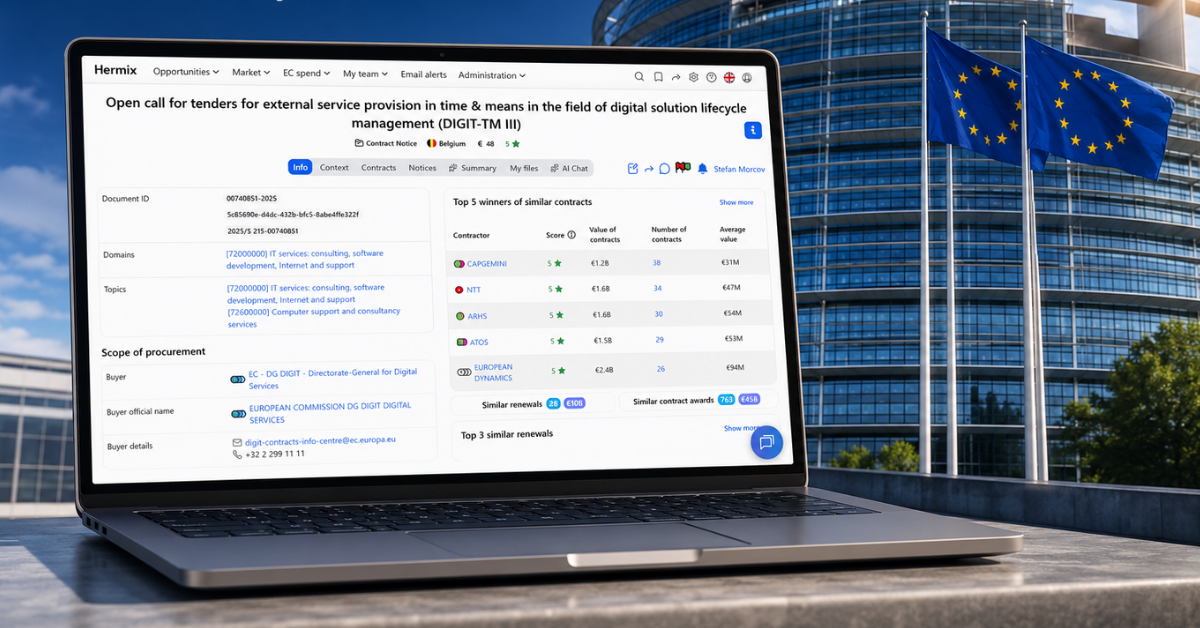
The European Commission’s flagship IT services framework has been awarded and multiple Hermix clients have secured a place on it.
Key Takeaways
- DIGIT-TM III, DG DIGIT’s four-year IT services framework for the European Commission and EU institutions, has been awarded at an estimated €3,971,638,879, split across three lots according to the documentation available at the current date.
- The framework replaces DIGIT-TM II’s cascade ranking system with a mini-competition on every Service Request, scoring 70% quality and 30% price.
- More than two dozen Hermix clients secured a place on the framework, including documented consortium wins for Tremend – Publicis, Kyndryl, Unisystems, Fujitsu, Seidor, ARHS, Accenture, Thaleria, Aricoma, and Alten.
- Framework entry required average annual turnover of €200 million to €600 million depending on the lot, which explains why most winners bid as consortiums, combining a specialist’s technical depth with a larger prime contractor’s balance sheet.
- The 39 standard consultant profiles lean toward cloud, data, and AI/ML roles, a marked shift from earlier generations of the contract.
The European Commission’s Directorate-General for Informatics, DG DIGIT, has awarded DIGIT-TM III, the framework contract that will supply external IT and digital services to the Commission and other EU institutions for the next four years. The award closes a procurement process that opened in November 2025 and covers close to €4 billion in contract value.
What DIGIT-TM III Actually Covers
DIGIT-TM III is worth an estimated €3,971,638,879 over a 48-month contract, split into three lots by delivery mode.
This are the most important numbers:
- Reference number: EC-DIGIT/2025/OP/0014
- Buyer: European Commission, DG DIGIT – Directorate-General for Digital Services
- Estimated total value: €3,971,638,879
- Contract duration: 48 months
- Procedure: Open, financed with EU funds
- Publication date: 7 November 2025
- Submission deadline: 29 January 2026
- Lot 1, far-site (remote service provision from anywhere inside the EU): €1,395,699,881
- Lot 2, near-site Belgium (Brussels & Geel), the largest of the three lots: €2,007,410,004
- Lot 3, near-site Luxembourg and Joint Research Centre sites (Ispra in Italy, Seville in Spain, Karlsruhe in Germany, Petten in the Netherlands, Grange in Ireland): €568,528,994
The scope runs across the full lifecycle of a digital solution: management and governance, definition and design, development and integration, transition and deployment, and ongoing operations, support, and data exploitation.
DG DIGIT runs this framework on behalf of the wider Commission, and the contract sits underneath the Commission’s Digital Strategy and the Digital Europe Programme. In practice, that means the consultants placed under DIGIT-TM III do not work for a single department. Past generations of the framework have staffed executive agencies alongside the Commission itself, including bodies such as the European Research Council Executive Agency and the Innovation and Networks Executive Agency, so the buyer behind any individual Service Request can vary even while the contract vehicle stays the same.
A Contract That Keeps Growing
DIGIT-TM III is the third generation of this framework. The original DIGIT-TM was awarded in 2018 for roughly €1 billion. DIGIT-TM II followed in 2022 at close to €2.8 billion. DIGIT-TM III now sits at just under €4 billion, nearly four times the value of the original contract inside a decade. Each generation has also widened its scope: DIGIT-TM III lists 39 standard consultant profiles across three work package categories, covering project and programme management, cloud and data engineering, cybersecurity, AI and machine learning, and operations and support, a considerably broader set than earlier generations of the framework.
What Changed Since DIGIT-TM II
DIGIT-TM III on top of carrying a bigger budget allocation than its predecessor, it also runs on a slightly different mechanism for deciding who actually gets the work once the framework is signed, and that mechanism is what determines how contractors compete for the next four years.
- DIGIT-TM II (cascade system): consortiums were ranked in advance, and each new staffing request went to whichever consortium sat next in line, with roughly two weeks to fill it. Once a company secured its position in the cascade, most of the competitive pressure disappeared. The real contest happened once, at the bidding stage, and rarely again.
- DIGIT-TM III (reopening of competition): every Service Request that DG DIGIT or another participating body issues triggers a mini-competition among all contractors awarded on the relevant lot.
- Evaluation formula: quality weighted at 70 percent, price at 30 percent, applied to every Service Request.
- Contractors per lot: each lot can carry as many as 20 framework contractors, all of whom compete against each other for every assignment, for the full four years of the contract.
Winning a place on DIGIT-TM III opens the door to multiple smaller competitions still ahead, one for every Service Request across the next four years.
Hermix Clients on the Winners’ List
Multiple Hermix clients have secured places on DIGIT-TM III, several of them through documented consortium wins.
Unisystems confirmed its award directly, alongside two other wins in the same stretch: a place on NATO’s Cyber Security Dynamic Marketplace and a major contract with the European Patent Office.
Seidor entered the framework as part of a consortium led by European Dynamics.
ARHS, Accenture, and Thaleria were awarded across all three lots as part of a consortium led by ARHS.
Aricoma and Alten secured places through a separate winning consortium.
Among Hermix clients confirmed among the DIGIT-TM III framework contractors are Kyndryl, Tata Consultancy Services, Charles Oakes, Fincons, Halian, Nova ICT, NetCompany, Capgemini, Westpole, Seidor, Fujitsu, Serco, Edda, Indra, Tremend, Atos, ARHS, Accenture, Thaleria, Aricoma, Alten, Unisys, Engineering, Unisystems, VASS, and Sopra Steria.
What the Data Already Showed
Before DIGIT-TM III was even published, Hermix’s own market intelligence on DG DIGIT showed a concentrated pool of incumbents. Looking at contracts awarded to date across tenders similar to this one, the ten most active contractors by value were:
- European Dynamics: €2.4 billion across 26 framework contracts
- Accenture: €2.1 billion across 20 contracts
- NTT: €1.6 billion across 34 contracts
- ARHS: €1.6 billion across 30 contracts
- Cegeka: €1.6 billion across 25 contracts
- Atos: €1.5 billion across 29 contracts
- Cronos: €1.3 billion across 25 contracts
- Capgemini: €1.2 billion across 38 contracts
- Sopra Steria (recorded as Sopra in Hermix’s contractor data): €1.1 billion across 20 contracts
- Netcompany Intrasoft: €856 million across 21 contracts
The Barrier to Entry Was High
Framework membership on DIGIT-TM III required serious financial standing:
- Lot 1: average annual turnover above €450 million across the last two closed financial years
- Lot 2: average annual turnover above €600 million
- Lot 3: average annual turnover above €200 million, even though it is the smallest lot by value
That threshold explains why so many of the winners are consortiums: it lets a mid-sized specialist combine its technical depth with a larger prime contractor’s balance sheet.
The technical bar sat alongside the financial one:
- At least three contract references demonstrating relevant delivery experience
- Every proposed consultant’s CV built to a fixed template, with minimum experience thresholds tied to education level: five years of IT experience for a master’s degree holder, seven for a bachelor’s degree, twelve without a university degree
- Current certifications required for certain roles, such as ITIL 4, PMI-PMP, or PRINCE2
- Proficiency in at least one working language at CEFR level B2 or higher
- A Personal Security Clearance in some cases, particularly for work involving sensitive information
None of that changes once the framework is live. Every one of those requirements resurfaces at the mini-competition stage, for every Service Request, for the next four years.
The Skills Being Bought
The 39 standard profiles skew heavily toward data and cloud work compared with earlier generations of the framework: cloud solution architects, data scientists, data engineers, AI and ML engineers, DevSecOps engineers, and cybersecurity engineers sit alongside the more familiar project and programme management roles. The tender documentation also names a specific technology stack contractors are expected to work within, including AWS, Azure, Docker, Kubernetes, and a standard set of testing, CI/CD, and monitoring tools. For contractors, that stack requirement works as a practical filter on top of the financial and technical bar: the Commission is effectively buying a stack it already knows how to run, and every proposed candidate needs to match it.
What Happens Next
DG DIGIT still needs to formalize the individual framework agreements, and any unsuccessful bidder retains the right to challenge the decision during a standstill period. Realistically, the first Service Requests are not expected to reach contractors before autumn 2026. Once they start, each request will name one of the 39 standard profiles, attach it to a specific lot, and give contractors a matter of days to propose a candidate, a technical approach, and a price.
There is also a consultant market shifting underneath the framework itself. Somewhere between two and three thousand consultants currently placed under DIGIT-TM II become free agents as that contract winds down, able to move to whichever framework company now offers the strongest terms. That transition window is expected to run into the first quarter of 2027, well before the normal volume of Service Requests even begins. For the companies on the winners’ list, the coming months call for readiness on two fronts at once: consultant CVs prepared to the required template and reference profiles matched against the likely mix of Service Requests, alongside a genuine pitch to the DIGIT-TM II consultants now shopping around for their next placement.
How Hermix Helps Companies Win More Public Sector Bids
Public procurement in Europe is a €2 trillion annual market, 54 percent of EU GDP, with 250,000 authorities buying every day. Most companies still chase that market the way they did 20 years ago: proposals written by hand, bid management in spreadsheets, and market research that can take anywhere from 1 to 10 days per opportunity. Roughly half of all presales effort goes into finding, reading, and qualifying tenders, and 2 to 6 percent of contract value gets burned on sales and bidding overall. A team reviewing 20 tenders a month, at roughly 4 hours of analysis plus 1 to 3 days of commercial research per opportunity, spends dozens of person-days before it submits a single proposal, and most of what it reviews turns out to be a poor fit anyway.
Hermix is built to close that gap, across four stages of the bid process:
- Tender Discovery. Hermix monitors TED, the EU Funding Portal, NATO, the UN, and more than 10 national procurement portals, ingesting roughly 3,000 new tenders every day. Alerts run daily, weekly, or monthly, filtered to a company’s own keywords and markets, and every document is searchable and downloadable in one click.
- Qualification. AI Tender Summarization reads a 500-plus page tender specification end to end and extracts scope, budget, deadlines, evaluation criteria, and eligibility in plain language, at 98 to 99 percent precision, in seconds. Commercial Qualification then turns what used to be a 5-day research marathon into a 5-minute confidence picture: who has won similar contracts before, how often, and at what value; an authority’s spending trends, typical contract sizes, and procurement cycles; and pricing benchmarks, competitive density, and similar open tenders. Together, this replaces 1 to 4 hours of manual tender analysis with a few minutes of reading. Behind it sit more than 200,000 buyer profiles, covering past tenders, contract history, budget trends, and preferred suppliers, and more than 1 million contractor profiles, covering services, industries, geographies, customers, and partnerships.
- Strategic Intelligence. Market reports break down value by domain, year, authority, and country. A competition map shows who delivers what, and where. Partnership affinity graphs show who tends to team up with whom, and contractor comparison tools let a team weigh competitors side by side. A renewal calendar and forecast, built on prior notices and buying signals, flags contracts likely to come back to market ahead of the next notice.
- Orchestration. Teams can ask Hermix direct questions about any tender document in natural language, get proposal writing support and compliance checking, and manage the whole pipeline on a kanban board that moves opportunities from Important to Qualified to In Progress to Submitted to Won, with shared views, comments, owners, saved reports, and one-click exports to Excel or CSV.
All of this runs on a dataset of 16 million contracts worth €18 trillion, 2.5 million indexed tender specifications, and 200,000 buyer and 1 million contractor profiles, cleaned, normalized, and enriched daily. Companies using this approach report qualifying an opportunity in about 5 minutes instead of days, a team of 4 doing the work that used to take 6 people, and win rates moving from the 10 to 20 percent range up toward 60 to 70 percent.
Congratulations and What It Means for Everyone Else
DIGIT-TM III is one framework among thousands of public contracts running across the EU institutional market at any given time, but its size and its four-year runway make it one of the more consequential ones to track. For the Hermix clients named above, it is a confirmed win. For everyone still watching from the sidelines, the underlying lesson holds regardless of the contract: the companies that understood a buyer’s history, budget patterns, and incumbent relationships before a tender closed were the ones best placed to act on it.
Create your free Hermix account today at hermix.com/sign-up and track opportunities like DIGIT-TM III as they develop, see which buyers and contractors are already active in your market, and get ahead of the next major EU framework before its deadline closes.