View full tender data: https://app.hermix.com/opportunities/00231679-2026
A €32.4 million framework for up to four wind turbines on Antwerp’s Left Bank gives suppliers a rare port infrastructure opportunity that combines long asset life, phased delivery and negotiation flexibility, while keeping the final buildout tied to environmental and permitting outcomes.
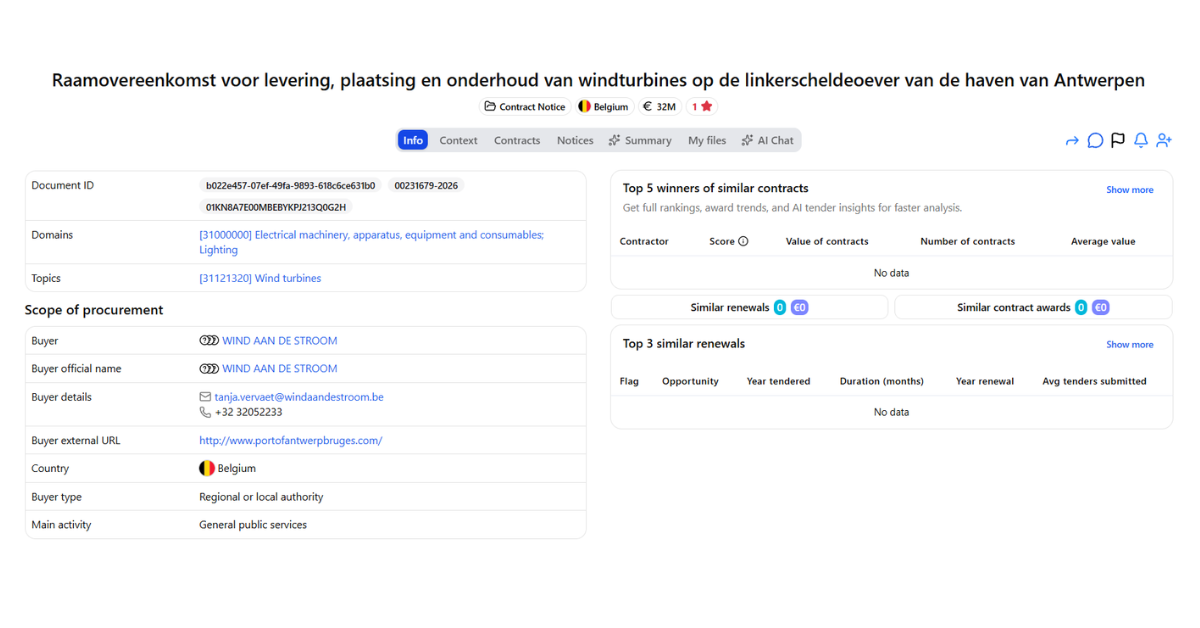
WIND AAN DE STROOM is taking a negotiated route to market for a framework that covers the supply, installation and maintenance of wind turbines in the Antwerp port area. The stated ambition is phased development of one to four turbines on the Linkerscheldeoever, with the final number still dependent on ongoing environmental assessment and permit tracks.
That combination matters. The value is meaningful, the duration is unusually long at 275 months, and the authority has explicitly split the assignment into a fixed part and a conditional part. For bidders, that points to a procurement that is commercial in scale but still structurally shaped by planning risk and nature constraints.
Opportunity overview
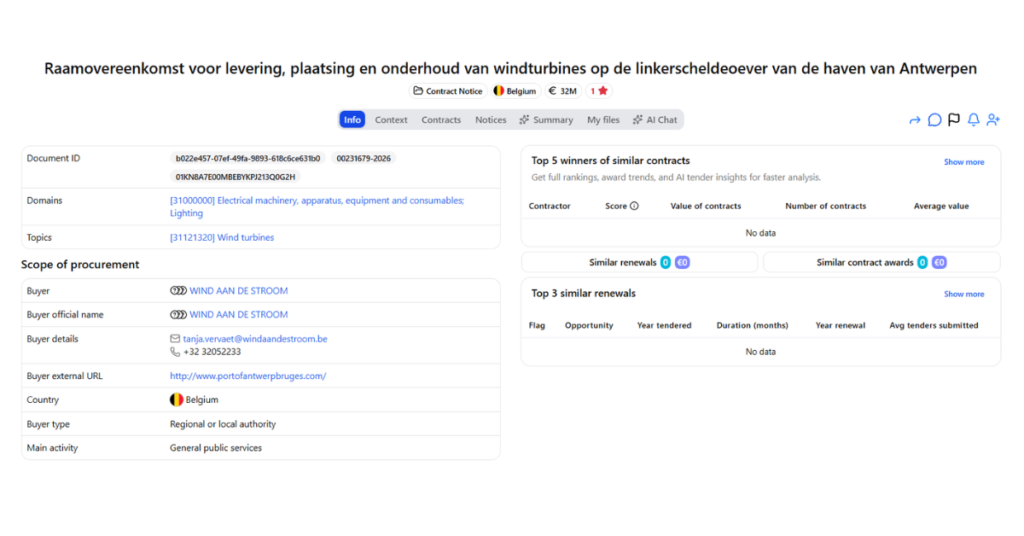
- Contracting authority: WIND AAN DE STROOM
- Buyer type: Regional or local authority
- Main activity: General public services
- Reference number: PPP0B3-19558/6411/B11330
- Document ID: 00231679-2026 / b022e457-07ef-49fa-9893-618c6ce631b0 / 01KN8A7E00MBEBYKPJ213Q0G2H
- Source: BOSA TED
- Tender title: Framework agreement for supply, installation and maintenance of wind turbines on the Left Bank of the Scheldt in the Port of Antwerp
- Contact: tanja.vervaet@windaandestroom.be | +32 32052233
- Buyer URL: http://www.portofantwerpbruges.com/
Scope of work: Supply equipment and carry out works needed for luminous signalling systems, retroreflective signage, photovoltaic lighting and low voltage cabinets for equipment other than public lighting, linked to phased wind turbine development on the strategic port network.
- Phased development of one to four wind turbines in the Antwerp port area, specifically the Linkerscheldeoever.
- Final turbine count remains dependent on ongoing environmental impact assessment and permit procedures.
- The contract is split into a fixed part and a conditional part.
Lot structure: One lot covering the full framework scope.
- Lot 1: wind turbine supply, installation and maintenance on the Linkerscheldeoever of the Port of Antwerp. Shared framework value: €32,392,496.60.
- Place of performance: Arr. Antwerpen, Belgium
- Estimated total value: €32,392,496.60
- Contract type: Supplies
- Contract duration: 275 months
- Procedure type: Negotiated with prior publication of a call for competition / competitive with negotiation
- Award criteria: Cost, Quality
- Publication date: 3 April 2026
- Submission deadline: 13 May 2026
- Tender opening date: Not stated
- Language requirements: Flemish
- EU funding: No
- Financial guarantees: Bond equal to 5% of the estimated contract amount excluding VAT, rounded up to the next higher ten
- Submission portal: https://www.publicprocurement.be
- Related notices: One related contract notice dated 3 April 2026. No prior notice is listed. No contract award history or renewals are shown in the visible Hermix context.
Ready to qualify tenders like this faster? Create your free Hermix account at https://hermix.com/sign-up/ and access AI-powered tender analysis, competitive intelligence, and automated monitoring across Europe’s €2 trillion public procurement market.
Authority and procurement context
The buyer is listed as a regional or local authority, with general public services as its main activity. Beyond that, the notice stays narrow and practical. It does not add a broad institutional description, so the procurement has to be read through the scope itself: a long-duration framework for wind turbines in a strategically important port environment, with delivery sequencing tied to planning and ecological constraints.
The Hermix context visible in the source is sparse for this buyer. There are no similar open tenders, no renewals, no similar contract awards and no prior notices shown in the visible buyer profile. That absence is useful in its own right. It means bidders cannot lean on a visible record of repeated tender cycles or incumbent award patterns in this summary view. The stronger read is that this opportunity should be qualified primarily on project requirements, financial thresholds and execution fit rather than on historical buyer behaviour.
- Similar open tenders: 0, value €0
- All open tenders: 0, value €0
- Similar renewals: 0, value €0
- All renewals: 0, value €0
- Similar contract awards: 0, value €0
- All contract awards: 0, value €0
- Other buyers with similar projects: 260, value €186M
- Similar prior notices: 0, value €0
- All prior notices: 0, value €0
The related notices section shows the contract notice itself and nothing more. There is no prior information notice in the visible record, and no separate award notice or renewal trail to read against. From a bidder perspective, that reduces the amount of public historical signalling available before engaging with the tender documents.
Competitive landscape
No winners of similar contracts table is visible in the source record for this opportunity. That means there is no ranked list of contractors, no contract values, no counts and no country breakdown of prior winners to benchmark directly against this buyer in the current Hermix view.
When that table is absent, the competitive lens has to shift outward. The only visible market reference point is the presence of 260 other buyers with similar projects worth €186 million. That tells us there is a broader addressable market for related wind turbine or comparable energy infrastructure work, but it does not identify named incumbents for this specific authority.
Practically, that creates a slightly cleaner field for qualification. Suppliers do not have an obvious published incumbent to position against in this summary. Instead, the contest is likely to turn on technical credibility, commercial structure, ability to manage phased deployment and confidence around the fixed and conditional portions of the assignment.
Commercial and procedural signals
Several commercial markers stand out immediately. First, the contract uses a negotiated procedure with prior publication. That is different from a straight open award on paper only. It means suppliers should expect a more active selection dynamic, where the authority can shape the competitive field through dialogue and negotiation rather than relying purely on a single sealed comparison.
Second, the procurement is long. A duration of 275 months points to an asset relationship rather than a short build package. That matters for pricing, maintenance assumptions, lifecycle service planning and risk allocation. Bidders need to think beyond turbine delivery and installation and price for a long operating horizon.
Third, the short description makes the phased logic explicit. The buyer wants to move forward with one to four turbines, but the final number is still contingent on environmental assessment and permitting. That is not background colour. It is one of the core commercial conditions of the opportunity. Suppliers should treat volume flexibility, sequencing and conditional mobilisation as live bid issues, not side notes.
The framework is also split into one fixed part and one conditional part. Even though the notice does not break out values for those components, the structure matters. It implies a baseline commitment plus an extension path that depends on how planning and nature-related constraints evolve. For bidders, that affects manufacturing scheduling, subcontracting, site planning and possibly how margin is distributed across the commercial model.
Language is another gate. Offers are to be submitted in Flemish. That narrows the realistic pool to suppliers who can manage not only technical delivery in Belgium but also tender drafting, negotiation and contract execution in the required language.
The financial guarantee is concrete. The notice requires a bond equal to 5% of the estimated contract value excluding VAT, rounded up to the next higher ten. That is a meaningful security requirement for suppliers and should be checked early against treasury capacity and banking arrangements.
The submission window runs from 3 April 2026 to 13 May 2026, which gives bidders 40 calendar days. That is workable, but not generous for a negotiated energy infrastructure procurement with environmental and phasing complexity. Suppliers will need to get legal, technical and financial workstreams moving quickly.
Strategic context and interpretation
This tender sits in an interesting middle ground. On one hand, it is a clearly defined infrastructure opportunity with a published value, one lot and an identifiable site geography. On the other hand, the actual buildout remains partly fluid because the final turbine count depends on environmental and permitting outcomes. That makes the project less like a straightforward equipment sale and more like a structured infrastructure programme with staged optionality.
The long duration reinforces that reading. A 275-month term suggests the authority is procuring for a long lifecycle relationship rather than a near-term construction package alone. Suppliers that only optimise for initial delivery cost may struggle if they do not also show credible long-horizon maintenance logic and operational resilience.
The absence of visible historical awards and renewals in the buyer profile means there is less public pattern recognition available than in more mature repeat-buy categories. That can make qualification harder, but it also reduces the gravitational pull of a visible incumbent narrative. In effect, the documents matter more than the history because the history shown here is almost nonexistent.
The combination of a negotiated procedure, a fixed plus conditional structure and explicit permit dependence suggests a buyer that wants room to shape the final commercial outcome rather than locking every variable at notice stage. Suppliers should read that as an instruction to present flexibility in a controlled way: robust where the fixed scope is clear, adaptable where the conditional scope may expand or contract.
Hermix users analysing this tender can access this competitive intelligence instantly, including detailed contractor profiles, authority spending patterns, and the full renewal pipeline, in minutes rather than hours.
Practical takeaways for bidders
Who this tender suits
- Suppliers with wind turbine delivery and installation capability in Belgium, especially those able to operate in a port or strategic transport environment.
- Bidders that can support both capital delivery and long-term maintenance over a 275-month horizon.
- Teams with the legal and commercial capacity to manage a negotiated procurement in Flemish.
- Suppliers comfortable with phased deployment where the final volume may range from one to four turbines and part of the scope is conditional.
Critical attention points
- Treat the €32,392,496.60 as the shared framework total. There is one lot and the published lot value matches the stated estimated total.
- Plan for a 5% performance bond on the estimated amount excluding VAT, rounded up to the next higher ten.
- Do not underplay planning and nature constraints. The final turbine count depends on ongoing environmental assessment and permitting procedures.
- Build a bid model that clearly separates the fixed part from the conditional part of the assignment, even though the notice does not assign separate values to them.
- Keep language capability in scope from the start. The offer language is Flemish, which has practical implications for drafting, negotiation and execution.
- Work to the 40-day submission window and do not assume a later reset. The notice does not list a tender opening date beyond the submission deadline.
Closing paragraph
This is a notable opportunity because it combines a meaningful framework value with a long delivery horizon and a project structure shaped by permitting and environmental dependency rather than a fixed construction count. For bidders, that makes disciplined qualification essential: the strongest submissions will be the ones that can price and deliver certainty where the notice is firm, while staying commercially credible where the scope remains conditional.
Create your free account today at https://hermix.com/sign-up/ and win more public contracts with the data-driven approach that helps companies consistently succeed in B2G sales across Europe.