View full tender data: https://app.hermix.com/opportunities/ukfts_032792-2026
A 60 month, €531.5 million framework for overhead line electrification, traction power, power distribution and associated design work puts a single-contractor model at the centre of Scotland’s rail decarbonisation pipeline.
Network Rail Infrastructure has taken a large step in the next phase of Scotland’s railway decarbonisation programme. The authority is procuring one contractor, through a competitive flexible procedure, to deliver electrification works and associated design activity across Scotland over a five year framework period.
The headline value is €531.5 million, but the notice text adds an important nuance: works currently intended to be awarded are estimated at about £300 million, while Scotland’s Railway has allowed for a £450 million total framework value over the full term. That combination makes this a major framework opportunity with room for later call off growth.
It also sits inside a buyer profile that already shows 288 similar contract awards worth €80 billion and 76 similar renewals worth €45 billion. This is not a one-off purchase. It is part of a much larger and ongoing infrastructure delivery pattern.
Opportunity overview
- Contracting authority: NETWORK RAIL INFRASTRUCTURE
- Buyer type: Ministry or any other national or federal authority
- Reference number: SR-PR-25-118
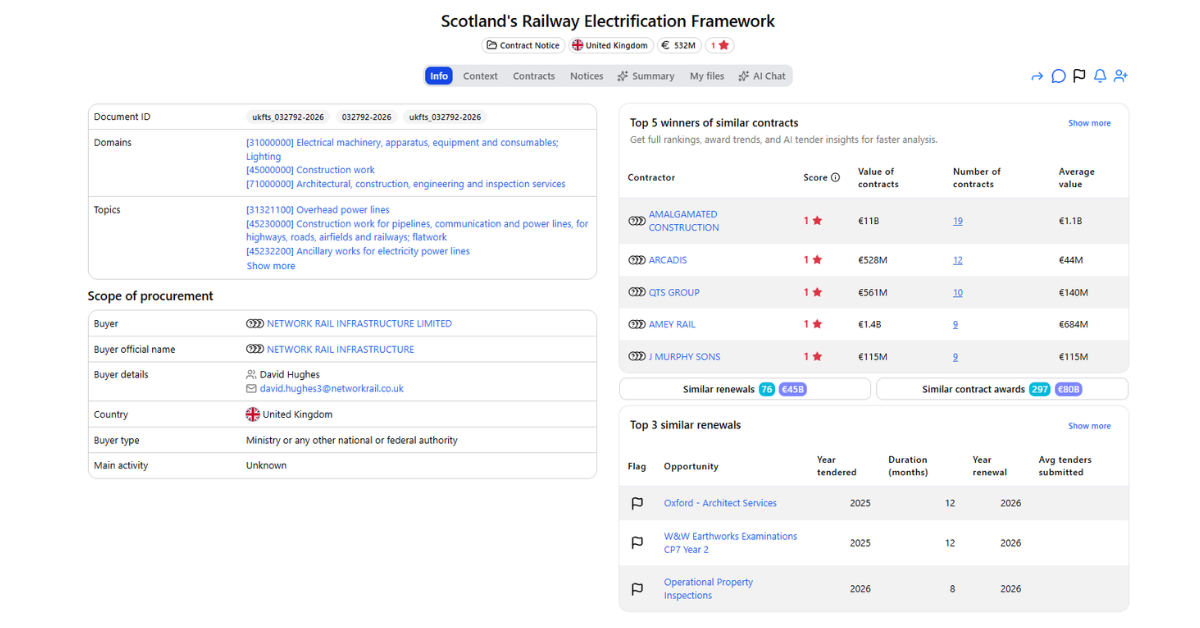
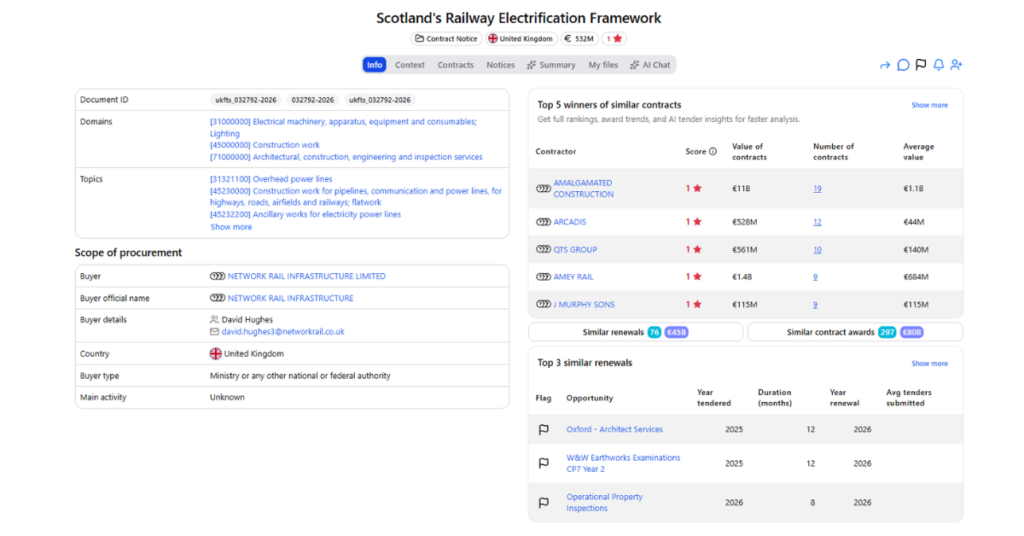
- Document ID: ukfts_032792-2026 / 032792-2026 / ukfts_032792-2026
- Tender title: Scotland’s Railway Electrification Framework
- Contact: networkrail@networkrail.co.uk
Scope of work: Framework for one contractor to deliver overhead line electrification, traction power, power and distribution, ancillaries, and associated design works across Scotland.
- Support the development, delivery, entry into service and handback of electrification elements tied to Scotland’s decarbonisation programme.
- Use the UK Master Series basis for overhead line electrification delivery.
- Operate under a nil value NR30 Framework Commission Agreement.
- Accommodate both currently intended works and emerging works that may arise during the framework term.
Lot structure: One lot: Lot 1, Scotland’s Railway Electrification Framework, valued at €531,525,359.67.
- Place of performance: Scotland
- Estimated total value: €531,525,359.67
- Contract type: Works
- Contract duration: 60 months
- Procedure type: Competitive flexible procedure
- Award criteria: Technical Questions (quality) 60%, Commercial (price) 40%
- Publication date: 10 April 2026
- Submission deadline: 14 May 2026
- EU funding: No
- Source: UK Find a Tender Service
- Related notices: One prior information notice published on 11 February 2026, followed by the contract notice published on 10 April 2026.
Ready to qualify tenders like this faster? Create your free Hermix account at https://hermix.com/sign-up/ and access AI-powered tender analysis, competitive intelligence, and automated monitoring across Europe’s €2 trillion public procurement market.
Authority and procurement context
The contracting authority is listed as NETWORK RAIL INFRASTRUCTURE, with the buyer type shown as a ministry or other national or federal authority. The main activity field is marked as unknown, so the article should stay disciplined and not add any operational description beyond what the notice itself confirms.
What the notice does make clear is the strategic role of this framework. It is intended to support electrification elements that are central to Scotland’s decarbonisation programme, and it is structured around one contractor with responsibility for delivery and associated design across the country. That is a large coordination brief, not a narrow works package.
The wider procurement footprint is substantial. The buyer profile shows 3 similar open tenders worth €275 million and 4 open tenders in total worth the same €275 million. It also shows 76 similar renewals worth €45 billion, 157 renewals overall worth €51 billion, 288 similar contract awards worth €80 billion, and 668 total contract awards worth €90 billion. Other buyers with similar projects account for 6.3K opportunities worth €996 billion.
The prior notice history matters as well. A prior information notice for the same framework appeared on 11 February 2026, then the contract notice followed on 10 April 2026. That sequence points to a procurement that was planned and pre-signalled, rather than pushed out without preparation.
- Similar open tenders: 3 opportunities worth €275M
- All open tenders: 4 opportunities worth €275M
- Similar renewals: 76 opportunities worth €45B
- All renewals: 157 opportunities worth €51B
- Similar contract awards: 288 contracts worth €80B
- All contract awards: 668 contracts worth €90B
- Other buyers with similar projects: 6.3K opportunities worth €996B
- Similar prior notices: 198 notices worth €106B
- All prior notices: 552 notices worth €122B
Competitive landscape
The visible winners table is limited to 10 results, but even that partial view is revealing. It is a market led by large rail and heavy infrastructure contractors, with contract values far above ordinary package sizes and with repeat winners already established in adjacent work.
Using the contract values shown in the visible top 10, the market is concentrated. The three largest visible contractors by value, Amalgamated Construction, Alun Griffiths Contractors, and Siemens, account for about €22.0 billion of the visible €28.11 billion total, or roughly 78.3%. That is a very top heavy competitive picture.
The contractor list also shows two distinct profiles. One is the repeat rail delivery group, such as QTS Group, Amey Rail, J Murphy Sons, Balfour Beatty and JSS Rail, with multiple wins and clear sector familiarity. The other is the very large value group, including Amalgamated Construction, Siemens and Alun Griffiths Contractors, where fewer or moderate counts still translate into outsized contract value.
Below is the full visible ranking, with implied averages recalculated from the stated contract values and counts.
- AMALGAMATED CONSTRUCTION: €11B across 19 contracts, implied average about €579M
- QTS GROUP: €561M across 10 contracts, implied average about €56M
- AMEY RAIL: €1.4B across 9 contracts, implied average about €156M
- J MURPHY SONS: €115M across 9 contracts, implied average about €13M
- CK RAIL SOLUTIONS: €2B across 7 contracts, implied average about €286M
- BALFOUR BEATTY: €380M across 6 contracts, implied average about €63M
- SIEMENS: €4.5B across 5 contracts, implied average about €900M
- STORY CONTRACTING: €1.4B across 5 contracts, implied average about €280M
- JSS RAIL: €254M across 5 contracts, implied average about €51M
- ALUN GRIFFITHS CONTRACTORS: €6.5B across 4 contracts, implied average about €1.63B
The countries view is overwhelmingly domestic. United Kingdom contractors account for €79 billion across 262 contracts, which implies an average contract size of about €302 million. France appears as a secondary presence with €1.1 billion across one contract. On the visible data, this remains a UK led market with limited foreign participation at the top end.
- Data limited to 10 results in the visible winners table
- Top 3 visible contractors by value account for about 78.3% of the visible top 10 total
- United Kingdom: €79B across 262 contracts, implied average about €302M
- France: €1.1B across 1 contract, average €1.1B
Commercial and procedural signals
The evaluation model is straightforward and important. Quality carries 60% and price carries 40%, so this is not a lowest cost race. Suppliers will need a serious technical response, especially given the framework’s countrywide scope and the fact that the authority wants one contractor covering delivery plus associated design activity.
The lot structure pushes in the same direction. There is only one lot, and the short description states that one contractor is intended to be appointed. That raises the threshold for prime bidders. Firms that cannot cover overhead line electrification, traction power, power and distribution, ancillaries, design, entry into service and handback in an integrated way are likely to need a supply chain position rather than a prime role.
The commercial framing also deserves close reading. The notice text says the framework is awarded under a nil value NR30 Framework Commission Agreement, that works currently intended to be awarded are about £300 million over the framework period, and that Scotland’s Railway has allowed for a £450 million total framework value to accommodate emerging work. For bidders, that means the published opportunity is both a live package and a platform for follow on call offs over time.
Timing is tight enough to matter. The period between publication and deadline is 34 calendar days. That is workable for established rail delivery teams, but it leaves little slack for building a fresh consortium or resolving major capability gaps. There are no language requirements, financial guarantees or corrigenda stated in the notice summary, so bidders need to verify the underlying procurement documents for any additional conditions.
- Award criteria: Technical Questions 60%, Commercial 40%
- Procedure type: Competitive flexible procedure
- Lot structure: one lot, one contractor intended
- Framework term: 60 months
- Submission window: 34 calendar days
- EU funding: No
- Place of performance: Scotland
- Related notices: prior information notice on 11 February 2026, contract notice on 10 April 2026
- Corrigenda listed: none stated
Strategic context and interpretation
This framework sits where rail decarbonisation policy meets delivery capacity. The scope is broad, the term is long, and the buyer is clearly looking for an integrated delivery model rather than a narrow civils or power package. That typically favours contractors who can manage programme interfaces, engineering assurance, design integration and handback in one structure.
The competitive backdrop supports that reading. Similar renewals are already large at €45 billion, and similar contract awards reach €80 billion. That tells bidders two things. First, the authority operates in a market with deep renewal activity and a long pipeline. Second, recent comparable work has tended to land with well capitalised rail specialists and major infrastructure names, not fringe suppliers looking for a first foothold.
The related notice history adds another layer. The February 2026 prior information notice gave the market an early view, then the April 2026 contract notice turned that intent into a live competition. Suppliers that tracked the prior notice should be better placed now, because they have had more time to shape teams, supply chains and delivery assumptions around the one-contractor model.
There is also a practical contrast between the £300 million of works currently intended to be awarded and the broader £450 million framework value reserved for emerging work. For bidders, that makes pipeline discipline important. Winning here is not only about the first work packages. It is about staying positioned for additional call offs that may surface during the 60 month term.
Hermix users analysing this tender can access this competitive intelligence instantly, including detailed contractor profiles, authority spending patterns, and the full renewal pipeline, in minutes rather than hours.
Practical takeaways for bidders
Who this tender suits
- Large rail electrification contractors able to cover overhead line electrification, traction power, power and distribution, ancillaries and associated design under one prime structure.
- Suppliers with proven delivery capacity across Scotland over a 60 month period.
- Bidders comfortable with a quality led evaluation model where technical questions carry more weight than price.
- Established rail infrastructure teams that have already prepared for the competition through earlier market tracking, including the February 2026 prior information notice.
Critical attention points
- The submission deadline is 14 May 2026, only 34 calendar days after publication on 10 April 2026. Bid teams need to move fast.
- This is a single lot framework with one contractor intended, so gaps in integrated scope coverage are a major risk for prime bidders.
- The notice combines countrywide delivery, associated design works, entry into service and handback responsibilities. Methodology and interface management will matter.
- The pricing response matters, but quality is heavier at 60%, so an underpowered technical submission is unlikely to hold up.
- The commercial framing includes approximately £300 million of currently intended works and a total framework value allowance of £450 million for emerging work. Bidders should model both the immediate opportunity and the later pipeline.
- No corrigenda are listed in the related notices shown here, but bidders should still check the live procurement record and underlying documents for any update before submission.
Closing
This is a major rail infrastructure opportunity with strategic weight beyond the first package of work. The value, five year term, one-contractor structure and prior notice history all place it firmly inside Network Rail’s broader electrification and decarbonisation cycle in Scotland.
For bidders, that makes disciplined qualification essential. Structured market data, buyer history and visible contractor patterns help separate a serious pursuit from an expensive distraction. Create your free account today at https://hermix.com/sign-up/ and win more public contracts with the data-driven approach that helps companies consistently succeed in B2G sales across Europe.