View full tender data: https://app.hermix.com/opportunities/88cb2304-406e-4ef3-b342-e478e9617028
A 47-month framework agreement for general pavement maintenance across the Antwerp municipality includes a reserved lot for social employment workshops, signaling Brasschaat’s commitment to accessible public procurement.
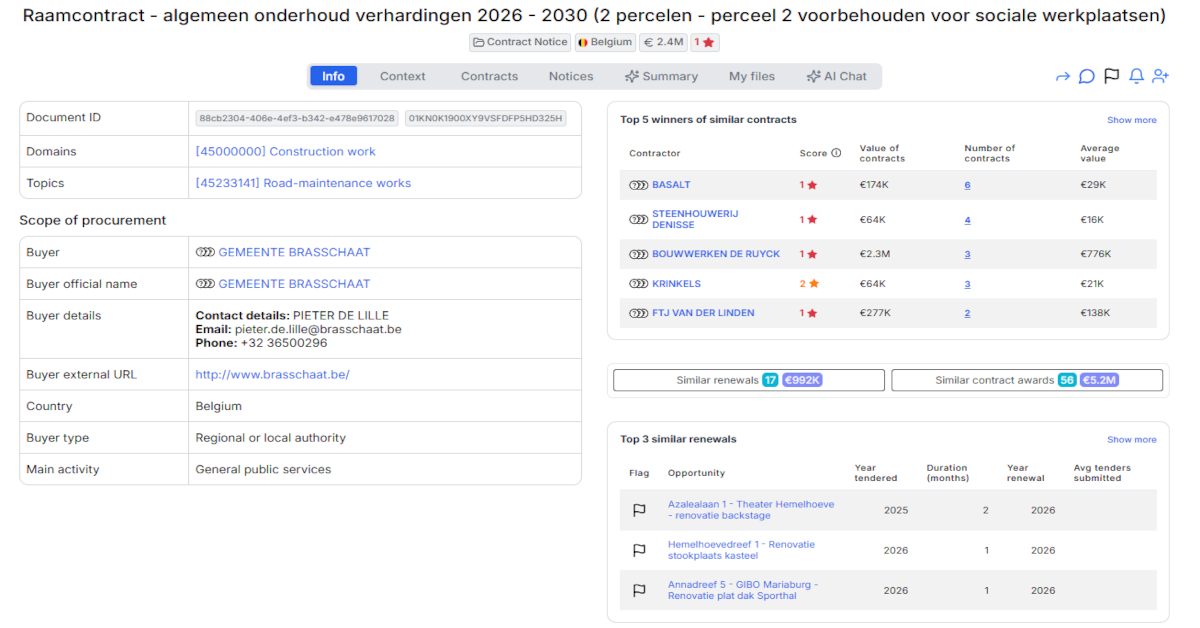
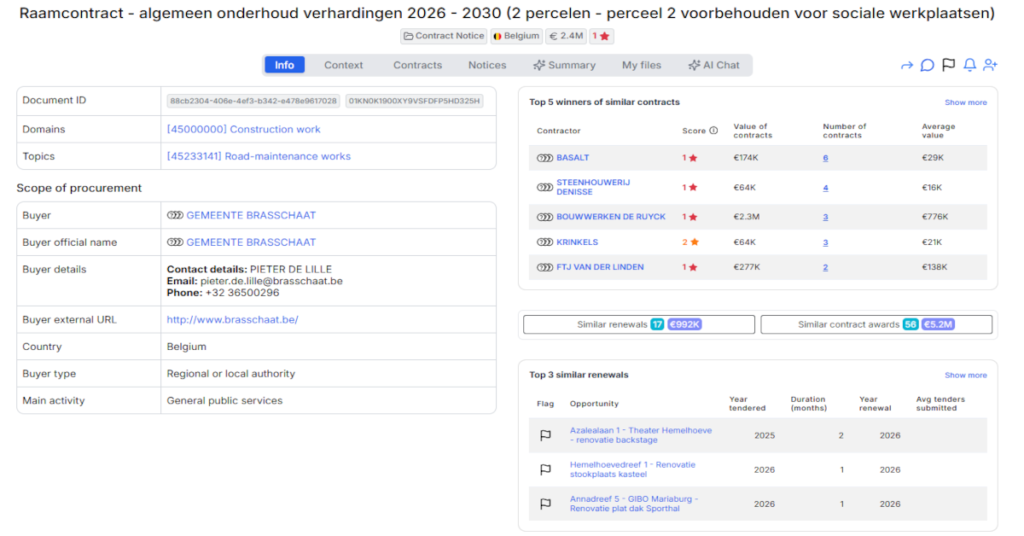
Gemeente Brasschaat has published an open tender worth €2.38 million for general road surface maintenance services across the municipality through 2030. The 47-month framework agreement splits into two distinct lots: a €2.05 million primary contractor lot and a €331,000 reserved lot exclusively for social employment workshops.
This procurement structure demonstrates Brasschaat’s dual objectives of securing reliable infrastructure maintenance capacity while fulfilling social procurement commitments under Belgian law. The reserved lot operates under Article 22 of Belgium’s June 15, 2006 public procurement legislation, restricting participation to registered social workshops that integrate disadvantaged workers into the labor market.
With a May 5, 2026 deadline and tender opening scheduled the same day, contractors face a 35-day response window to prepare submissions for this standard municipal road maintenance portfolio. The cost-only award criterion and Flemish language requirement position this opportunity squarely within regional construction market dynamics, favoring local firms with established pavement maintenance operations.
Opportunity Overview
Contracting Authority: Gemeente Brasschaat
Reference Number: PPP0AA-2856/6102/2025-311
Tender Title: Raamcontract – algemeen onderhoud verhardingen 2026 – 2030 (Framework Agreement – General Pavement Maintenance 2026-2030)
Scope of Work:
- General maintenance of paved surfaces throughout Gemeente Brasschaat
- Road surface repairs and rehabilitation
- Pavement maintenance across municipal road network
- Framework structure enabling call-off contracts for specific maintenance tasks
Lot Structure:
Lot 1: Framework for General Contractors – Road Maintenance 2026-2030
- Scope: General pavement maintenance within Gemeente Brasschaat
- Value: €2,049,610.00
- Location: Arr. Antwerpen
- Award Criterion: Cost
Lot 2: Framework for Social Employment Workshops – Road Maintenance 2026-2030 (Reserved)
- Scope: General pavement maintenance within Gemeente Brasschaat, reserved for social employment workshops under Article 22 §1 of the June 15, 2006 public procurement law
- Value: €330,600.00
- Location: Arr. Antwerpen
- Award Criterion: Cost
Location: Gemeente Brasschaat, Arrondissement Antwerpen, Belgium
Estimated Total Value: €2,380,210.00
Contract Duration: 47 months
Procedure Type: Open
Award Criteria: Cost only
Key Dates:
- Publication Date: March 31, 2026
- Deadline for Submission: May 5, 2026
- Tender Opening Date: May 5, 2026
Language Requirements: Flemish only
EU Funding: No
Financial Guarantees: Performance bond required at 3% of estimated lot value (excluding VAT), rounded up to the nearest ten
Contact Details:
- Email: info@brasschaat.be
- Phone: +32 36502930
- Website: http://www.brasschaat.be/
Submission Portal:
https://www.publicprocurement.be
Ready to qualify tenders like this faster?
Create your free Hermix account at https://hermix.com/sign-up/ and access AI-powered tender analysis, competitive intelligence, and automated monitoring across Europe’s €2 trillion public procurement market.
Authority Profile and Procurement History
Gemeente Brasschaat operates as a regional authority within the Antwerp arrondissement, managing local government functions including infrastructure maintenance, urban planning, and public services for the municipality. As a Belgian commune, Brasschaat maintains autonomous procurement authority for local infrastructure projects while adhering to federal public procurement regulations.
The municipality’s geographic position in the Antwerp region places it within Flanders, Belgium’s Dutch-speaking northern region, explaining the Flemish-only language requirement for tender submissions. This linguistic specification narrows the competitive field to contractors operating within Flemish administrative frameworks or those with established Flemish-language capabilities.
Hermix procurement data reveals Brasschaat’s contract activity patterns:
Total Contract Awards: 146 contracts worth €14 million
Active Tender Pipeline: 4 open tenders
Renewal Forecast: 61 contracts worth €12 million scheduled for renewal
Similar Contract Awards: 55 road maintenance contracts totaling €5.2 million
Similar Renewals: 17 road maintenance renewals worth €992,000
Other Buyers with Similar Projects: 7,800 Belgian authorities have procured comparable road maintenance services, representing €3.4 billion in total contract value
The procurement history demonstrates Brasschaat operates systematic road maintenance programs with established renewal cycles. The €2.38 million framework represents a substantial increase over the authority’s historical average for similar contracts (€5.2 million across 55 awards equals approximately €95,000 per contract), suggesting either contract consolidation, extended duration, or expanded scope compared to past procurement patterns.
The 47-month contract duration aligns with multi-year municipal budgeting cycles while providing contractors sufficient timeline to amortize equipment investments, develop operational efficiencies, and build institutional knowledge of Brasschaat’s road network. Framework agreements of this duration typically include annual call-off schedules aligned with seasonal construction windows and municipal capital improvement planning.
Brasschaat’s decision to structure procurement with a reserved social employment lot reflects Belgium’s broader public policy priorities around inclusive procurement. The €331,000 allocation represents approximately 14% of total framework value, signaling meaningful commitment beyond token compliance with social procurement legislation.
Competitive Landscape and Market Position
Winners of similar contracts from Hermix data reveal a fragmented supplier base with no single dominant contractor:
- BOUWWERKEN DE RUYCK
• Total Contract Value: €2.3 million
• Number of Contracts: 3
• Average Contract Value: €776,000 - FTJ VAN DER LINDEN
• Total Contract Value: €277,000
• Number of Contracts: 2
• Average Contract Value: €138,000 - VAN CAUTER MULTITECHNIEKEN
• Total Contract Value: €178,000
• Number of Contracts: 2
• Average Contract Value: €89,000 - BASALT
• Total Contract Value: €174,000
• Number of Contracts: 6
• Average Contract Value: €29,000 - BERGEN B D
• Total Contract Value: €145,000
• Number of Contracts: 2
• Average Contract Value: €73,000 - PAINTINGS INDUSTRIAL COATINGS
• Total Contract Value: €114,000
• Number of Contracts: 2
• Average Contract Value: €57,000 - VAN OPSTAL KLIMAAT ENERGIE
• Total Contract Value: €72,000
• Number of Contracts: 2
• Average Contract Value: €36,000 - RESITEC
• Total Contract Value: €68,000
• Number of Contracts: 2
• Average Contract Value: €34,000 - STEENHOUWERIJ DENISSE
• Total Contract Value: €64,000
• Number of Contracts: 4
• Average Contract Value: €16,000 - KRINKELS
• Total Contract Value: €59,000
• Number of Contracts: 2
• Average Contract Value: €29,000
Market concentration analysis reveals BOUWWERKEN DE RUYCK commands the largest share with €2.3 million across three contracts, representing 44% of total similar contract value. However, the firm’s €776,000 average contract size falls substantially below the current €2.05 million Lot 1 value, suggesting either this framework consolidates multiple previous awards or represents expanded scope beyond historical patterns.
The competitive landscape shows significant fragmentation, with ten contractors capturing measurable market share but no single dominant player controlling procurement. This distribution pattern indicates Brasschaat historically awarded maintenance contracts across multiple firms rather than concentrating work with a single preferred contractor. The open procedure for this framework suggests continuation of competitive procurement practices rather than incumbent favoritism.
Contract frequency versus value analysis reveals interesting patterns. BASALT secured six contracts but averaged only €29,000 each, indicating specialization in smaller repair works or supplementary services. In contrast, BOUWWERKEN DE RUYCK won three contracts averaging €776,000, suggesting capability on larger rehabilitation projects. The current framework’s €2.38 million total value and 47-month duration favors contractors demonstrating capacity for sustained operations rather than project-by-project engagement.
Geographic contractor distribution shows exclusively Belgian suppliers, with all 51 contracts awarded to domestic firms averaging €103,000 per contract. This 100% local market penetration reflects both linguistic requirements (Flemish-only submissions) and the localized nature of municipal road maintenance, where proximity to work sites, knowledge of regional material specifications, and established relationships with local asphalt suppliers create competitive advantages for regional contractors.
The presence of specialized firms like STEENHOUWERIJ DENISSE (a stonemason), PAINTINGS INDUSTRIAL COATINGS (surface treatments), and VAN OPSTAL KLIMAAT ENERGIE (climate and energy services) among top contractors suggests Brasschaat’s past awards included diverse maintenance work beyond standard asphalt repairs. This diversity implies the current framework may require comprehensive capabilities across multiple road surface types and maintenance disciplines.
Commercial and Procedural Signals
Award Criteria and Evaluation Approach
The tender specifies cost as the sole award criterion, eliminating quality, technical methodology, or environmental sustainability factors from formal evaluation. This price-focused approach positions the procurement as a commodity service acquisition where Brasschaat defines technical requirements upfront through specifications, leaving contractors to compete exclusively on commercial terms.
Cost-only evaluation creates transparent bid comparison but removes opportunities for contractors to differentiate through service quality commitments, innovative maintenance techniques, or enhanced material performance. Winning submissions will depend entirely on accurate cost estimation, efficient resource deployment planning, and competitive pricing without premium service propositions.
The framework structure with 47-month duration introduces unit pricing complexity. Contractors must project material costs, labor rates, and overhead expenses across nearly four years of potential inflation, fuel price fluctuation, and wage increases. Successful bids will balance competitive initial pricing against built-in escalation mechanisms or conservative contingencies protecting contractor margins during the extended contract period.
Procedure Type Implications
The open procedure provides unrestricted market access to all qualified bidders meeting Brasschaat’s technical and financial requirements. This procedural choice signals the municipality’s confidence in defining clear specifications and evaluation criteria upfront, avoiding the complexity and timeline extension of negotiated or competitive dialogue procedures.
Open procedures limit post-submission clarification opportunities compared to negotiated formats. Bidders must ensure initial submissions comprehensively address all technical requirements, unit pricing structures, and administrative documentation without expecting iterative refinement rounds. The May 5, 2026 tender opening scheduled for the same day as the submission deadline eliminates buffer periods for late clarifications or submission corrections.
Language Constraints and Market Access
The Flemish-only submission requirement creates a significant market access barrier for non-Flemish contractors, effectively restricting competition to firms operating within Flanders’ administrative and linguistic frameworks. This specification extends beyond simple translation into compliance documentation, technical specifications, and ongoing contract administration conducted exclusively in Dutch.
Flemish language capability requirements favor regional Antwerp-area contractors with established municipal procurement experience over international firms or even contractors from Belgium’s French-speaking Wallonia region. The practical effect narrows the competitive field to local and regional Belgian companies with existing Flemish operational capacity.
Lot Structure and Social Procurement Strategy
The two-lot structure segregates mainstream contractors (Lot 1) from social employment workshops (Lot 2), preventing direct competition between commercial firms and social enterprises with different cost structures and operational mandates. This separation protects the reserved lot’s social policy objectives while maintaining competitive dynamics within the primary contractor lot.
Lot 2’s €331,000 value represents approximately 14% of total framework budget, indicating substantive rather than token social procurement commitment. Social workshops bidding this lot operate under Article 22 §1 of Belgium’s 2006 public procurement law, requiring legal recognition as organizations integrating disadvantaged workers. Standard contractors cannot bid Lot 2 regardless of competitive pricing, making this a distinct market segment.
The lot division strategy allows Brasschaat to pursue both commercial efficiency (Lot 1) and social objectives (Lot 2) simultaneously without compromising either goal. Contractors should note they can bid both lots only if they meet social workshop legal requirements for Lot 2; otherwise, submissions must target Lot 1 exclusively.
Financial Guarantees and Risk Allocation
The performance bond requirement of 3% of estimated lot value (excluding VAT), rounded to the nearest ten, translates to approximately €61,500 for Lot 1 and €9,900 for Lot 2. These guarantees protect Brasschaat against contractor default or performance failures while remaining modest compared to construction industry standards, which often range from 5-10% on new build projects.
The relatively low guarantee percentage suggests Brasschaat views road maintenance frameworks as lower-risk procurement compared to major capital works. Contractors should still factor guarantee costs into pricing while recognizing the financial commitment represents manageable working capital requirements for established firms.
Contract Duration and Mobilization Timeline
The 47-month framework duration provides stability for contractors to amortize equipment investments, develop operational efficiencies, and build detailed knowledge of Brasschaat’s road network conditions and priority areas. This timeframe assumes contract commencement in mid-2026, running through 2030, aligning with typical municipal infrastructure planning horizons.
Framework agreements typically require immediate mobilization capacity upon award, with initial call-off contracts issued within weeks rather than months. Contractors should demonstrate ready access to paving equipment, material supply chains, and qualified crews capable of starting maintenance operations without extended preparation periods.
Submission Timeline and Competitive Intensity
The March 31, 2026 publication with May 5, 2026 deadline provides 35 calendar days for bid preparation. This compressed timeline assumes contractors maintain pre-qualified documentation, standard unit pricing models, and technical specifications ready for customization to Brasschaat requirements. The timeline favors firms with recent similar framework submissions over those requiring extensive document development from scratch.
The tender opening scheduled for the submission deadline day (May 5, 2026) indicates immediate evaluation commencement, suggesting Brasschaat targets contract awards within standard Belgian procurement timelines of 60-90 days post-deadline. This schedule points toward summer 2026 contract commencement, aligning with peak construction season in Belgium.
Strategic Context and Market Dynamics
Brasschaat’s road maintenance framework emerges within broader trends in Belgian municipal infrastructure procurement, where authorities increasingly consolidate multiple small contracts into comprehensive frameworks balancing operational efficiency against social procurement obligations.
The competitive landscape reveals a fragmented market where BOUWWERKEN DE RUYCK’s €2.3 million across three contracts represents the largest single share, yet still falls short of the current €2.05 million Lot 1 value. This gap suggests either the current framework consolidates previously separate awards or expands scope beyond historical patterns. Either interpretation signals Brasschaat’s intent to streamline contractor management through larger, longer-term engagements rather than administering numerous small contracts.
The presence of specialized contractors like STEENHOUWERIJ DENISSE (masonry), PAINTINGS INDUSTRIAL COATINGS (surface treatments), and VAN OPSTAL KLIMAAT ENERGIE (climate services) among past winners reveals Brasschaat’s maintenance needs extend beyond standard asphalt repairs. Successful framework bidders must demonstrate comprehensive capabilities across diverse pavement types, specialized surface treatments, and ancillary works that past procurement patterns indicate form part of general maintenance scope.
The 100% Belgian contractor market penetration reflects linguistic and geographic barriers favoring regional firms. Flemish-only submissions eliminate non-Dutch-speaking contractors, while the localized nature of road maintenance work creates competitive advantages for Antwerp-area firms with nearby equipment yards, established material suppliers, and knowledge of local specifications and authority preferences.
The reserved social employment lot represents more than compliance theater. At €331,000 (14% of total budget), Lot 2 demonstrates substantive commitment to inclusive procurement. Social workshops operate under different economic logic than commercial contractors, integrating training, supervision, and social support costs into operational models. The reserved lot structure acknowledges these dynamics by preventing direct price competition between social enterprises and commercial firms with fundamentally different cost structures.
Hermix users analyzing this tender can instantly access detailed contractor profiles, authority spending patterns, and the full renewal pipeline. The platform’s contractor comparison functionality reveals that BASALT secured six contracts averaging only €29,000 each, while BOUWWERKEN DE RUYCK won three averaging €776,000, highlighting the distinction between small repair specialists and comprehensive maintenance contractors. This insight helps bidders position submissions according to their operational scale and capabilities.
The cost-only award criterion eliminates opportunities for quality-based differentiation, reducing evaluation to pure price competition. This dynamic favors established regional contractors with efficient operations over premium-service providers or firms proposing innovative maintenance technologies at higher initial cost. Winning bids will balance aggressive pricing against sustainable margins across 47 months of inflation exposure and potential material cost volatility.
Brasschaat’s renewal forecast showing 61 contracts worth €12 million demonstrates systematic infrastructure procurement beyond this single framework. Contractors winning this road maintenance award gain visibility into adjacent opportunities, relationship continuity advantages, and reference deployment credentials valuable for pursuing similar frameworks across Flanders and broader Belgian municipal markets.
Practical Takeaways for Bidders
Who This Tender Suits:
- Road construction and maintenance contractors with established Flemish-language operational capacity, Antwerp regional presence, and demonstrated experience in municipal pavement maintenance frameworks
- Firms capable of comprehensive road surface maintenance including asphalt repairs, specialized surface treatments, masonry work, and ancillary civil engineering tasks based on historical contractor profiles
- Contractors with financial capacity to mobilize €2 million+ worth of equipment, materials, and labor resources over 47 months while managing working capital requirements including €61,500 performance guarantees
- Social employment workshops legally recognized under Belgian Article 22 §1 public procurement law may bid the reserved Lot 2, providing specialized opportunity for organizations integrating disadvantaged workers into construction trades
Critical Attention Points:
- Flemish Language Requirement: All submission documentation, technical specifications, project management communications, and ongoing contract administration must be conducted exclusively in Flemish, eliminating contractors without Dutch-language capabilities regardless of technical competence
- Cost-Only Award Criterion: Evaluation focuses exclusively on price, eliminating opportunities to differentiate through quality commitments, innovative methodologies, or enhanced materials; winning depends entirely on aggressive yet sustainable unit pricing across 47-month inflation exposure
- Performance Bond Requirement: 3% guarantee translates to approximately €61,500 for Lot 1 and €9,900 for Lot 2, rounded to nearest ten; contractors must arrange surety bonds or bank guarantees before contract commencement, requiring advance coordination with financial institutions
- Framework Structure Implications: The agreement establishes unit pricing for call-off contracts rather than guaranteed work volumes; contractors must price competitively while accepting volume uncertainty and seasonal fluctuation across the 47-month period
- Comprehensive Capability Requirements: Historical contractor diversity (masonry, coatings, climate services among past winners) suggests scope extends beyond standard asphalt repairs to specialized treatments, multiple surface types, and ancillary civil works requiring broad technical capacity
- 35-Day Submission Timeline: May 5, 2026 deadline allows limited time for site investigations, traffic impact assessments, or detailed technical discovery; submissions favor contractors with existing municipal framework experience and ready-to-deploy pricing models
- Same-Day Tender Opening: May 5, 2026 opening scheduled for submission deadline eliminates buffer periods for late corrections or clarifications; contractors must ensure complete, compliant documentation in initial submissions
- Reserved Lot Eligibility: Lot 2 access restricted to social workshops meeting Article 22 §1 legal requirements; commercial contractors cannot bid this lot regardless of pricing competitiveness, making it a legally segregated market segment
- Regional Market Dynamics: 100% Belgian contractor penetration in historical awards reflects competitive advantages for Flemish regional firms; international bidders face linguistic barriers, unfamiliar specifications, and proximity disadvantages despite open procedure legal access
- Immediate Mobilization Expectations: Framework agreements typically require operational readiness within weeks of award; contractors should demonstrate ready access to paving equipment, Antwerp-area material suppliers, and qualified crews capable of rapid deployment without extended preparation periods
The Brasschaat road maintenance framework represents a substantial municipal infrastructure commitment combining operational efficiency objectives with social procurement policy implementation. The €2.38 million budget and 47-month duration provide contractors meaningful revenue stability, while the authority’s €14 million total procurement portfolio demonstrates ongoing investment capacity across adjacent infrastructure categories.
Competitive analysis reveals a fragmented market where BOUWWERKEN DE RUYCK’s €2.3 million historical share leads but does not dominate, suggesting genuine competitive opportunity for qualified bidders. The cost-only award criterion eliminates quality differentiation pathways, positioning this procurement as pure price competition where operational efficiency and accurate cost estimation determine outcomes.
The reserved social employment lot demonstrates Brasschaat’s commitment to inclusive procurement beyond token compliance, allocating 14% of framework value to organizations integrating disadvantaged workers. This dual-lot structure balances commercial efficiency with social policy objectives, creating distinct market opportunities for both mainstream contractors and specialized social workshops.
Create your free account today at https://hermix.com/sign-up/ and win more public contracts with the data-driven approach that helps companies consistently succeed in B2G sales across Europe.