
The €2 trillion market that only 1.3% of European businesses dare to enter
33.5 million companies operate across the European Union. Only 400,000 bid for public contracts.
That’s 1.3% participation in a market representing half of Europe’s economy.
The public sector accounts for 53% of the economy. Public procurement alone represents 14% of GDP. We’re talking about a €2 trillion annual market with 250,000 buying authorities across Europe.
Yet the overwhelming majority of European businesses never submit a single bid.
The barrier isn’t capability. The barrier is effort, combined with a market that remains stubbornly difficult to access despite years of policy interventions designed to open it up.
The SME definition and distribution
An SME is a company with fewer than 250 employees and either annual turnover of €50 million or less, or a balance sheet total of €43 million or less.
The distribution of European enterprises breaks down like this:
29.36 million micro enterprises (fewer than 10 employees) represent 87% of all companies. 3.84 million small enterprises (10-49 employees) make up another 11%. 251,000 medium enterprises (50-249 employees) account for 0.8%. Just 55,000 large enterprises (250+ employees) represent 0.2% of the total.
Together, small and micro enterprises employ 48% of the EU’s business workforce and generate 35% of total value added to the economy. Medium enterprises employ 15% of people and generate 16% of value added. Large enterprises, despite being just 0.2% of companies, employ 37% of the labour force and generate 49% of total value added.
The participation gap
When it comes to public procurement, the pattern flips.
All large enterprises participate in public contracts. Most medium enterprises participate. Very few small and micro enterprises do.
By number of contracts awarded, SMEs win 71% according to TED database analysis. In many EU countries, SMEs are awarded around 55-60% of contracts by number (please note that the numbers provided by studies are sometimes divergent, even if the studies are issued by the same authority, e.g. the European Commission).
But contract value tells a different story. SMEs capture only 28-55% of total contract value, depending on the country and analysis method. Medium enterprises secure 15% of value. Small enterprises get 9%. Micro enterprises win just 4% of contract value.
Large enterprises, making up 0.2% of companies, win 29% of contracts by number but capture 45-72% of total contract value.
Some trends show the problem getting worse
A 2014 study examining 2009-2011 procurement data revealed that SMEs won 29% of the total value of above-threshold procurement through direct contracts. When including SME participation as partners in joint bids or subcontractors, the percentage grew to 46%.
This was significantly lower than the 58% which represented SME contribution to GDP during the same period.
Analysis of 2011-2017 data showed that an estimated 61% of public contracts above EU thresholds were awarded to SMEs. The breakdown among SMEs was: micro enterprises won 19% of contracts, small enterprises won 22%, and medium enterprises won 20%.
Despite policies aimed at increasing SME participation, the gap between their economic contribution and their procurement market share has persisted.
Our analysis of European Commission R&D grants shows an even starker concentration. Just 1.5% of beneficiaries receive 57% of the total budget.
Participation rates and dissatisfaction
According to the 2021 SME Needs Analysis in Public Procurement report published by the European Commission, 57.5% of small enterprises across 5 EU member countries have participated in public procurement in the past.
For micro enterprises, 44.7% reported ever participating in public procurement processes.
Here’s the troubling part: 24.3% of small enterprises that participated have no interest in doing so again in the future.
The experience is driving companies away from the market, not drawing them in.
The formal barriers
EU procurement rules are theoretically designed to facilitate SME participation. The policies sound encouraging.
Contracting authorities are formally encouraged to split contracts into lots. They’re asked to reduce unnecessary administrative burden. They’re supposed to accept consortia and subcontracting arrangements.
The European Single Procurement Document (ESPD) was introduced specifically to help SMEs. In theory, companies only submit a self-declaration. Full documentation is requested only from the winning bidder.
In practice, these safeguards are inconsistently applied.
Our analysis of 1.8 million tender notices totaling €9 trillion over 8 years shows that average tender size and lot size do not show a decreasing trend. Contract values remain, on average, high. Turnover requirements sometimes reach tens or hundreds of millions of euros.
The formal encouragement exists on paper. The practical barriers remain in place.
Entry barriers remain high, but they are not necessarily the biggest barrier to participation. Smaller companies can still participate in tenders and fulfil financial and technical selection criteria, by joining together in consortia, or relying on the capacities of third parties or subcontractors.
The real killer: effort
The biggest barrier isn’t formal requirements. The biggest barrier is effort and cost.
1. Tender discovery
Finding the right tender requires zero false negatives and minimal false positives. Miss a relevant opportunity, and you lose potential revenue. Chase too many irrelevant opportunities and you waste resources on information noise.
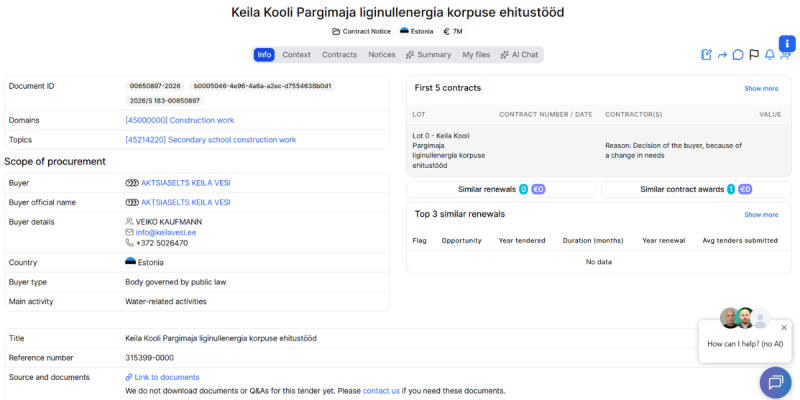
The data landscape is overwhelming. Tender notices are published across TED (Tenders Electronic Daily), national portals like SEAP in Romania, eTendering for EU institutions, Belgium’s BOSA, Netherlands’ TenderNED, Norway’s Doffin, Germany’s procurement portal, and dozens of other platforms.
Finding one relevant opportunity in this haystack takes hours of manual searching. False positives create information noise, wasted effort, and unnecessary cost.
2. Tender qualification
Once you find a tender, qualification begins.
Technical qualification means reading 30 to 300 pages of specifications, annexes, and requirements. This takes anywhere from 30 minutes for simple tenders to 2 hours for moderately complex ones, and up to 10 hours for the most complex opportunities.
Commercial qualification is worse. You need to search TED, procurement portals, and Google for budgets and past contracts. For a simple tender, this takes 2+ hours. For complex tenders, expect 2-3 days of desk research.
3. Market Intelligence
Then comes proposal writing. A typical bid requires a team of 5 sales employees and 1 presales manager working for 20 days. At average daily rates of €300 for sales and €400 for presales, that’s a €38,000 investment per bid.
Writing tenders costs up to 2% of total contract value for large companies. For SMEs, it can reach 6% of revenues.
A 2019 survey of 179 UK construction firms found that companies winning one in every five projects could be spending up to 22% of operational turnover on sales and presales effort.
The effort required is not proportional to tender value or success rate. Most SMEs run the numbers and walk away.
How Technology Addresses the Problem
The public procurement market needs what already exists in B2C and B2B markets: automated analytics and intelligence.
In consumer and retail sectors, analytics are standard. Google Analytics, Facebook Analytics, LinkedIn Sales Navigator, Salesforce, HubSpot. These platforms provide demographic data, behavioural analysis, and market intelligence as a baseline expectation.
In B2G sales, most companies still use Excel spreadsheets with thousands of manually updated lines.
Modern technology can compress the effort required at every stage.
1. Finding tenders:
AI-powered monitoring across all major portals with smart filtering by country, authority type, CPV codes, funding type, and custom keywords. Daily email alerts deliver only relevant opportunities. Zero false negatives, minimal false positives.
2. Technical qualification:
Large language models can summarize 300-page specifications into concise summaries. AI chat interfaces answer specific questions about requirements, budgets, expert profiles, and deliverables without reading the full document.
3. Commercial qualification:
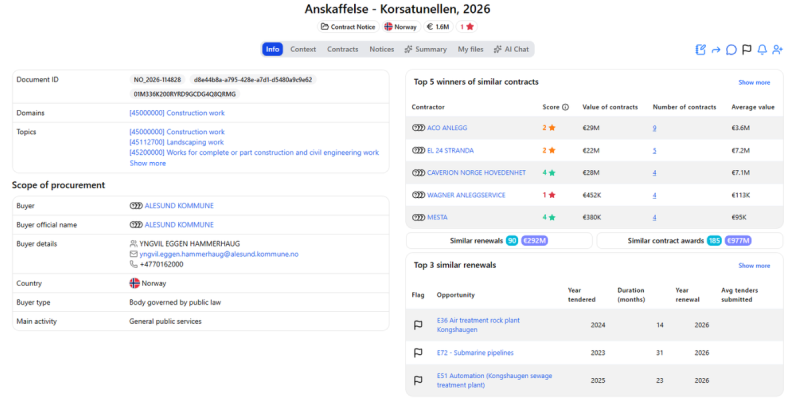
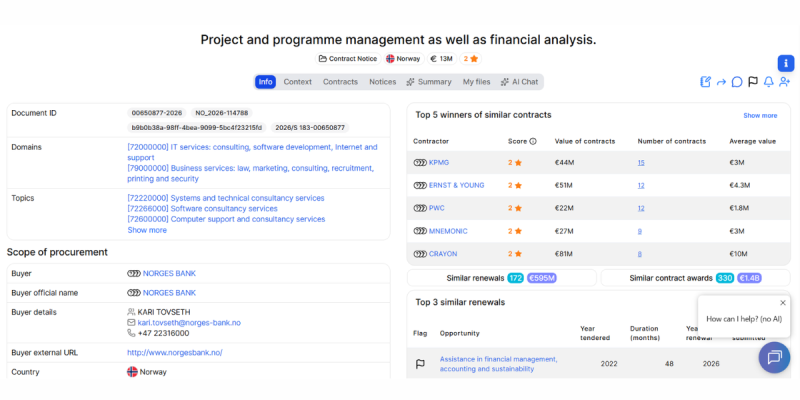
Market intelligence platforms analyse millions of public contracts across Europe. They reveal past winners, typical budgets, authority spending patterns, and competitive landscapes. What took 2-3 days of desk research now takes 5 minutes.
4. Partnership analysis:
Graph analysis maps relationships between contractors, identifying consortia patterns, partnership histories, and compatible collaborators. Network graphs show who works with whom, in which markets, with what success rates.
5. Proposal automation:
AI assists with drafting based on past successful bids, requirement extraction, and compliance checking.
Hermix compresses qualification time by 87% for market research, 85% for tender summaries, and 75% for detailed analysis. It increases relevant opportunity identification by 50%.
Hermix replaces 2-3 persons on your team. A 4-person sales team using Hermix delivers the work of 6 people. The platform replaces 1-4 hours of technical specs analysis per tender and 2+ hours to 2-3 days of commercial qualification.
For proposal writing, the time reduction is 60%. Instead of 20 days, a team works 8 days with AI assistance. That’s €22,800 saved per bid.
The path forward for SMEs
SMEs have strategic options for participating in large tenders despite formal requirements that might seem prohibitive.
Rely on other companies’ capacities. You don’t need to meet all requirements yourself. Demonstrate access to subcontractors, consortium partners, or third parties who fill capability gaps, i.e. technical, financial and economic selection criteria.
Bid as part of a consortium or as a subcontractor. Team up with complementary companies. One partner brings technical expertise, another brings references, a third brings geographic presence. While you might consider some smaller companies as your competitors, sometimes it is better to join forces with them to be able to compete in the Bigger League.
Use technology to compete on efficiency. Tools like Hermix level the playing field. What large enterprises achieve with dedicated presales teams, SMEs can achieve with smart platforms.
Write smarter tenders. The proposal itself has three parts: administrative paperwork, technical proposal, and financial proposal. The compliance check ensures all formal mandatory criteria are met (forms, declarations, turnover, previous project references, experts, certifications).
But winning isn’t about compliance. Winning requires originality and value of the technical proposal, competitive pricing, and demonstrating deep understanding of buyer needs.
People intelligence matters more here than formal requirements. Technology handles the data. Humans provide the creativity and strategic insight that differentiate winning bids.
Market intelligence as competitive advantage
Understanding your buyer before you bid is critical.
Sales veterans rely heavily on personal knowhow and networking – meeting with partners, clients, participating in industry events. But knowing your market and customer also requires a huge desk effort.
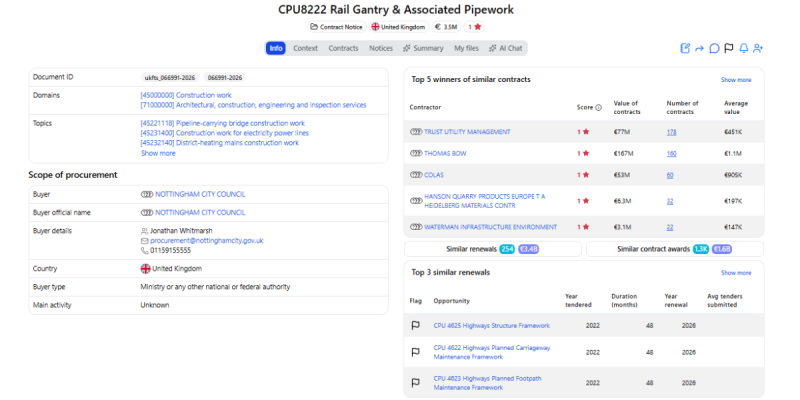
Each Buyer profile includes past tenders, budgets, contract history, types of services typically purchased, budget patterns, timelines, and preferred suppliers – current and past winners of similar contracts in the same market.
Contractor profiles reveal competition strengths, past wins, partnership patterns, and opportunity gaps.
Hermix answers critical questions instantly:
- Who are my best potential partners?
- Who are my partners currently working with this Buyer?
- What is my competition doing?
- Which are our best markets and target clients?
- What relevant contracts will expire and will be re-tendered soon??
Real-world impact
The effort required exceeds the possibilities of most SMEs. The barriers feel insurmountable.
This explains why nearly a quarter of small enterprises that tried public procurement have no interest in participating again.
Technology can fix this, by making public procurement accessible for suppliers.
When a 4-person team can do the work of 6, the economics change. When qualification takes minutes instead of days, more opportunities become viable. When you can identify the right tenders with high win probability, bid selectivity improves.
The B2G market shouldn’t belong only to the largest 1.3% of companies.
Conclusion
The public procurement market is huge, relevant, and systematically avoided by the vast majority of European businesses.
The barriers are real. Finding tenders is hard. Qualifying opportunities is time-consuming. Writing proposals is expensive. Win rates are uncertain.
But the barriers aren’t insurmountable. They’re addressable with modern technology.
AI and machine learning can automate tender monitoring, compress qualification time significantly, provide market intelligence, identify partnerships, and assist with proposal generation.
Companies like Capgemini, IBM, Fujitsu, Indra, OTE, KPMG, Cancom, Wipro, Aricoma, Euroforce, and Technopolis use platforms like Hermix to make public sector sales systematic, efficient, and data-driven.
The opportunity is here. The technology is real. The question is whether your business is ready to compete in the largest market that most companies ignore.
PLEASE NOTE: This article was drafted with the support of AI tools (Claude). We also used GPT5 to support our market research. All content was reviewed and verified manually.